

Amazon Web Services (AWS) has announced the public preview of Amazon Bedrock Managed Agents powered by OpenAI, a significant architectural development that integrates customized versions of OpenAI’s Agents API directly into the native AWS ecosystem. Revealed as part of the company’s weekly operational and service updates, this integration allows enterprise developers and cloud architects to design, deploy, and manage AI agents that operate entirely within the security, identity, and governance frameworks native to AWS.
The announcement signifies a strategic convergence between two major entities in the artificial intelligence landscape, bridging OpenAI’s advanced reasoning and agentic workflows with AWS’s enterprise-grade cloud infrastructure. By tailoring the OpenAI Agents API to be AWS-native, the collaboration aims to alleviate friction for organizations seeking to implement complex generative AI applications without compromising established corporate compliance and security postures.
Main Facts and Technical Architecture
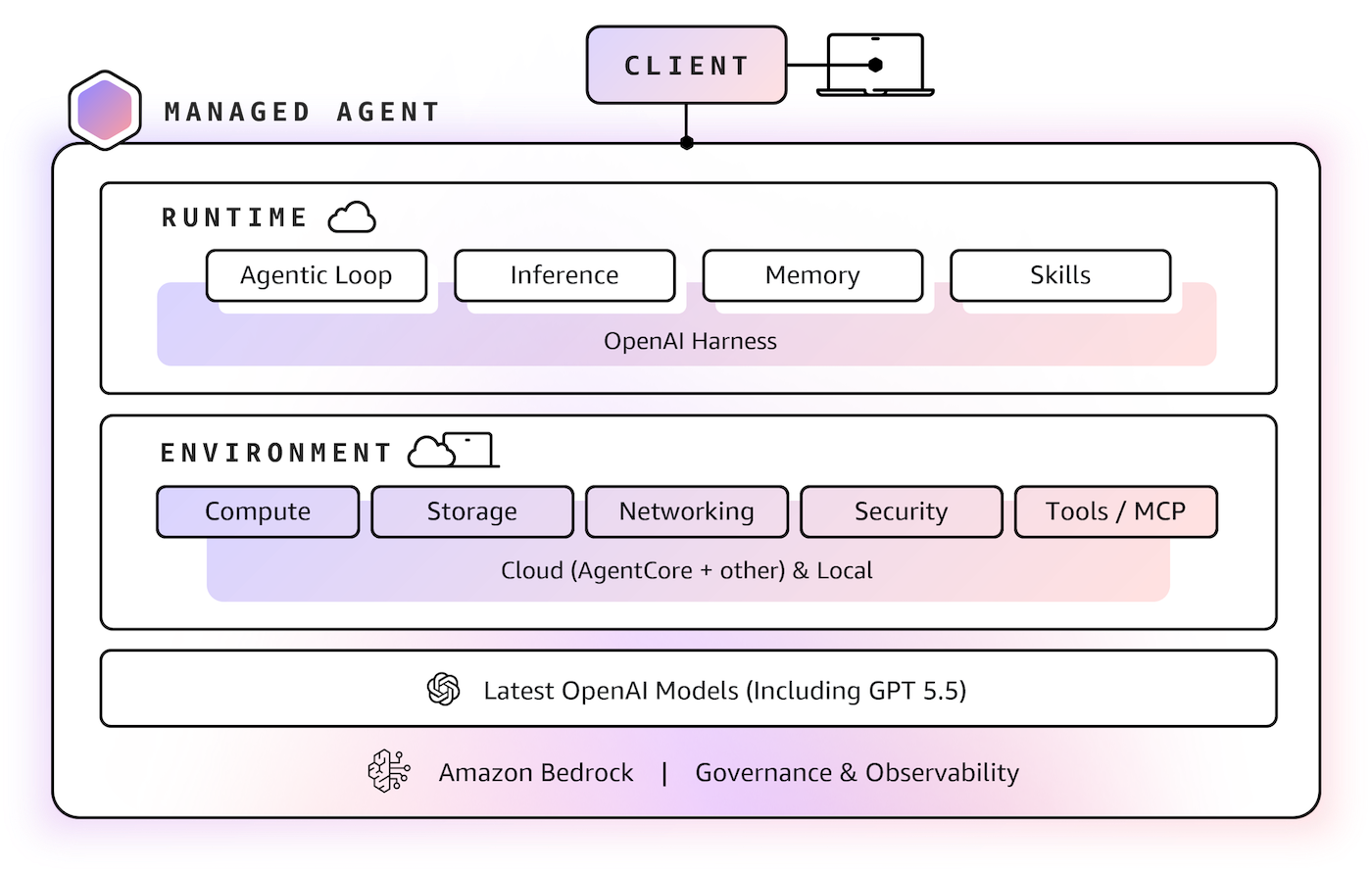
The newly introduced Amazon Bedrock Managed Agents feature grants developers the capability to build models optimized for OpenAI while leveraging pre-existing AWS infrastructure, identity management, and permission controls. According to AWS documentation, users can select between two distinct execution environments depending on their operational requirements and architectural preferences.
The first option involves self-hosted compute environments, allowing teams to utilize existing development machines, custom containers, or localized compute resources to manage agent workflows. Alternatively, organizations can deploy the Amazon Bedrock AgentCore Runtime. This managed runtime service facilitates streamlined session management and provides configurable storage options housed directly within the user’s designated AWS account.
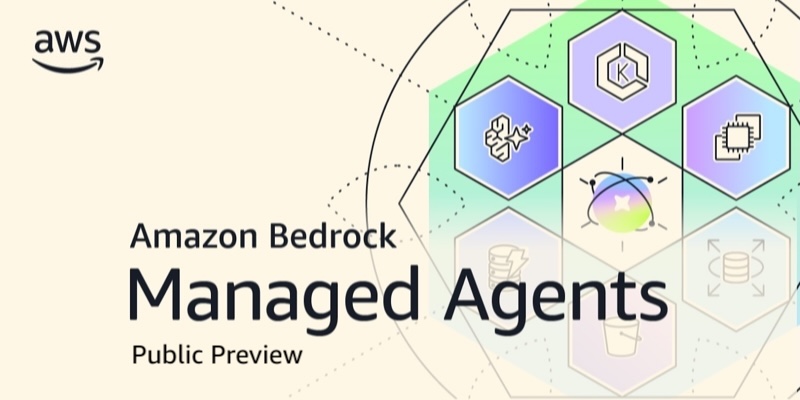
This dual-environment approach caters to a wide spectrum of enterprise needs, from rapid prototyping on local development kits to fully managed, scalable production deployments in the cloud. By embedding these agents within the AWS governance framework, administrators can apply standard Identity and Access Management (IAM) policies, monitor interactions through AWS CloudWatch, and secure data pipelines using AWS Key Management Service (KMS).
Background Context and Chronology
The rollout of Amazon Bedrock Managed Agents builds upon a multi-year strategy by AWS to position Bedrock as the premier, model-agnostic hub for enterprise generative AI development. Since its initial launch, Amazon Bedrock has steadily expanded its catalog to include foundational models from leading AI research laboratories and commercial entities, such as Anthropic, Cohere, Meta, Mistral AI, and AI21 Labs.
The integration of OpenAI technology via a managed agent framework represents an evolution in how cloud providers support multi-model strategies. Historically, enterprises wishing to combine OpenAI’s models with AWS infrastructure had to architect custom API wrappers, manage external authentication tokens independently of AWS IAM, and construct disparate logging systems. The public preview, announced in late September 2026, formalizes this relationship by offering an engineered-for-AWS variant of the Agents API.
Concurrently, AWS detailed its routine product lifecycle management schedule. In alignment with established administrative protocols, the cloud provider updated its service availability disclosures on September 29, 2026. These updates outline a structured timeline for transitioning legacy services into maintenance phases, sunset states, or full end-of-support status, ensuring that enterprise clients have predictable windows to execute necessary workload migrations and minimize operational disruptions.
Supporting Data and Industry Implications
The enterprise adoption of generative AI agents has accelerated dramatically, driven by a demand for systems capable of autonomously executing multi-step business processes, querying databases, and interacting with third-party software APIs. Market research indicates that organizations prioritizing agentic workflows experience higher productivity gains compared to those utilizing static conversational interfaces.

However, security and governance remain primary concerns for chief information security officers (CISOs). A survey of cloud computing decision-makers revealed that over 65% of enterprises cite data privacy and regulatory compliance as the principal bottlenecks in deploying third-party AI models. By bringing OpenAI’s agent capabilities inside the AWS perimeter—where data encryption at rest and in transit, VPC (Virtual Private Cloud) endpoints, and localized data residency rules apply—AWS and OpenAI are directly addressing these enterprise risk parameters.
The architectural separation between self-hosted compute and the Amazon Bedrock AgentCore Runtime also reflects varying organizational maturity levels regarding cloud infrastructure. Smaller development teams can iterate quickly using localized environments, while large enterprises requiring stringent audit trails and predictable resource scaling can rely on the fully managed runtime.
Official Responses and Ecosystem Reactions
While direct statements from independent third parties remain measured during the public preview phase, industry analysts view the move as a pragmatic acknowledgment of the multi-cloud and multi-model reality defining the modern enterprise software market. Rather than enforcing a closed ecosystem, major technology providers are increasingly compelled to interoperate to capture market share among large corporate clients who utilize diverse technology stacks.
Representatives from AWS emphasized that the primary design objective behind the Bedrock Managed Agents integration is to reduce operational overhead. By removing the complexity associated with synchronizing external API calls with internal cloud security controls, developers can focus on application logic and business value generation rather than infrastructure plumbing.
Furthermore, the continuous expansion of frontier model choices on Amazon Bedrock underscores the platform’s strategy to serve as a comprehensive orchestration layer. Developers are no longer restricted to a single vendor’s ecosystem; instead, they can select the optimal model for specific tasks—whether reasoning, coding, or data retrieval—while maintaining a unified management plane.
Broader Impact and Future Outlook
The availability of Amazon Bedrock Managed Agents powered by OpenAI marks a notable milestone in the maturation of generative AI infrastructure. As enterprises move past initial experimentation phases toward widespread production deployments, the demand for robust orchestration, governance, and security tools will only intensify.
The integration points established in this public preview suggest a future where foundational model capabilities are increasingly commoditized, with competitive differentiation shifting toward integration depth, operational security, and developer ergonomics. For AWS, embedding prominent third-party models natively reinforces Bedrock’s position as an indispensable control center for enterprise AI. For OpenAI, integration within the AWS ecosystem expands its enterprise reach into organizations deeply committed to Amazon’s cloud architecture.
As the public preview progresses toward general availability, enterprise feedback will likely shape the refinement of execution environments, storage configurations, and pricing models. In the interim, developers and cloud architects are encouraged to review the official Amazon Bedrock documentation, test deployment pipelines within their designated sandbox environments, and prepare for upcoming educational tracks and community discussions at events such as AWS re:Invent and regional AWS Community Days.
