

SEATTLE, WA – March 4, 2026 – Amazon Web Services (AWS) today announced the general availability of OpenClaw on Amazon Lightsail, marking a significant step in making advanced, self-hosted artificial intelligence (AI) agents more accessible to a broader user base. This integration allows users to effortlessly launch OpenClaw instances, seamlessly pair them with their browsers, enable robust AI capabilities powered by Amazon Bedrock, and optionally connect to popular messaging channels. The new offering addresses a growing demand for private, autonomous AI assistants while simplifying the often-complex deployment and security challenges associated with self-hosting such sophisticated tools.
OpenClaw is an innovative open-source project that provides a framework for a self-hosted, autonomous private AI agent. Designed to function as a personal digital assistant, OpenClaw operates directly on a user’s chosen computing environment, offering unparalleled privacy and control over data and AI interactions. Unlike conventional chatbots that primarily answer questions, OpenClaw is engineered to perform a wide array of practical tasks, including managing emails, browsing the web for information, and organizing files. This capability transforms the AI agent from a conversational interface into a proactive, task-executing digital assistant, directly on behalf of the user.

The impetus for this new Lightsail blueprint originated directly from AWS customers. Many users had expressed interest in deploying OpenClaw on AWS infrastructure, with some even attempting complex manual installations on Amazon EC2 instances. These endeavors often highlighted the inherent difficulties and significant security considerations involved in setting up and maintaining an autonomous AI agent, particularly for those without extensive cloud or system administration expertise. The manual process, as noted by AWS blog authors, frequently proved challenging, underscored by the need for meticulous configuration and robust security protocols to protect sensitive data and operations. By offering a pre-configured, secure, and streamlined deployment option on Amazon Lightsail, AWS aims to lower the barrier to entry, enabling more users to harness the power of private AI agents without the traditional overhead.
The Rise of Autonomous AI Agents and the Need for Privacy
The proliferation of artificial intelligence has ushered in an era where AI assistants are becoming increasingly integrated into daily life. However, alongside the convenience of cloud-based AI services, there has been a growing discourse around data privacy, control, and the desire for personalized AI experiences that are not beholden to third-party data policies. OpenClaw directly addresses these concerns by offering a self-hosted solution. The open-source nature of OpenClaw allows for transparency and community-driven development, fostering trust and enabling users to inspect and customize their AI environment. This aligns with a broader industry trend towards "local AI" or "private AI," where computational tasks and data processing occur closer to the user, enhancing both privacy and responsiveness.
The global market for AI assistants and autonomous agents has been experiencing exponential growth, projected to reach hundreds of billions of dollars in the coming years. This surge is driven by advancements in Large Language Models (LLMs) and the increasing demand for intelligent automation across personal and professional domains. Users are no longer content with simple query-response systems; they seek proactive agents that can manage workflows, synthesize information, and execute complex tasks with minimal human intervention. OpenClaw, with its ability to integrate with messaging platforms and perform actions across various digital interfaces, represents a significant step towards realizing this vision of a truly autonomous digital companion.

Amazon Lightsail: Simplifying Cloud for Developers and Small Businesses
Amazon Lightsail serves as a pivotal platform for this integration, known for its simplified approach to cloud computing. Launched in 2016, Lightsail was designed to provide developers, small businesses, and students with an easy-to-use cloud platform for launching virtual private servers (VPS), databases, containers, and other cloud resources with predictable pricing. It abstracts away much of the complexity of AWS’s broader suite of services, offering pre-configured blueprints for various applications and operating systems. This "easy button" approach makes it an ideal environment for deploying solutions like OpenClaw, where the focus is on getting an application up and running quickly and securely, rather than managing intricate infrastructure components.
The decision to integrate OpenClaw into Lightsail underscores AWS’s commitment to democratizing advanced technologies. While Amazon EC2 offers unparalleled flexibility and power for enterprise-scale deployments, its learning curve can be steep for individuals or small teams. Lightsail, by contrast, streamlines the entire process, from instance creation to network configuration, allowing users to focus on leveraging their AI agent rather than on infrastructure management. This strategic pairing makes the powerful capabilities of OpenClaw accessible to a much wider audience, including those who may not possess deep cloud expertise but stand to benefit significantly from a personal AI assistant.
Amazon Bedrock: Powering OpenClaw’s Intelligence
Central to OpenClaw’s AI capabilities on Lightsail is its pre-configuration with Amazon Bedrock as the default AI model provider. Amazon Bedrock is a fully managed service that makes foundation models (FMs) from Amazon and leading AI startups available through a single API. This service offers a broad range of high-performing FMs, including those from AI21 Labs, Anthropic, Cohere, Meta, Stability AI, and Amazon’s own Titan family of models. By leveraging Bedrock, OpenClaw instances gain access to state-of-the-art generative AI capabilities, enabling sophisticated natural language understanding, generation, and complex reasoning required for task execution.
The integration with Bedrock offers several key advantages. Firstly, it provides users with immediate access to powerful AI models without the need for additional configuration or model deployment. This "out-of-the-box" functionality significantly reduces the setup time and technical burden. Secondly, Bedrock’s managed nature ensures scalability, security, and continuous access to updated models, allowing OpenClaw to evolve with the latest advancements in AI. For OpenClaw users, this means a reliable, high-performance AI backend that supports a diverse range of tasks, from drafting complex emails to summarizing lengthy web articles and organizing digital assets. The secure, enterprise-grade environment of Bedrock also aligns perfectly with the privacy-focused ethos of OpenClaw, ensuring that AI interactions are handled responsibly within the AWS ecosystem.
A Step-by-Step Path to Personal AI Autonomy
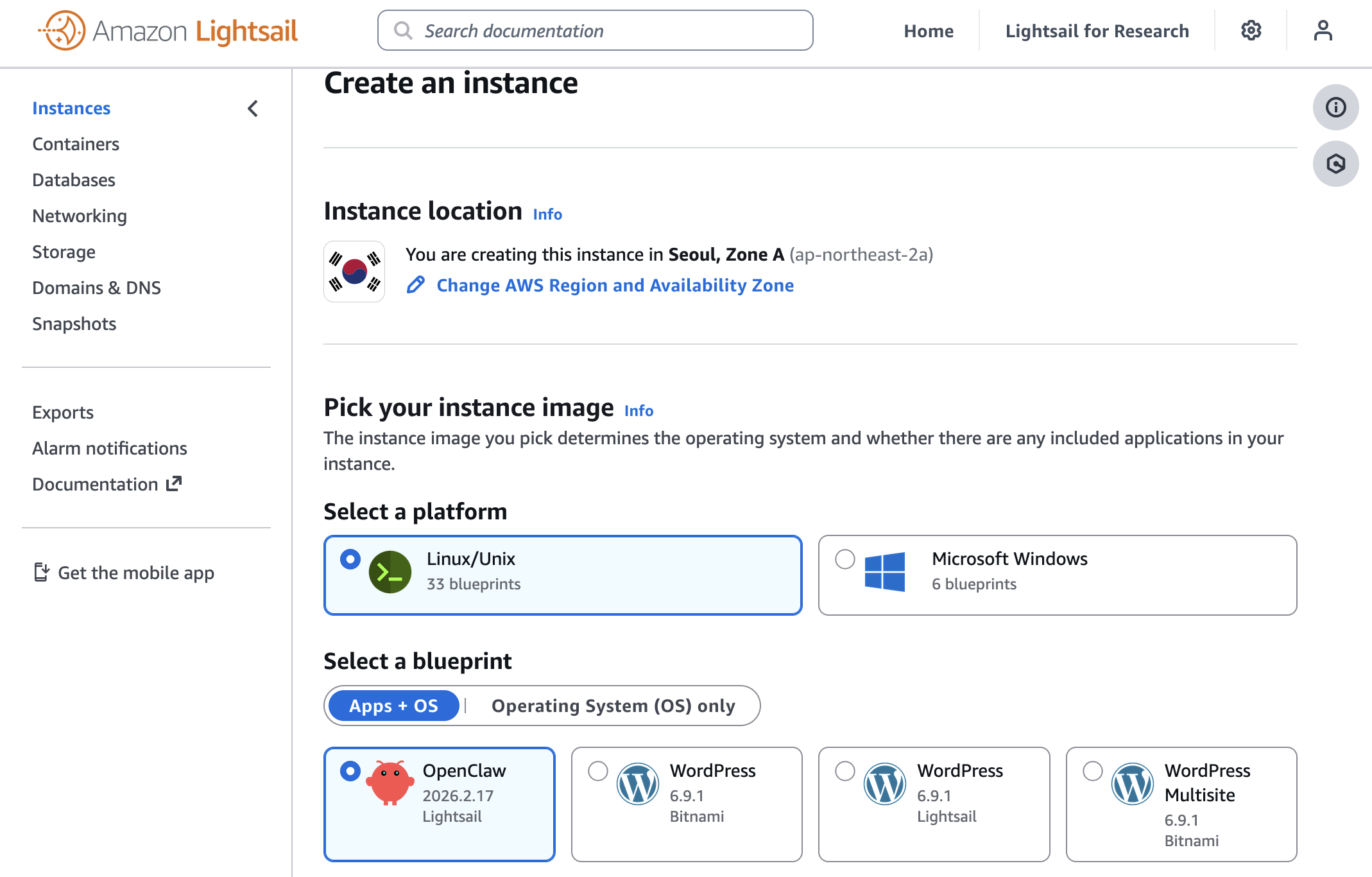
The deployment process for OpenClaw on Amazon Lightsail has been meticulously designed for simplicity and security. Users initiate the process within the Amazon Lightsail console by selecting the "Create instance" option. After choosing their preferred AWS Region and Availability Zone – an important step for latency and data residency considerations – and specifying the Linux/Unix platform, users can now select OpenClaw directly under the "Select a blueprint" section. This blueprint encapsulates all the necessary software and configurations, ensuring a consistent and secure deployment.
AWS recommends a 4 GB memory plan for optimal performance, a crucial detail given the computational demands of running an autonomous AI agent. Once the instance plan is selected and a descriptive name is assigned, the instance transitions to a "Running" state within minutes, ready for the next steps.
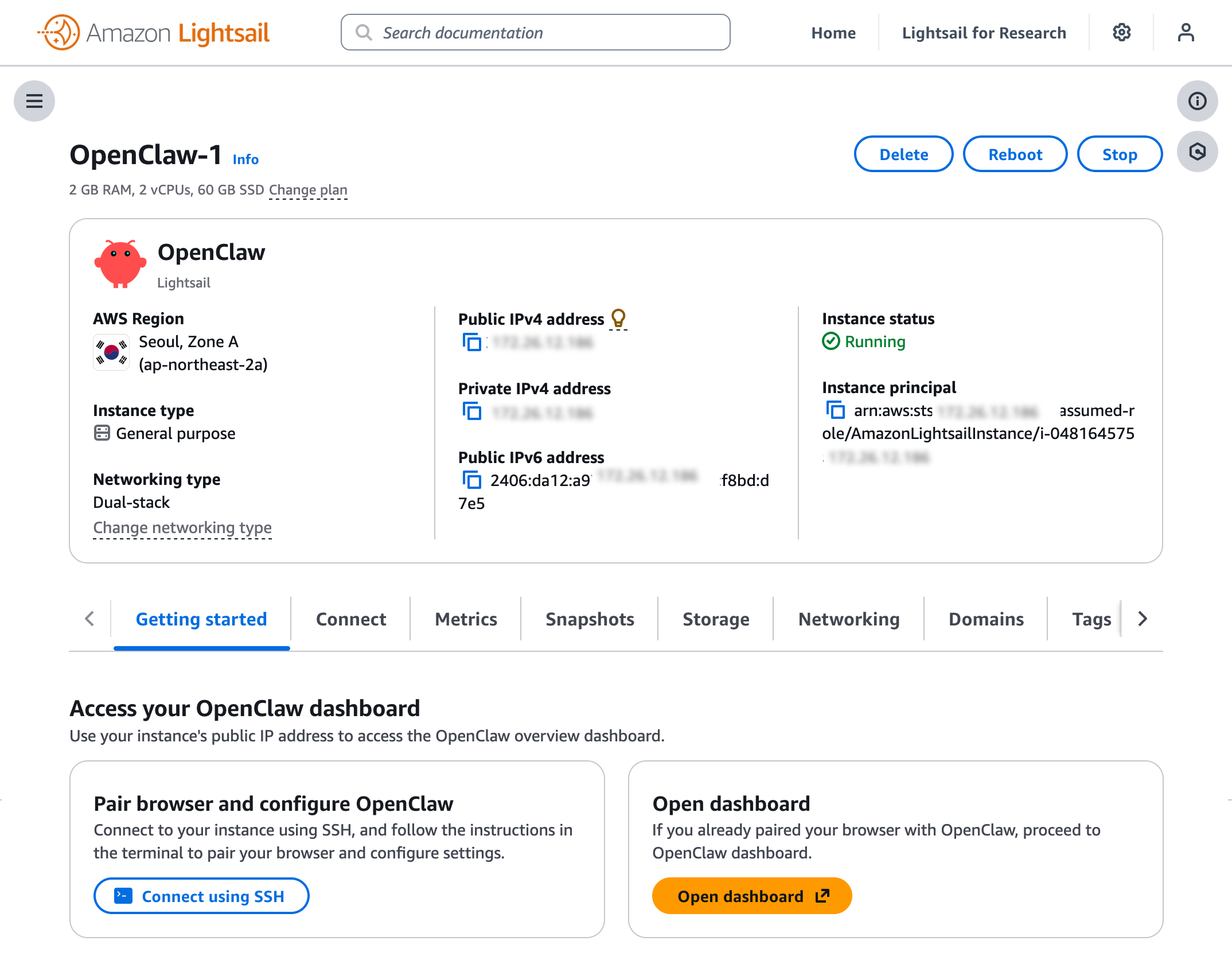
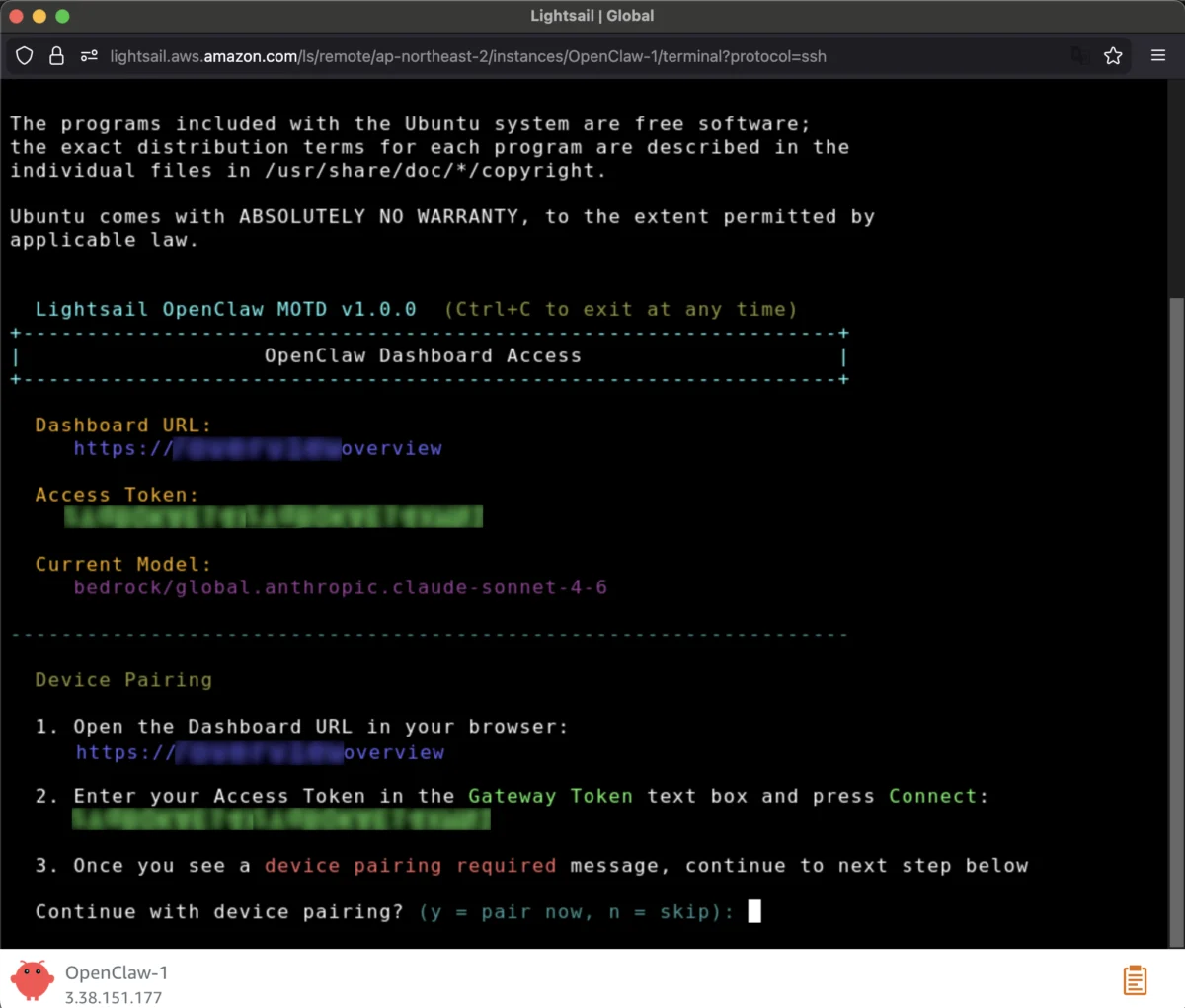
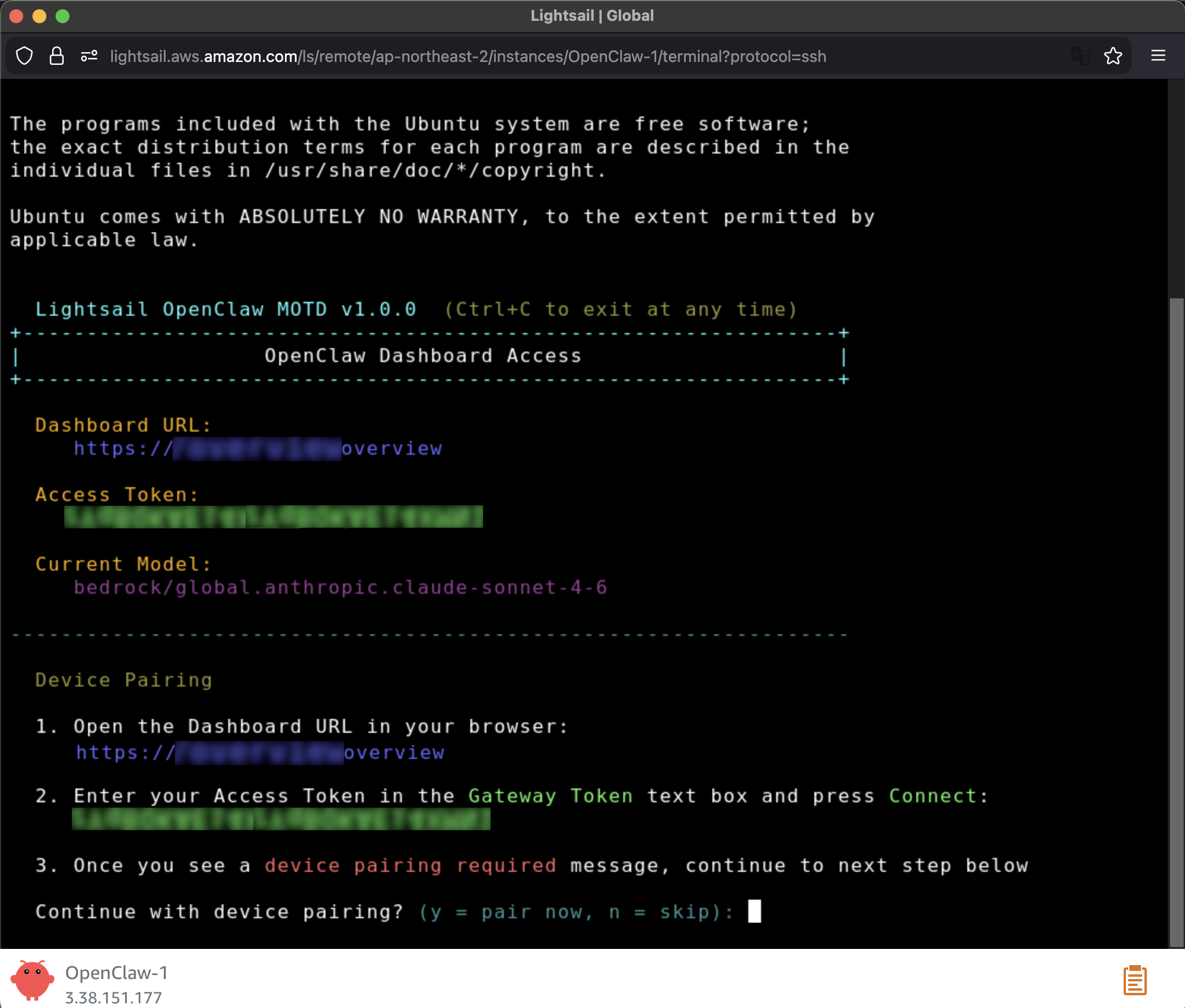
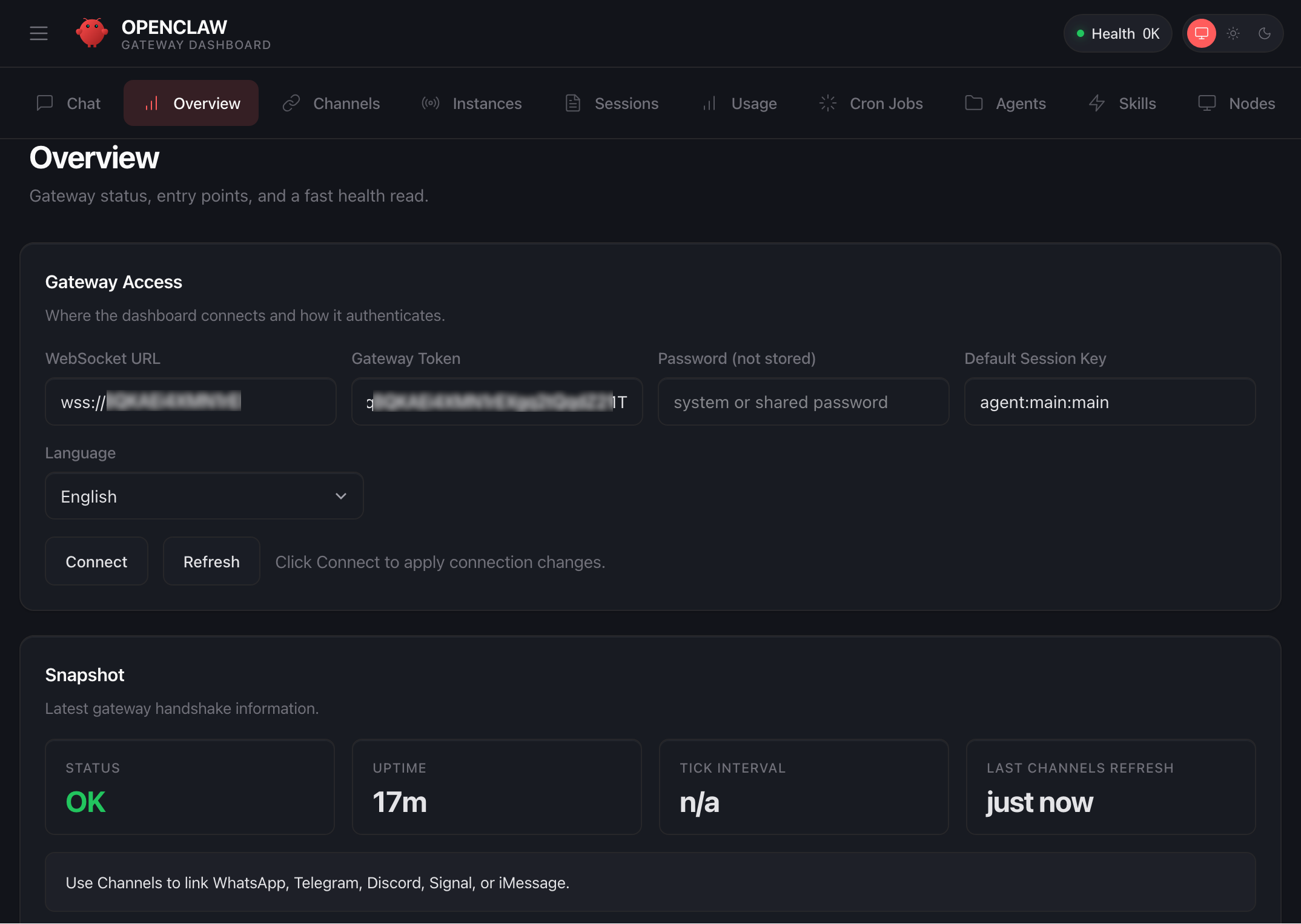
A key security feature involves pairing the user’s browser with the OpenClaw instance. This establishes a secure connection, vital for protecting sensitive interactions with the AI agent. Users connect to their Lightsail instance via an in-browser SSH terminal, where essential security credentials, including a dashboard URL and gateway token, are displayed. This token is then used within the OpenClaw dashboard in a new browser tab to authenticate and secure the connection. The process is finalized by confirming device pairing in the SSH terminal, leading to an "OK" status in the OpenClaw dashboard, signifying a successfully secured and connected browser session.
To activate the powerful AI capabilities, OpenClaw on Lightsail is configured to use Amazon Bedrock. Users simply copy a pre-provided script from the "Getting started" tab and execute it within the AWS CloudShell terminal. AWS CloudShell provides a browser-based shell that makes it easy to securely manage, explore, and interact with AWS resources. This script securely enables the necessary Bedrock API access for the OpenClaw instance, adhering to AWS’s principle of least privilege and secure access management. Upon successful script completion, users can immediately navigate to the "Chat" section of the OpenClaw dashboard and begin interacting with their newly deployed AI assistant.
Further enhancing its utility, OpenClaw supports integration with popular messaging applications such as Telegram and WhatsApp. This feature allows users to interact with their AI assistant directly from their mobile devices or preferred messaging clients, extending the agent’s reach beyond the browser interface. Such integrations transform the AI from a desktop tool into a truly ubiquitous personal assistant, capable of responding to commands and executing tasks on the go. Comprehensive instructions for setting up these messaging channel connections are available in the Amazon Lightsail User Guide, providing clear guidance for users seeking to maximize their AI agent’s accessibility.
Broader Impact and Strategic Implications
The general availability of OpenClaw on Amazon Lightsail carries significant implications for various stakeholders. For individual developers and small businesses, it drastically lowers the technical and financial barriers to deploying sophisticated AI agents. This democratizes access to advanced AI tools, enabling innovation and productivity gains that were previously the exclusive domain of larger enterprises with dedicated cloud engineering teams. The predictable pricing model of Lightsail further enhances its appeal, allowing users to experiment and scale their OpenClaw instances without unexpected costs.
From a strategic perspective, this move reinforces AWS’s position as a leading provider of comprehensive AI solutions, catering to a diverse range of user needs – from complex, enterprise-grade AI/ML pipelines on SageMaker and EC2, to simplified, accessible AI deployments on Lightsail. It demonstrates AWS’s responsiveness to customer feedback and its commitment to fostering an ecosystem where advanced technologies are made consumable for everyone. By embracing an open-source project like OpenClaw and integrating it with proprietary services like Amazon Bedrock, AWS is building bridges between the open-source community and its robust cloud infrastructure, potentially accelerating the adoption and development of next-generation AI agents.
This offering also contributes to the ongoing evolution of personal computing. As AI capabilities become more powerful and ubiquitous, the ability for individuals to host and control their own intelligent agents represents a shift towards greater digital autonomy. Users can tailor their OpenClaw instances to specific needs, ensuring that the AI truly serves their personal and professional objectives without compromising privacy or data ownership. This could pave the way for a new class of personalized applications and services built on self-hosted AI, driving innovation across various sectors.
Availability and Future Outlook
OpenClaw on Amazon Lightsail is now generally available across all AWS commercial Regions where Amazon Lightsail itself is offered. This broad regional availability ensures that users around the globe can deploy their private AI agents with low latency and in compliance with regional data residency requirements. Detailed information on regional availability and the broader AWS capabilities by region can be found on the AWS Capabilities by Region page.
AWS encourages users to explore this new capability through the Lightsail console and to provide feedback. Channels such as AWS re:Post for Amazon Lightsail and usual AWS support contacts are available for users to share their experiences, report issues, and suggest future enhancements. This feedback loop is critical for AWS to continue refining its services and ensuring that OpenClaw on Lightsail evolves in a way that truly meets user needs. The proactive engagement with the user community is a hallmark of AWS’s development philosophy, promising a future roadmap that is shaped by real-world usage and demands. The introduction of OpenClaw on Lightsail is not just a new product offering; it represents a commitment to empowering individuals and small organizations with the tools to navigate and thrive in an increasingly AI-driven world.
