
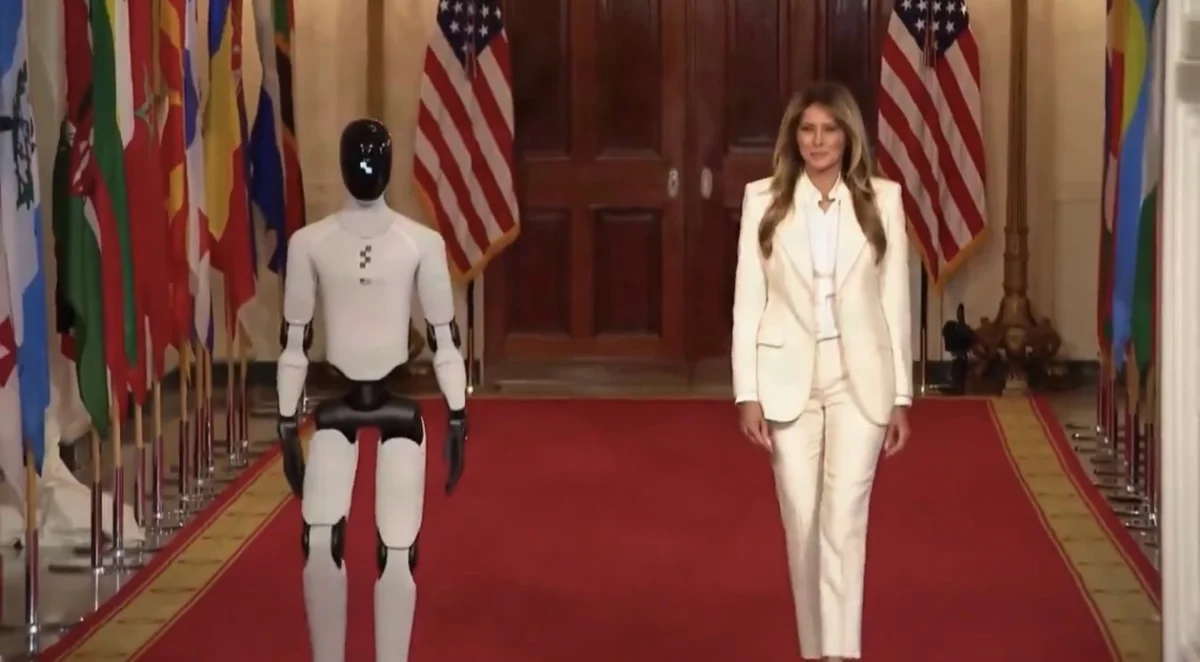

The intersection of robotics and early childhood development took center stage at the White House last week as First Lady Melania Trump hosted a summit dedicated to artificial intelligence (AI) education and safety. The event, which featured the appearance of a state-of-the-art humanoid robot, served as the platform for a proposal that could fundamentally redefine the American educational landscape: the introduction of AI-powered "humanoid educators" designed to provide personalized, home-based instruction for children.
The summit opened with a demonstration of Figure 03, a humanoid robot developed by Figure, an American robotics startup. Figure has recently garnered significant industrial attention and capital, securing funding from a consortium of technology giants including Microsoft, Nvidia, Intel, and OpenAI, as well as Amazon founder Jeff Bezos. The robot’s brief participation, which included walking alongside the First Lady and delivering a brief statement on empowering children through technology, was intended to personify the "bleeding edge" of modern educational tools.
The Vision for Plato: The Humanoid Tutor
During her keynote address, the First Lady detailed a vision for the future of education where the traditional classroom model is supplemented or, in some cases, replaced by autonomous humanoid systems. Central to this proposal is a concept she named "Plato," an AI educator titled after the classical Greek philosopher.
According to the proposal, these robots would transition AI from a digital interface on mobile devices into physical, humanoid forms capable of navigating human-designed environments. The First Lady argued that because the modern world is built for the human form, humanoid robots are uniquely suited to provide utility within the home and school.
The projected capabilities of the "Plato" system include:
- Hyper-Personalization: Utilizing machine learning to adapt curriculum and pacing to the specific cognitive needs and learning styles of individual students.
- Constant Availability: Providing 24/7 access to humanity’s entire corpus of information, including science, literature, mathematics, and classical studies.
- Home-Based Integration: Facilitating a shift toward remote learning environments where students can receive high-level instruction without the necessity of a physical school commute.
"The future of AI is personified," the First Lady stated during the summit. "Very soon, Artificial Intelligence will move from our mobile phones to humanoids that deliver utility. They fit well within our world."
Technical and Economic Context of Figure AI
The presence of Figure 03 at the White House highlights the rapid acceleration of the humanoid robotics industry. Figure AI, the company behind the robot, has positioned itself as a leader in the race to create general-purpose humanoids. The company’s valuation has surged following its recent $675 million funding round, reflecting a broader market belief that AI-driven physical labor and service are the next frontiers of the digital revolution.
Industry analysts note that while the technology demonstrated—walking on a red carpet and delivering pre-programmed speech—is impressive, the leap to "autonomous educator" remains a significant technical hurdle. Current humanoid models still face limitations regarding battery life, fine motor skills, and the nuanced linguistic processing required to manage an unpredictable classroom or a developing child’s inquiries. However, the integration of OpenAI’s large language models (LLMs) into Figure’s hardware suggests a trajectory where conversational fluency and pedagogical "patience" could soon become a reality.
Lessons from the Pandemic: The Socialization Debate
The proposal to move education further into the home via AI humanoids has reignited a debate that began during the COVID-19 pandemic. Between 2020 and 2022, global school closures forced a massive experiment in remote learning. While digital tools allowed for the continuation of curriculum, subsequent studies from organizations such as the American Academy of Pediatrics have highlighted a "lost generation" regarding social-emotional development.
Critics of the "Plato" concept argue that education is not merely the transfer of data from a source to a recipient, but a social process. In a traditional classroom, children learn essential life skills, including:
- Conflict Resolution: Navigating peer-to-peer interactions and playground dynamics.
- Critical Reasoning: Engaging in spontaneous debate and group problem-solving.
- Human Connection: Developing empathy through interactions with human teachers who can read body language, facial expressions, and emotional distress—nuances that current AI systems struggle to replicate.
The First Lady’s proposal suggests that AI will eventually be able to "detect when a pupil is only pretending to understand," but child psychologists remain skeptical about whether a machine can provide the authentic emotional support necessary for healthy cognitive growth.
Institutional Adoption and the "Return on Investment"
While the White House summit focused on early childhood education, higher education institutions in the United States are already serving as a testing ground for large-scale AI integration. The results have been polarized.
At California State University (CSU), the administration recently invested $17 million to provide students and faculty with access to ChatGPT Edu. However, the initiative has met with internal resistance. A growing petition among students and staff urges the university not to renew the contract, citing concerns over the devaluation of human instruction and the potential for "AI-generated mediocrity" in academic output.
Similarly, the University of South Carolina (USC) announced a $2 million annual expenditure on AI tools. The university’s administration defended the move by stating that AI "offers a return on investment we cannot ignore." This shift toward prioritizing ROI in education has sparked concerns among faculty who believe that the fiscal benefits of replacing human labor with AI may come at the cost of educational rigor and critical thinking.
Pedagogical Implications: Spoon-feeding vs. Active Learning
A primary concern raised by educators following the summit is the "curation" aspect of AI. In a traditional setting, a student is encouraged to seek out information from various sources—books, primary documents, and diverse perspectives.
An AI educator like "Plato" functions as an intermediary. It processes, summarizes, and delivers information in "digestible bytes." Critics argue this could lead to a passive form of learning, where students are "spoon-fed" information rather than being taught how to research and synthesize data independently. Furthermore, the programming of the AI’s worldview remains a point of contention. If a single entity or a small group of developers programs the "logic" of an AI educator, the potential for ideological bias or the suppression of dissenting viewpoints becomes a systemic risk.
"A good decision is based on knowledge and not on numbers," the original Plato once wrote. Modern skeptics echo this, suggesting that the "numbers" and algorithms driving AI might lack the wisdom required to foster true intellectual independence.
Long-term Social Impact and the Digital Divide
The implementation of humanoid educators also raises questions about the "digital divide." If high-quality, personalized AI tutors become a staple of affluent households, the gap between those with access to cutting-edge technology and those reliant on underfunded public schools could widen.
Conversely, there is the risk of a "humanity gap." If AI becomes the primary educator for the masses due to its cost-effectiveness, human-to-human instruction could become a luxury good available only to the elite. This inversion would see the most privileged children receiving the benefit of human mentorship, while others are relegated to standardized machine interactions.
Conclusion: The Path Forward
The White House summit on AI education has successfully initiated a national conversation on the role of robotics in the next generation’s development. While the First Lady’s vision of a "personified AI future" offers a solution to the shortage of teachers and the need for personalized learning, it faces significant hurdles.
The debate currently rests on whether AI should be an "enabler" or a "replacement." As a classroom assistant, AI can handle administrative tasks, provide instant data, and support teachers in managing diverse learning speeds. However, as a replacement for the human element of teaching, the technology remains unproven and controversial.
As the 2026 educational landscape takes shape, the words of the classical Plato remain relevant: "Knowledge which is acquired under compulsion obtains no hold on the mind." Whether a machine can inspire the "love of learning" that has traditionally been the hallmark of a great human teacher remains the central question of this technological transition. For now, the "Plato" humanoid remains a provocative concept—a glimpse into a potential future that requires careful ethical, social, and technical scrutiny before it can be fully realized in the American home.
