
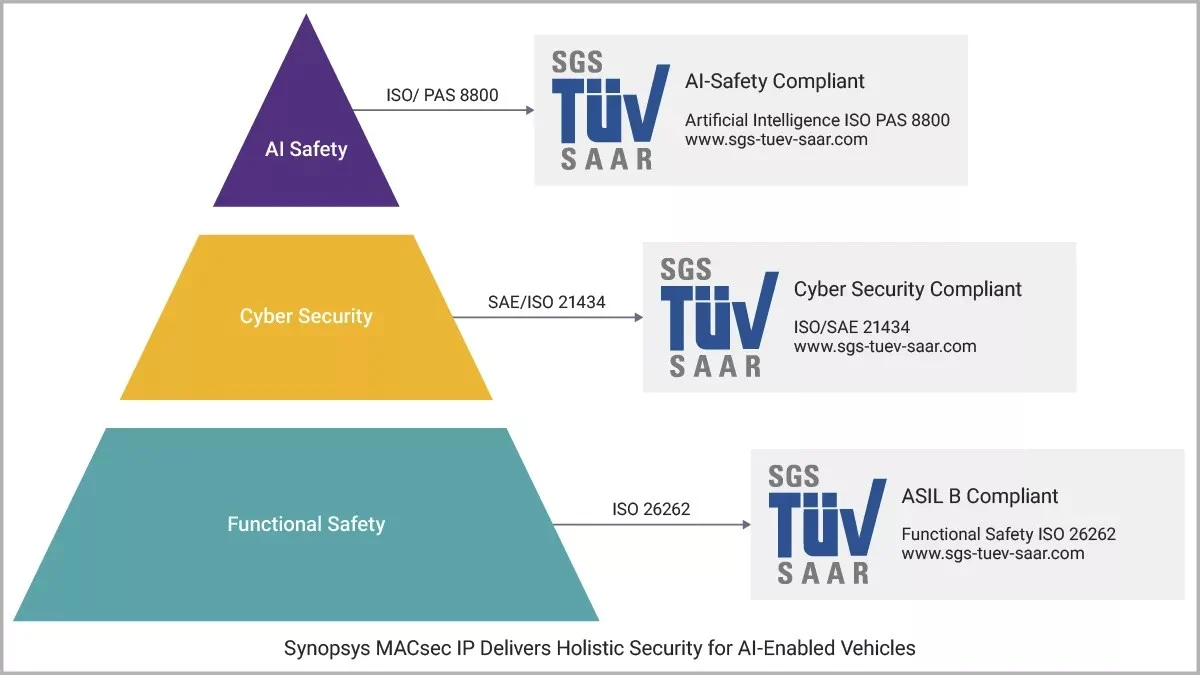

Synopsys has officially become the first company in the world to achieve product certification for ISO/PAS 8800, a milestone that establishes a new regulatory and safety benchmark for artificial intelligence (AI) integrated into road vehicles. The certification, issued following a rigorous independent evaluation by SGS TÜV Saar, marks a pivotal moment in the transition toward "physical AI"—a generation of vehicles capable of sensing, deciding, and acting in real-time within complex physical environments. As the automotive industry moves aggressively toward software-defined vehicles (SDVs), this certification addresses a critical vulnerability: the trustworthiness of the data that fuels AI-driven decision-making.
The achievement specifically applies to Synopsys’ Media Access Control Security (MACsec) Intellectual Property (IP), a technology designed to protect Ethernet communication within the vehicle’s internal network. By securing this certification, Synopsys provides a blueprint for how hardware-level security must evolve to support the unpredictable and high-stakes nature of automotive AI. The certification signals to the broader industry that the safety of autonomous systems is no longer solely a matter of algorithm performance, but a fundamental requirement of the underlying communication infrastructure.
The Evolution of Automotive Safety Standards: A Chronology
To understand the weight of the ISO/PAS 8800 certification, it is necessary to examine the chronology of automotive safety and cybersecurity standards. For decades, the industry relied on ISO 26262, the definitive standard for functional safety. ISO 26262 focuses on identifying hardware failures and ensuring that systems transition to a safe state if a fault occurs. However, as vehicles began incorporating more complex software and connectivity, the industry introduced ISO/SAE 21434 to address cybersecurity risks, focusing on protecting systems from external threats and unauthorized access.
Despite these frameworks, a gap remained regarding artificial intelligence. Traditional functional safety standards are designed for deterministic systems—those where a specific input always results in a predictable output. AI, particularly machine learning (ML) and neural networks, is inherently non-deterministic. These systems learn from data and can behave in ways that are difficult to predict using traditional "if-then" logic.
Recognizing this, the International Organization for Standardization (ISO) developed Publicly Available Specification (PAS) 8800. Released to provide specific safety requirements for AI in road vehicles, ISO/PAS 8800 addresses the "black box" nature of AI. It focuses on the robustness of AI models, the quality of training data, and the integrity of the execution environment. Synopsys’ attainment of this certification represents the first time a commercial IP product has been verified to meet these specific, AI-centric safety mandates.
The Technical Intersection of MACsec and Physical AI
At the heart of this development is the concept of "Physical AI." Unlike generative AI, which operates in digital environments to produce text or images, physical AI interacts with the tangible world. In an automotive context, this involves processing massive streams of data from LiDAR, radar, and high-resolution cameras. This data must travel from the sensor to a centralized compute unit, where AI models interpret the environment and issue commands to steering, braking, or acceleration systems.
The data path is the "nervous system" of the vehicle. If the data traveling across this network is delayed by even a few milliseconds, or if a single packet is intercepted or altered, the consequences can be catastrophic. A delay in sensor data could result in a late braking decision, while a "replay attack"—where old sensor data is re-sent to the processor—could trick the vehicle into thinking a road is clear when an obstacle has appeared.
Synopsys utilizes MACsec (IEEE 802.1AE) to mitigate these risks. MACsec provides point-to-point security on wired Ethernet links, ensuring that every frame of data is authenticated and encrypted. The significance of the ISO/PAS 8800 certification is that it proves Synopsys’ MACsec IP does not just secure the data, but does so without compromising the strict timing requirements of AI. In autonomous driving, security and latency are often in conflict; encryption takes time. Synopsys has demonstrated that its hardware-level implementation maintains the "predictable timing behavior" necessary for real-time AI processing, effectively merging cybersecurity with functional safety.
Why Data Integrity is the Bedrock of Autonomous Trust
The automotive industry is currently grappling with a "crisis of trust" regarding full autonomy. While compute power has increased exponentially, the reliability of AI decisions remains under intense scrutiny. The industry consensus is shifting toward the mantra: "If the data cannot be trusted, the AI cannot be trusted."
Supporting data suggests that the volume of data generated by a single autonomous vehicle can reach up to 4 terabytes per day. As vehicles transition to zonal architectures—where data from various sensors is aggregated in local zones before being sent to a central "brain"—the internal network becomes a bottleneck and a primary target for potential failure or interference.
By achieving ISO/PAS 8800, Synopsys addresses the "integrity" pillar of the CIA triad (Confidentiality, Integrity, and Availability) specifically for AI workloads. The certification ensures that the AI model is receiving an accurate reflection of the physical world. Without this assurance, even the most sophisticated neural network is prone to "hallucinations" caused by data corruption or malicious injection, leading to erratic vehicle behavior.

Implications for Original Equipment Manufacturers (OEMs)
For automotive OEMs (Original Equipment Manufacturers), the Synopsys certification offers a significant reduction in development complexity and liability risk. Traditionally, OEMs and Tier 1 suppliers had to perform their own extensive safety analyses to prove that every component in the AI chain met safety standards.
With a pre-certified MACsec IP, OEMs can:
- Accelerate Time-to-Market: By using IP that already carries ISO/PAS 8800, ISO 26262, and ISO/SAE 21434 certifications, manufacturers can bypass many of the lengthy internal verification processes.
- Ensure Scalability: As OEMs move toward centralized compute platforms, they need security solutions that can scale across different vehicle models. Hardware-based security IP allows for a consistent security posture from entry-level vehicles to luxury autonomous fleets.
- Future-Proof Systems: As autonomy levels move from Level 2+ (Advanced Driver Assistance) to Level 4/5 (Full Autonomy), the safety requirements will only become more stringent. Starting with a certified foundation allows for smoother over-the-air (OTA) updates and feature expansions.
Industry analysts suggest that the cost of safety recalls related to software and electronic components has risen by over 20% annually. By embedding certified security at the silicon level, OEMs can mitigate the risk of systemic failures that lead to costly recalls and reputational damage.
Strengthening the Automotive Supply Chain
The impact of this certification extends deep into the semiconductor supply chain. Tier 1 suppliers and system integrators are now under pressure to prove the "trustworthiness" of their sub-systems. Synopsys is facilitating this by delivering a comprehensive "Safety Package" alongside its MACsec IP.
This package includes:
- AI Safety Analysis: A detailed breakdown of how the IP handles AI-specific failure modes.
- AI Safety Manual: Guidance for integrators on how to maintain the certified safety levels during the chip design process.
- AI Safety Assurance Argument: A structured set of evidence that justifies why the system is safe for its intended AI application.
- The ISO/PAS 8800 Assessment Report: The formal documentation from SGS TÜV Saar.
This level of transparency is becoming a requirement for semiconductor companies looking to win contracts with major automakers. It shifts the industry from a model of "performance at all costs" to "verified performance under all conditions."
Analysis: The Shift from Process to Performance
A critical takeaway from the ISO/PAS 8800 framework is the shift in focus. While previous standards like ISO 26262 focused heavily on the process—how a product was built and the documentation of its development—ISO/PAS 8800 places a significant emphasis on verified product behavior in real-world operation.
This distinction is vital for the age of physical AI. In a machine learning context, the "process" includes the training of the model, but the "behavior" is how that model reacts to a pedestrian in the rain or a faded lane marking. By certifying the communication IP under this framework, Synopsys is asserting that the infrastructure supporting the AI is robust enough to handle the dynamic, often unpredictable variables of the real world.
Furthermore, this certification reinforces the convergence of three formerly distinct disciplines: functional safety, cybersecurity, and AI ethics. For a vehicle to be truly safe, it must be protected from random hardware failures (Safety), malicious actors (Security), and biased or incorrect logic (AI Safety).
Future Outlook: The Road to Universal AI Trust
The achievement by Synopsys is likely the first of many such certifications as the industry aligns with ISO/PAS 8800. As physical AI becomes more prevalent in other sectors—such as industrial robotics, medical devices, and aerospace—the lessons learned in the automotive sector will serve as a template for broader technological safety.
The future of mobility depends on the industry’s ability to prove that autonomous systems are not just "smart," but fundamentally reliable. As vehicles evolve into intelligent, decision-making entities, the "plumbing" of the vehicle—the secure data movement—becomes just as critical as the "brain" itself. Synopsys’ milestone marks a definitive step toward a future where the infrastructure of intelligence is as rigorously tested and certified as the physical components of the car, ensuring that the age of physical AI is built on a foundation of verified trust.
