
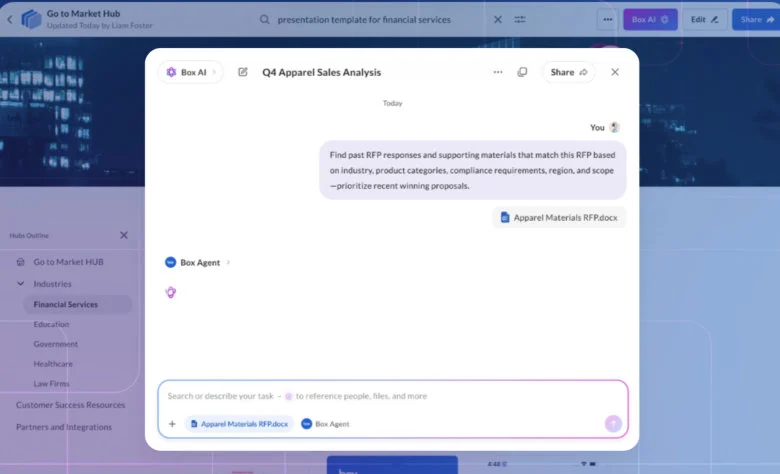

Enterprise content management leader Box has announced the launch of Box Agent, a sophisticated, multi-purpose artificial intelligence assistant designed to move beyond simple task execution toward comprehensive workflow orchestration. This development marks a significant shift in the company’s strategy, transitioning from specialized, single-purpose AI tools to a unified autonomous agent capable of managing complex, multi-step processes across the entirety of an organization’s digital library. By integrating advanced foundation models with Box’s deep understanding of enterprise data structures, the new agent aims to solve the growing challenge of managing massive volumes of unstructured data while enhancing organizational productivity.
The introduction of Box Agent follows a period of rapid iteration for the Redwood City-based firm. While previous iterations of Box AI focused on specific functions—such as summarizing a single document or drafting a brief email—the new agent is designed to act as a centralized intelligence layer. Yash Bhavnani, Head of AI at Box, highlighted the intuitive nature of this shift, noting that the goal is to remove the cognitive load from the user. In the new ecosystem, users no longer need to navigate between different agents for different tasks; instead, the Box Agent serves as a versatile interface that identifies the necessary steps and resources to complete a request autonomously.
A Chronology of Box’s AI Evolution
The launch of the Box Agent is the culmination of a multi-year roadmap intended to transform Box from a cloud storage provider into a "Content Cloud" powered by intelligence. The journey began in early 2023 with the initial announcement of Box AI, which integrated Large Language Models (LLMs) directly into the Box interface to allow users to query individual files. By late 2023, the company expanded these capabilities with the introduction of Box Hubs, which allowed organizations to curate specific "virtual content stores" or collections of documents for specific departments or projects.
In early 2024, Box introduced Box AI Studio, a low-code environment allowing enterprises to configure custom AI models. The current release of the Box Agent represents the final piece of this architectural puzzle, connecting the intelligence of AI Studio with the curated knowledge of Box Hubs. This progression reflects a broader industry trend where enterprise software vendors are moving away from "chatbots" toward "agentic workflows"—systems that don’t just talk but actually perform work by interacting with various data sources and software layers.
Technical Architecture and Model Agnosticism
A defining feature of the Box Agent is its model-agnostic architecture. Recognizing that the landscape of generative AI is evolving at a breakneck pace, Box has engineered the agent to harness a variety of foundation models from leading providers, including OpenAI, Anthropic, Google (Gemini), and Grok. This flexibility allows the agent to select the most efficient or capable model for a specific task—utilizing a high-reasoning model for complex analysis while perhaps opting for a faster, more cost-effective model for simple summarization.
However, the true value of the Box Agent lies not in the underlying models themselves, but in what Box calls the "context layer." General-purpose AI models often struggle with enterprise-specific nuances, such as folder hierarchies, document versions, and user permissions. Box Agent bridges this gap by applying the platform’s existing metadata and security protocols to every AI interaction. This ensures that the agent understands not just the content of a file, but its relevance to the specific user. For instance, when a user asks the agent to "find the most recent contract," the agent utilizes Box’s versioning history and metadata to ensure it does not retrieve an obsolete draft.
To support high-demand enterprise environments, Box has introduced specialized tiers for the agent. The "Pro Mode" utilizes advanced reasoning models for sophisticated planning and execution, while the "Expanded Mode" provides a massive context window of up to four million tokens. This expanded capacity is critical for tasks involving high-volume repetition or the analysis of thousands of documents simultaneously, such as a legal discovery process or a comprehensive audit of historical financial records.
Customization via Box AI Studio and Box Hubs
While the standard Box Agent is designed for day-to-day office tasks, Box is empowering enterprises to build "custom agents" via Box AI Studio. These bespoke agents are typically tethered to a Box Hub, which acts as a "source of truth." For example, a human resources department can create an "Onboarding Agent" by pointing the tool toward a Hub containing the latest employee handbooks, 401(k) policies, and holiday schedules.
The strategic advantage of this system is its maintenance-free nature. As policies change, HR staff simply update the documents within the Hub; the agent automatically adjusts its responses based on the new content without requiring any re-coding or manual training. This "Reference Knowledge" approach ensures that the AI remains accurate and grounded in legitimate company sources, mitigating the risk of "hallucinations" that often plague consumer-grade AI tools.
Addressing the Unstructured Data Crisis
The launch comes at a time when organizations are struggling with an explosion of unstructured data. Industry estimates suggest that approximately 80% to 90% of all enterprise data is unstructured, consisting of contracts, emails, chat logs, video recordings, and slide decks. Paradoxically, the rise of generative AI has exacerbated this problem. As AI makes it easier to generate content, the volume of digital noise increases—a phenomenon some industry analysts refer to as "AI slop."
Box’s leadership argues that the goal of the Box Agent is to convert this noise back into valuable "co-created content." By using the agent to synthesize insights from multiple sources—such as summarizing a series of client interviews into a two-page brief—users are creating new, high-value assets that are then fed back into the enterprise’s knowledge base. This creates a virtuous cycle where the AI helps manage the data it helps create, ensuring that the final output is concise, searchable, and useful for future collaborators.
Real-World Applications and Sector Impact
Early access customers have already begun deploying Box Agent to solve "burdensome" and "hard" problems. In the financial services sector, one firm reported using the agent to automate the manual research process previously conducted by analysts. By instructing the agent to scan thousands of pages of market data and internal reports, the firm was able to identify emerging trends and client opportunities that were previously invisible due to resource constraints. This automation has allowed analysts to shift their focus from data entry and retrieval to high-value client advisory roles.
Other documented use cases include:
- Request for Proposal (RFP) Responses: The agent can draft complex responses by retrieving and analyzing product documentation, compliance guides, and historical win/loss data.
- Contract Lifecycle Management: Legal teams use the agent to review vendor contracts against established company policies, flagging deviations and suggesting redlines.
- Product Development: Marketing teams use the agent to analyze customer service interactions and feedback documents to produce reports on the most requested product features.
Market Implications and Competitive Landscape
The release of Box Agent places the company in direct competition with other "agentic" platforms, such as Salesforce’s Agentforce and Microsoft’s Copilot. However, Box’s competitive advantage lies in its role as a neutral, "system of knowledge." Unlike transactional systems (CRMs or ERPs) that focus on structured data, Box’s expertise in unstructured content makes it uniquely suited for generative AI, which thrives on interpreting human language and document-based information.
Furthermore, by maintaining a secure, permission-based environment, Box addresses the primary concern of enterprise IT leaders: data leakage. The Box Agent operates within the same security perimeter that has earned Box certifications across regulated industries, including healthcare (HIPAA) and government (FedRAMP).
Conclusion and Future Outlook
The transition from task-based AI to multi-purpose agents represents a fundamental shift in the relationship between humans and software. For decades, users have had to learn how to navigate software; with tools like Box Agent, the software is beginning to learn how to navigate the user’s world.
As enterprises continue to grapple with "knowledge velocity"—the speed at which an organization can turn information into action—the ability to deploy autonomous agents that understand context, permissions, and complex workflows will likely become a baseline requirement for digital competitiveness. The success of Box Agent will ultimately be measured by its ability to free human workers from the "drudgery" of data management, allowing them to focus on the creative and strategic tasks that AI cannot yet replicate. Industry observers will be watching closely to see how the platform’s 100,000+ customers adopt these capabilities and whether this "agentic" approach can truly tame the ever-growing mountain of unstructured enterprise data.
