
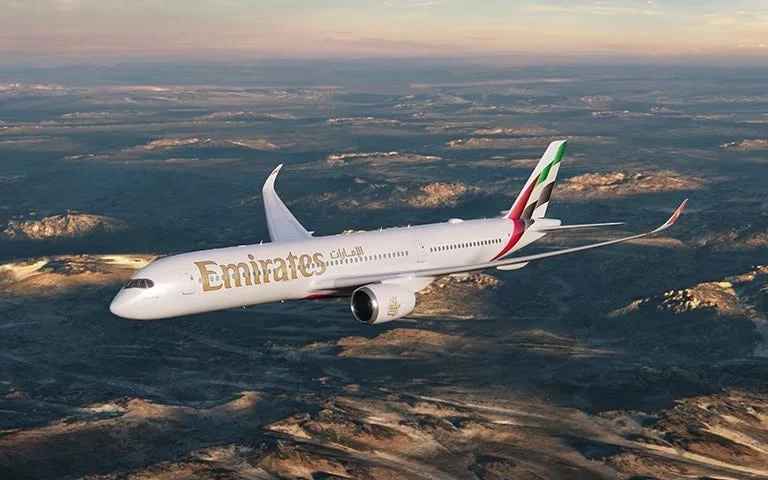

Emirates has finalized plans to overhaul its in-flight connectivity (IFC) offerings by integrating SpaceX’s Starlink satellite internet across its entire fleet, a move that signals a definitive departure from legacy Geostationary Orbit (GEO) systems. The Dubai-based carrier will begin the deployment of Starlink’s high-speed, low-latency Wi-Fi on its Boeing 777 aircraft starting in November 2025, with a target completion date for the entire in-service fleet by mid-2027. This initiative is a central pillar of the airline’s broader $5 billion fleet refurbishment program, which seeks to modernize cabin interiors and enhance the digital passenger experience to meet surging data demands.
The transition to Starlink marks a significant shift in the aviation industry’s approach to connectivity. For decades, airlines relied on GEO satellites positioned approximately 35,000 kilometers above the Earth. While these systems provided broad coverage, they were plagued by high latency—the delay in data transmission—which often resulted in a sluggish user experience. By opting for Starlink’s Low-Earth Orbit (LEO) constellation, which operates at altitudes of roughly 550 kilometers, Emirates aims to provide passengers with "fiber-like" internet speeds, enabling seamless streaming, online gaming, and real-time collaboration tools that were previously unreliable at 35,000 feet.
The Technical Imperative: Overcoming the Limitations of Legacy Systems
The decision to adopt Starlink was driven by persistent technical shortcomings in existing IFC infrastructure. Patrick Brannelly, Senior Vice President of IFE & Connectivity for Emirates, noted that legacy systems often failed to meet passenger expectations regardless of the level of investment. Data analysis conducted by the airline revealed that penetration rates—the percentage of passengers successfully using the Wi-Fi—were lower than expected. This was attributed not only to limited bandwidth but also to "clunky" portals and hardware incapable of managing high-density environments.
A primary technical hurdle with GEO-based systems is latency, which typically sits around 600 to 700 milliseconds. This delay is particularly disruptive for modern web architecture, which requires multiple "handshakes" between a device and a server to load a single page. In contrast, Starlink’s LEO network offers latency as low as 25 to 50 milliseconds. Brannelly emphasized that passengers often confuse high latency with low bandwidth; even a high-capacity pipe feels slow if the response time is delayed. By slashing latency, Emirates expects to eliminate the "spinning wheel" frustration common in aircraft cabins.
Furthermore, Emirates is addressing the "stadium effect" of aircraft connectivity. An airplane cabin is a highly dense environment where hundreds of users attempt to access the network simultaneously. To solve this, the airline is moving toward the installation of multiple Extra Wireless Access Points (XWAPs) and advanced antenna arrays. These hardware upgrades are designed for redundancy and to ensure that 100% of the passengers on a wide-body aircraft can remain connected without a degradation in service quality.
Chronology of the Starlink Integration and Fleet Refurbishment
The timeline for Emirates’ digital transformation is aggressive, reflecting the competitive pressure in the long-haul aviation market.
- November 2023: Emirates first announces its intent to explore Starlink as a viable solution for its fleet, surprising the traditional IFC market.
- 2024: Extensive testing and technical evaluations are conducted to ensure the LEO system can handle the demands of wide-body aircraft like the Airbus A380 and Boeing 777.
- November 2025: The official rollout begins, with the first Starlink-equipped Boeing 777s entering service.
- 2026: The installation pace accelerates as part of the $5 billion retrofitting project, which includes the installation of new Premium Economy cabins and refreshed interiors across 191 aircraft.
- Mid-2027: The airline expects to achieve full fleet-wide implementation, offering free, high-speed Wi-Fi to all passengers regardless of cabin class.
The $5 billion investment is one of the largest in aviation history for a cabin refreshment project. Beyond connectivity, it involves the total replacement of seats in many cabins, updated upholstery, and the integration of the latest generation of "ice" in-flight entertainment systems. The inclusion of Starlink is viewed as the "digital glue" that connects these physical upgrades to the modern traveler’s lifestyle.
Connectivity as a "Hygiene Factor" and the ROI of Free Wi-Fi
One of the most notable aspects of Emirates’ new strategy is the decision to offer the service for free to all customers. Traditionally, airlines viewed Wi-Fi as a premium add-on or a revenue-generating tool. However, Emirates is reframing connectivity as a "hygiene factor"—a basic necessity similar to in-flight lavatories or quality meal service.
Brannelly argues that the Return on Investment (ROI) for such a service is found in brand loyalty and customer retention rather than direct ancillary revenue. He drew a parallel to Emirates’ 1991 decision to become the first airline to install seatback TVs across all cabins. At the time, there was no clear business case for the massive expenditure, but it ultimately defined the Emirates brand as a leader in passenger comfort.
Recent data supports this shift. During a recent 25-minute repositioning flight between Dubai World Central (DWC) and Dubai International (DXB) following a weather event, Emirates observed that nearly 100% of passengers connected to the Starlink system. The data consumption during this short hop exceeded what is typically seen on a seven-hour flight using legacy systems. This spike was attributed to passengers checking rebooking options and flight status in real-time—a use case that requires immediate, reliable access.
Market Implications and the Future of Satellite Technology
The move by Emirates is expected to send shockwaves through the IFC industry, which has long been dominated by players like Viasat, Inmarsat (now owned by Viasat), and Panasonic Avionics. While Viasat continues to provide essential services for cockpit communications and enterprise-level aviation needs, Starlink’s entry represents a consumer-centric disruption.
Starlink’s advantage lies in its vertical integration. SpaceX designs, builds, and launches its own satellites, allowing for rapid technological iterations. One key innovation highlighted by Emirates is the use of satellite-to-satellite laser links. This technology allows Starlink satellites to pass data packets to one another in the vacuum of space until they reach a satellite positioned over a ground station. This solves the "oceanic gap" problem, where traditional satellites struggled to maintain high-speed connections over the middle of the Atlantic or Pacific oceans.
Industry analysts suggest that the aviation sector may be heading toward a multi-orbit future. While LEO provides the low latency desired by passengers, GEO satellites still offer massive localized capacity that can be useful for specific high-traffic hubs. However, Brannelly’s comments suggest that for the passenger experience, the benefits of LEO are becoming undeniable.
The potential for a Starlink monopoly in the LEO space remains a topic of discussion. While competitors like Eutelsat OneWeb and Amazon’s Project Kuiper are developing their own constellations, Starlink’s "first-mover" advantage in the aviation hardware space is significant. Once an airline installs complex antenna hardware on a fleet of 200 aircraft, the cost and downtime required to switch to a competitor are prohibitive.
Broader Impact on Passenger Expectations
The Emirates-Starlink partnership arrives at a time when the "always-on" culture of the ground has fully migrated to the air. Data consumption on mobile devices is growing exponentially, with users now accustomed to bandwidth-heavy activities such as short-form video streaming (TikTok/Reels), cloud-based gaming, and high-definition video conferencing.
By future-proofing its fleet with LEO technology, Emirates is positioning itself to handle the next decade of data growth. The airline’s strategy reflects a belief that the "internet in the sky" should not be a compromised version of the "internet on the ground." As more carriers follow suit—with Qatar Airways, Hawaiian Airlines, and United Airlines also announcing Starlink agreements—the era of paid, slow, and unreliable in-flight Wi-Fi appears to be coming to a close.
In conclusion, Emirates’ commitment to Starlink is more than a technical upgrade; it is a strategic repositioning. By integrating high-speed connectivity into a $5 billion refurbishment plan, the airline is betting that the future of long-haul travel will be defined by the quality of the digital environment as much as the physical one. As the rollout progresses toward its 2027 completion, the industry will be watching closely to see if this "leap of faith" yields the same brand-defining results as the seatback TV revolution of three decades ago.
