

Amazon Web Services (AWS) today announced the general availability of managed daemon support for Amazon Elastic Container Service (Amazon ECS) Managed Instances, a significant enhancement designed to empower platform engineers with independent control over critical operational agents. This new capability builds upon the managed instances experience first introduced in September 2025, addressing long-standing challenges associated with the deployment and lifecycle management of software agents such as monitoring, logging, and tracing tools within large-scale containerized environments. The update promises to improve reliability, ensure consistent host-level monitoring, and drastically reduce the operational burden on development and operations teams.
A New Paradigm for Operational Agent Management
The proliferation of microservices and containerized applications has dramatically increased the complexity of managing modern IT infrastructure. While container orchestrators like Amazon ECS have revolutionized application deployment, the management of auxiliary operational agents – vital for observability, security, and compliance – has often remained a cumbersome process. Historically, these agents were tightly coupled with application deployments, meaning any update to a monitoring agent, for instance, necessitated coordination with application development teams, modifications to task definitions, and often a full redeployment of the application itself. This intricate dance created significant operational overhead, particularly for organizations running hundreds or thousands of services.
According to a recent industry report by the Cloud Native Computing Foundation (CNCF), container adoption continues its upward trajectory, with 96% of organizations using or evaluating containers in production. However, the same report highlights operational complexity as a persistent challenge, with managing monitoring and logging identified as a key pain point for 38% of respondents. AWS’s new managed daemon support directly confronts this challenge by introducing a dedicated construct for operational tooling, effectively decoupling the lifecycle management of these agents from that of the applications they serve.
Decoupling and Standardization for Enhanced Efficiency
At its core, the managed daemon feature in Amazon ECS Managed Instances enables platform teams to centrally define, deploy, and update operational agents across their container infrastructure without requiring direct intervention or redeployment from application teams. This separation of concerns is a critical architectural shift, fostering greater agility and operational independence. Platform engineers can now ensure that every instance consistently runs required daemons, enforcing a standardized operational posture across their entire fleet.
The system guarantees that daemons are started before application tasks and are the last to drain during instance termination or updates. This "start before stop" mechanism is crucial for maintaining continuous data collection for logging, tracing, and monitoring, eliminating critical blind spots that could arise during application lifecycle events. This level of consistency is paramount for maintaining robust observability, which is essential for rapid incident response and proactive system health management. Data from organizations adopting advanced observability practices often shows a significant reduction in Mean Time To Resolution (MTTR) by as much as 30-50%, underscoring the importance of always-on monitoring.
Flexible Deployment and Optimized Resource Utilization
Managed daemons offer considerable flexibility in deployment strategies. Platform engineers can deploy these agents across multiple capacity providers or target specific capacity providers, allowing for granular control over agent rollout strategies. This means an organization can, for example, deploy a specific security agent only to capacity providers handling sensitive workloads, or gradually roll out a new logging agent to a subset of their infrastructure before a full deployment.
Resource management for daemons is also centralized and independent of application configurations. Teams can define CPU and memory parameters for their daemons separately, without the need to rebuild Amazon Machine Images (AMIs) or update application task definitions. This not only streamlines management but also optimizes resource utilization. Each instance runs exactly one copy of a daemon, which is shared across multiple application tasks running on that instance. This contrasts with traditional sidecar patterns, where each application task might run its own agent, leading to redundant resource consumption and increased operational costs. For large enterprises, this optimization can translate into substantial savings on compute resources.
A Practical Demonstration: Deploying the CloudWatch Agent

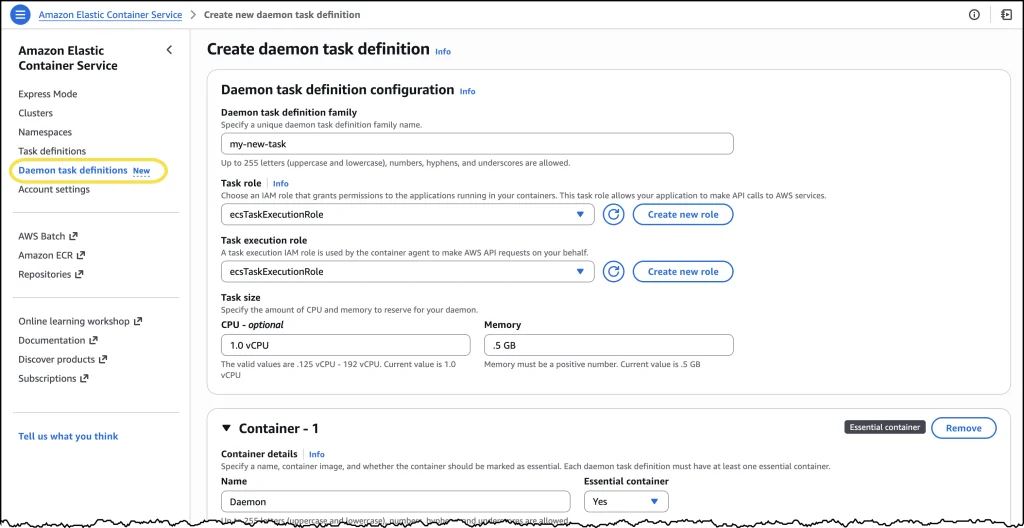
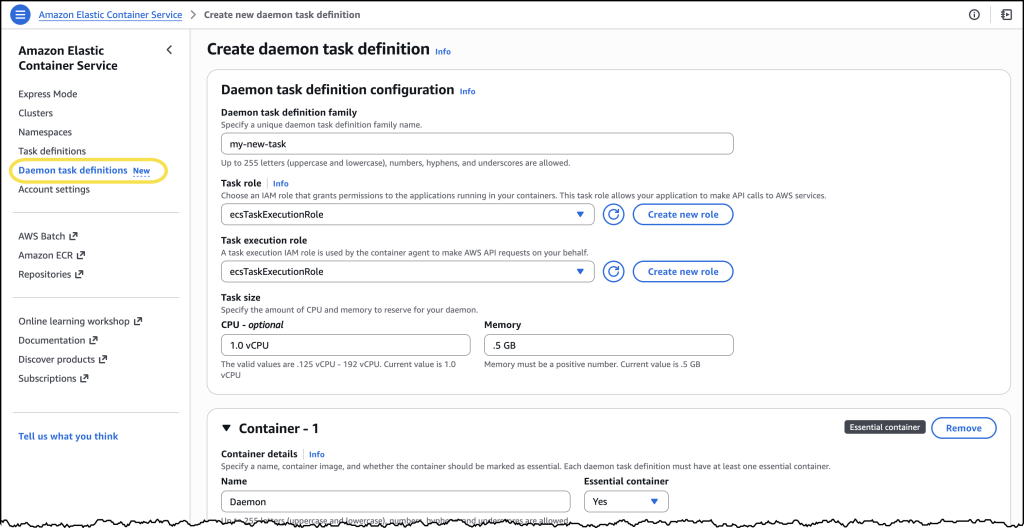
To illustrate the new capabilities, an early adopter scenario involved deploying the Amazon CloudWatch Agent as a managed daemon. The process begins within the Amazon Elastic Container Service console, where a new "Daemon task definitions" option is now visible in the navigation pane. This dedicated interface allows platform engineers to define their managed daemons, separate from standard application task definitions.
The initial setup involved creating a new daemon task definition, configuring the CloudWatch Agent with specified CPU and memory parameters (e.g., 1 vCPU and 0.5 GB of memory). A descriptive daemon task definition family name was assigned, and the ecsTaskExecutionRole was selected for the Task execution role. For the container section, the public.ecr.aws/cloudwatch-agent/cloudwatch-agent:latest image URI was used, along with additional configuration details.
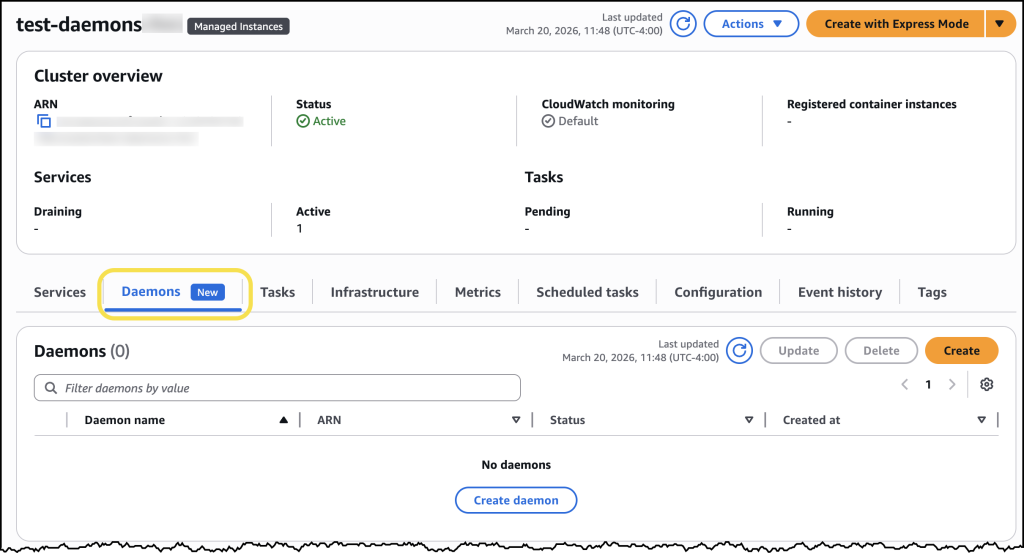
Once the daemon task definition was created, the next step involved navigating to the Clusters page, selecting the desired ECS cluster, and accessing the newly introduced "Daemons" tab. Here, a simple "Create daemon" button initiates the configuration process. Under "Daemon configuration," the newly created daemon task definition family is selected, and a daemon name is assigned. For "Environment configuration," the relevant ECS Managed Instances capacity provider is chosen. After confirming the settings, the daemon is created.
Upon creation, ECS automatically ensures the daemon task launches first on every provisioned ECS managed instance within the selected capacity provider. In a test deployment, a sample NGINX web service was deployed as a workload. The console confirmed that ECS Managed Daemons had automatically deployed the CloudWatch Agent daemon alongside the application, without any manual intervention required from the application deployment process.
Crucially, the system also handles updates seamlessly. When the daemon was later updated, ECS initiated a rolling deployment automatically. This involved provisioning new instances with the updated daemon, starting the daemon first, then migrating application tasks to these new instances before terminating the old ones. This "start before stop" approach ensures continuous daemon coverage, meaning logging, monitoring, and tracing agents remain operational throughout the update cycle with no gaps in data collection. The configurable drain percentage allows platform engineers to control the pace of this replacement, providing full control over addon updates without incurring application downtime.
Under the Hood: Technical Innovations
The managed daemon experience is underpinned by several technical innovations. The introduction of a new daemon_task_definition construct provides a dedicated schema and validation mechanism, distinctly separating daemon configurations from application task definitions. A novel daemon_bridge network mode enables daemons to communicate effectively with application tasks while maintaining isolation from application-specific networking configurations, enhancing security and preventing potential conflicts.
Furthermore, managed daemons support advanced host-level access capabilities, which are fundamental for the operation of many essential operational tools. Platform engineers can configure daemon tasks as privileged containers, add additional Linux capabilities, and mount paths directly from the underlying host filesystem. These capabilities are particularly vital for sophisticated monitoring and security agents that require deep visibility into host-level metrics, processes, system calls, and network interfaces. Without this deep access, many advanced security and performance monitoring tools would be ineffective.
When a daemon is deployed, ECS orchestrates the launch of exactly one daemon process per container instance before any application tasks are placed. This fundamental ordering guarantees that operational tooling is fully in place and operational before any application starts receiving traffic, preventing scenarios where an application might run unmonitored or unlogged. The built-in support for rolling deployments with automatic rollbacks further instills confidence, allowing platform teams to update agents knowing that the system can automatically revert to a stable state if issues arise.
Broader Industry Impact and Expert Commentary
The introduction of managed daemon support for Amazon ECS Managed Instances is poised to have a significant impact on how organizations manage their containerized workloads. Industry analysts have long highlighted the "undifferentiated heavy lifting" associated with managing infrastructure and auxiliary services. This feature directly addresses that by abstracting away much of the complexity, allowing platform teams to focus on higher-value tasks.
"This new capability from AWS is a game-changer for platform engineering teams," commented Sarah Chen, a leading cloud architect specializing in container orchestration. "The ability to decouple agent lifecycle management from application deployments is not just a convenience; it’s a strategic advantage. It significantly reduces the friction between development and operations, enabling faster innovation cycles while simultaneously improving the overall reliability and security posture of containerized applications. We anticipate this will drive even greater adoption of ECS in enterprise environments, especially those with stringent compliance and observability requirements."
The feature also strengthens ECS’s position in the competitive container orchestration landscape. While Kubernetes offers similar daemonset functionality, the managed nature of AWS’s solution further simplifies the operational burden, aligning with AWS’s broader strategy of providing fully managed services. This differentiation can be particularly appealing to organizations seeking to minimize operational overhead and maximize developer velocity without needing deep expertise in Kubernetes internals.
The implications extend to cost savings and resource optimization. By ensuring that only one instance of each daemon runs per host and by allowing independent resource allocation, enterprises can expect to reduce their cloud spend associated with agent overhead. This efficiency is increasingly important as cloud costs continue to be a focus for CFOs and IT leaders.
Availability and Cost
Managed daemon support for Amazon ECS Managed Instances is available today in all AWS Regions where Amazon ECS is offered. Customers can get started immediately by visiting the Amazon ECS console or by reviewing the updated Amazon ECS documentation. The new managed daemons Application Programming Interface (APIs) are also fully documented, enabling programmatic control and integration into existing CI/CD pipelines.
AWS has confirmed that there is no additional cost to use managed daemons. Customers will only pay for the standard compute resources consumed by their daemon tasks, consistent with AWS’s pay-as-you-go pricing model for ECS. This transparent pricing structure further enhances the value proposition, ensuring that organizations can leverage this powerful new capability without incurring unforeseen expenses.
Looking ahead, this foundational capability could pave the way for further innovations in the ECS ecosystem, potentially leading to a broader marketplace for certified managed daemons or tighter integrations with AWS’s own suite of security and management tools, solidifying Amazon ECS as a comprehensive platform for enterprise-grade container deployments.
