
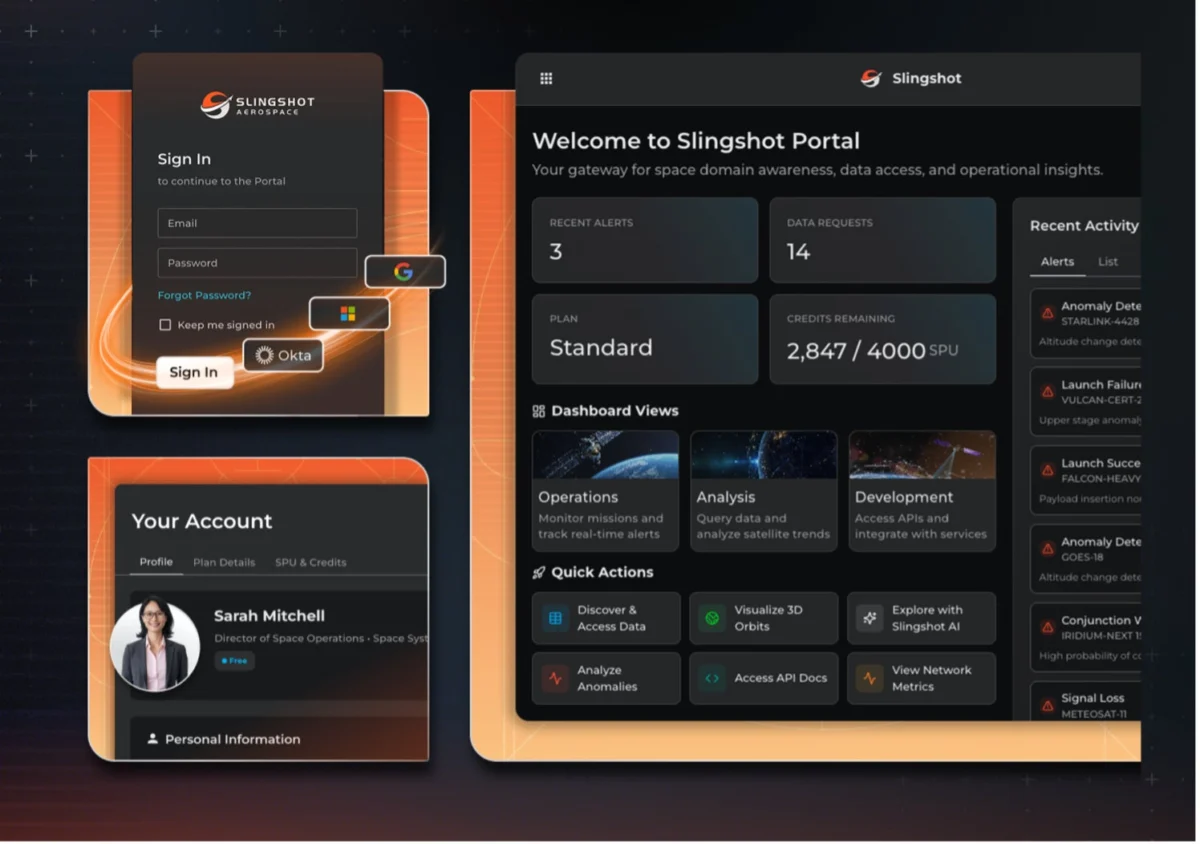

Slingshot Aerospace, a leading force in space-tracking technology, has officially launched Portal, a sophisticated artificial intelligence-driven platform designed to transform how satellite operators monitor, analyze, and safeguard their assets in an increasingly crowded orbital environment. The introduction of Portal marks a significant milestone in the evolution of Space Domain Awareness (SDA), moving beyond traditional reactive monitoring toward a proactive, intelligence-led model. By synthesizing massive streams of proprietary and external data through an advanced analytics engine, Portal provides defense, civil, and commercial users with the tools necessary to navigate the complexities of modern space operations, where the margin for error is shrinking and the stakes for global infrastructure are at an all-time high.
The software functions as a centralized hub, integrating diverse data flows to create a comprehensive "common operating picture" of the orbital domain. At its core, Portal leverages the Slingshot Global Sensor Network (GSN), a worldwide array of optical sensors that provide persistent tracking of objects in Low Earth Orbit (LEO), Medium Earth Orbit (MEO), and Geostationary Orbit (GEO). This internal data is augmented by government-provided tracking information and a meticulously maintained, continuously updated catalog of space objects. Recognizing the need for flexibility in high-stakes environments, Slingshot has engineered Portal to allow customers to ingest their own proprietary telemetry and third-party data sources, ensuring that the platform can be tailored to specific mission requirements and security protocols.
The Technical Architecture of Portal: Data Fusion and AI Analysis
The primary challenge of modern space situational awareness is not merely the collection of data, but the interpretation of it. With tens of thousands of tracked objects currently in orbit—and hundreds of thousands more too small to be consistently monitored—satellite operators are often overwhelmed by a "data deluge" of conjunction warnings and orbital perturbations. Slingshot Portal addresses this by utilizing artificial intelligence to filter noise and highlight actionable intelligence.
The platform’s analytics engine is built on a foundation of physics-based modeling. Unlike traditional 2D tracking systems that represent satellites as static points on a map, Portal utilizes high-fidelity 3D visualizations. These visualizations allow operators to see the spatial relationships between assets and potential threats in real time, accounting for the complex gravitational and atmospheric forces that influence orbital mechanics. When an anomaly is detected—such as an unexpected change in a satellite’s trajectory or the approach of a non-cooperative "stalker" satellite—Portal’s AI assists operators in evaluating maneuvering options. It calculates the fuel costs, mission impacts, and long-term orbital consequences of various responses, empowering decision-makers to act with a level of confidence that was previously unattainable.
Navigating a Congested and Contested Orbital Environment
The release of Portal comes at a critical juncture for the space industry. The "Big Sky" theory—the idea that space is so vast that collisions are statistically impossible—has been thoroughly debunked by the reality of the 21st-century space race. Since the launch of the first mega-constellations, the number of active satellites has increased exponentially. As of early 2024, there are more than 9,000 active satellites in orbit, a number projected to grow to over 60,000 by the end of the decade.
This congestion is compounded by the problem of space debris. Millions of fragments from spent rocket stages, defunct satellites, and past collisions circle the Earth at speeds exceeding 17,000 miles per hour. At these velocities, even a piece of debris the size of a marble can deliver the kinetic energy of a hand grenade, potentially triggering a "Kessler Syndrome" event—a chain reaction of collisions that could render certain orbits unusable for generations.
Furthermore, the geopolitical landscape has shifted. Space is now officially recognized by the United States and its allies as a contested "warfighting domain." Adversarial nations have demonstrated anti-satellite (ASAT) capabilities, and the rise of "dual-use" satellites—those capable of both commercial service and military reconnaissance or interference—has created a climate of uncertainty. Slingshot Aerospace CEO Tim Solms emphasized this reality during the launch, stating that the tools developed for the orbital domain of the past are no longer sufficient for today’s challenges. By unifying sensing, intelligence, and action, Portal is designed to provide the speed and agility required to operate in this high-threat environment.
Strategic Utility for Defense and National Security
One of the most distinctive features of Slingshot Portal is its ability to operate within disconnected command-and-control (C2) environments. This capability is specifically aimed at national security and defense users who may be operating in "Denied, Degraded, Intermittent, or Limited" (DDIL) communication settings. In the event of a conflict where terrestrial or satellite-based communications are jammed or severed, Portal can continue to function locally, providing commanders with the situational awareness needed to protect critical space-based assets such as GPS, secure communications, and early-warning systems.
For defense operators, the ability to distinguish between a natural orbital decay and a deliberate, hostile maneuver is paramount. Portal’s AI-supported analysis helps bridge this gap by identifying patterns of behavior that deviate from standard orbital maintenance. This "behavioral monitoring" allows defense agencies to establish a baseline for normal activity and receive immediate alerts when an object exhibits suspicious or aggressive flight characteristics.
A Chronology of Slingshot Aerospace and the SDA Market
The development of Portal is the culmination of years of rapid growth and strategic acquisitions by Slingshot Aerospace. Founded in 2017 with the goal of using data to make space safer and more sustainable, the company quickly established itself as a disruptor in the aerospace sector.
- 2017-2020: Slingshot focuses on early-stage data fusion platforms, securing contracts with the U.S. Air Force and the Space Force’s Space and Missile Systems Center.
- 2021: The company expands its footprint by acquiring Seradata, a leader in space industry data and analysis, which provided a massive historical database of satellite launches and failures.
- 2022: Slingshot acquires Numerica Corporation’s Space Domain Awareness division, bringing in a highly sophisticated global network of ground-based optical sensors. This acquisition allowed Slingshot to move from a software-only model to a vertically integrated data provider.
- 2023: The company begins testing "Slingshot Beacon," a collaborative platform designed to help operators communicate and coordinate maneuvers to avoid collisions.
- 2024: The launch of Portal represents the integration of all these previous efforts—sensors, historical data, collaborative tools, and AI—into a single, unified operational interface.
The trajectory of Slingshot mirrors the broader growth of the private Space Domain Awareness market. Historically, the tracking of space objects was the exclusive purview of government entities, such as the U.S. Space Command’s Space Surveillance Network. However, as the commercial space sector has outpaced government capacity, private firms have stepped in to provide higher-resolution data and more user-friendly software interfaces.
Economic Implications and the Commercial Satellite Boom
While the defense applications of Portal are clear, the commercial sector represents a massive and growing market. For companies like SpaceX, OneWeb, and Amazon’s Project Kuiper, the economic viability of their constellations depends on their ability to avoid collisions. A single collision not only results in the loss of a multi-million dollar asset but also damages the company’s reputation and increases insurance premiums across the industry.
Insurance providers are increasingly looking at SDA tools as a requirement for coverage. In an era where "near-misses" occur daily, insurers want to see that operators are using the best available technology to mitigate risk. Portal provides the forensic-level data necessary for insurance companies to assess the "health" of an orbit and the competence of an operator’s collision-avoidance protocols.
Moreover, the commercial sector is interested in "Life Extension" services—missions where specialized spacecraft dock with aging satellites to refuel them or repair components. These operations require extremely precise tracking and proximity operations data. Portal’s physics-based 3D visualizations are ideally suited for these types of complex, high-precision commercial missions.
Industry Reactions and the Path Forward
The unveiling of Portal has been met with positive early indicators from industry analysts and potential partners. Analysts suggest that the platform’s ability to integrate third-party data is its strongest selling point, as it prevents "vendor lock-in" and allows for a more collaborative approach to space safety.
Inferred reactions from the commercial sector highlight a desire for standardized data. Currently, different tracking services often provide slightly different coordinates for the same object, leading to confusion during conjunction alerts. By offering a platform that can reconcile these differences through AI-driven data fusion, Slingshot is positioning Portal as the "gold standard" for orbital truth.
Looking ahead, the implications of Slingshot Portal extend to the realm of international policy and space law. As more nations and private actors enter the space domain, the need for transparent, verifiable tracking data becomes a matter of global stability. If an incident occurs in orbit, having a platform like Portal that provides a clear, data-backed timeline of events could be the difference between a diplomatic resolution and an escalation of hostilities.
Slingshot Aerospace’s Portal is more than just a software update; it is a response to the fundamental transformation of the final frontier. As space transitions from a remote vacuum to a bustling economic and strategic theater, the ability to "see" and "understand" the environment in real time will be the defining factor of success. With Portal, Slingshot has provided a window into that future, ensuring that as humanity reaches further into the stars, it does so with its eyes wide open.
