

All digital data and systems, from the cloud platforms that power global services to the apps on our smartphones and the websites we visit daily, are ultimately hosted on tangible hardware in the real world. The distinction between "virtual server" and "physical server" doesn’t denote an abstract versus concrete existence, but rather describes how computing resources are structured and utilized. This article delves into the fundamental characteristics, advantages, and disadvantages of each, providing a comprehensive overview for businesses navigating the complexities of modern IT infrastructure.
The Foundation: What is a Physical Server?
A physical server, often referred to as a bare metal server, is a dedicated piece of hardware engineered to perform specific, often intensive, computing tasks. It comprises all the essential components of a computer: a central processing unit (CPU), graphical processing unit (GPU) if applicable, random-access memory (RAM), storage devices, a power supply unit, network interfaces, and an operating system along with server application software. These machines are meticulously designed for continuous operation, typically running 24/7, and are not intended for general user computing but rather for serving other computers and applications. Whether it’s a compact desktop-like unit or a substantial rack-mounted system, its physical presence and dedicated hardware define it as a physical server. Organizations can either house these servers on-premises, maintaining complete control, or access them through leading cloud providers who offer dedicated bare metal instances.
Key Features of Physical Servers
The paramount advantage of a physical server lies in its exclusive allocation of all machine resources to a single tenant or purpose. This dedicated access translates into enhanced security and superior performance potential. Key features include:
- Exclusive Resource Allocation: All CPU, RAM, storage, and network bandwidth are dedicated solely to the server’s tasks, eliminating resource contention from other users.
- Maximum Performance: Direct access to hardware allows for unthrottled performance, crucial for highly demanding applications.
- Enhanced Security and Isolation: With no shared hardware, the risk of cross-tenant security breaches is significantly reduced. Data is physically isolated.
- Full Control and Customization: Administrators have complete control over hardware selection, configuration, and software installation, allowing for deep customization to meet specific needs.
- Direct Hardware Access: This allows for specialized hardware configurations, such as high-performance GPUs or specific network interface cards, that might not be available in virtualized environments.
Use Cases and Historical Context
In the early 2000s, the IT landscape was dominated by physical servers. The prevailing model saw individual companies hosting their own dedicated machines to power their internal IT systems, websites, and applications. This meant each workload, or a closely related set of workloads, resided on its own distinct physical box. This approach, while robust, was often inefficient, leading to underutilized hardware and significant capital expenditure.
While the advent of virtualization has shifted the balance, with virtual machines (VMs) now handling the majority of global server workloads, physical servers remain indispensable for specific, high-demand applications. Their reliability and raw power are still sought after for:
- High-Performance Computing (HPC): Scientific simulations, complex data analysis, and rendering farms benefit immensely from dedicated, unshared processing power.
- Mission-Critical Databases: For applications requiring the absolute fastest transaction speeds and lowest latency, direct hardware access on a physical server is often preferred.
- Intensive Gaming Servers: Real-time gaming demands minimal lag and consistent performance, which dedicated hardware can provide.
- Big Data Analytics: Processing massive datasets often requires the raw power and dedicated storage of physical servers.
- Video Streaming and Media Production: Encoding, rendering, and streaming large media files can tax system resources heavily.
- Legacy Applications: Some older applications may not be compatible with or perform optimally in virtualized environments.
Industries Relying on Physical Servers
Sectors that prioritize absolute reliability, unparalleled performance, and stringent security measures continue to leverage physical servers. These include:
- Financial Services: High-frequency trading platforms, complex risk analysis, and secure transaction processing demand the speed and isolation physical servers offer.
- Healthcare: Sensitive patient data and critical medical imaging analysis require the highest levels of security and performance.
- Government and Defense: National security applications, classified data processing, and critical infrastructure management rely on dedicated, secure hardware.
- Aerospace: Complex simulations for aircraft design, weather modeling, and real-time flight control systems necessitate powerful, dedicated resources.
- Manufacturing: Industrial control systems, real-time operational monitoring, and large-scale simulation for product design often depend on physical server infrastructure.
- Media and Entertainment: High-end video editing, 3D rendering, and large-scale content distribution pipelines benefit from the power of bare metal.
These industries place a premium on the reliability, performance, security, isolation, and direct ownership that physical servers provide, making them a continued cornerstone of their IT strategies.
The Evolution of Computing: What is a Virtual Server?
A virtual server, in essence, is a software-based emulation of a physical server. It is typically created by partitioning the resources of a single physical server to host multiple isolated virtual environments. This process, known as virtualization, is the bedrock of cloud computing and enables hyperscale providers to efficiently manage and offer computing resources at a global scale, maximizing the utilization of their hardware investments.
Imagine a powerful, state-of-the-art physical server – a robust machine equipped with substantial computing power, extensive storage, high-speed networking, and robust security features. A virtual server allows this single physical machine to be transformed into numerous distinct virtual servers, each sharing the underlying hardware resources. Each of these virtual machines (VMs) is allocated a specific portion of the physical server’s CPU, RAM, and storage, operating as an independent, isolated system. This fundamental capability is what drives the scalability and accessibility of cloud computing services worldwide.
Key Features of Virtual Servers
Virtual servers offer a distinct set of advantages centered around flexibility, cost-efficiency, and agility:
- Resource Flexibility and Scalability: Resources can be dynamically allocated, scaled up or down based on demand, offering unparalleled agility.
- Cost-Effectiveness: By sharing hardware, the cost per server instance is significantly reduced, making it an economical choice for many applications.
- Rapid Deployment: New virtual servers can be provisioned and deployed in minutes, dramatically shortening deployment cycles.
- High Availability and Disaster Recovery: Virtualization platforms often incorporate features for live migration of VMs between hosts and automated failover, enhancing resilience.
- Isolation (Logical): While sharing hardware, VMs are logically isolated from each other, preventing one VM’s issues from affecting others.
- Portability: VMs can be easily moved or copied between different physical hosts, simplifying maintenance and upgrades.
Use Cases for Virtual Servers
The applicability of virtual servers is virtually boundless, permeating nearly every facet of modern digital interaction. They are integral to the operation of virtually every industry and power a vast array of applications. Even everyday internet users interact with virtual servers constantly without realizing it when browsing websites, logging into social media, or accessing cloud-based productivity tools.
Popular use cases include:

- Web Hosting: Hosting websites, from small blogs to large e-commerce platforms.
- Application Hosting: Running business applications, CRM systems, ERP software, and more.
- Database Management: Hosting relational and NoSQL databases for various applications.
- Development and Testing Environments: Providing isolated environments for developers to build and test software without impacting production systems.
- Cloud Computing Services: The foundation for Infrastructure as a Service (IaaS), Platform as a Service (PaaS), and Software as a Service (SaaS).
- Virtual Desktop Infrastructure (VDI): Delivering desktop computing environments to end-users remotely.
- Big Data Processing: Scalable environments for processing and analyzing large datasets.
- Containerization Platforms: Often used as the underlying infrastructure for container orchestration systems like Kubernetes.
Beyond these common applications, virtual servers are crucial for advanced computing tasks such as High-Performance Computing (HPC) clusters and facilitating complex cloud-native architectures.
Virtual Servers vs. Physical Servers: A Comparative Analysis
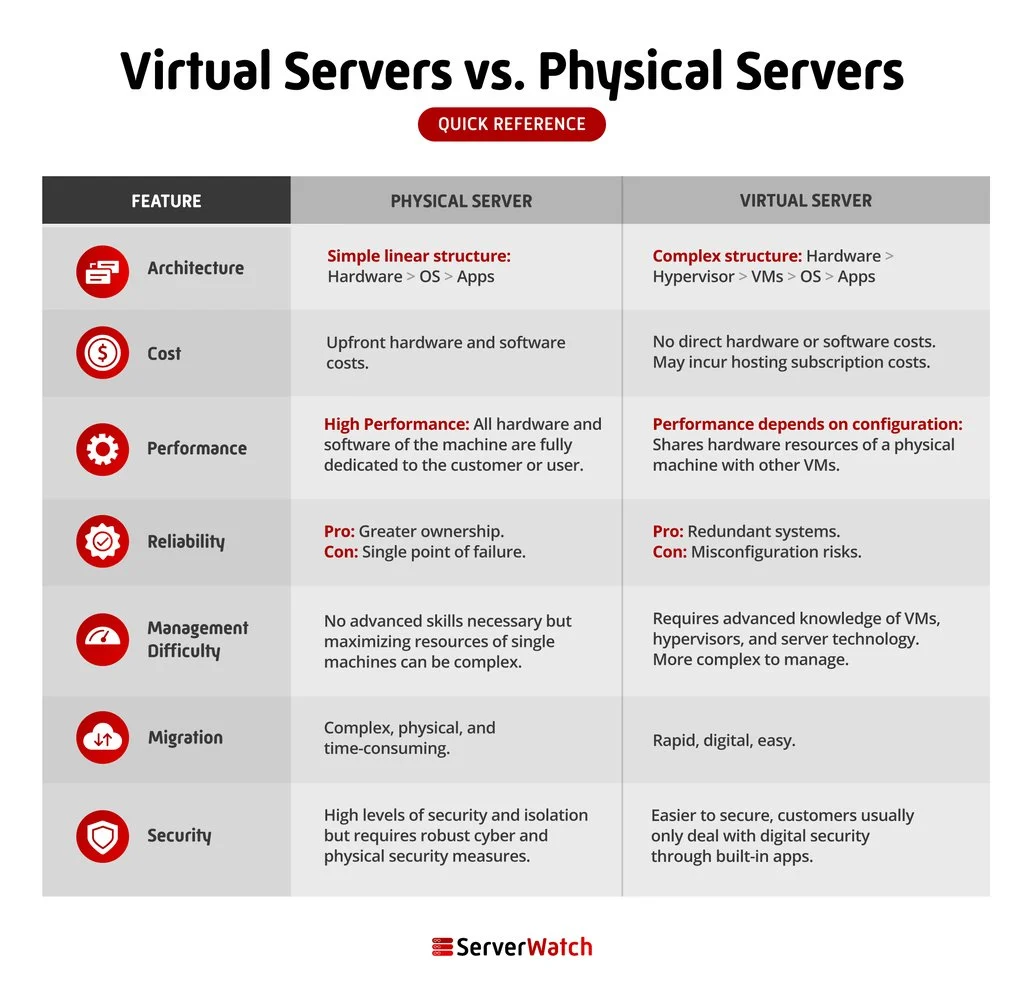
The choice between a virtual and a physical server hinges on a nuanced understanding of their architectural differences, cost implications, performance characteristics, reliability factors, management overhead, migration ease, and security postures.
Architecture
The fundamental divergence lies in their structural design. Physical servers are discrete, self-contained hardware units, offering direct access to all components. Virtual servers, conversely, are software constructs that reside atop a physical server, abstracting the underlying hardware through a hypervisor. This hypervisor manages the distribution of physical resources among multiple VMs, creating a layer of abstraction.
Cost
While virtualization technology itself involves complexity and upfront investment in software and potentially specialized hardware, it offers significant cost efficiencies at scale. The ability to consolidate multiple workloads onto fewer physical machines reduces hardware acquisition costs, power consumption, cooling requirements, and physical space needs. Furthermore, when utilizing cloud-based virtual servers, organizations offload the substantial costs associated with hardware maintenance, repair, energy bills, and physical security. The vendor assumes these responsibilities, often translating to a more predictable operational expenditure (OpEx) model compared to the capital expenditure (CapEx) heavy model of managing physical servers.
Performance
The performance race between physical and virtual servers is highly competitive and context-dependent. A well-configured physical server, with its dedicated hardware, can offer unparalleled raw performance for specific, resource-intensive tasks, especially those requiring very low latency or direct hardware manipulation. However, modern virtualization technologies have advanced significantly, minimizing the performance overhead associated with abstraction. For many workloads, the difference in performance between a physical server and a similarly configured virtual server can be negligible, especially when considering the ease of scaling and resource allocation in a virtual environment. Factors like hardware configuration, software optimization, network latency, and the efficiency of the hypervisor all play critical roles in determining which system ultimately performs better for a given application.
Reliability
Reliability is a critical consideration for any IT infrastructure. Both physical and virtual servers can be engineered for extreme reliability. Physical servers can be deployed with redundant power supplies, RAID storage, and robust cooling systems for enhanced uptime. Virtualization platforms, however, offer advanced features that can bolster reliability. Technologies like live migration allow VMs to be moved between physical hosts without downtime for maintenance or in response to hardware issues. Automated failover mechanisms can quickly restart a VM on a different host if its original server fails. The overall reliability of a virtual server deployment is heavily influenced by the underlying physical hardware, the virtualization software, the network infrastructure, and the operational practices of the IT team or cloud provider.
Management Difficulty
Managing servers, whether physical or virtual, can be a complex undertaking. Physical servers require hands-on management of hardware, operating systems, and applications. This includes tasks like hardware installation, troubleshooting, patching, and physical security. For virtual servers, especially those hosted by cloud providers, many of these management burdens are outsourced to the vendor. The cloud provider handles the physical infrastructure maintenance, hypervisor updates, and often provides tools for easy VM provisioning and management. However, administrators are still responsible for managing the operating system, applications, and security within the virtualized environment. The complexity shifts from physical hardware management to software and network configuration within the virtualized framework.
Migration
Migrating virtual servers is considerably simpler and faster than migrating physical servers. Virtual servers, as software entities, can be easily copied, cloned, or moved from one physical host to another with just a few clicks, often with minimal or no downtime. This portability is a significant advantage for scaling, load balancing, or disaster recovery. In contrast, migrating a physical server typically involves physically moving the hardware, backing up the entire system, and manually reconfiguring it on a new machine, a process that is time-consuming, labor-intensive, and carries a higher risk of error or extended downtime.
Security
Both virtual and physical servers can achieve high levels of security, but they require diligent configuration and ongoing management. Physical servers offer inherent isolation due to dedicated hardware, which can be appealing for highly sensitive data. However, they are vulnerable to physical breaches, theft, and hardware failures. Virtual servers provide logical isolation between VMs, preventing one from directly impacting another. Security in virtual environments also relies heavily on the hypervisor’s security, network segmentation, access controls, and regular security patching of the guest operating systems. Cloud providers invest heavily in physical and network security for their data centers, offering a robust security foundation for virtual server deployments. The ultimate security of either depends on the implementation and ongoing vigilance of the administrators.
The Bottom Line: Choosing the Right Server Solution for Your Business
Both virtual and physical servers possess distinct strengths and weaknesses. The optimal choice for any given business is not a one-size-fits-all answer but rather a strategic decision dictated by specific operational needs, budgetary constraints, performance requirements, and security mandates.
Virtual servers generally represent a compelling proposition for the majority of businesses. Their inherent affordability, remarkable scalability, and access to cutting-edge technology make them an attractive option. The agility to scale resources up or down rapidly in response to fluctuating demand, coupled with the reduced overhead of managing physical infrastructure, positions virtual servers as a powerful tool for modern enterprises seeking flexibility and cost efficiency.
However, physical servers retain their importance for businesses that demand the utmost in performance, require complete hardware ownership and control, or handle data of such extreme sensitivity that absolute physical isolation is non-negotiable. For workloads that push the boundaries of computational power, such as large-scale scientific simulations, real-time financial trading, or highly proprietary data processing, the uncompromised performance and direct hardware access of a physical server remain unmatched.
As businesses continue to evolve and leverage digital technologies, understanding these fundamental differences is paramount. A thorough assessment of current and future IT requirements, alongside a strategic evaluation of the trade-offs between flexibility, cost, performance, and control, will guide organizations toward the server architecture that best supports their growth and operational objectives. For those looking to harness the power of virtualization, exploring solutions like the best server virtualization software can unlock significant efficiencies and advanced capabilities.
