

Amazon Web Services (AWS) has announced the launch of its new AWS Sustainability Console, a standalone service designed to centralize and simplify access to sustainability reporting and resources for its vast customer base. This strategic development marks a significant step in AWS’s ongoing commitment to environmental responsibility, providing organizations with enhanced tools to measure, monitor, and ultimately reduce the environmental impact of their cloud workloads. The console addresses critical feedback from customers, particularly regarding data accessibility and integration, by offering a dedicated platform independent of traditional billing permissions.
Background and Context: The Climate Pledge and Broader Sustainability Imperatives
The introduction of the AWS Sustainability Console is a direct extension of Amazon’s broader environmental commitments, most notably The Climate Pledge. Launched in 2019, The Climate Pledge saw Amazon co-founding an initiative to reach net-zero carbon across its operations by 2040 – a decade ahead of the Paris Agreement’s 2050 target. This ambitious goal underpins how AWS designs, builds, and operates its global infrastructure, from sourcing renewable energy for its data centers to optimizing resource efficiency across its services.
In recent years, the urgency for corporate sustainability has escalated dramatically. Stakeholders, including investors, regulators, customers, and employees, are increasingly demanding greater transparency and accountability from companies regarding their environmental, social, and governance (ESG) performance. Global frameworks like the Task Force on Climate-related Financial Disclosures (TCFD) and evolving regulations such as the European Union’s Corporate Sustainability Reporting Directive (CSRD) and the U.S. Securities and Exchange Commission’s (SEC) proposed climate disclosure rules are pushing businesses to meticulously track and report their carbon emissions and other environmental metrics. For organizations operating in the cloud, understanding the environmental footprint of their digital infrastructure is no longer optional but a critical component of comprehensive ESG reporting.
Prior to this launch, AWS offered the Customer Carbon Footprint Tool (CCFT) within the AWS Billing Console, providing customers with an estimate of their carbon emissions. While valuable, this tool had inherent limitations, primarily its dependency on billing-level permissions. This structure often created a disconnect, as sustainability professionals and reporting teams, who require access to emissions data, typically do not (and should not) have broad access to an organization’s financial and billing information. The new Sustainability Console directly resolves this friction point, reflecting AWS’s responsiveness to customer needs and the evolving landscape of corporate sustainability management.
Addressing Key Challenges: Democratizing Access to Carbon Data

A core innovation of the AWS Sustainability Console is its independent permissions model. By decoupling access to carbon footprint data from billing permissions, AWS empowers a wider range of organizational roles to engage with sustainability metrics. This is particularly beneficial for dedicated sustainability teams, environmental compliance officers, and reporting specialists who can now directly access the data they need without navigating complex internal permission structures or relying on other departments to extract information. This streamlined access is crucial for timely and accurate reporting, enabling faster decision-making and more agile responses to sustainability mandates.
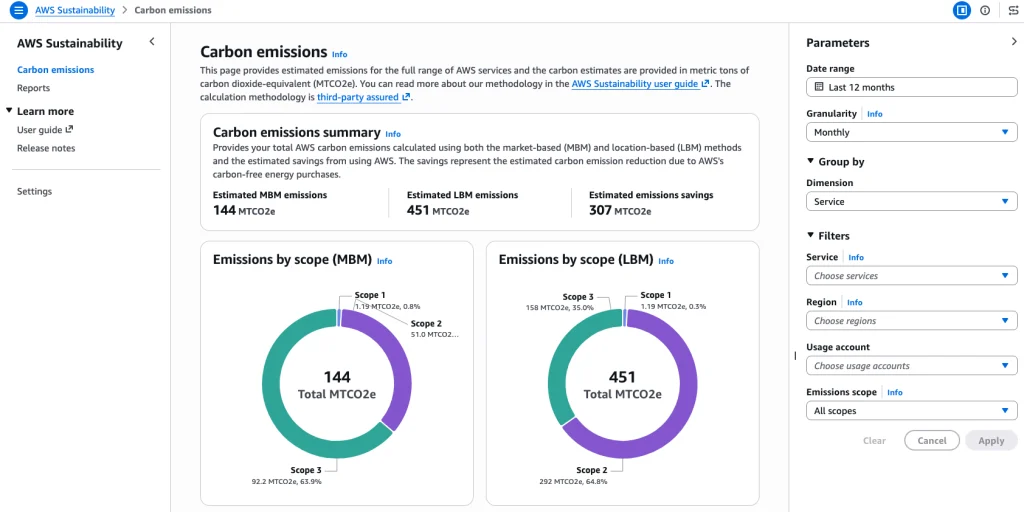
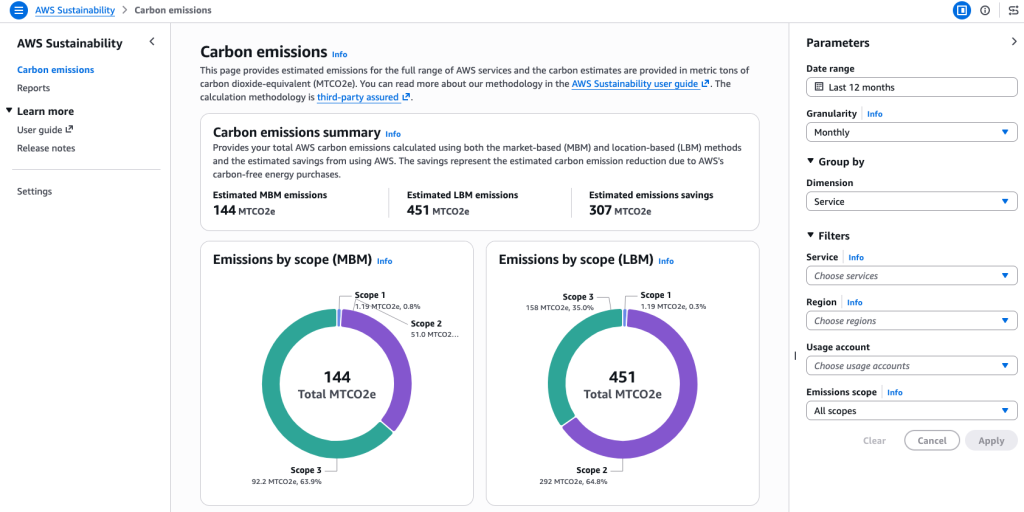
The console provides a detailed breakdown of Scope 1, Scope 2, and Scope 3 emissions attributed to an organization’s AWS usage. For clarity, Scope 1 emissions refer to direct greenhouse gas emissions from sources owned or controlled by the company (e.g., fuel combustion in data centers). Scope 2 emissions are indirect emissions from the generation of purchased energy (electricity, steam, heat, or cooling). The console differentiates between market-based method (MBM), which accounts for energy attribute certificates like Renewable Energy Certificates (RECs), and location-based method (LBM), which uses average local grid emissions factors. Scope 3 emissions encompass all other indirect emissions that occur in a company’s value chain, both upstream and downstream, such as the manufacturing of servers and the construction of data centers. By providing this comprehensive view, AWS enables customers to understand their full environmental impact within the cloud environment and align with widely accepted greenhouse gas (GHG) accounting protocols. The underlying data and methodology, independently verified by third-party consultants like Apex, remain consistent with those used by the CCFT, ensuring continuity and reliability.
Enhanced Reporting and Integration Capabilities
Recognizing the increasing complexity of sustainability reporting requirements, the AWS Sustainability Console introduces robust new features designed for flexibility and integration. A dedicated Reports page allows users to download preset monthly and annual carbon emissions reports, encompassing both MBM and LBM data. Beyond these standard reports, customers can now build custom comma-separated values (CSV) reports, selecting specific fields, time granularity, and other filters to tailor the output to their unique reporting needs. This level of customization is invaluable for organizations needing to comply with varied regulatory frameworks or internal reporting standards.
Furthermore, the console addresses a common challenge for global enterprises: fiscal year misalignment. Many organizations operate on fiscal calendars that do not coincide with the standard calendar year. The AWS Sustainability Console now allows users to configure their reporting period to match their organization’s fiscal year and quarters. This seemingly minor feature significantly reduces a common friction point for finance and sustainability teams, ensuring that all data views and exports reflect the appropriate reporting cycles, thereby simplifying internal reconciliation and external disclosures.
For organizations requiring deeper integration and automation, the console offers programmatic access via a new API and the AWS Software Development Kits (SDKs). This capability is a game-changer for businesses looking to embed emissions data directly into their existing reporting pipelines, custom dashboards, or compliance workflows. For instance, large enterprises managing hundreds or thousands of AWS accounts can programmatically pull monthly emissions data across their entire portfolio without manual data exports. It also facilitates the creation of custom account groupings that may not align with existing AWS Organizations structures, offering unparalleled flexibility in how emissions data is aggregated and analyzed. This level of programmatic access is crucial for large-scale operations and for fostering a data-driven approach to sustainability management.
Operationalizing Sustainability: How the Console Works

Accessing the AWS Sustainability Console is straightforward, integrated directly into the AWS Management Console. Users can simply search for "sustainability" to navigate to the new interface. Upon arrival, the console presents a clear overview of estimated carbon emissions, expressed in metric tons of carbon dioxide equivalent (MTCO2e). The dashboard visually breaks down emissions by scope (Scope 1, 2, 3), utilizing both MBM and LBM metrics. Interactive filters allow users to adjust the date range and drill down into emissions data by specific AWS Region or service, such as Amazon CloudFront, Amazon Elastic Compute Cloud (Amazon EC2), and Amazon Simple Storage Service (Amazon S3). This granular visibility enables customers to identify "hotspots" – services or regions with higher emissions – and take targeted action to optimize their workloads for reduced environmental impact.
The ability to visualize emissions trends over time, coupled with the detailed breakdowns, provides actionable insights. For example, a company might discover that a particular application hosted in a specific region contributes disproportionately to its carbon footprint. With this insight, they could explore options such as migrating the workload to a region powered by a higher percentage of renewable energy, optimizing code for greater efficiency, or rightsizing compute resources to eliminate waste. These types of operational adjustments, informed by precise data from the Sustainability Console, contribute directly to achieving organizational sustainability goals.
Beyond the visual console, the API and AWS Command Line Interface (AWS CLI) provide powerful tools for programmatic data retrieval. A simple API call can fetch detailed emissions data for a specified time period, returning values for total LBM and MBM carbon emissions. This combination of an intuitive visual interface and robust programmatic access ensures that customers have multiple pathways to interact with their sustainability data, catering to different operational needs and technical proficiencies. The console also features a "Release notes" page under the "Learn more" tab, providing continuous updates on new features and methodology enhancements, ensuring users are always informed about the latest capabilities.
Broader Implications for Businesses and the Cloud Industry
The launch of the AWS Sustainability Console carries significant implications for businesses leveraging cloud technology and for the cloud industry as a whole. For AWS customers, it represents a substantial enhancement in their ability to meet growing ESG reporting demands. By providing readily accessible, granular, and verifiable carbon footprint data, AWS empowers organizations to strengthen their sustainability disclosures, enhance their corporate reputation, and potentially attract environmentally conscious investors and customers. The transparency offered by the console can also drive internal accountability, fostering a culture of sustainability within organizations as teams become more aware of the environmental impact of their cloud architecture decisions.
From an operational standpoint, the console provides the necessary data to drive efficiency. By identifying high-emission services or regions, companies can strategically optimize their cloud usage, which often translates into cost savings as well. More efficient use of cloud resources, driven by sustainability insights, can lead to reduced compute, storage, and data transfer costs. This convergence of environmental responsibility and financial prudence underscores the "green IT" movement, where sustainable practices are increasingly intertwined with operational excellence.
For the broader cloud industry, AWS’s move sets a higher bar for transparency and customer enablement in sustainability. As major cloud providers increasingly emphasize their own renewable energy commitments and efficiency efforts, the focus is shifting towards helping customers understand and manage their share of the emissions. This console positions AWS as a leader in providing practical, actionable tools for customer-side carbon management, potentially spurring other providers to enhance their own offerings. It reinforces the idea that cloud providers are not just offering infrastructure but also becoming partners in their customers’ sustainability journeys.
Looking Ahead: The Future of Cloud Sustainability
AWS has stated that the Sustainability Console is designed to grow, with plans to continuously release new features and expand its capabilities in response to customer feedback and evolving market needs. This commitment to iterative development suggests that the console will likely incorporate additional environmental metrics, more sophisticated analytical tools, and perhaps even recommendations for optimizing workloads for sustainability. As regulatory landscapes mature and data collection methods improve, the console could become an even more powerful instrument for comprehensive environmental management within the cloud.
The ongoing commitment by AWS, alongside Amazon’s broader Climate Pledge, highlights the critical role technology companies play in addressing global climate change. By investing in tools that empower customers to manage their environmental impact, AWS is not only fulfilling its own sustainability goals but also enabling thousands of organizations worldwide to contribute to a more sustainable future. This collaborative approach, where the cloud provider and its customers work in tandem, is essential for accelerating the transition to a low-carbon economy.
Availability and Getting Started
The AWS Sustainability Console is available immediately at no additional cost to AWS customers. It can be accessed directly from the AWS Management Console. To facilitate immediate insights, historical data is available dating back to January 2022, allowing organizations to analyze past emissions trends and establish a baseline for future improvements. Customers are encouraged to explore the console today to begin understanding and managing their cloud carbon footprint, leveraging AWS’s extensive resources on sustainability for further guidance.
