
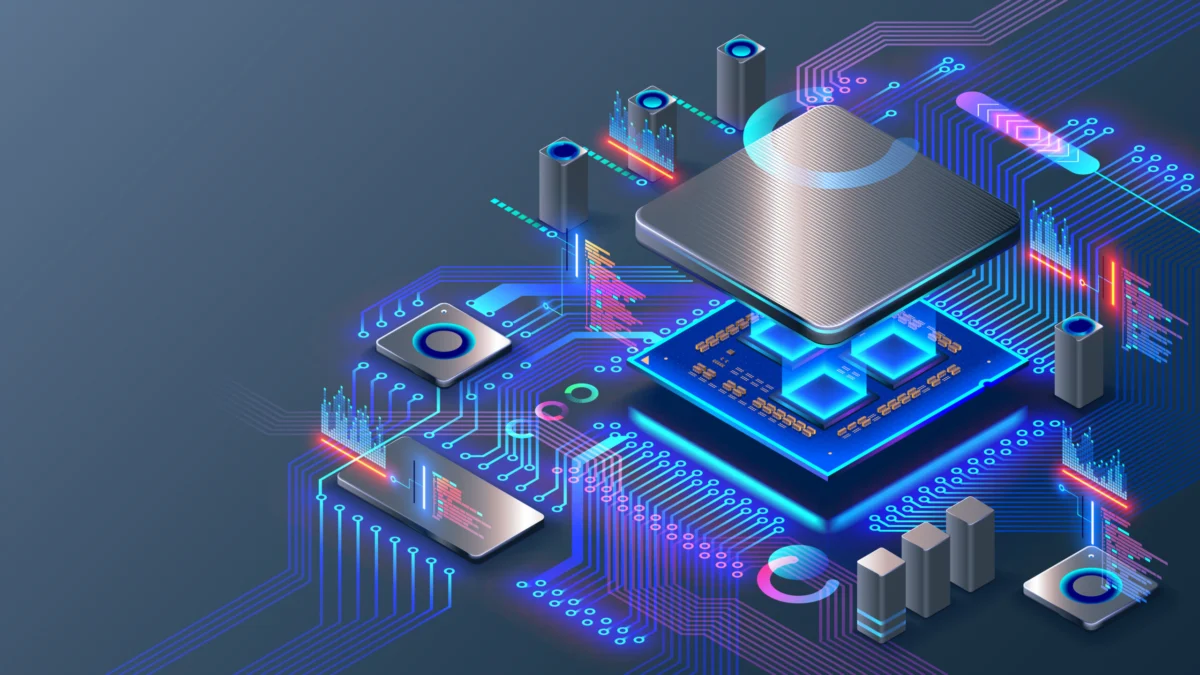

The Shift Toward System-on-Integrated-Chiplets (SoIC)
The semiconductor industry is currently navigating a fundamental transition. For decades, the primary driver of progress was Moore’s Law, which predicted the doubling of transistor density on a single monolithic die every two years. However, as physical limits and skyrocketing fabrication costs have made monolithic scaling increasingly difficult, the industry has turned toward "More than Moore" strategies. The most prominent of these is the use of chiplets—modular, specialized components that are manufactured separately and then integrated into a single package.
System-on-Integrated-Chiplets (SoIC) represents the cutting edge of this movement. Unlike traditional multi-chip modules (MCMs) where chips are placed side-by-side on a substrate, SoIC utilizes advanced 3D stacking techniques. This involves bonding chiplets vertically using technologies such as Through-Silicon Vias (TSVs) and hybrid bonding. While this approach offers unprecedented bandwidth, reduced latency, and lower power consumption, it introduces a fragile electrical environment. The UC Riverside research highlights that the very features that make 3D microsystems powerful—ultra-short interconnects and high-density bonding—also make them exceptionally sensitive to the sudden surges of current known as electrostatic discharge.
Chronology of Packaging Evolution and ESD Complexity
The evolution of semiconductor packaging has directly influenced the complexity of ESD protection strategies. To understand the significance of the UC Riverside paper, it is essential to trace the timeline of integration technologies:
- The Monolithic Era (1970s – 2010s): ESD protection was relatively straightforward, focused on peripheral I/O pads. Large ESD protection structures could be placed near the bond pads to shunt high-voltage transients away from sensitive core logic.
- The Rise of 2.5D Integration (2010s – 2020): The introduction of silicon interposers (such as TSMC’s CoWoS) allowed chiplets to sit side-by-side with high-bandwidth memory. This required the first generation of "micro-bump" ESD protection, which had to be significantly smaller than traditional bond pad protection.
- The 3D Integration Breakthrough (2020 – 2024): True 3D stacking, such as Intel’s Foveros and AMD’s 3D V-Cache, began to reach the consumer market. These designs utilized TSVs to pass signals vertically through the silicon. ESD protection became a "hidden" challenge, as internal interfaces (die-to-die) became as vulnerable as external interfaces.
- The SoIC and Hybrid Bonding Era (2025 – Present): With the arrival of hybrid bonding, which eliminates traditional solder bumps in favor of direct copper-to-copper connections, the pitch between interconnects has shrunk to below 10 micrometers. The UC Riverside paper, published in early 2026, addresses this specific era, where traditional ESD clamps are often too bulky or possess too much parasitic capacitance to be viable.
Technical Challenges: The ESD Reliability Gap
The researchers at UC Riverside identify a "reliability gap" created by the shrinking dimensions of 3D microsystems. Electrostatic discharge occurs when two objects with different electrical potentials come into contact or close proximity, resulting in a sudden flow of electricity. In a chiplet environment, this can happen during the manufacturing process, during automated assembly, or even during testing.
One of the primary data points highlighted in the research is the drastic reduction in the "ESD Design Window." As transistors move toward 2nm and 1nm nodes, the gate oxides become thinner and more susceptible to dielectric breakdown at lower voltages. Simultaneously, the operating voltages of these chips are decreasing, leaving very little margin between the normal operating voltage and the voltage that will destroy the circuit.
Furthermore, 3D stacking creates thermal bottlenecks. ESD protection devices work by converting the energy of a static spark into heat. In a monolithic chip, this heat can dissipate across the substrate. In a 3D stack, a heat-generating ESD event in the middle of a stack can cause localized melting or "thermal runaway" because the heat is trapped between layers of silicon and dielectric material.
Supporting Data and Research Directions
The paper outlines several critical research directions that will define the next five years of semiconductor reliability engineering. According to the study, the industry must move toward "In-SoIC" protection—solutions that are natively integrated into the 3D fabric rather than added as an afterthought.
1. Ultra-Low Parasitic ESD Structures
Traditional ESD protection diodes add capacitance to the circuit, which can degrade high-speed signals. In 3D chiplet interfaces, where data rates often exceed 112 Gbps per lane, even a few femtofarads of extra capacitance can be catastrophic. The UC Riverside team suggests the development of new semiconductor geometries and the use of silicon-controlled rectifiers (SCRs) optimized for the 3D environment to provide high-level protection with minimal signal interference.
2. Modeling and Simulation for Heterogeneous Environments
Currently, ESD simulation tools are largely designed for 2D layouts. The research emphasizes the need for 3D-aware Electronic Design Automation (EDA) tools. These tools must be capable of simulating ESD current paths that traverse multiple chiplets, TSVs, and hybrid bonds. Without accurate modeling, designers are forced to "over-design," wasting valuable silicon real-time, or "under-design," leading to field failures.
3. Cross-Layer ESD Management
The paper proposes a holistic approach where ESD protection is shared across the stack. For example, a "master" ESD protection chiplet could potentially provide a discharge path for "slave" chiplets stacked above it. This would allow specialized chiplets (like high-performance logic) to dedicate more surface area to transistors rather than protection circuitry.
Industry Implications and Expert Reactions
The release of this technical paper has resonated across the semiconductor ecosystem. While official corporate statements from foundries are pending the next cycle of technical conferences, industry analysts have noted the urgency of the UC Riverside findings.
"The industry has been racing toward 3D integration for performance reasons, but the reliability physics haven’t always kept pace," noted a lead analyst in semiconductor manufacturing. "The work by Wang and his team at UC Riverside highlights that we cannot simply stack chips like LEGO bricks without reconsidering the fundamental electrical safety nets that prevent these billion-dollar systems from being fried by a simple static charge."
From a manufacturing perspective, the implications for yield are significant. In a 3D stack of six chiplets, if the sixth chiplet fails due to an ESD event during the final stages of assembly, the entire stack—including the five known-good dies—is often lost. This "compound yield" problem makes ESD protection a direct driver of the economic viability of 3D-IC technology.
Broader Impact on Future Technology
The research published in March 2026 is expected to influence standards bodies such as the ESD Association (ESDA) and JEDEC. As the industry moves toward standardized chiplet interfaces (like UCIe – Universal Chiplet Interconnect Express), the "In-SoIC" ESD protection strategies outlined by Li, Miao, Yue, and Wang will likely serve as a foundation for new compliance requirements.
Beyond consumer electronics, the findings are vital for the automotive and aerospace sectors. In autonomous vehicles, 3D microsystems will handle massive sensor fusion tasks. In these applications, a latent ESD defect—a chip that is damaged but doesn’t fail until months later—could have life-safety implications. The "Future Research Directions" suggested in the paper provide a path toward "zero-defect" manufacturing in the 3D era.
In conclusion, "In-SoIC ESD Protection for Chiplet-Based 3D Microsystems: Future Research Directions" serves as both a warning and a guide. It acknowledges that while heterogeneous integration is the future of the semiconductor industry, that future is only attainable if the industry can master the invisible threat of electrostatic discharge within the increasingly crowded and complex world of 3D silicon. The roadmap provided by the UC Riverside researchers will likely be a primary reference for engineers as they attempt to balance the demands of ultra-high performance with the absolute necessity of long-term reliability.
