

The global cloud computing landscape reached a significant milestone on April 22, 2026, with the official launch of Kubernetes v1.36, nicknamed "Haru." Led by Ryota Sawada, a Principal Engineer and veteran of the Kubernetes release process, the latest iteration of the world’s most widely used container orchestration platform introduces 70 enhancements designed to address the burgeoning demands of artificial intelligence (AI) workloads and the necessity for zero-trust security architectures. The release follows a rigorous 15-week development cycle, marking the first major update of the year for the Open Source project maintained by the Cloud Native Computing Foundation (CNCF).
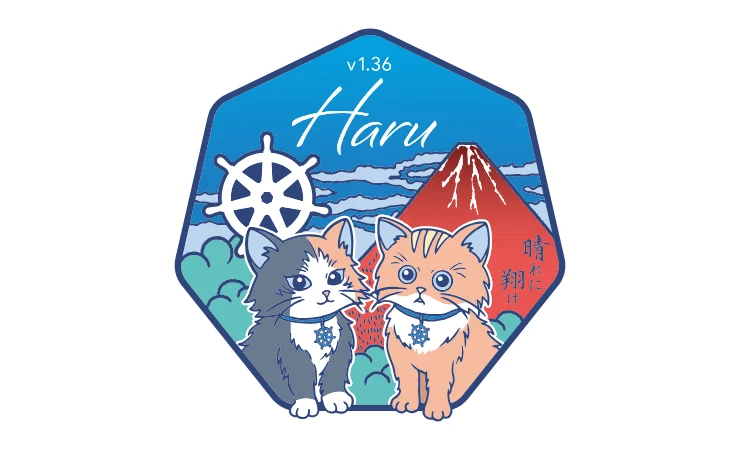
The name "Haru," a Japanese term signifying "Spring," was chosen by Sawada to reflect the transition from the "cloudy and cold" development phase in January to a brighter, more expansive future for the ecosystem. The release is visually represented by a logo created by artist Natsuho Ide, which reimagines Hokusai’s iconic "Red Fuji" in the ukiyo-e style. The artwork features the Kubernetes helm floating above the mountain, flanked by two cats, Stella and Nacho—the pets of the release team—acting as traditional shrine protectors. This symbolism underscores the release’s dual focus: technical evolution and the human-centric community that sustains it.
The Statistical Landscape of v1.36
Kubernetes v1.36 arrives with a balanced distribution of features across the maturity spectrum. Of the 70 enhancements included in this version, 18 have graduated to "Stable" status, indicating they are production-ready with long-term support and guaranteed backward compatibility. Another 25 features have moved into the "Beta" phase, where they are enabled by default but still subject to refinement based on user feedback. The remaining 25 enhancements have entered "Alpha," representing the cutting edge of experimental development within the community.
This release reflects a shift in the project’s maturity. While early versions of Kubernetes focused on the fundamental mechanics of running pods and managing compute nodes, v1.36 demonstrates a focus on refined governance, hardware specialization, and the reduction of operational overhead for third-party integrations.
Strengthening the Security Perimeter
Security remains the foremost priority for enterprise adopters, and v1.36 delivers several critical updates to the platform’s security posture. Most notably, the graduation of User Namespace support to Stable marks the conclusion of a four-year development journey. Registered as KEP-127 (Kubernetes Enhancement Proposal), this feature allows the user inside a container to be mapped to a non-privileged user on the host operating system.
The implications of this change are profound for multi-tenant environments. In the event of a container escape, a malicious actor would find themselves restricted to an unprivileged account on the host node, effectively neutralizing the "blast radius" of the breach. The delay in reaching stability for KEP-127 was attributed to the complexity of ensuring backward compatibility across diverse Linux distributions and storage drivers, a testament to the community’s commitment to stability over speed.
Further hardening the control plane, Fine-grained Kubelet API Authorization has reached General Availability (GA). Previously, monitoring and observability tools often required broad permissions to interact with the Kubelet—the agent running on every node. This new framework allows administrators to grant specific, scoped permissions, adhering to the principle of least privilege. Additionally, External ServiceAccount Token Signing has reached Stable, allowing Kubernetes to delegate cryptographic signing duties to external identity providers. This reduces the risk associated with managing sensitive keys within the Kubernetes control plane itself.
Optimized Infrastructure for AI and GPU Workloads
As enterprises pivot toward large-scale AI deployment, Kubernetes has evolved to manage the specialized hardware required for machine learning and deep learning. The "Haru" release advances the Dynamic Resource Allocation (DRA) framework, which is designed to replace the aging device plugin system.
Resource Health Status, now in Beta, integrates directly with DRA to provide a standardized method for monitoring the health of GPUs, custom ASICs, and network accelerators. Sawada noted that prior to this integration, operators were forced to rely on fragmented, third-party metrics and logs to determine if a hardware device was functioning. By bringing health status into the core Kubernetes API, the platform can now treat hardware health with the same level of visibility as pod or node status, allowing the scheduler to make more informed decisions about workload placement.
Perhaps the most innovative addition for AI practitioners is the introduction of Workload Aware Scheduling (WAS) in Alpha. Traditional Kubernetes scheduling is "pod-atomic," meaning it treats each container as an independent entity. However, distributed AI training jobs often require "all-or-nothing" scheduling—where a job only begins if all required pods can be placed simultaneously. WAS introduces the "PodGroup" concept, making scheduling decisions atomic for a logical group of pods. This prevents "resource deadlocks" where half of a training job occupies expensive GPU resources while waiting indefinitely for the remaining pods to be scheduled.
Modernizing the API with Common Expression Language (CEL)
The graduation of MutatingAdmissionPolicies to Stable represents a significant reduction in the "operational tax" of running Kubernetes. Traditionally, enforcing custom rules or modifying resources during the API request process required the deployment of "Admission Webhooks"—separate web servers that administrators had to build, secure, and maintain.
With MutatingAdmissionPolicies, these rules can now be expressed directly within the Kubernetes API using the Common Expression Language (CEL). This move toward "in-process" policy management eliminates the latency and failure points associated with external webhooks. It allows platform engineers to implement complex logic—such as automatically injecting sidecar containers or enforcing specific labels—without the infrastructure overhead of managing certificates and scaling external webhook servers.
Observability and Real-Time Diagnostics
Understanding the internal state of a cluster without manual intervention is a core tenet of the v1.36 release. Pressure Stall Information (PSI) metrics have reached Stable status, providing operators with high-fidelity data regarding resource contention. Unlike traditional CPU usage metrics, PSI indicates whether a workload is actively "stalling" due to a lack of CPU, memory, or I/O throughput. This allows for more precise autoscaling and troubleshooting.
The release also introduces Native Histogram support in Alpha for the control plane. This allows for more granular monitoring data to be exported with dynamically adjusted resolution, providing a clearer picture of latency and performance bottlenecks. A small but significant addition is the "last-used" timestamp for Persistent Volume Claims (PVCs). This feature allows administrators to identify orphaned or unused storage volumes, facilitating more efficient cloud spend management and resource reclamation.
Lifecycle Management: Deprecations and Removals
As Kubernetes evolves, the community must also prune legacy features that pose security risks or have been superseded by better alternatives. In v1.36, the gitRepo volume driver has been permanently removed. Deprecated since 2018 (v1.11), the driver allowed volumes to be populated directly from Git repositories but was increasingly viewed as a security liability and a violation of the separation of concerns.
Furthermore, the Service specification’s externalIPs field has been officially deprecated, with a scheduled removal in v1.43. This field has been identified as a potential attack vector for traffic interception (CVE-2020-8554). The release team has urged operators to migrate to more secure alternatives, such as LoadBalancer services or Ingress controllers, ahead of the future removal.
Chronology of the v1.36 Cycle
The journey to v1.36 began in early January 2026, amid the traditional "winter lull" in the Northern Hemisphere. The cycle was structured into several critical phases:
- Enhancements Freeze (Week 4): The deadline for defining which KEPs would be included in the release.
- Code Freeze (Week 11): A period where only bug fixes and documentation updates were permitted to ensure code stability.
- Beta Releases (Weeks 12-14): Successive pre-releases provided to the community for integration testing.
- Release Day (April 22, 2026): The final synchronization of binaries, documentation, and the official announcement.
Sawada highlighted that the timing of the "Haru" release was intentional. The previous version, v1.35, coincided with the year-end holiday period, which often limits contributor availability. By contrast, the v1.36 cycle benefited from peak community engagement during the first quarter of the year, allowing for the completion of long-standing projects like User Namespaces.
Broader Impact and Industry Implications
The release of Kubernetes v1.36 "Haru" confirms the platform’s shift from a disruptive technology to a foundational utility. By integrating AI-specific scheduling and hardware health monitoring, Kubernetes is positioning itself as the "operating system of the data center" for the generative AI era.
For enterprises, the stabilization of security features like KEP-127 and CEL-based policies reduces the complexity of maintaining compliant environments. For cloud providers, the enhancements in DRA and observability offer more robust tools for managing multi-tenant infrastructure at scale.
As the industry moves toward 2027, the "Haru" release serves as a bridge. It addresses the technical debt of the past through long-awaited stable features while laying the groundwork for the future of distributed, hardware-accelerated computing. The "horizon" Sawada referenced in his launch notes is now visible: a Kubernetes that is more secure, more observant, and more capable of powering the next generation of intelligent applications.
