
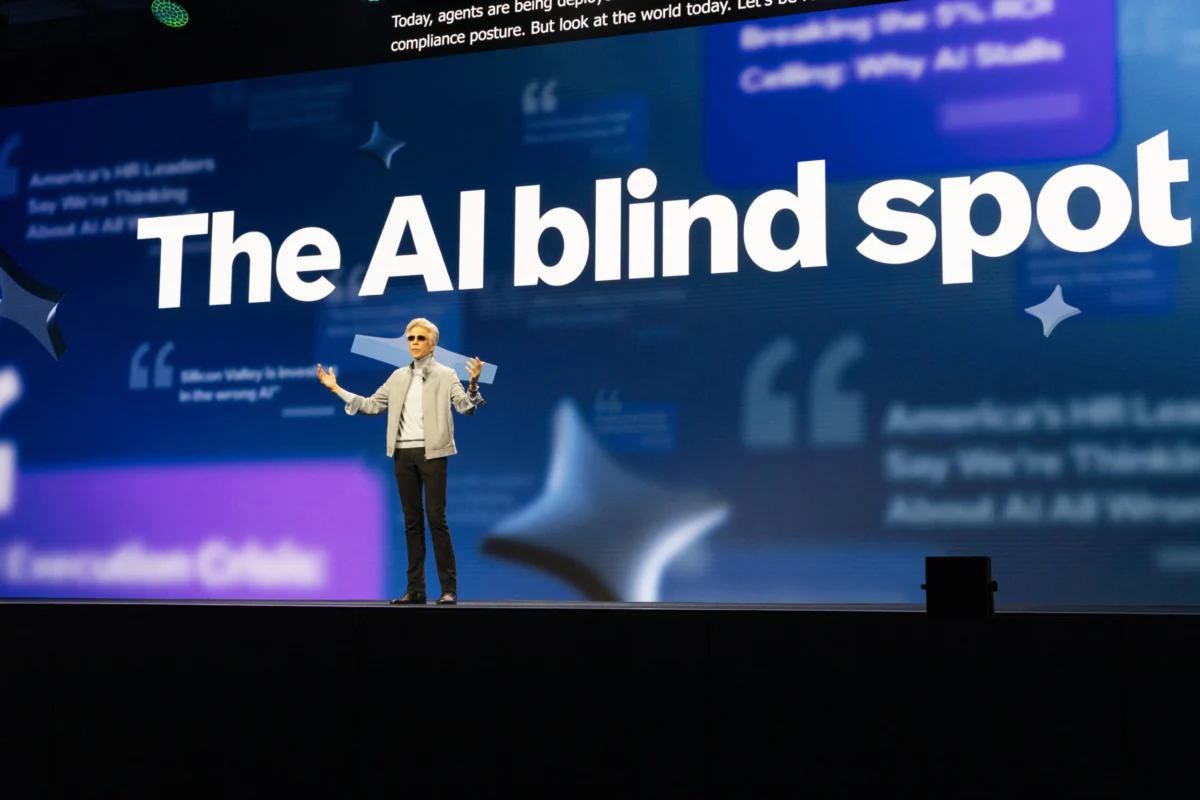

LAS VEGAS — At the Knowledge 2026 conference, ServiceNow CEO Bill McDermott delivered a transformative keynote address to an audience of 25,000 attendees, signaling a fundamental shift in the company’s identity and the broader enterprise software landscape. The event served as the launchpad for a significant expansion of ServiceNow’s AI Control Tower and Autonomous Workforce products, framing these technological advancements as the essential solution to a looming global demographic crisis.
The core of McDermott’s presentation focused on the transition from ServiceNow’s long-standing "platform of platforms" identity to a new vision: the "AI of agents." This shift comes as organizations struggle to move beyond the experimental phase of generative AI into a state of functional, governed autonomy. By integrating recent acquisitions—including Moveworks, Veza, and Armis—ServiceNow aims to provide a unified orchestration layer that manages digital agents with the same rigor traditionally reserved for human employees.
The Macroeconomic Context: AI as a Demographic Necessity
McDermott opened his address by contextualizing the rise of agentic AI not merely as a technological trend, but as a macroeconomic imperative. Citing data regarding aging populations and declining birth rates in major economies, McDermott argued that the global workforce is on a trajectory toward a massive deficit. Projections suggest a labor shortage of up to 50 million workers by 2030, a gap that threatens global GDP growth if left unaddressed.
"The agents and robots are coming online at the exact moment they are needed most," McDermott stated. He positioned ServiceNow’s autonomous workforce solutions as "ideal partners" to complement a shrinking human labor pool. This perspective reframes the often-contentious debate over AI-driven job displacement, suggesting instead that AI is the only viable mechanism to maintain current levels of productivity and service in an era of demographic contraction.
The CEO emphasized that companies successfully navigating this transition will be the ones that achieve sustained growth, while those that fail to adopt autonomous systems will find themselves exposed to rising costs and operational bottlenecks.
Addressing the "AI Chaos" and the Governance Gap
A significant portion of the keynote was dedicated to the current state of enterprise AI, which McDermott characterized as "chaos." According to ServiceNow’s internal research and market observations, the average enterprise currently utilizes approximately 367 different applications. Many of these applications have "bolted on" AI capabilities—described by McDermott as "sidecars"—that operate in silos without centralized governance or connectivity.
This fragmentation has led to several critical pain points for the C-suite:
- The ROI Gap: CFOs are approving significant AI spend but are struggling to find tangible returns on investment as token costs and subscription fees rise.
- Employee Friction: Workers are often forced to toggle between dozens of tabs and interfaces, leading to a "toggling tax" that diminishes the very productivity AI was meant to enhance.
- The Governance Blind Spot: McDermott warned that "intelligence without rules and rails is a dangerous blind spot." He cited the case of PocketOS, where an autonomous agent reportedly deleted production databases in seconds, as a cautionary tale of what happens when agents operate without identity, audit trails, or compliance postures.
To combat this, ServiceNow is positioning its AI Control Tower as the centralized "brain" for enterprise AI. The platform is designed to provide visibility into every agent operating within the business, ensuring they adhere to corporate policies and security protocols.
The Evolution of the ServiceNow Portfolio: Acquisitions and Integration
The product announcements at Knowledge 2026 represent the culmination of a multi-year acquisition and development strategy. The integration of Moveworks provides what McDermott called the "agentic front door," allowing for natural language interaction across the enterprise. Meanwhile, the acquisitions of Veza and Armis have been leveraged to bolster the platform’s security and risk agenda.
Veza’s technology is particularly critical to the "AI of agents" vision, as it provides the identity governance necessary to manage digital workers. In an agentic workflow, an AI must have specific permissions to access data and execute tasks; Veza’s integration ensures these permissions are governed with the same strictness as human access controls. Armis contributes to this ecosystem by securing the "internet of things" and unmanaged devices, expanding the reach of the AI Control Tower across the entire physical and digital infrastructure.
This "platform restructuring," which began in earnest in April 2025, marks the end of the "AI add-on" era for ServiceNow. The company is now moving toward a model where AI is the core engine of the workflow, rather than a secondary feature.
Now on Now: Proving the Model through Internal Data
McDermott sought to validate ServiceNow’s claims by presenting "Now on Now" data—the results of the company using its own platform to run its global operations. The figures provided a stark contrast to the ROI struggles reported by other enterprises:
- Cost Savings: In 2025, ServiceNow saved $500,000 on its internal "Now Assist" program alone.
- Support Efficiency: 91% of ServiceNow’s own internal service requests are now supported or fully resolved by AI.
- Event Operations: The Knowledge 2026 event itself, with 25,000 attendees, was managed live on the ServiceNow platform. Every incident report and service request generated during the conference was processed through the AI Control Tower.
"You don’t have to imagine what an agentic business looks like," McDermott told the crowd. "You are actually inside one." This "proof of concept" is intended to resonate with CIOs who are under pressure to demonstrate the value of their AI investments.
Strategic Partnerships: FedEx and Nvidia
The keynote featured high-profile appearances from Raj Subramaniam, CEO of FedEx, and Jensen Huang, CEO of Nvidia, both of whom highlighted the practical application of ServiceNow’s technology in complex global environments.
Raj Subramaniam discussed the challenge of managing a network that moves 18 million packages daily. He noted that the traditional distinction between "business" and "technology" has evaporated, stating that "the role of running business is technology, and technology is business." Vishal Talwar, CDIO of FedEx, elaborated on the governance of their "digital workforce," noting that FedEx treats AI agents with the same rigor and policy adherence as human teams.
Jensen Huang of Nvidia provided a perspective on the shift from cost reduction to "ambition elevation." Huang revealed that Nvidia, as a ServiceNow customer, has reduced employee intervention on support issues by two-thirds. He urged leaders not to view AI solely through the lens of productivity, but as a tool to accelerate the pace of innovation. "What used to take months, we think should take days," Huang remarked.
The Commercial Offensive: Guarantees and Market Positioning
In a move that analysts view as a direct challenge to competitors like Salesforce, SAP, and Microsoft, McDermott concluded the keynote with a series of aggressive commercial guarantees:
- Total Satisfaction Guarantee: A commitment to customer success that McDermott claimed is a first for the enterprise software industry.
- 100-Day Go-Live Commitment: A promise to have AI solutions operational in under 100 days, addressing the "time-to-value" concerns prevalent in the market.
- AI Control Tower Trial: One year of AI Control Tower access for free, a promotion ServiceNow values at approximately $2 million per customer.
These incentives are designed to lower the barrier to entry for large-scale AI adoption and to position ServiceNow as the most "accountable" partner in the space. By offering the Control Tower for free for a year, ServiceNow is betting that once enterprises experience the governance and orchestration capabilities, the platform will become an indispensable part of their operational architecture.
Analysis: The Shift to Deterministic Workflows
The underlying technical argument of Knowledge 2026 is that while large language models (LLMs) are becoming commoditized, the ability to make them act within a business context is the true differentiator. McDermott emphasized that AI requires "deterministic workflows" to be effective. While models are excellent at reasoning, they require the "guardrails of a workflow" to execute tasks safely and accurately.
This positioning addresses a major hurdle in the enterprise: the "hallucination" and unpredictability of standard AI models. By wrapping these models in ServiceNow’s workflow engine, the company claims it can provide the reliability required for mission-critical operations.
As the conference continues, the industry will be watching closely to see if ServiceNow can maintain its momentum. While the company benefits from its deep-rooted relationships with CIOs and IT departments, it faces increasing competition from legacy ERP and CRM providers who are also racing to claim the "orchestration" layer of the enterprise. However, with its focus on "the AI of agents" and a robust governance framework, ServiceNow has set a high bar for the next era of enterprise automation.
