

OpenAI has announced a significant upgrade to its flagship conversational AI, ChatGPT, by replacing the default model with GPT-5.5 Instant. This latest iteration promises faster response times, more concise answers, and a notable reduction in factual inaccuracies, marking a strategic shift towards enhancing the everyday usability and dependability of its widely adopted platform. The move follows a series of incremental improvements and reflects OpenAI’s ongoing efforts to refine its AI models for broader accessibility and practical application.
A Refined Approach to Everyday Interactions
The introduction of GPT-5.5 Instant builds upon the foundation laid by its predecessor, GPT-5.3 Instant, which was rolled out in March of this year. GPT-5.3 Instant was designed to address user feedback by reducing what OpenAI termed "moralizing" responses and unnecessary refusals, aiming for more direct and helpful interactions. GPT-5.5 Instant carries this ethos forward, prioritizing a smoother, more intuitive user experience for common tasks such as content generation, data analysis, and general information retrieval.
According to OpenAI’s official blog post, the core selling point of GPT-5.5 Instant is its enhanced "accuracy." The company states, "Instant is now more dependable, with significant improvements in factuality across the board and the largest gains in domains where accuracy matters most." This focus on factual correctness is crucial for building user trust, especially as AI tools become increasingly integrated into professional workflows and daily routines. The AI industry, in general, has been striving to overcome the challenge of "hallucinations" – instances where AI models generate plausible but incorrect information. GPT-5.5 Instant represents a concrete step in that direction.
Performance Benchmarks and Data
OpenAI has provided specific data to illustrate the performance gains of GPT-5.5 Instant. The model demonstrates notable improvements in areas requiring complex reasoning, such as visual comprehension, mathematical problem-solving, and scientific understanding. For instance, on the CharXiv scientific chart reasoning benchmark, GPT-5.5 Instant achieved an impressive score of 81.6%, a substantial increase from the 75.0% recorded by GPT-5.3 Instant.

Further evidence of its enhanced capabilities comes from the MMMU-Pro benchmark, a multimodal reasoning evaluation developed by academic researchers. Here, GPT-5.5 Instant reached a score of 76.0%, compared to 69.2% for its predecessor. While these figures are based on OpenAI’s internal assessments and comparisons with competing models have not been publicly detailed, they indicate a clear upward trend in the model’s analytical and reasoning faculties. These benchmarks are critical for understanding the practical implications of the new model, suggesting it can handle more nuanced queries and provide more reliable insights across a wider range of subject matters.
A New Paradigm: GPT-5.5 Instant Alongside GPT-5.5
It is important to distinguish GPT-5.5 Instant from OpenAI’s more powerful flagship model, GPT-5.5, which was launched in April and described as a "new class of intelligence" capable of tackling highly complex reasoning tasks. GPT-5.5 Instant functions as a lighter, more agile variant, optimized for the vast majority of everyday user requests. This tiered approach allows OpenAI to cater to different user needs and computational demands. The more demanding, cutting-edge tasks can be delegated to the premium GPT-5.5 model, while GPT-5.5 Instant ensures a swift and efficient experience for routine interactions within ChatGPT. This strategy ensures that users receive the most appropriate level of AI capability for their specific needs, balancing performance with resource utilization.
Enhanced User Control and Data Transparency
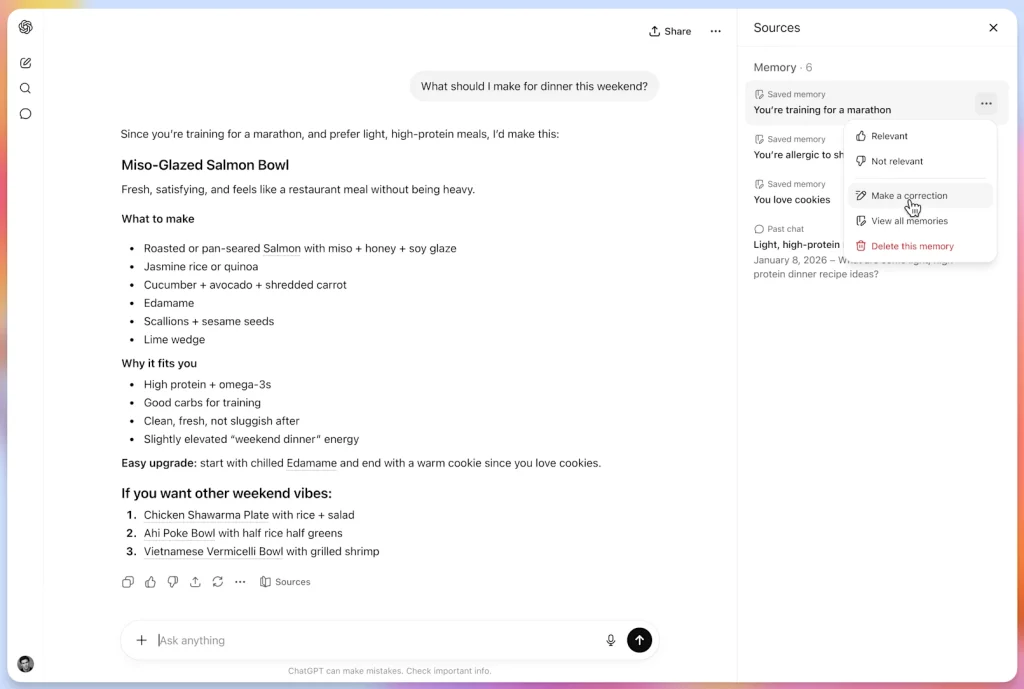
Beyond the core model performance, OpenAI is also placing a renewed emphasis on how ChatGPT utilizes and explains the personal data that fuels its personalized responses. The platform has long been capable of drawing context from past conversations, uploaded files, and connected services. With the introduction of GPT-5.5 Instant, OpenAI is rolling out "memory sources" across all ChatGPT models. This new feature provides users with greater transparency by indicating precisely which inputs were used to generate a personalized response.
Users can now view the specific context, such as saved memories or past chat logs, that informed a particular output. Crucially, they also have the ability to remove or correct this information if it is outdated or no longer relevant. As OpenAI articulated, "When a response is personalized, you can see what context was used, such as saved memories or past chats, and delete or correct it if something is outdated or no longer relevant." This initiative is a significant step towards empowering users with more control over their data and the personalization mechanisms of the AI.
While this feature aims to make personalization more understandable, OpenAI acknowledges that it may not always capture every single input that contributed to a response. In certain instances, the system may surface only the most pertinent past chats or memories, rather than an exhaustive list of all referenced data. The company has stated its intention to expand this visibility over time, further refining the transparency of its personalization features. This commitment to user control and data governance is becoming increasingly vital in the broader AI landscape, as concerns about privacy and algorithmic bias continue to grow.

Market Context and Competitive Landscape
The development of faster, lower-cost AI models for everyday use is a trend that is rapidly shaping the competitive landscape. OpenAI’s GPT-5.5 Instant enters a market where major players are also introducing optimized solutions. Google, for instance, has launched Gemini Flash, specifically designed for low-latency tasks, offering rapid responses for time-sensitive applications. Similarly, Anthropic, a prominent AI research company, offers Claude Haiku, a model optimized for speed and cost-effectiveness, making it suitable for high-volume, less complex interactions.
GPT-5.5 Instant fits squarely within this category of accessible, efficient AI. It is positioned to handle the bulk of user requests within ChatGPT, freeing up more powerful, resource-intensive models for tasks that demand deeper analytical capabilities. This tiered offering ensures that users benefit from the best of both worlds: speed and affordability for common tasks, and advanced intelligence for complex challenges.
For users of ChatGPT, the pricing of GPT-5.5 Instant is largely abstracted, as it is integrated into subscription tiers rather than being a separate cost per model. This bundling strategy makes the advanced capabilities of the AI more accessible to a broad user base. For developers utilizing OpenAI’s API, however, the trade-offs between cost and performance for different models, including more powerful variants of GPT-5.5, remain a critical consideration for production deployments. The availability of GPT-5.5 Instant as the default model within ChatGPT signifies OpenAI’s commitment to making its most advanced AI technologies as user-friendly and broadly beneficial as possible. The rollout of GPT-5.5 Instant across ChatGPT is effective immediately, signaling a new era of more responsive, accurate, and user-centric AI interaction.
The strategic importance of this upgrade cannot be overstated. By refining the default model to be faster, more accurate, and more transparent in its personalization, OpenAI is not only improving the user experience of ChatGPT but also setting a higher standard for conversational AI. The industry is increasingly moving beyond the novelty of AI to focus on its practical utility and trustworthiness. GPT-5.5 Instant represents a significant stride in that direction, aiming to make AI a more reliable and indispensable tool for millions worldwide. The ongoing advancements in AI necessitate a constant evaluation of performance, ethical considerations, and user impact. OpenAI’s latest move underscores its dedication to addressing these multifaceted challenges.
