
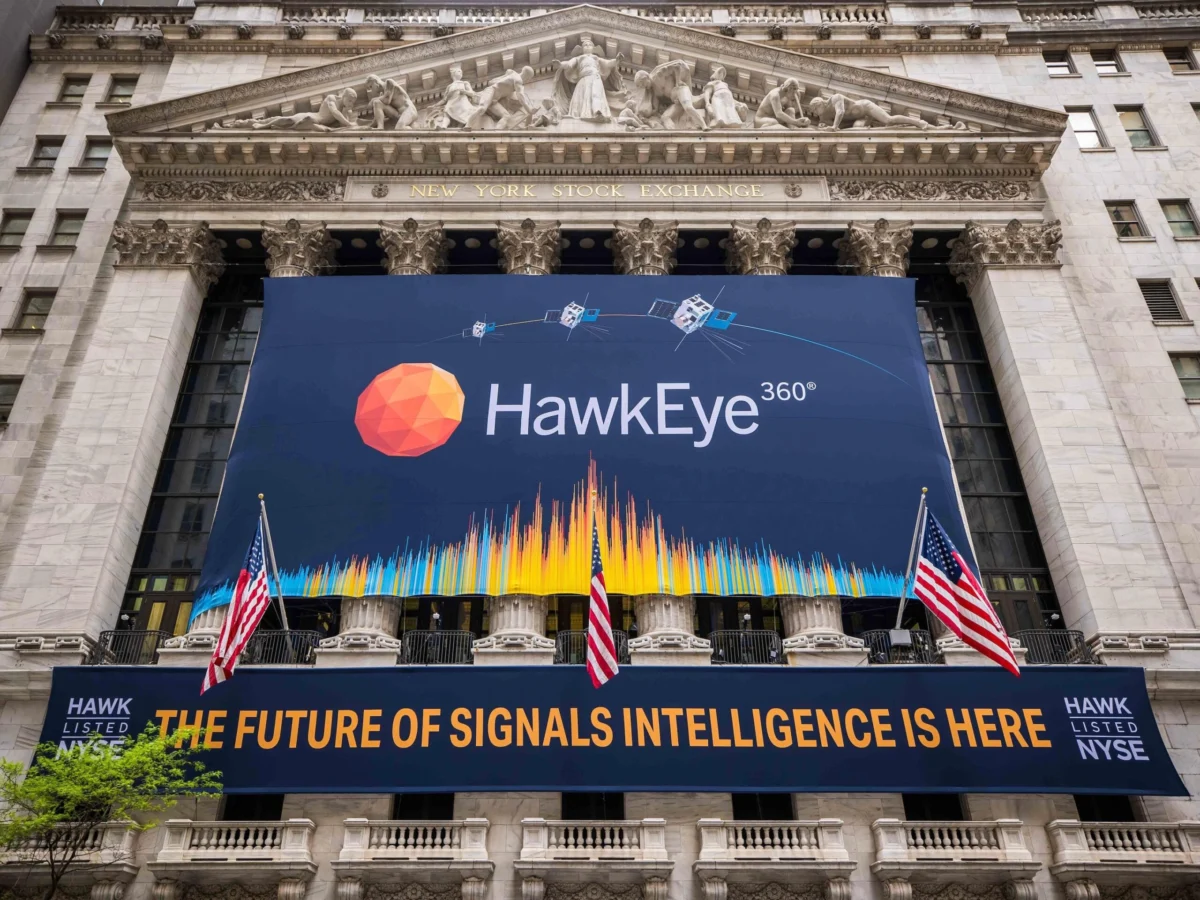

HawkEye 360, a pioneer in the field of space-based radio frequency (RF) data and analytics, officially entered the public markets on Thursday, marking a significant milestone for the commercial space sector. The Virginia-based company raised $416 million in its initial public offering (IPO), pricing its shares at $26 each—the upper limit of its previously projected range. Trading under the ticker symbol on the New York Stock Exchange (NYSE), the company saw immediate and robust investor enthusiasm. By the closing bell, shares had surged by 30%, ending the inaugural trading day at $34 per share. This successful debut values the company at a multi-billion dollar market capitalization and solidifies its position as a leader in the burgeoning field of tactical space intelligence.
The offering consisted of 16 million shares, a volume that suggests strong institutional appetite for companies that have moved beyond the research and development phase into proven operational and financial viability. HawkEye 360’s successful listing represents the second major space-focused IPO of the year, following the $629 million debut of spacecraft manufacturer York Space Systems in January. Together, these listings signal a potential resurgence in the space equity markets, which had cooled significantly following the volatility of the Special Purpose Acquisition Company (SPAC) era in 2021 and 2022.
Core Operations and Technological Advantage
Founded in 2019, HawkEye 360 has carved out a unique niche in the "New Space" economy. While the majority of Earth observation companies focus on optical imagery (taking pictures) or Synthetic Aperture Radar (imaging through clouds and darkness), HawkEye 360 focuses on the invisible spectrum: radio frequency signals. The company operates a growing constellation of small satellites that fly in clusters of three. These clusters use "time difference of arrival" and "frequency difference of arrival" techniques to precisely geolocate a wide array of RF emitters from space.
The intelligence gathered by HawkEye 360 is critical for a variety of defense, security, and environmental applications. Its sensors can detect and analyze signals from maritime VHF radios, emergency position-indicating radio beacons (EPIRBs), X-band marine radars, and L-band mobile satellite communications. This capability allows the company to track "dark ships"—vessels that turn off their Automatic Identification System (AIS) transponders to engage in illegal activities such as illicit ship-to-ship transfers, unauthorized fishing, or smuggling. Beyond maritime applications, the company’s data is increasingly used by defense departments to map electronic warfare activity, detect GPS interference, and monitor communication patterns in contested regions.
Financial Trajectory and the Pivot to Profitability
The decision to go public was backed by a period of extraordinary financial growth. According to the prospectus filed with the Securities and Exchange Commission (SEC) in late April, HawkEye 360 reported revenue of $98.7 million for the fiscal year 2025. This figure represents an approximate 100% increase over its 2024 performance, illustrating a rapid scaling of its subscription-based data services.
Perhaps more significantly for prospective investors, 2025 marked the company’s first year of net income, posting a profit of $2.7 million. In an industry characterized by high capital expenditures and long lead times before reaching the break-even point, HawkEye 360’s transition to profitability served as a key selling point during its IPO roadshow. The company’s ability to generate positive net income just six years after its founding differentiates it from many of its peers in the satellite sector, many of whom remain in the "pre-revenue" or high-burn phases of their development.
The company’s revenue stream is largely anchored by long-term government contracts. As the primary provider of commercial RF data to the U.S. National Geospatial-Intelligence Agency (NGA) and various components of the Department of Defense, HawkEye 360 has established a "moat" around its service offerings. Furthermore, the company has expanded its footprint among international allies, providing signal intelligence to partner nations in Europe and the Indo-Pacific who are seeking to enhance their maritime domain awareness without the prohibitive cost of launching their own dedicated military constellations.
Strategic Allocation of IPO Proceeds
The $416 million raised in the IPO is earmarked for several strategic initiatives aimed at strengthening the company’s balance sheet and expanding its technical capabilities. A primary focus of the funds will be the repayment of outstanding debt, a move designed to reduce interest expenses and provide the company with greater financial flexibility as it enters its next phase of growth.
Additionally, a portion of the capital will be used to satisfy a deferred payment related to the acquisition of Innovative Signals Analysis (ISA) in December 2025. The ISA acquisition was a pivotal move for HawkEye 360, bringing in-house advanced signal processing algorithms and a team of experts specialized in high-performance computing for signal intelligence. By integrating ISA’s technology, HawkEye 360 has been able to move further up the value chain—transitioning from a provider of raw data to a provider of sophisticated, actionable intelligence.
The remaining funds are designated for general corporate purposes and working capital. This includes the continued manufacturing and launching of new satellite clusters. The company is currently working on its next generation of satellites, which are expected to offer broader frequency coverage and higher sensitivity, allowing for the detection of even lower-power signals that were previously difficult to capture from low-Earth orbit.
Historical Timeline and Growth Milestones
HawkEye 360’s journey from a startup to a public entity has been marked by a series of successful funding rounds and technical achievements.
- 2019: The company is formally established, building on early concepts of RF geolocation. It secures initial venture capital to begin the development of its first satellite cluster.
- 2021: HawkEye 360 completes a Series C funding round, raising $145 million. This capital allows the company to accelerate its launch cadence and expand its ground station network.
- 2022-2023: The company successfully launches multiple clusters (Pathfinder, Clusters 2 through 6), achieving global revisit rates that allow for near-persistent monitoring of key geographic areas.
- 2024: Revenue doubles as the company secures major contracts with the U.S. government and begins providing critical data for international security monitoring.
- 2025: The company acquires Innovative Signals Analysis (ISA) and reports its first annual profit of $2.7 million on nearly $100 million in revenue.
- April 2026: HawkEye 360 files its S-1 prospectus with the SEC, signaling its intent to go public.
- May 7, 2026: The company debuts on the NYSE, raising $416 million with a 30% first-day stock price increase.
Broader Impact on the Space Economy and Defense Sector
The success of the HawkEye 360 IPO is being closely watched by industry analysts and venture capitalists as a bellwether for the "Space 2.0" ecosystem. For several years, the sector struggled with the fallout of the SPAC bubble, which saw many companies go public prematurely, leading to disappointing stock performances and a general wariness among retail and institutional investors. HawkEye 360’s traditional IPO path—characterized by a standard filing process, a rigorous roadshow, and a focus on fundamental financial metrics like revenue growth and net income—suggests that the market is once again open to space companies, provided they demonstrate a clear path to profitability.
From a geopolitical perspective, the rise of commercial signal intelligence (SIGINT) represents a paradigm shift in how nations conduct surveillance. Historically, SIGINT was the exclusive domain of national intelligence agencies operating billion-dollar "exquisite" satellites. HawkEye 360 has "democratized" this data, making it available to a broader range of government agencies and even commercial entities. This transparency has significant implications for global security; for instance, the ability to publicly document sanctions-evading behavior or military build-ups in real-time can influence diplomatic efforts and international policy.
Industry experts suggest that the "dual-use" nature of HawkEye 360’s technology—serving both defense and commercial environmental needs—provides a diversified revenue base that is less susceptible to fluctuations in any single sector’s budget. While defense remains the primary driver, the growing demand for environmental monitoring (such as tracking illegal logging or protecting marine sanctuaries) offers a secondary growth lever.
Market Outlook and Future Implications
As HawkEye 360 begins its life as a public company, the focus will shift to its ability to maintain its growth trajectory and defend its market share against emerging competitors. While HawkEye 360 is currently the leader in the commercial RF space, other companies such as France’s Unseenlabs and Luxembourg-based Kleos Space have also made strides in the sector. However, HawkEye’s significant capital infusion and its established relationship with the U.S. defense establishment provide it with a substantial competitive edge.
The 30% jump in share price on opening day reflects a market that views space-based intelligence not as a speculative venture, but as a critical infrastructure component for the 21st century. As global tensions remain high and the need for transparent, verifiable data increases, companies that can provide a "digital eye and ear" over the planet are likely to remain in high demand.
The successful listings of York Space Systems and HawkEye 360 in the first half of 2026 may encourage other late-stage space startups to consider the public markets. Observers will be looking to see if this momentum carries into the second half of the year, potentially ushering in a new era of stability and growth for the commercial space industry. For HawkEye 360, the transition to the NYSE is not merely a financial exit for early investors, but a strategic "launchpad" for a more expansive constellation and a deeper integration into the global security architecture.
