

OpenAI launched three new speech-focused models on Thursday: GPT-Realtime-2, its first voice model with what the company calls “GPT-5-class reasoning”; GPT-Realtime-Translate for live translations; and GPT-Realtime-Whisper for fast transcriptions. This significant announcement marks a pivotal moment in the evolution of conversational AI, pushing the boundaries of natural language understanding and interaction within voice-based systems. The release underscores OpenAI’s commitment to developing sophisticated AI that can engage with users in more nuanced, intelligent, and efficient ways, aiming to unlock new frontiers for application development across various industries.
GPT-Realtime-2: A Leap Forward in Conversational Reasoning
GPT-Realtime-2 represents a substantial advancement over its predecessor, GPT-Realtime-1.5, which was last updated in February. The original GPT-Realtime model, introduced in the summer of 2025, was designed to provide a voice-native model capable of more natural user interaction than prior iterations. This latest iteration promises an 11% performance improvement over GPT-Realtime-1.5. A key enhancement is the dramatic expansion of the context window, which has been increased from 32,000 tokens to a remarkable 128,000 tokens. This extended context window is crucial for voice-agent workflows, enabling the model to process and retain information over longer periods, thus handling more complex and extended interactions with greater fidelity. This addresses a known pain point for developers who previously faced limitations with shorter context windows in complex conversational scenarios.
The true game-changer with GPT-Realtime-2, however, lies in its enhanced reasoning capabilities, now described as "GPT-5-class." OpenAI articulated the necessity for such advancements in its announcement, stating, "building useful voice products takes more than fast turn-taking and a natural-sounding voice. A voice agent needs to understand what someone means, keep track of context, recover when a request changes, use tools while the conversation continues, and respond in a way that feels appropriate to the moment." This highlights a shift from mere conversational fluency to genuine comprehension and intelligent action.
With GPT-Realtime-2, developers can now implement more sophisticated conversational dynamics. For instance, the model can initiate interactions with subtle preambles like "let me check that," providing users with immediate feedback that the agent is actively processing their request. This small but significant feature can greatly improve user experience by reducing perceived latency and increasing transparency. Furthermore, the model’s ability to perform parallel tool calls, mirroring the functionality of contemporary agentic systems, allows for more efficient execution of tasks. This means the AI can simultaneously gather information from multiple sources or perform several actions in response to a single user query, streamlining complex operations. The system can also now clearly communicate its ongoing actions to the user, further enhancing transparency and trust.

Developers have granular control over the model’s reasoning effort, with options ranging from minimal to “xhigh.” This allows for fine-tuning the balance between processing power and response speed, catering to diverse application needs. The pricing for GPT-Realtime-2 remains consistent with its predecessor, at $32 per 1 million audio input tokens and $64 per 1 million audio output tokens, making these advanced capabilities accessible to a broad range of developers and businesses.
GPT-Realtime-Translate: Bridging Language Barriers in Real-Time
Complementing the advancements in conversational AI, OpenAI also introduced GPT-Realtime-Translate, a dedicated model for live translation services. While previous OpenAI speech models offered some translation capabilities, this marks the first instance of a specialized, real-time translation model being offered. GPT-Realtime-Translate supports over 70 input languages, enabling translation into 13 distinct output languages. This capability is poised to revolutionize cross-cultural communication, facilitating seamless interactions in global business, customer support, and international collaboration. The model’s real-time nature ensures that conversations can flow uninterrupted, with translations occurring instantaneously, mirroring the fluidity of natural dialogue. The cost for this service is set at $0.034 per minute, making it a competitive and accessible solution for real-time multilingual communication needs.
GPT-Realtime-Whisper: Accelerating Transcription Accuracy
The third new model, GPT-Realtime-Whisper, focuses on enhancing speech-to-text transcription. Whisper has long been a benchmark in the field of speech recognition since its initial release in 2022, becoming a widely adopted open-weight model. While the open-source version has not seen a recent update, OpenAI has continued to offer transcription services through its API via models like gpt-4o-transcribe and 4o-mini-transcribe. GPT-Realtime-Whisper builds upon this legacy by offering a fast and efficient streaming transcription model. This is particularly valuable for applications requiring immediate transcription of live audio feeds, such as meeting summarization, live captioning for events, or real-time analysis of audio data. The pricing for GPT-Realtime-Whisper is set at $0.017 per minute, making it an economical choice for high-volume transcription tasks.
A New Era for Voice AI Applications
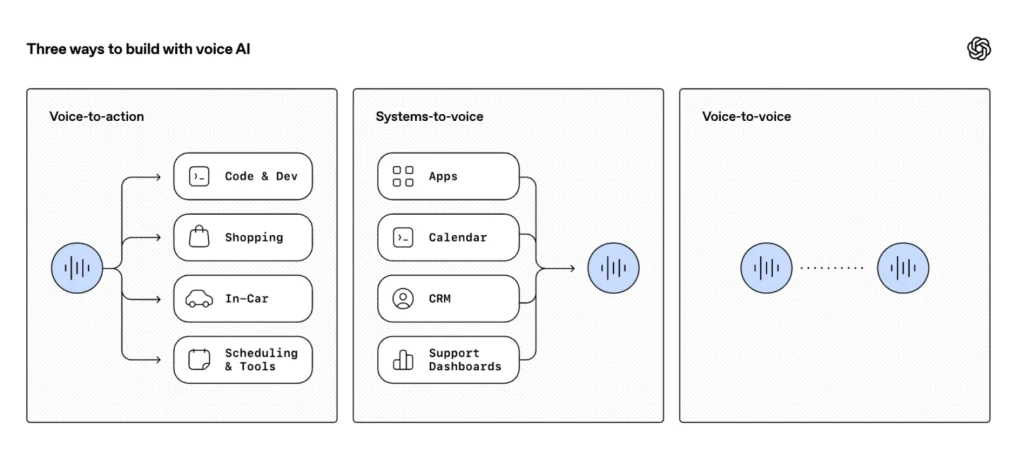
OpenAI’s strategic release of these three models signals a concerted effort to empower developers in building a new generation of voice-powered applications. The company identifies three primary patterns in how developers are leveraging voice AI:
-
Voice-to-Action: This pattern involves users articulating their needs, which the AI system then interprets and executes as tasks. Examples include voice commands to control smart home devices, dictate emails, or initiate complex workflows. GPT-Realtime-2’s enhanced reasoning and tool-use capabilities are particularly relevant here, enabling more accurate and comprehensive task execution.

-
System-to-Voice: This category focuses on AI providing voice-based guidance and information to users. An illustrative example provided by OpenAI is, "Your inbound flight is delayed, but you can still make your connection." This type of proactive, informative communication is vital for customer service, personal assistants, and advisory systems. The natural-sounding voice output and contextual understanding of GPT-Realtime-2 will enhance the helpfulness and user-friendliness of such systems.
-
Voice-to-Voice: This is arguably the most complex pattern, enabling live, interactive conversations that span multiple tasks and adapt to changing contexts. This is the domain where GPT-Realtime-2 truly shines, with its improved reasoning, extended context window, and ability to handle dynamic conversational flows. Applications here could range from sophisticated virtual tutors that engage in nuanced dialogue to AI companions that can hold extended, context-aware conversations. GPT-Realtime-Translate also plays a crucial role in enabling these interactions across language barriers.
The implications of these releases are far-reaching. For businesses, the enhanced capabilities of GPT-Realtime-2 could lead to more intelligent and efficient customer service chatbots, sophisticated virtual assistants for employees, and more personalized interactive experiences. The accessibility of GPT-Realtime-Translate could dismantle communication barriers in international markets, fostering greater global collaboration and customer engagement. Meanwhile, GPT-Realtime-Whisper’s speed and accuracy will benefit industries that rely heavily on audio data processing, from legal transcription to media analysis.
The development and release of these advanced voice models by OpenAI underscore a broader trend in the artificial intelligence landscape: the increasing sophistication and integration of AI into everyday human interactions. As these technologies mature, they hold the potential to fundamentally reshape how we communicate, work, and interact with the digital world, making information and services more accessible and intuitive than ever before. The company’s strategic focus on real-time processing and advanced reasoning suggests a commitment to practical, deployable AI solutions that address real-world challenges and unlock new opportunities for innovation.
