

Details have emerged concerning a critical, unpatched local privilege escalation (LPE) vulnerability affecting the Linux kernel, dubbed "Dirty Frag." This newly identified flaw has been described by security researchers as a significant successor to "Copy Fail" (CVE-2026-31431, CVSS score: 7.8), a recently disclosed LPE vulnerability in the Linux kernel that has already seen active exploitation in the wild. The discovery and subsequent public disclosure of Dirty Frag underscore the persistent challenge of maintaining the security integrity of the widely used operating system, especially as threat actors rapidly weaponize newly discovered weaknesses.
The Anatomy of ‘Dirty Frag’: A Successor to Notorious Flaws
Security researcher Hyunwoo Kim (@v4bel) detailed "Dirty Frag" as a sophisticated vulnerability class capable of achieving root privileges across a broad spectrum of Linux distributions. Its core mechanism involves chaining two distinct page-cache write vulnerabilities: the xfrm-ESP Page-Cache Write and the RxRPC Page-Cache Write. This chaining technique allows attackers to bypass certain environmental protections and achieve a high success rate in exploitation.
The significance of Dirty Frag lies in its deterministic nature, a characteristic it shares with its predecessors, "Dirty Pipe" (CVE-2022-0847) and "Copy Fail." Unlike many traditional vulnerabilities that rely on precarious race conditions—where the timing of operations must be precisely aligned for an exploit to succeed—Dirty Frag is a deterministic logic bug. This means it does not depend on a timing window, making exploits remarkably reliable and consistent. As Kim explains in a comprehensive write-up, "no race condition is required, the kernel does not panic when the exploit fails, and the success rate is very high." This reliability is a coveted trait for attackers, translating into a greater likelihood of successful compromise once an initial foothold is established on a system.
Page-cache write vulnerabilities represent a particularly dangerous class of flaws. The page cache is a fundamental component of the Linux kernel, used to store data from disk in memory for faster access. If an attacker can manipulate this cache to write arbitrary data, they can corrupt critical system files, modify configuration settings, or inject malicious code into processes, ultimately leading to privilege escalation. The ability to reliably corrupt the page cache, as Dirty Frag allows, grants an unprivileged local user the power to rewrite crucial files such as /etc/passwd or /etc/shadow, effectively creating or modifying root user accounts.
Chaining Attack Paths: The Dual Vulnerability Strategy
Dirty Frag’s broad applicability stems from its innovative approach of combining two separate vulnerabilities to overcome environmental restrictions. The first component, the xfrm-ESP Page-Cache Write vulnerability, originates in the IPSec (xfrm) subsystem. It functions by providing attackers with a 4-byte store primitive, similar to Copy Fail, enabling small but critical overwrites within the kernel’s page cache. However, exploiting xfrm-ESP typically requires the unprivileged user to create a user namespace. This capability is often restricted in hardened environments, such as Ubuntu, which employs AppArmor to block such actions by default.
This is where the second component, the RxRPC Page-Cache Write vulnerability, becomes crucial. The RxRPC (Remote Procedure Call) subsystem vulnerability does not necessitate the privilege to create a user namespace. This makes it an effective alternative in environments where namespace creation is disallowed. However, the rxrpc.ko module itself is not universally included in all Linux distributions. For instance, the default build of RHEL 10.1 does not ship with rxrpc.ko. Conversely, on Ubuntu, where user namespace creation is often blocked, the rxrpc.ko module is loaded by default.
Kim succinctly explains the synergy: "Chaining the two variants makes the blind spots cover each other. In an environment where user namespace creation is allowed, the ESP exploit runs first. Conversely, on Ubuntu, where user namespace creation is blocked but rxrpc.ko is built, the RxRPC exploit works." This intelligent chaining ensures that Dirty Frag maintains a high success rate across diverse Linux configurations, making it a versatile and potent threat.
The technical root of these vulnerabilities lies in specific kernel code commits. The xfrm-ESP Page-Cache Write vulnerability was introduced in a source code commit (ID: cac2661c53f3) made in January 2017. Interestingly, this very same commit was also identified as the underlying cause for another buffer overflow vulnerability, CVE-2022-27666 (CVSS score: 7.8), which affected various Linux distributions. The RxRPC Page-Cache Write vulnerability, on the other hand, was introduced more recently, in June 2023, via commit ID 2dc334f1a63a. These long-standing vulnerabilities highlight the deep-seated nature of some kernel flaws and the difficulty of identifying them amidst a vast and constantly evolving codebase.
Timeline of Discovery and Disclosure
The timeline of Dirty Frag’s emergence is critical for understanding its current threat posture. The vulnerability was initially reported to Linux kernel maintainers on April 30, 2026, initiating the standard coordinated disclosure process. This process typically involves a period of embargo to allow vendors to develop and deploy patches before public details are released, minimizing the window for exploitation.

However, the embargo for the xfrm-ESP Page-Cache Write vulnerability component was reportedly broken. Detailed information and an exploit for this specific flaw were published publicly by an unrelated third-party, leading to a premature disclosure of critical attack vectors. This incident underscored the challenges of maintaining strict embargoes in a global, open-source development environment. Following this, broader details about Dirty Frag, including its chaining mechanism, were made public on May 7, 2026, notably through discussions on the Openwall oss-security mailing list. The rapid progression from private reporting to public knowledge, partly due to the embargo breach, heightened the urgency for system administrators to implement mitigations.
Widespread Impact Across Linux Ecosystems
The successful exploitation of Dirty Frag grants an unprivileged local user elevated root access, providing complete control over the compromised system. This level of access allows an attacker to perform virtually any action, including installing malware, exfiltrating sensitive data, modifying system configurations, or establishing persistent backdoors.
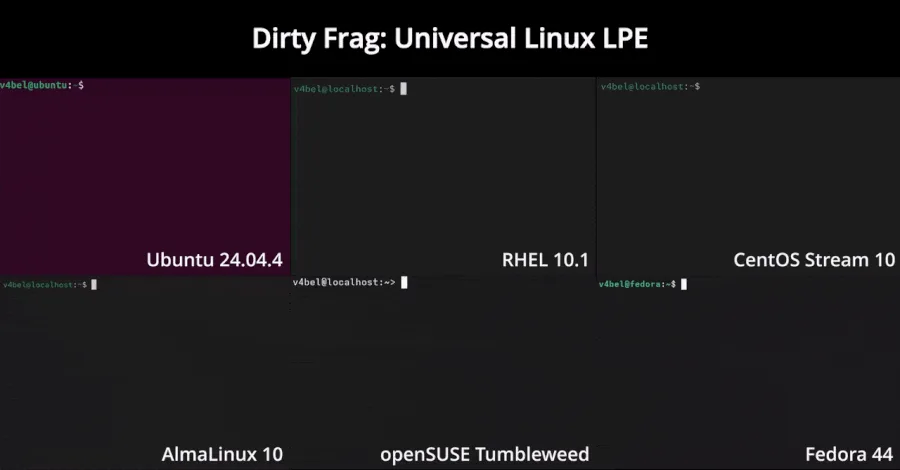
The vulnerability’s impact is extensive, affecting a wide array of popular Linux distributions. Confirmed vulnerable systems include Ubuntu 24.04.4, RHEL 10.1, openSUSE Tumbleweed, CentOS Stream 10, AlmaLinux 10, and Fedora 44. This broad compatibility makes Dirty Frag a potent threat across enterprise servers, cloud instances, and developer workstations.
Beyond traditional local privilege escalation on host machines, Dirty Frag also poses a significant risk in containerized environments. Ubuntu’s advisory explicitly warned that "In container deployments that may execute arbitrary third-party workloads, the vulnerability may additionally facilitate container escape scenarios, in addition to local privilege escalation on the host." A container escape is a particularly severe form of compromise where an attacker breaks out of the isolated container environment to gain access to the underlying host operating system. In cloud-native architectures, where multiple containers from different tenants often share a single host, a container escape can lead to cross-tenant data breaches and widespread compromise.
However, Wiz, a cloud security firm, offered a nuanced perspective on container exploitation. Researchers Merav Bar and Rami McCarthy noted that while Dirty Frag combines powerful page-cache write primitives, "the exploit usually requires high-level system permissions, such as CAP_NET_ADMIN. This means exploitation is less likely in hardened containerized environments (e.g., Kubernetes with default seccomp profiles)." This suggests that while the potential for container escape exists, well-configured and hardened container orchestrations might offer some degree of resilience against this specific attack vector. Nevertheless, the underlying host remains vulnerable to direct LPE if an initial foothold is gained.
Industry Response and Temporary Safeguards
In the wake of the vulnerability’s disclosure, various Linux distributions and security vendors swiftly issued advisories and mitigation guidance. CloudLinx, for example, detailed that the flaw resides in the "ESP-in-UDP MSG_SPLICE_PAGES no-COW fast path and is reachable via the XFRM user netlink interface." AlmaLinux elaborated further, explaining that "The bug lives in the in-place decryption fast paths of esp4, esp6, and rxrpc: when a socket buffer carries paged fragments that are not privately owned by the kernel (e.g., pipe pages attached via splice(2)/sendfile(2)/MSG_SPLICE_PAGES), the receive path decrypts directly over those externally-backed pages, exposing or corrupting plaintext that an unprivileged process still holds a reference to." This technical description highlights the kernel’s mishandling of memory, allowing unprivileged processes to access and modify data that should be protected.
Given the immediate threat and the release of a working proof-of-concept (PoC) capable of gaining root access in a single command, urgent temporary mitigations were crucial. Until official patches become widely available and deployed, system administrators are advised to blocklist the esp4, esp6, and rxrpc kernel modules. This action prevents these modules, which contain the vulnerable code paths, from being loaded, thereby neutralizing the attack surface. The recommended command for this temporary mitigation is:
sudo sh -c "printf 'install esp4 /bin/falseninstall esp6 /bin/falseninstall rxrpc /bin/falsen' > /etc/modprobe.d/dirtyfrag.conf; rmmod esp4 esp6 rxrpc 2>/dev/null; true"
This command creates a configuration file that instructs the kernel not to load these modules and attempts to unload them if they are currently active. It is important to note that this is a stopgap measure, and a proper kernel update is the definitive solution.
It is also crucial to distinguish Dirty Frag from Copy Fail, especially concerning mitigation strategies. The researcher emphasized that "Dirty Frag can be triggered regardless of whether the algif_aead module is available. In other words, even on systems where the publicly known Copy Fail mitigation (algif_aead blacklist) is applied, your Linux is still vulnerable to Dirty Frag." This highlights the distinct nature of Dirty Frag’s attack vectors, rendering previous mitigations for similar flaws ineffective.
Evidence of Active Exploitation in the Wild

The threat posed by Dirty Frag is not merely theoretical. Microsoft’s security teams have reported observing limited in-the-wild activity leveraging techniques that could be indicative of either "Dirty Frag" or "Copy Fail" for privilege escalation. This suggests that sophisticated threat actors are already attempting to exploit these types of kernel vulnerabilities post-compromise.
Microsoft detailed a sequential attack timeline observed in these campaigns:
- Initial Access: An external connection gains SSH access to a system.
- Shell Spawning: An interactive shell is spawned, providing the attacker with command-line control.
- Staging and Execution: An ELF binary, typically named
./update, is staged and executed. - Privilege Escalation: The binary immediately triggers a privilege escalation, often via the
su(substitute user) command, to gain root access.
Upon achieving elevated privileges, the unknown threat actors proceed with post-exploitation activities, demonstrating their intent to maintain persistence and exfiltrate data. These activities include modifying a GLPI (IT asset management software) LDAP authentication file, performing reconnaissance of the GLPI directory and system configuration, and inspecting an exploit artifact. Subsequently, attackers have been observed accessing sensitive data and interacting with multiple PHP session files, including deleting and forcefully wiping some of them, likely in an attempt to disrupt active sessions and steal session contents.
Microsoft underscored the design philosophy behind Dirty Frag, stating, "Dirty Frag is notable because it introduces multiple kernel attack paths involving rxrpc and esp/xfrm networking components to improve exploitation reliability. Rather than relying on narrow timing windows or unstable corruption conditions often associated with Linux local privilege escalation exploits, Dirty Frag appears designed to increase consistency across vulnerable environments." This consistency makes it a highly attractive tool for attackers, reducing the variability and potential for failure in their operations.
Broader Implications for Linux Security
The emergence of Dirty Frag, following closely on the heels of other significant Linux kernel LPEs like Dirty Pipe and Copy Fail, highlights a concerning trend in Linux security. These vulnerabilities often stem from long-standing code logic errors, underscoring the immense challenge of auditing and securing a codebase as vast and complex as the Linux kernel. The sheer volume of code, coupled with contributions from thousands of developers over decades, makes it inevitable that deeply embedded flaws will occasionally surface.
The impact extends across the entire Linux ecosystem, affecting individual users, system administrators, cloud providers, and enterprises globally. For cloud environments, where Linux forms the backbone of infrastructure and containerization is prevalent, such LPEs can have catastrophic consequences, potentially leading to widespread outages, data breaches, and regulatory non-compliance. Enterprises running critical applications and services on Linux servers face an immediate imperative to patch their systems, as the window between disclosure and active exploitation continues to shrink.
This continuous cycle of vulnerability discovery and patching also places immense pressure on the open-source community to rapidly develop and distribute fixes. The rapid response from various Linux distributions in issuing advisories and temporary mitigations demonstrates the collaborative strength of the community, yet the underlying challenge of preventing these bugs from entering the kernel in the first place remains. Improved static analysis tools, more rigorous code review processes, and perhaps even AI-assisted vulnerability detection could play a role in mitigating future risks.
Patching Status and Future Outlook
As of the latest updates, the xfrm-ESP Page-Cache Write vulnerability has been officially assigned CVE-2026-43284. A patch addressing this specific component has been merged into the mainline Linux kernel at commit f4c50a4034e62ab75f1d5cdd191dd5f9c77fdff4. This is a crucial step towards securing systems against one part of the Dirty Frag chain.
However, the RxRPC Page-Cache Write vulnerability, which is the other critical component of Dirty Frag, has also been assigned an identifier, CVE-2026-43500. As of the time of writing, a publicly available patch for this specific flaw has not yet been released. This means that while one part of the vulnerability chain has been addressed, systems remain susceptible to Dirty Frag if the RxRPC component is exploitable in their specific configuration (e.g., Ubuntu systems where rxrpc.ko is loaded by default).
System administrators are strongly urged to monitor official announcements from their respective Linux distribution vendors for the availability of kernel updates that fully address both CVE-2026-43284 and CVE-2026-43500. Until then, the temporary module blocklisting mitigation remains critical for reducing exposure. The ongoing discovery of such high-impact kernel vulnerabilities reinforces the importance of a robust patch management strategy and a proactive security posture for anyone operating Linux systems.
