
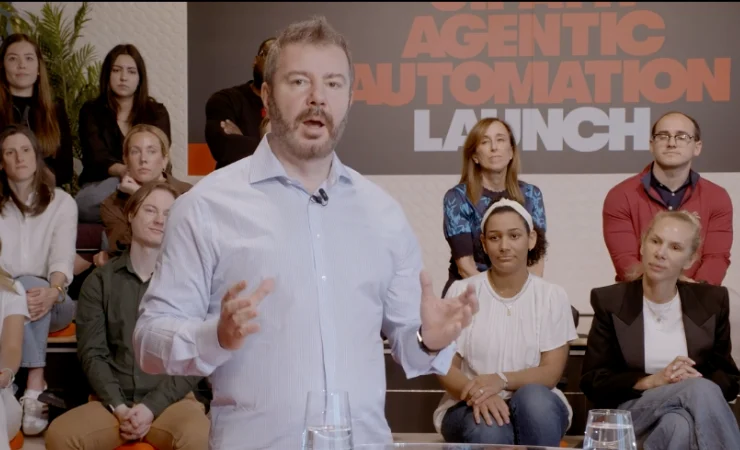

UiPath, a global leader in enterprise automation and robotic process automation (RPA), has officially unveiled UiPath for Coding Agents, a comprehensive platform-wide integration designed to bring autonomous AI coding agents into a governed, enterprise-grade orchestration layer. At launch, the platform supports Anthropic’s Claude Code and OpenAI’s Codex, with the company promising a roadmap of additional integrations extending through 2026. This announcement marks a significant milestone in the evolution of the "Agentic AI" era, as UiPath positions itself as the primary infrastructure provider for the next generation of software development and process automation.
The launch is described by the company as an industry first, aimed at solving the disconnect between high-velocity AI code generation and the rigorous stability requirements of large-scale corporate environments. By integrating these agents directly into its existing orchestration and governance framework, UiPath seeks to transform how businesses build, deploy, and maintain automation workflows, effectively shifting the focus from manual development to intent-based orchestration.
Strategic Context and the Pivot Toward Agentic Automation
The introduction of UiPath for Coding Agents is the culmination of a strategic shift signaled by CEO and founder Daniel Dines over several months. During the company’s Q4 FY2026 earnings call in March, Dines identified the "automation backlog" as a critical bottleneck for modern enterprises. He argued that the demand for business automation was growing at a pace far exceeding the capacity of human developers to build them. This theme was further elaborated during an investor product strategy session in April, where Dines outlined a future in which the UiPath platform would be optimized for coding agents rather than human developers.
This pivot reflects a broader trend in the software industry where generative AI is no longer viewed merely as a productivity tool for individuals, but as a core architectural component. Dines has consistently argued that as the cost of generating code drops toward zero due to AI advancements, the value in the technology stack migrates upward. In this new paradigm, the "durable value" lies in the layers that provide trust, integration, reliability, and accountability—the very layers UiPath has spent a decade refining for its RPA robots.
Technical Architecture: Orchestration, Observability, and Governance
The core challenge UiPath aims to solve is the "isolation" of current coding agents. While tools like Claude Code and GitHub Copilot are highly effective at writing functions or refactoring modules, they typically exist outside of enterprise-grade continuous integration and deployment (CI/CD) pipelines. They lack direct connections to security policies, code review standards, and the live systems they are intended to automate. UiPath for Coding Agents addresses this through a three-pillared architectural approach.
1. Open and Multi-Agent Architecture
Unlike competitors who may attempt to lock customers into a proprietary model, UiPath has opted for an open architecture. This allows enterprises to deploy different agents for different tasks—utilizing Claude Code’s long-context capabilities for complex refactoring in one department while using OpenAI’s Codex for greenfield generation in another. The platform is designed to be model-agnostic, ensuring that as new models are released by Google, Meta, or the open-source community, they can be integrated without a total overhaul of the enterprise’s automation infrastructure.
2. The Maestro Orchestration Layer
At the heart of the new offering is Maestro, UiPath’s workflow orchestrator built on Temporal’s durable execution technology. Durable execution ensures that every step of a workflow is persisted in a stateful manner. This means that if an infrastructure failure occurs, or if a complex automation needs to be paused for human intervention, the process can be resumed exactly where it left off. By applying this technology to coding agents, UiPath provides a "scaffolding" that ensures AI-generated code operates within a stable, observable environment. The execution layer compounds in value with every model release, while the orchestration layer compounds with every new automation built.
3. Enterprise-Grade Governance
For large-scale organizations, the primary barrier to AI adoption is often risk management. UiPath for Coding Agents includes built-in policy enforcement, audit trails, credential vaults, and role-based access control (RBAC). These runtime controls are applied to every automation that enters the platform, regardless of whether it was authored by a senior developer or an autonomous agent. This ensures that even as the underlying models are updated or replaced, the automations themselves remain compliant with corporate and regulatory standards.
Leadership Perspective: Redefining the ‘Builder’
In a statement following the launch, Daniel Dines emphasized that this release signals a fundamental change in the definition of a "builder" on the UiPath platform. "We are first to market with a platform that treats AI-generated automations as first-class citizens, with the same governance, reliability, and scale that enterprises demand," Dines stated. He noted that the barrier to entry for creating automation is dropping to the level of natural language description.
According to Dines, the primary user of the platform is no longer strictly the human developer working in a specialized IDE like UiPath Studio. Instead, the primary user is the coding agent, while the human’s role evolves into that of a supervisor who describes intent, exercises judgment, and approves the final output. This democratization of development aims to allow product managers, business analysts, and operators to bridge the gap between an idea and a functional execution without needing to master the underlying code.
However, industry analysts note that this transition is not without its challenges. While the technical barrier to entry is lowering, the "prompt engineering" and conversational skills required to direct an agent effectively represent a new type of learning curve. Knowing how to phrase a request, identify errors in an agent’s logic, and provide corrective feedback remains a specialized skill set that will require organizational training and adaptation.
Market Data and the Growing Automation Gap
The launch comes at a time when the demand for enterprise automation is reaching an all-time high. According to recent data from IDC, the global market for AI-centric software is expected to grow at a compound annual growth rate (CAGR) of over 30% through 2027. Furthermore, Gartner predicts that by 2028, 75% of enterprise software engineers will use AI coding assistants, up from less than 10% in early 2023.
Despite this surge in tool availability, many enterprises report that their "automation gap"—the distance between business needs and deployed solutions—is widening. Traditional development cycles are often too slow to respond to rapidly changing market conditions. By enabling agents to handle the heavy lifting of code generation and UI interaction, UiPath aims to dissolve the bottleneck of development resources that currently leaves many projects stuck in a sandbox or "pilot purgatory."
Addressing the Governance Gap in Regulated Sectors
One of the most critical aspects of the new platform is how it handles governance before an automation is officially submitted. In highly regulated sectors such as banking, healthcare, and insurance, auditors require more than just the final code; they often require a "reasoning trace" of how that code was produced.
UiPath’s current launch materials highlight governance for automations "entering the platform." However, industry observers are closely watching to see how much transparency UiPath will provide into the "pre-submission" phase—specifically the prompting history, the agent’s internal reasoning process, and the specific inputs used to train or guide the agent. For an orchestration layer to be truly "constant" and "durable," its integrity must extend into the workflow that produces the artifacts. UiPath has indicated that further briefings and updates will address these deeper layers of agent governance, including credential isolation during the generation phase and sandboxing of agent activity.
Broader Implications for the Enterprise AI Ecosystem
The decision by UiPath to act as a neutral orchestrator rather than a model provider is a calculated move that aligns with current enterprise buying patterns. Most large organizations are currently "hedging their bets" by working with multiple foundation model providers (such as OpenAI, Anthropic, and Google) to avoid vendor lock-in. By providing a unified layer that manages these disparate agents, UiPath creates a "moat" based on operational complexity rather than model performance.
This strategy also addresses the concept of software cost deflation. If AI can produce code for a fraction of the previous cost, the competitive advantage for a software company shifts from the "creation" of the software to the "management and reliability" of the software. UiPath’s pivot suggests that the company is betting its future on being the "operating system" for AI agents, providing the necessary plumbing that allows raw AI output to function as a reliable corporate asset.
Future Outlook and Timeline
UiPath for Coding Agents is currently available to enterprise customers, with immediate support for Claude Code and OpenAI Codex. The company’s roadmap through 2026 includes the addition of more agents, including those from Google and potentially specialized open-source models tailored for specific industries.
As the product moves into broader adoption, the tech industry will be looking for concrete case studies from early adopters. Success will be measured not just by the speed of automation creation, but by the long-term stability and maintainability of agent-generated code. If UiPath can successfully prove that its orchestration layer reduces the "technical debt" often associated with rapid AI generation, it could set a new standard for how AI and humans collaborate in the enterprise.
In the coming weeks, UiPath is expected to provide further technical deep dives into the governance of agent reasoning and the integration of these tools into existing DevOps workflows. For now, the launch stands as a bold assertion that the future of enterprise automation is not just built for agents—it is built by them.
