

In a significant move to bolster the burgeoning commercial space sector, SpinLaunch and Aalyria Technologies have announced a strategic partnership aimed at designing and developing the foundational infrastructure for SpinLaunch’s Meridian low-Earth orbit (LEO) communications constellation. The collaboration, officially unveiled on May 12, marks a pivotal alignment between two of the industry’s most innovative players: one specializing in kinetic-energy-based launch systems and the other in advanced software-defined network orchestration.
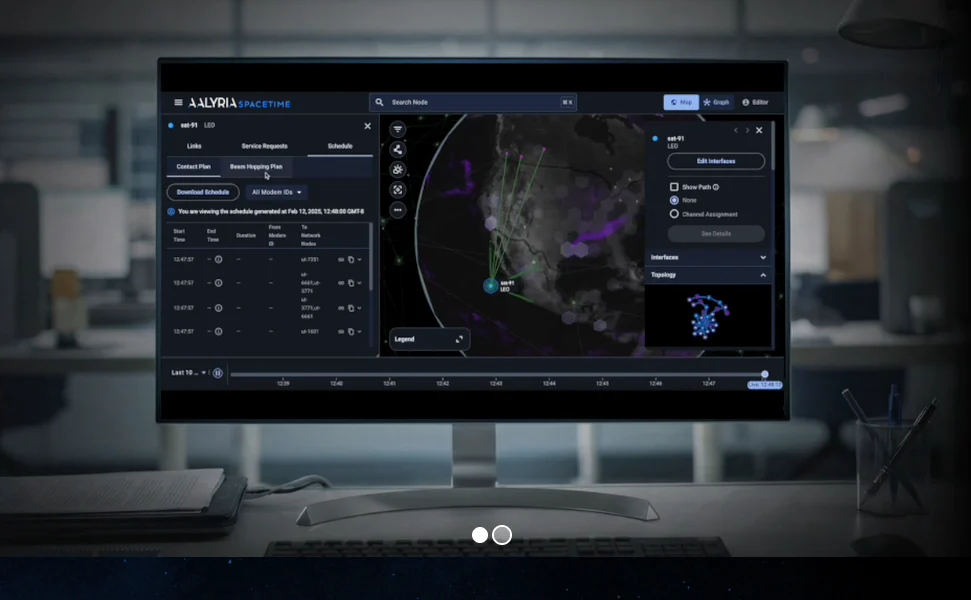
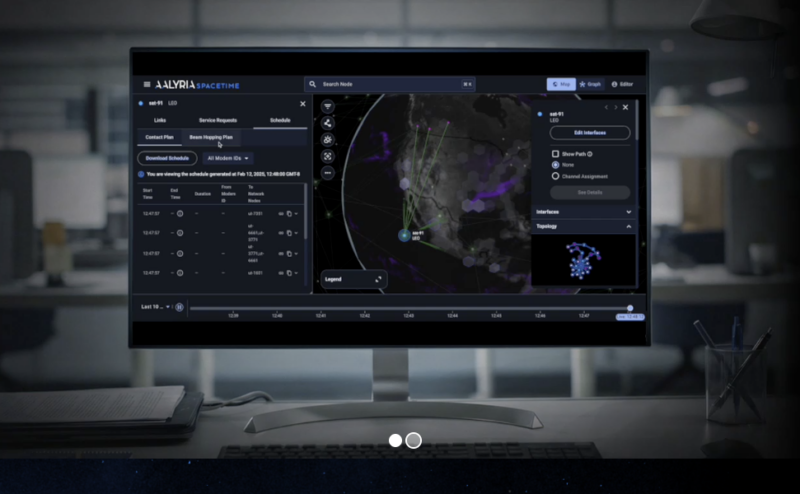
Under the terms of the agreement, Aalyria will serve as a strategic partner, providing both technical and commercial support for the architecture of the Meridian constellation. The central component of this collaboration is the integration of Aalyria’s Spacetime platform, a sophisticated network orchestration layer that will manage the complex communications requirements of the Meridian network. This partnership is designed to accelerate the deployment of high-performance satellite connectivity, catering to a global client base that includes both commercial enterprises and government agencies.
The Strategic Vision for the Meridian Constellation
SpinLaunch’s Meridian constellation represents a paradigm shift in how LEO networks are conceived and deployed. Traditionally, satellite constellations have been limited by the high costs and infrequent cadences of chemical rocket launches. SpinLaunch aims to bypass these hurdles using its proprietary mass accelerator technology, which utilizes a vacuum-sealed centrifuge to whirl satellites at hypersonic speeds before releasing them into space. This method significantly reduces the amount of fuel required, thereby lowering costs and increasing the potential frequency of launches.
However, a low-cost launch is only one half of the equation for a successful satellite network. Once in orbit, these satellites must be able to communicate seamlessly with each other and with ground stations, often across rapidly changing trajectories and environmental conditions. This is where the Meridian constellation’s architecture requires a highly flexible, vendor-agnostic control layer. The goal is to maximize mission success and service uptime by ensuring that the network can adapt to real-time changes in demand and orbital dynamics.
The partnership with Aalyria is specifically intended to address these networking challenges. By leveraging Aalyria’s Spacetime software, SpinLaunch aims to ensure that its ground segment is ready well in advance of the initial satellite deployments, providing a robust backbone for the Meridian program’s long-term operational success.
Understanding Spacetime: The "Brain" of the Network
Aalyria’s Spacetime is not merely a management tool; it is a dynamic network orchestration platform capable of planning, managing, and optimizing multi-domain networks in real time. Its utility spans across ground, air, and space, making it uniquely suited for the complexities of a LEO constellation like Meridian.
The Spacetime platform was born out of nearly a decade of research and development within Google’s parent company, Alphabet, specifically through projects like Loon (the high-altitude balloon internet project) and various internal laser communications initiatives. When Aalyria spun out as an independent entity, it took with it this sophisticated codebase, which had already been battle-tested in challenging atmospheric and orbital environments.
Spacetime’s primary strength lies in its ability to handle "highly dynamic" links. In a LEO constellation, satellites move at thousands of miles per hour relative to the ground and to each other. Maintaining a stable data connection requires predictive modeling and instantaneous switching of signals—a process often referred to as "handover." Spacetime automates this process, accounting for factors such as weather interference, orbital decay, and hardware health to maintain a continuous, high-bandwidth stream of data.
A Chronology of Innovation and Partnership
The path to this partnership is paved with several years of technological milestones for both companies.
SpinLaunch, founded in 2014 by Jonathan Yaney, spent several years in stealth mode developing its kinetic launch technology. By 2021, the company had successfully conducted its first suborbital test flights at Spaceport America in New Mexico. These tests proved that sensitive satellite electronics could survive the extreme G-forces associated with a centrifugal launch. In 2022, SpinLaunch signed a Space Act Agreement with NASA to test and integrate NASA payloads, further validating its unconventional approach to space access.
Aalyria, meanwhile, emerged from Alphabet in late 2022, backed by prominent venture capital firms and led by CEO Chris Taylor. Almost immediately, the company began securing high-profile contracts. In November 2023, Telesat selected Aalyria’s Spacetime to orchestrate its "Lightspeed" LEO constellation, a multi-billion dollar project aimed at providing global enterprise-class connectivity. This was followed in early 2026 by the Air Force Research Laboratory (AFRL) selecting Aalyria for the Space Data Network Experimentation (SDNX) program, highlighting the platform’s utility for national security and defense.
The May 12 announcement of the SpinLaunch-Aalyria partnership represents a convergence of these two timelines, bringing together a disruptive launch provider and a cutting-edge software firm to tackle the next generation of space infrastructure.
Supporting Data and the Economic Landscape of LEO
The demand for LEO satellite services is projected to grow exponentially over the next decade. Industry analysts suggest that the global satellite communications market could reach a valuation of over $150 billion by 2030, driven largely by the need for high-speed internet in underserved regions and the increasing data requirements of autonomous systems and the Internet of Things (IoT).
Current LEO leaders, such as SpaceX’s Starlink and Amazon’s Project Kuiper, have demonstrated the viability of large-scale constellations. However, these systems often rely on proprietary, vertically integrated stacks. The SpinLaunch-Aalyria collaboration offers a different model: a flexible, vendor-agnostic architecture that can be adapted for various payloads and mission profiles.
From a cost perspective, SpinLaunch’s goal is to reduce the cost of launch by an order of magnitude. While traditional small-satellite launches can cost between $5 million and $15 million, SpinLaunch targets a price point significantly lower, potentially under $500,000 per launch. When combined with Aalyria’s Spacetime, which reduces operational overhead by automating network management, the total cost of ownership for a constellation like Meridian becomes highly competitive.
Official Responses and Strategic Alignment
Leadership from both companies emphasized the shared vision that underpins this agreement. Chris Taylor, CEO of Aalyria, highlighted the alignment between SpinLaunch’s disruptive goals and Aalyria’s technical capabilities.
“SpinLaunch’s ambitious goal to redefine space communications is squarely aligned with Aalyria’s mission,” Taylor said in a statement. “We look forward to supporting the Meridian program—from shared technical vision to long-term technology support—as it progresses toward operational and market success.”
While SpinLaunch has historically focused on the mechanics of the launch, the company has increasingly emphasized the importance of the "space-to-ground" ecosystem. By partnering with Aalyria, SpinLaunch ensures that its hardware capabilities are matched by world-class software, a necessity for attracting high-value commercial and government contracts.
Industry observers note that this partnership also serves as a signal to the Department of Defense (DoD). The U.S. military has expressed a keen interest in "proliferated LEO" architectures that are resilient to interference and can be rapidly reconstituted if satellites are lost. The combination of SpinLaunch’s rapid launch cadence and Aalyria’s dynamic network optimization fits perfectly within the military’s vision for a resilient space architecture.
Broader Impact and Industry Implications
The implications of the SpinLaunch-Aalyria partnership extend beyond the Meridian constellation itself. This collaboration serves as a blueprint for the "New Space" economy, where specialized firms cooperate to build complex systems rather than attempting to build every component in-house.
- Software-Defined Space: The use of Spacetime underscores the transition toward software-defined satellites. In the past, a satellite’s function was largely fixed at launch. Today, through sophisticated orchestration software, the network can be reconfigured on the fly to prioritize different regions or types of data, effectively extending the functional life and utility of the hardware.
- Sustainability in Launch: SpinLaunch’s kinetic approach offers a "greener" alternative to traditional rocketry. By using electricity to power its accelerator rather than tons of chemical propellants for the initial stage of flight, the company reduces the carbon footprint of each launch. As environmental regulations around the aerospace industry tighten, this could become a significant competitive advantage.
- Democratic Access to Space: By lowering the barrier to entry—both in terms of launch cost and network complexity—partnerships like this allow smaller nations and private enterprises to deploy their own orbital assets. This democratization of space has the potential to accelerate global innovation in telecommunications, climate monitoring, and disaster response.
As the Meridian program moves toward its initial deployment phases, the industry will be watching closely to see how the integration of Spacetime performs in a live environment. If successful, the partnership could set a new standard for how LEO constellations are managed, moving the industry away from static, rigid networks toward fluid, intelligent systems that can meet the ever-increasing data demands of the 21st century.
With the ground segment readiness being prioritized, the next major milestones for the partnership will likely involve integrated testing of the Spacetime software with Meridian-representative hardware, followed by the first orbital launches using SpinLaunch’s revolutionary accelerator technology. For now, the May 12 announcement stands as a clear indicator that the future of space is not just about how we get there, but how we stay connected once we arrive.
