

A Network Policy Server (NPS) is a foundational component for organizations seeking to establish and enforce stringent policies governing network access, thereby ensuring that only authorized users and devices can leverage critical network resources. This versatile solution plays a pivotal role in centralizing authentication, authorization, and accounting (AAA) processes for all entities that connect to a network. At its core, NPS represents Microsoft’s robust implementation of a Remote Authentication Dial-In User Service (RADIUS) server and proxy within its Windows Server operating systems, making it an indispensable element in contemporary network management and security frameworks. To fully appreciate the significance of NPS, it is essential to first understand the underlying RADIUS protocol, the purpose and benefits of NPS, its multifaceted roles within a network, and the best practices for its effective management.
The Imperative of Network Security and Policy Management in the Digital Age
In an era defined by escalating digital transformation, where business operations, data exchange, and communication are increasingly reliant on interconnected technologies and the internet, networks and servers have become prime targets for a sophisticated array of cyber threats. This heightened risk landscape underscores the absolute necessity for robust network security measures and meticulous policy management. The implications of inadequate security are far-reaching, potentially leading to substantial financial losses through data breaches, operational disruptions, reputational damage, and non-compliance with stringent regulatory mandates.
The key reasons why network security and policy management are of paramount importance include:
- Protection of Sensitive Data: Organizations handle vast amounts of sensitive information, including customer data, proprietary intellectual property, and financial records. Effective security and policy management are crucial to prevent unauthorized access, theft, or leakage of this data, which can have devastating consequences.
- Ensuring Business Continuity: Network downtime or compromise can bring business operations to a standstill. Strong security protocols and well-defined access policies minimize the risk of such disruptions, ensuring that services remain available and operations can continue uninterrupted.
- Compliance with Regulations: A growing number of industry-specific and general data protection regulations (e.g., GDPR, HIPAA, PCI DSS) mandate strict security controls and data handling procedures. Failure to comply can result in severe penalties, including substantial fines and legal action.
- Maintaining Customer Trust and Reputation: In the digital economy, trust is a valuable commodity. A significant data breach or security incident can erode customer confidence, leading to a loss of business and long-term damage to an organization’s brand reputation.
- Controlling Resource Access: Policy management ensures that users and devices have access only to the network resources they require for their roles, preventing misuse, accidental data exposure, and the spread of malware.
Decoding the RADIUS Protocol: The Foundation of Network Access Control
The RADIUS (Remote Authentication Dial-In User Service) protocol is a widely adopted networking protocol that provides comprehensive and centralized Authentication, Authorization, and Accounting (AAA) management for users who connect to and utilize network services. Developed in 1991, RADIUS has evolved to become a de facto standard for network access servers, playing an instrumental role in managing granular network access control across diverse environments, from corporate networks to public Wi-Fi hotspots.
The core of the RADIUS protocol lies in its AAA framework:
Authentication: Verifying User Identity
The first "A" in AAA stands for Authentication. This is the critical process of verifying a user’s identity. When a user attempts to access a network, they are typically required to provide credentials, such as a username and password, a certificate, or a token. The RADIUS server then meticulously checks these credentials against its authorized user database and established security policies. This rigorous verification ensures that only legitimate and recognized users are granted entry into the network, forming the initial line of defense against unauthorized access.
Authorization: Defining Access Privileges
Once a user has been successfully authenticated, the next step is Authorization. This process determines the specific network resources and services that an authenticated user is permitted to access and the actions they can perform. For instance, an IT administrator will typically have broader access rights than a standard end-user. RADIUS servers manage these permissions by assigning users to different security groups or profiles, each with its own set of defined privileges. This ensures that users can only access resources that are relevant and appropriate to their role and responsibilities, thereby minimizing the attack surface and preventing privilege escalation.
Accounting: Tracking Network Usage
The final "A" in AAA signifies Accounting. This function involves the meticulous tracking and logging of user activities and the consumption of network resources. This includes recording the duration of user sessions, the specific network services accessed, the amount of data transferred, and other relevant usage metrics. This detailed accounting information is invaluable for various purposes, including billing for metered services, conducting security audits, forensic investigations, capacity planning, and gaining a comprehensive understanding of network usage patterns.
The Operational Mechanics of RADIUS Servers
RADIUS operates on a fundamental client-server model. In this architecture, the RADIUS client is typically a network access server, such as a VPN server, a wireless access point (WAP), or a dial-up server. When a user attempts to connect, the RADIUS client intercepts the connection request and forwards the user’s credentials and connection details to the RADIUS server.
The RADIUS server then processes these incoming requests. It consults its internal databases, which store user accounts and authentication credentials, and applies predefined policies to determine whether the user should be authenticated and authorized. Based on this evaluation, the RADIUS server sends a response back to the client, either granting access (along with specific access attributes like IP addresses or bandwidth limits) or denying it.
Key features and functionalities of RADIUS servers include:
- Centralized AAA Management: Consolidating AAA functions into a single point of management simplifies administration and enhances security consistency.
- Support for Various Authentication Methods: RADIUS can be configured to support a wide range of authentication protocols, including PAP, CHAP, MS-CHAPv1/v2, EAP, and EAP-TLS, allowing for flexible and secure authentication mechanisms.
- Policy Enforcement: RADIUS servers can enforce granular access policies based on user groups, time of day, IP address, NAS port type, and other criteria.
- Interoperability: The RADIUS protocol is an industry standard, ensuring interoperability between RADIUS clients and servers from different vendors.
- Scalability: RADIUS solutions can be scaled to accommodate the needs of small businesses to large enterprises with millions of users.
The Purpose and Value Proposition of Network Policy Server (NPS)
Within the intricate network infrastructure of many organizations, an NPS serves as a critical cornerstone. Functioning as Microsoft’s native implementation of a RADIUS server and proxy, the primary objective of NPS is to centralize and streamline the Authentication, Authorization, and Accounting (AAA) processes for users and devices attempting to access a network. This centralization significantly enhances both network security posture and overall management efficiency.

Centralized Authentication and Authorization: The Bedrock of Network Security
The principle of centralized authentication ensures that all users and devices are rigorously verified before being granted access to any network resources. This proactive approach dramatically strengthens security by preventing unauthorized entities from entering the network perimeter. Authorization, in turn, defines the precise scope of access and privileges that authenticated entities are permitted to exercise. NPS manages these crucial functions to foster a secure and efficient network environment:
- Unified Credential Management: NPS consolidates user credentials and authentication policies in a central location, eliminating the need for distributed authentication databases and reducing the risk of configuration drift.
- Granular Access Control: Administrators can define sophisticated access policies that specify exactly which users or groups can access which network resources, under what conditions, and at what times. This ensures the principle of least privilege is effectively applied.
- Support for Network Access Protection (NAP): NPS integrates with NAP to enforce health policies. Devices must meet specific health requirements (e.g., updated antivirus, patches) before being granted network access, thereby preventing the propagation of malware or compromised systems.
- RADIUS Server and Proxy Functionality: NPS can act as both a RADIUS server, directly handling authentication requests, and a RADIUS proxy, forwarding requests to other RADIUS servers, facilitating scalability and distributed network management.
Accounting and Compliance: Ensuring Accountability and Regulatory Adherence
The accounting function of NPS is pivotal for auditing, monitoring, and maintaining compliance with various regulatory standards. In today’s data-sensitive world, businesses often operate under stringent legal and industry-specific mandates concerning data handling and access. NPS aids in ensuring compliance through:
- Detailed Audit Trails: NPS logs all authentication and authorization attempts, including successful and failed logins, session durations, and resource access details. These logs provide an invaluable audit trail for security investigations and compliance reporting.
- Usage Monitoring and Reporting: The accounting data collected by NPS allows administrators to monitor network resource utilization, identify trends, and generate reports that can be used for capacity planning, cost allocation, and performance optimization.
- Support for Regulatory Requirements: By providing comprehensive logging and access control, NPS helps organizations meet the stringent requirements of regulations like GDPR, HIPAA, and PCI DSS, which mandate robust security controls and accountability for data access.
- Troubleshooting and Forensics: Detailed accounting records are essential for diagnosing network access issues and conducting forensic analysis in the event of a security incident.
Policy-Based Network Management: Tailoring Access to Organizational Needs
Policy-based network management, a core capability of NPS, empowers administrators to create and enforce specific network access policies, precisely tailoring network security and usage to meet the unique needs of an organization. This approach offers a high degree of control:
- Dynamic Access Control: Policies can be dynamic, adapting to changing conditions such as time of day, user group membership, device health status, or even location. This allows for flexible yet secure access management.
- Condition-Based Policies: Administrators can define policies based on a wide array of conditions, including user groups, Windows security groups, connection type (e.g., wireless, VPN), client certificate attributes, and more.
- Connection Request Policies (CRPs): These policies determine how NPS processes incoming connection requests, including whether to process them locally or forward them to another RADIUS server.
- Network Policies (NPs): These policies define the conditions under which network access is granted or denied, and what constraints are applied to that access (e.g., bandwidth limitations, specific services allowed).
Tangible Benefits of Implementing NPS
The strategic implementation of NPS within an organization’s network infrastructure yields a multitude of benefits that significantly enhance both security and operational efficiency, making it a valuable asset for optimizing network management practices.
- Enhanced Network Security: By centralizing AAA and enforcing granular policies, NPS significantly reduces the risk of unauthorized access, data breaches, and internal threats.
- Improved Centralized Management: Consolidating authentication and authorization functions simplifies administrative tasks, reduces the potential for human error, and streamlines policy updates across the network.
- Scalability and Flexibility: NPS can be scaled to accommodate growing user bases and network complexity, supporting various network access technologies and authentication methods.
- Cost-Effectiveness: As a native component of Windows Server, NPS offers a cost-effective solution for implementing robust RADIUS services without requiring additional third-party software purchases for basic functionality.
- Compliance Assistance: The comprehensive logging and policy enforcement capabilities of NPS directly contribute to meeting various regulatory compliance requirements.
- Simplified Troubleshooting: Centralized logs and policy definitions make it easier to diagnose and resolve network access issues.
- Support for Modern Authentication: NPS supports modern authentication protocols, including Extensible Authentication Protocol (EAP) methods, enabling secure wireless (WPA2/WPA3-Enterprise) and VPN connections.
The Tripartite Roles of NPS in Network Management
NPS is designed to fulfill three distinct yet interconnected roles, each contributing to its comprehensive network access management capabilities.
1. NPS as a RADIUS Server: The Direct Gatekeeper
In its primary role as a RADIUS server, NPS is directly responsible for processing authentication and authorization requests for network access. When a user or device attempts to connect to a network resource (e.g., Wi-Fi, VPN), the network access server forwards the authentication request to NPS. NPS then verifies the user’s credentials against its configured user database and applies relevant policies to determine access privileges. It can seamlessly integrate with a variety of network access servers, including VPN servers, wireless access points, and dial-up servers, making it a versatile solution for diverse network types. This role is pivotal in centralizing and streamlining the authentication process, thereby efficiently managing user access across the entire network.
2. NPS as a RADIUS Proxy: Orchestrating Distributed Access
When configured as a RADIUS proxy, NPS acts as an intermediary, forwarding authentication and configuration requests to other RADIUS servers within the network. This functionality is particularly invaluable in complex, geographically dispersed, or multi-subnet network environments. NPS can intelligently route requests to the appropriate RADIUS server based on predefined rules, facilitating centralized management of authentication policies across a federated RADIUS infrastructure. Furthermore, it can provide load balancing by distributing incoming requests among multiple RADIUS servers, enhancing performance and availability. In scenarios where a primary RADIUS server might become unavailable, NPS can be configured with failover mechanisms to ensure continuous network access.
3. NPS as a Network Policy Server: Enforcing Access Rules
This role is where NPS truly shines in defining and enforcing the rules of network engagement. As a network policy server, NPS manages and enforces the conditions under which users and devices are granted or denied network access. It allows for the creation of highly granular policies based on a multitude of conditions, such as user group membership, the time of day, the type of network connection being used, or even the health status of a connected device (through integration with Network Access Protection, NAP). This granular control ensures that only compliant and authorized entities can communicate on the network, significantly bolstering the security posture and operational integrity.
Best Practices for Deploying and Managing NPS
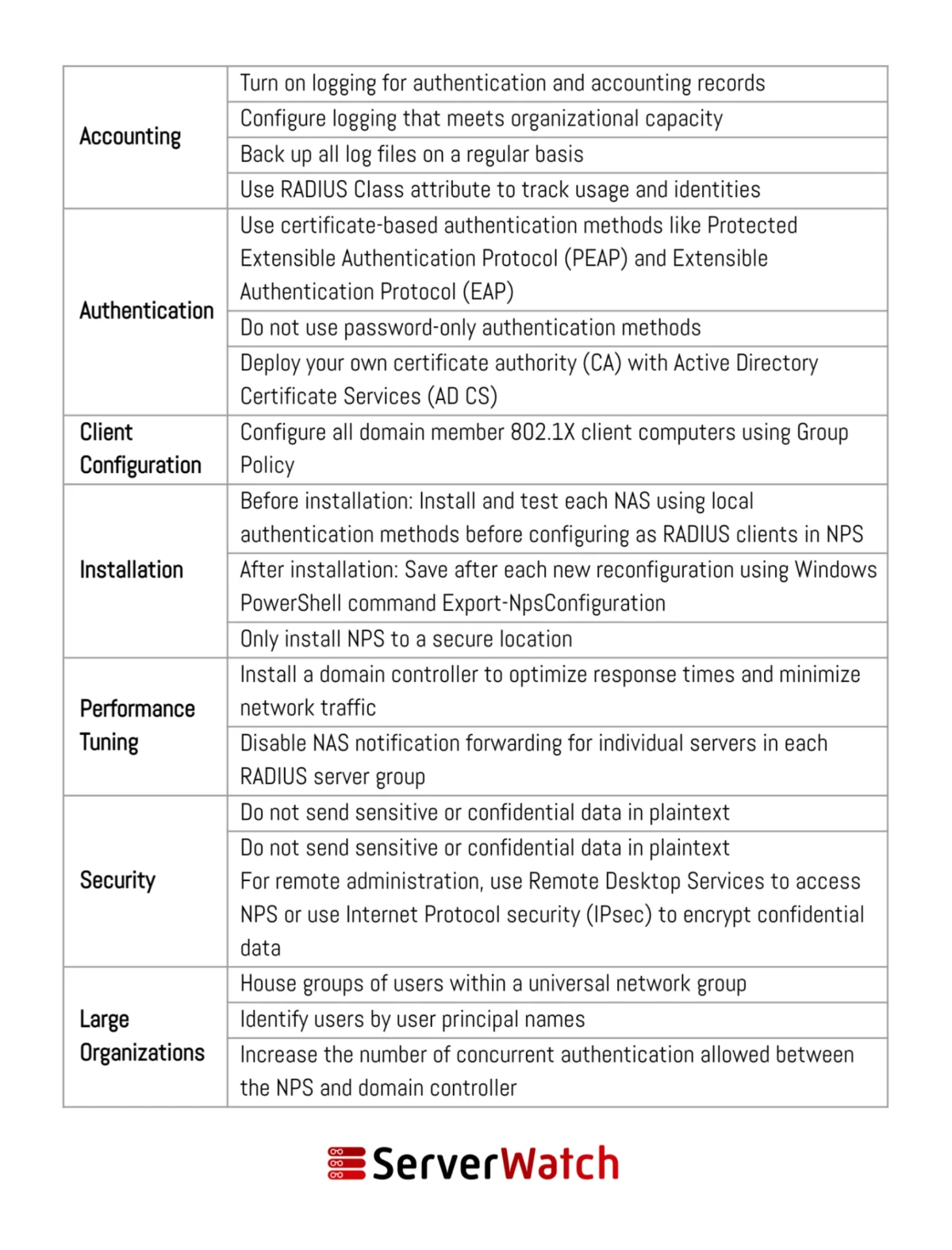
Effective utilization of NPS hinges on adhering to established network and server management best practices. These guidelines ensure that NPS operates efficiently, securely, and in alignment with an organization’s overarching network management objectives. Microsoft provides several recommendations, and further best practices include:
- Secure NPS Installation: Install NPS on a dedicated server or a server that is not running other critical services to isolate potential security risks and ensure performance. Ensure the server is hardened according to security best practices.
- Strong Password Policies: Enforce strong password policies for all user accounts that authenticate through NPS to mitigate brute-force attacks.
- Use of Certificates for Authentication: For enhanced security, implement certificate-based authentication (e.g., EAP-TLS) for wireless and VPN access, eliminating the reliance on passwords alone.
- Regularly Update NPS and Operating System: Keep the Windows Server operating system and the NPS role updated with the latest security patches and updates to address known vulnerabilities.
- Implement Robust Logging and Monitoring: Configure comprehensive logging within NPS and set up proactive monitoring to detect suspicious activities, failed authentication attempts, and policy violations. Regularly review these logs.
- Define Clear and Specific Policies: Create detailed and specific connection request policies (CRPs) and network policies (NPs) that align precisely with organizational security requirements and user roles. Avoid overly broad or permissive policies.
- Test Policies Thoroughly: Before deploying new or modified policies in a production environment, test them rigorously in a staging or lab environment to ensure they function as intended and do not inadvertently lock out legitimate users or grant unauthorized access.
- Utilize RADIUS Proxy for Scalability: In larger or distributed environments, leverage the RADIUS proxy functionality of NPS to distribute authentication load and manage authentication across multiple RADIUS servers.
- Integrate with Active Directory: Seamlessly integrate NPS with Active Directory for centralized user and group management, simplifying policy creation and enforcement.
- Regular Audits: Conduct periodic audits of NPS configurations, policies, and logs to ensure continued adherence to security best practices and compliance requirements.
- Consider High Availability: For critical network services, implement high availability for NPS by deploying redundant NPS servers and utilizing load balancing.
Bottom Line: The Indispensable Role of NPS in Modern Network Management
The Network Policy Server (NPS) has unequivocally emerged as an indispensable tool in the modern network and server administration landscape, offering a robust, flexible, and cost-effective solution for ensuring secure and efficient network operations. The seamless integration of NPS within an organization’s network infrastructure not only significantly enhances security by enforcing rigorous and granular access policies but also substantially simplifies administrative tasks, leading to more efficient management of precious network resources.
By diligently adhering to the recommended best practices in deploying and managing NPS, organizations can substantially mitigate the inherent risks associated with network security. This proactive approach ensures a more resilient, secure, and seamlessly operational network environment, capable of supporting the evolving demands of the digital age. Organizations seeking to bolster their network security and streamline access management will find NPS to be a powerful and essential component of their IT infrastructure.
To further optimize NPS functionality and performance, consider leveraging advanced tools. Experts have curated a list of the best free RADIUS server testing and monitoring tools, which can provide invaluable insights and capabilities for maintaining a secure and efficient network.
Sam Ingalls contributed to this article.
