
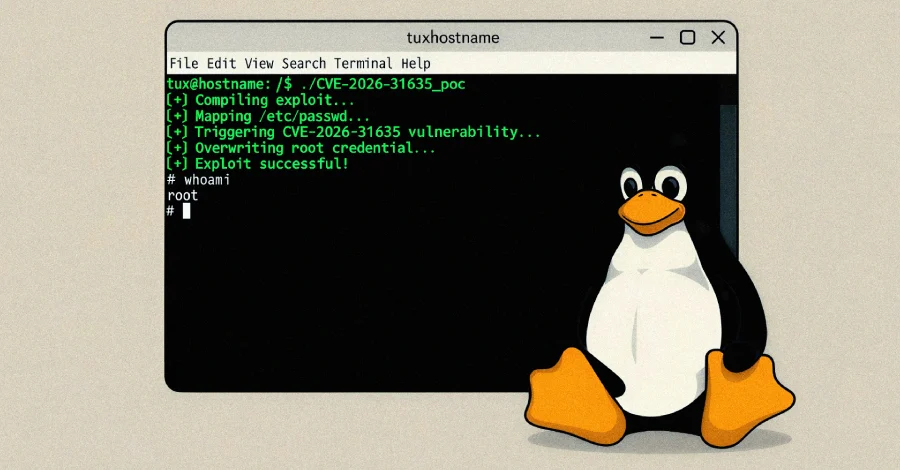

The DirtyDecrypt vulnerability, tracked as CVE-2026-31635 with a CVSS score of 7.5, was independently discovered and reported by the Zellic and V12 security team on May 9, 2026. However, the maintainers informed the researchers that the flaw was a duplicate of a vulnerability that had already been addressed in the mainline kernel. Despite this, the release of the PoC underscores the practical threat posed by this class of bugs. The National Vulnerability Database (NVD) record for CVE-2026-31635 now includes a direct link to the DirtyDecrypt PoC, confirming its relevance.
Understanding the DirtyDecrypt Vulnerability
At its core, DirtyDecrypt is described as an "rxgk pagecache write due to missing COW [copy-on-write] guard in rxgk_decrypt_skb," as explained by Luna Tong (aka cts and gf_256), co-founder of Zellic, in a description shared on GitHub. This technical detail points to a fundamental failure in memory management within a specific kernel function.
The vulnerability resides specifically in rxgk_decrypt_skb(), a function responsible for decrypting incoming sk_buff (socket buffer) data on the receive side of the kernel’s network stack. Linux kernels, like many operating systems, employ a critical optimization known as "copy-on-write" (COW). COW is a resource-management technique used to efficiently handle memory pages that might be shared between multiple processes. When a process attempts to write to a shared page, the COW mechanism ensures that a private copy of that page is made before the write operation occurs. This prevents the write from inadvertently modifying data that belongs to another process, thereby preserving data integrity and isolation between applications.
In the case of DirtyDecrypt, the rxgk_decrypt_skb() function was found to lack this crucial COW guard. The absence of this protection means that when data is written to a memory page that is partly shared, instead of a private copy being created, the write operation directly modifies the shared page. This "bleed-through" effect can have severe security implications. Depending on the exploit path, an unprivileged local attacker could manipulate the page cache of privileged processes or critical system files. This could include files like /etc/shadow, which stores encrypted user passwords; /etc/sudoers, which dictates user privileges for sudo commands; or even SUID (Set User ID) binaries, which execute with the permissions of their owner (often root). Modifying such files allows an attacker to elevate their privileges from a standard user to root, effectively gaining full control over the compromised system.
The impact of DirtyDecrypt is not universal across all Linux installations. It specifically affects distributions where CONFIG_RXGK is enabled. This configuration option is typically active in popular distributions such as Fedora, Arch Linux, and openSUSE Tumbleweed. Furthermore, in modern containerized environments, which heavily rely on shared kernel resources, a worker node running a vulnerable version of Linux could provide an attacker with a pathway to escape the confines of their containerized pod, granting them access to the underlying host system. This highlights the broad attack surface and the potential for cascading security failures that such kernel vulnerabilities present.
A Flurry of Copy-on-Write Related Vulnerabilities
The DirtyDecrypt flaw is not an isolated incident but rather the latest in a series of similar vulnerabilities discovered in the Linux kernel that exploit weaknesses in its copy-on-write mechanisms. Zellic researchers have assessed DirtyDecrypt as a variant of previous high-profile LPE flaws, including:
- Copy Fail (CVE-2026-31431): Disclosed by researchers at Theori on April 29, 2026, this local privilege escalation flaw affected the AF_ALG cryptographic socket interface. It was one of the first in this recent wave to draw significant attention to COW-related issues.
- Dirty Frag (CVE-2026-43284 and CVE-2026-43500), also known as Copy Fail 2: This vulnerability emerged about a week after Copy Fail. Dirty Frag expanded on the original Copy Fail concept by introducing two new page-cache write primitives, making it more versatile for exploitation.
- Fragnesia (CVE-2026-46300): This is another variant of Dirty Frag, specifically impacting the XFRM ESP-in-TCP subsystem. Like its predecessors, Fragnesia allows unprivileged local attackers to modify read-only file contents within the kernel page cache, ultimately leading to root privileges.
This rapid succession of closely related vulnerabilities underscores a systemic challenge in the Linux kernel’s memory management and cryptographic handling, prompting deeper scrutiny from security researchers and developers alike.
The Disclosure Dilemma and its Aftermath

The disclosure process for these vulnerabilities has not been without its complexities, particularly concerning Dirty Frag. Security researcher Hyunwoo Kim initially discovered and reported the flaw, entering into an agreed-upon embargo period to allow time for patches to be developed and deployed. However, this embargo ended prematurely on May 5 when a merged patch for CVE-2026-43284 became publicly available upstream. Another researcher, operating under the online aliases 0xdeadbeefnetwork and afflicted.sh, independently analyzed the public commit, recognized the security implications, and subsequently published details of the defect along with a proof-of-concept.
This incident sparked a debate within the security community regarding responsible disclosure practices, particularly when fixes for vulnerabilities are committed to public repositories before the agreed-upon embargo period expires. As 0xdeadbeefnetwork noted, "The work is n-day weaponization from a public upstream commit, which is standard practice once a security-relevant fix lands in a public tree." This highlights the tension between allowing developers time to fix vulnerabilities and the reality that once a patch is public, it can be reverse-engineered by malicious actors or other researchers, accelerating the window for exploitation.
Other Noteworthy Linux Vulnerabilities
Beyond the COW-related issues, the Linux ecosystem has seen other significant local privilege escalation flaws emerge concurrently. These include:
- PackageKit Daemon LPE (CVE-2026-41651, aka Pack2TheRoot): With a CVSS score of 8.8, this vulnerability in the Linux PackageKit daemon could allow unprivileged local users to achieve root access. PackageKit is a system service that provides a consistent way to install and update software, making a flaw in its daemon particularly impactful as it often runs with elevated privileges. The discovery, detailed by researchers at GitHub Security, showcased how improper handling of user input or environment variables could lead to dangerous privilege escalation.
- Kernel Improper Privilege Management (CVE-2026-46333, aka ssh-keysign-pwn): This flaw, with a CVSS score of 5.5, resides directly within the kernel and relates to improper privilege management. It enables an unprivileged local user to read root-owned secrets, such as SSH private keys. While not directly granting root access, the ability to steal SSH private keys belonging to the root user or other privileged accounts can lead to unauthorized access to remote systems, lateral movement within a network, and severe data breaches. The PoC for this vulnerability was also publicly released, demonstrating its exploitability. Various Linux distributions have since released advisories for CVE-2026-46333, urging users to update their systems promptly.
The cumulative effect of these disclosures paints a picture of a challenging security landscape for Linux users and administrators, demanding heightened vigilance and rapid patching.
Industry’s Proactive Responses: Kernel Killswitch and Security Repositories
The rapid succession of these critical vulnerabilities, particularly those allowing local privilege escalation, has prompted significant discussion and proposals within the Linux kernel development community regarding more agile security response mechanisms.
The "Killswitch" Proposal: A Radical Approach?
One of the most intriguing proposals comes from Linux kernel developer and maintainer Sasha Levin, who has put forward the concept of an emergency "killswitch." This feature would allow system administrators to disable vulnerable kernel functions at runtime, providing a temporary mitigation for zero-day vulnerabilities until a permanent patch becomes available.
As detailed in Levin’s proposal, the killswitch would enable a privileged operator to "make a chosen kernel function return a fixed value without executing its body, as a temporary mitigation for a security bug while a real fix is being prepared." The mechanism leverages the kprobe layer, a facility for dynamically tracing kernel functions. Once engaged, the specified function would simply return an operator-supplied value, bypassing its original code execution entirely. This change would be instantaneous and effective across all CPUs, remaining in effect until explicitly disengaged or until the system is rebooted.
The potential benefits of such a killswitch are significant: it offers a rapid, albeit crude, response to actively exploited zero-day vulnerabilities, buying crucial time for developers to craft, test, and distribute stable patches. This could drastically reduce the window of exposure for critical systems. However, the proposal also raises complex questions regarding its implementation, potential for misuse, and the risk of introducing new instabilities or unintended side effects by forcefully altering kernel behavior. The debate within the kernel development community is ongoing, weighing the immediate security benefits against the long-term maintainability and reliability of the kernel.

Rocky Linux’s Accelerated Security Repository
In a more concrete step towards enhancing security responsiveness, Rocky Linux has introduced an optional "security repository." This initiative is designed to enable the distribution to ship urgent security fixes more rapidly, especially in scenarios where severe vulnerabilities become public knowledge and exploit code exists before coordinated upstream fixes are fully integrated into the standard release cycle.
The security repository is intentionally disabled by default. This design choice aligns with Rocky Linux’s core philosophy of providing a predictable, stable, and fully upstream-compatible operating system experience. System administrators who require accelerated fixes for critical, publicly known, and exploitable vulnerabilities can opt into this repository when necessary.
Rocky Linux has explicitly stated that this security repository is not a replacement for its regular release process. Instead, it caters to "specific, narrow" cases where the urgency of a public vulnerability outweighs the usual release cadence. The maintainers acknowledge a trade-off: "If we push a fix and upstream decides not to address it, the next upstream kernel release will supersede our patched version. Users who haven’t version-locked their kernel will, at that point, no longer have our fix. That’s the trade-off we accepted when building this." This approach demonstrates a pragmatic balance between rapid response and maintaining alignment with upstream developments, offering administrators a flexible tool for managing their security posture.
Broader Implications for Linux Security
The confluence of these events – the ongoing discovery of critical kernel vulnerabilities, particularly those exploiting fundamental memory management mechanisms like copy-on-write, coupled with discussions around emergency mitigation strategies and accelerated patching channels – underscores a pivotal moment for Linux security.
The prevalence of LPE vulnerabilities highlights the persistent challenge of securing a codebase as vast and complex as the Linux kernel. Even subtle flaws in low-level functions can have catastrophic consequences, granting attackers the highest level of system control. For system administrators, these developments reinforce the critical importance of maintaining a rigorous patching schedule, especially for kernel updates. The speed at which PoCs are released post-patch, or even pre-patch in cases of premature disclosure, means that the window for exploitation can be extremely narrow.
Furthermore, the proposals for a kernel killswitch and the implementation of security repositories by distributions like Rocky Linux reflect a growing recognition within the Linux community that traditional patching cycles, while robust, may not always be sufficient to counter the agility of modern threat actors. These innovations represent an effort to adapt to an increasingly hostile cyber landscape, providing administrators with more tools to defend their systems against zero-day and N-day exploits.
As Linux continues to power a vast array of systems, from cloud infrastructure and enterprise servers to embedded devices and personal workstations, the ongoing commitment to identifying, disclosing, and mitigating these vulnerabilities remains paramount. The continuous collaboration between security researchers, kernel developers, and distribution maintainers is essential to ensure the enduring security and reliability of this foundational operating system.
