

Amazon Web Services (AWS) today announced the general availability of Amazon Redshift RG instances, a significant advancement in cloud data warehousing, designed to deliver superior performance and cost-effectiveness for both traditional analytics and emerging AI-driven workloads. These new instances, powered by AWS Graviton processors, represent the latest evolution in Amazon Redshift’s decade-long commitment to providing robust, scalable, and economical data analytics solutions. The introduction of RG instances promises up to 2.2 times faster performance for data warehouse workloads compared to the previous RA3 instances, coupled with a 30% reduction in price per vCPU. Crucially, they integrate an enhanced data lake query engine, offering performance boosts of up to 2.4 times for Apache Iceberg and 1.5 times for Apache Parquet, marking a pivotal step towards a more unified and efficient analytics ecosystem.
The Evolving Landscape of Data Analytics and Redshift’s Journey
Since its launch in 2013, Amazon Redshift has been a cornerstone of cloud data warehousing, offering enterprises the full power of a massively parallel processing (MPP) data warehouse at a fraction of the cost associated with on-premises solutions. Its initial appeal lay in democratizing high-performance analytics, making it accessible to a broader range of businesses without the heavy upfront investment and operational overhead of traditional data infrastructure. Over the years, Redshift has consistently innovated to meet the escalating demands of data-intensive organizations.
The first architectural generation focused on dense compute instances, providing powerful processing capabilities. This was followed by the introduction of Amazon RA3 instances, which brought about a fundamental shift with their managed storage and the ability to scale compute and storage independently. This innovation allowed customers to pay only for the storage they used while scaling compute resources to match workload demands, dramatically improving flexibility and cost efficiency. The evolution continued with Amazon Redshift Serverless, a fully managed, pay-per-query option that further simplified operations by automatically provisioning and scaling compute capacity, eliminating the need for manual cluster management. Each successive generation has aimed to make queries cheaper, faster, and more efficient, directly responding to the ever-growing volume and complexity of enterprise data.
Over the past decade, the analytics landscape has undergone a profound transformation. Data volumes have not merely grown; they have exploded, encompassing a vast array of structured, semi-structured, and unstructured data types. This proliferation has led to the widespread adoption of hybrid architectures, where organizations leverage traditional data warehouse tables for structured, frequently accessed data, alongside data lakes—typically built on Amazon Simple Storage Service (Amazon S3)—for cost-effective storage and analysis of diverse, large-scale datasets. The strategic advantage of data lakes lies in their ability to store raw, unprocessed data at scale, allowing for schema-on-read flexibility and supporting a wide range of analytical tools and machine learning applications.
More recently, the advent of sophisticated artificial intelligence (AI) agents has introduced a new dimension to data consumption. These agents, designed for autonomous decision-making, predictive analytics, and complex data exploration, query data warehouses at a scale and frequency that far surpass typical human usage. This massive influx of automated queries presents significant challenges, including increased operational costs, the potential for performance bottlenecks, and the need for extremely low-latency responses to support real-time AI applications. Recognizing this shift, Amazon Redshift has strategically focused on enhancing its core capabilities to address the demands of both human-driven business intelligence (BI) and AI-driven agentic workloads. A notable example of this commitment was the March 2026 update, which significantly improved the performance of BI dashboards and ETL workloads by speeding up new queries by up to seven times. This enhancement directly benefited near-real-time analytics, BI applications, ETL pipelines, and, critically, autonomous AI agents requiring rapid data access.
The Graviton Advantage: A Foundation for Next-Generation Performance
The launch of Amazon Redshift RG instances is rooted in AWS’s pioneering work with custom silicon, particularly the AWS Graviton family of processors. Graviton processors are custom-designed by AWS, leveraging the Arm Neoverse architecture, and optimized specifically for cloud workloads. The journey began with the first-generation Graviton processor in 2018, primarily aimed at general-purpose computing. Subsequent iterations, Graviton2 and Graviton3, have demonstrated remarkable gains in performance and energy efficiency, quickly becoming the preferred choice for a wide array of AWS services, including Amazon EC2, Amazon RDS, AWS Lambda, and now, Amazon Redshift.
The rationale behind Graviton’s success lies in its tailored design. By optimizing the processor for the specific demands of cloud workloads—which often involve high concurrency, diverse data types, and varying compute patterns—AWS can achieve superior price-performance ratios compared to traditional x86-based processors. Graviton processors are known for their high core count, large caches, and efficient instruction sets, making them particularly well-suited for CPU-intensive tasks common in data warehousing, such as complex query execution, data compression, and ETL operations. Their energy efficiency also translates directly into lower operational costs for AWS, which can then be passed on to customers in the form of more competitive pricing. For data warehousing, where processing massive datasets and executing complex analytical queries are routine, the Graviton architecture offers a compelling advantage, promising faster data processing, improved query response times, and a reduced total cost of ownership (TCO).
Deep Dive into Redshift RG Instances: Performance, Cost, and Integrated Analytics
Amazon Redshift RG instances represent a significant leap forward, primarily due to their Graviton-powered architecture and deeply integrated data lake query engine. These instances are engineered to deliver a transformative experience across several key dimensions:
- Unprecedented Performance for Data Warehouse Workloads: For traditional data warehouse queries, RG instances offer a performance improvement of up to 2.2 times compared to RA3 instances. This acceleration translates into significantly faster execution of complex analytical queries, improved response times for interactive BI dashboards, and quicker completion of ETL (Extract, Transform, Load) processes. In practical terms, this means business users can gain insights more rapidly, and critical data pipelines can be completed within tighter windows, enhancing operational agility.
- Cost Efficiency Reimagined: Beyond raw speed, RG instances introduce a substantial cost advantage, boasting a 30% lower price per vCPU than RA3 instances. This direct cost reduction, combined with performance enhancements, results in a significantly lower price-performance ratio, making high-performance analytics more accessible and sustainable. Organizations can achieve more analytical output for the same or reduced expenditure, optimizing their cloud spending.
- Integrated Data Lake Query Engine: A standout feature of RG instances is their integrated data lake query engine. This engine allows users to run SQL analytics directly across both their Redshift data warehouse tables and data residing in Amazon S3 data lakes from a single, unified system. The performance gains here are particularly noteworthy: up to 2.4 times faster for Apache Iceberg and up to 1.5 times faster for Apache Parquet data formats compared to RA3 instances. This integration is crucial for modern analytics, as it eliminates the need for separate query engines or complex data movement between the warehouse and the lake, simplifying architecture and reducing operational overhead.
- Elimination of Redshift Spectrum Scanning Fees: A major cost benefit of the integrated data lake query engine is the complete elimination of the $5 per terabyte (TB) Redshift Spectrum scanning fees that previously applied to data lake queries. With RG instances, data lake queries are executed directly on the cluster nodes, which process data warehouse workloads. This means queries stay within the customer’s Virtual Private Cloud (VPC) boundary, utilize existing IAM roles for security, and incur zero per-terabyte scanning charges. This provides greater cost predictability and substantial savings for customers heavily relying on data lake analytics.
- Optimized for Open Data Formats: The enhanced performance for Apache Iceberg and Apache Parquet underscores Redshift’s commitment to open data formats. Apache Iceberg, known for its transactional capabilities, schema evolution, and hidden partitioning, provides greater reliability and performance for large analytical tables in data lakes. Apache Parquet, a columnar storage format, is highly optimized for analytical queries, offering efficient compression and predicate pushdown. By boosting performance for these formats, Redshift RG instances empower customers to leverage their data lake investments more effectively.
Instance Specifications and Use Cases
AWS has provided a clear migration path and equivalent RG instances for common RA3 configurations:
| Current RA3 Instance | Recommended RG instance | vCPU | Memory (GB) | Primary Use Case |
|---|---|---|---|---|
ra3.xlplus |
rg.xlarge |
4 | 32 | Small cluster departmental analytics |
ra3.4xlarge |
rg.4xlarge |
12 – 16 (1.33:1 ratio) | 96 GB – 128 GB (1.33:1 ratio) | Standard production workloads, medium data volumes |
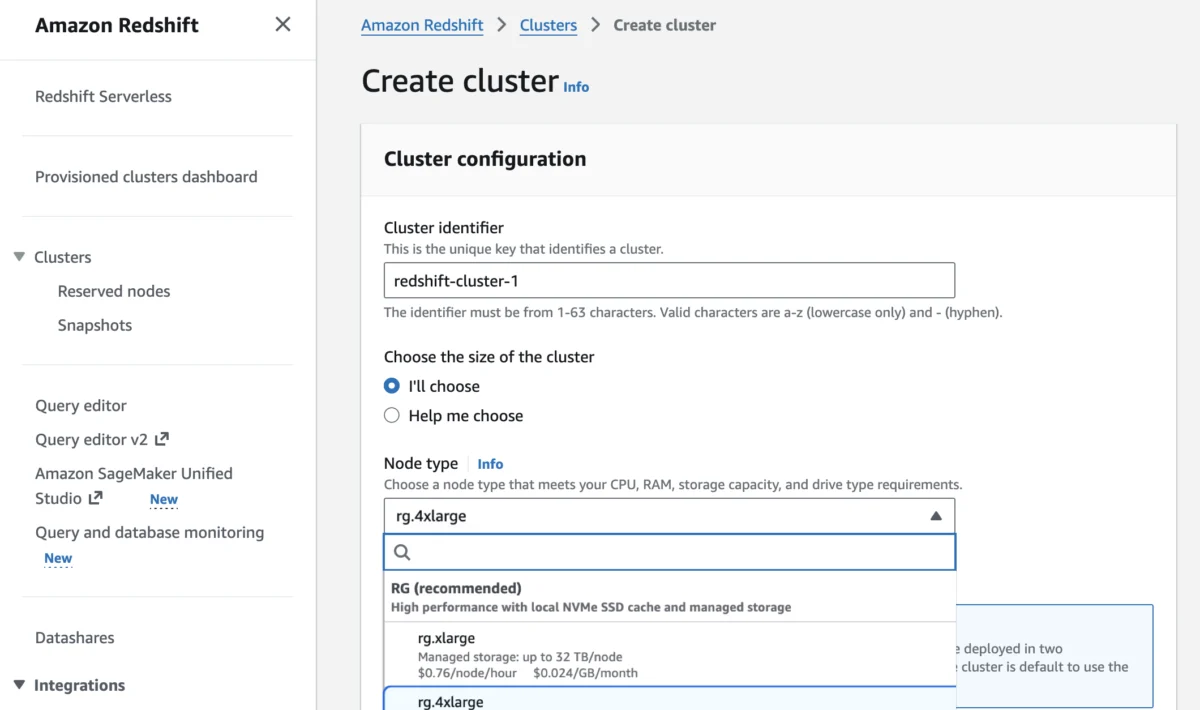
The rg.xlarge instance is ideally suited for smaller departmental analytics workloads, offering a cost-effective entry point to the new capabilities. The rg.4xlarge targets standard production environments and medium data volumes, providing a significant upgrade in both compute power and memory capacity over its RA3 predecessor. These carefully calibrated instances ensure that customers can select the optimal configuration for their specific needs, maximizing both performance and cost efficiency.
Addressing the AI Agent Challenge with Converged Analytics
The rise of AI agents has fundamentally altered the demands on data infrastructure. These agents, whether performing real-time fraud detection, personalized recommendation generation, or complex predictive modeling, require instantaneous access to vast quantities of data. Their querying patterns are characterized by high concurrency and a relentless need for low-latency responses, which can quickly overwhelm traditional data warehouse architectures and lead to escalating operational costs.
Amazon Redshift RG instances are specifically engineered to address these challenges. The combination of Graviton-powered performance, significant cost reductions, and a seamlessly integrated data lake query engine makes them exceptionally well-suited for AI-driven workloads. The ability to execute queries up to 2.2 times faster for warehouse data and even faster for data lake formats means AI agents can process information more rapidly, leading to quicker insights and more responsive applications. The 30% lower price per vCPU and the elimination of Spectrum scanning fees directly mitigate the spiraling operational costs associated with high-volume, automated queries, making AI initiatives more economically viable at scale.
This strategic move by AWS aligns with the broader industry trend towards converged analytics platforms, where the traditional boundaries between data warehouses and data lakes are blurring. Organizations increasingly seek a unified environment that can handle diverse data types and analytical patterns without sacrificing performance or incurring excessive costs. RG instances, with their ability to query both warehouse and lake data from a single engine, simplify the architecture, reduce complexity, and provide a holistic view of an organization’s data assets, enabling more comprehensive and agile AI development.
Seamless Migration and Operational Simplicity

AWS has prioritized ease of adoption for RG instances. Customers can launch new Redshift clusters or migrate existing ones through the intuitive AWS Management Console, the robust AWS Command Line Interface (AWS CLI), or via the AWS API. The integrated data lake query engine is enabled by default, ensuring immediate access to its benefits without additional configuration.
A critical advantage for existing Redshift users is the seamless migration experience. There is no need to recreate external tables or modify application code. Existing external tables, schemas, and query syntax—including those previously used with Redshift Spectrum—remain fully compatible. This "no code change" approach significantly reduces the migration effort and risk, allowing organizations to upgrade their infrastructure with minimal disruption to ongoing operations or analytical workflows. The Redshift Management Guide provides comprehensive documentation and optimal paths for migrating previous-generation instances, helping customers estimate costs, validate compatibility, and automate execution. This commitment to backward compatibility and operational simplicity underscores AWS’s understanding of enterprise requirements for smooth transitions to new technologies.
Strategic Implications and Market Impact
The introduction of Amazon Redshift RG instances is poised to have several significant implications for the cloud data warehousing market and the broader analytics ecosystem.
- Strengthening Redshift’s Competitive Position: This launch significantly strengthens Amazon Redshift’s position against competitors like Snowflake, Google BigQuery, and Databricks SQL. By offering superior price-performance and a tightly integrated data lake query engine, AWS is addressing key customer pain points related to cost, complexity, and the need for unified analytics. The Graviton advantage, in particular, provides a unique differentiator that competitors may find challenging to replicate quickly.
- Accelerating Cloud Adoption: The enhanced capabilities and cost efficiencies of RG instances are likely to further accelerate the migration of on-premises data warehouses to the cloud. The compelling economics and simplified management make the argument for cloud adoption even stronger, especially for organizations grappling with legacy infrastructure costs and performance limitations.
- Empowering AI Innovation: By providing a highly performant and cost-effective foundation for AI-driven analytics, RG instances will empower organizations to push the boundaries of AI innovation. Faster data access and lower querying costs remove significant barriers to developing and deploying sophisticated AI models and agents at scale, fostering greater experimentation and faster time-to-insight.
- Driving Open Data Standards: The optimized performance for Apache Iceberg and Parquet reinforces AWS’s commitment to open data formats, encouraging broader adoption of these standards within data lake architectures. This promotes interoperability, reduces vendor lock-in, and fosters a more collaborative data ecosystem.
- Reinforcing AWS’s Custom Silicon Strategy: This launch further validates AWS’s multi-year investment in custom silicon. The success of Graviton processors across a growing range of AWS services demonstrates the strategic advantage of designing specialized hardware optimized for cloud workloads, delivering tangible benefits to customers in terms of performance, cost, and energy efficiency.
Availability and Pricing
Amazon Redshift RG instances are now available across a wide array of AWS Regions, including US East (N. Virginia, Ohio), US West (N. California, Oregon), Asia Pacific (Hong Kong, Hyderabad, Jakarta, Malaysia, Melbourne, Mumbai, Osaka, Seoul, Singapore, Sydney, Taiwan, Tokyo), Canada (Central), Europe (Frankfurt, Ireland, Milan, London, Paris, Spain, Stockholm), and South America (São Paulo). For the most up-to-date regional availability and future roadmap, customers can consult the AWS Capabilities by Region page.
For Redshift Provisioned clusters, customers have flexible pricing options. They can choose On-Demand Instances with hourly billing and no long-term commitments, offering maximum flexibility. Alternatively, for greater cost savings and predictable workloads, Reserved Instances are available, allowing customers to commit to a one- or three-year term in exchange for significant discounts. AWS encourages customers to utilize the AWS Pricing Calculator to estimate savings based on their specific workload patterns and choose the most suitable pricing model. Further details are available on the Amazon Redshift Pricing page.
The introduction of Amazon Redshift RG instances marks a pivotal moment in the evolution of cloud data warehousing. By harnessing the power of AWS Graviton processors and integrating a high-performance data lake query engine, AWS is delivering a solution that is not only faster and more cost-effective but also uniquely positioned to meet the escalating demands of the AI era. Customers are encouraged to explore the new RG instances in the Redshift console and provide feedback through AWS re:Post for Amazon Redshift or their usual AWS Support contacts, continuing the collaborative development that has defined Redshift’s success.
Updated 5/12/26: Middle East (UAE) removed from available regions.
