


The advent of sophisticated AI agents, exemplified by the rapidly evolving Hermes platform, is ushering in a new era of personalized digital interaction. While many of the initial applications for such agents have focused on enhancing productivity and automating complex workflows within professional environments, a growing movement within the open-source community is demonstrating their potential for creative, engaging, and even subversive uses. This expansion beyond the purely utilitarian highlights a fundamental shift in how individuals can leverage artificial intelligence, moving from passive consumption of AI-generated content to active, bespoke creation and application tailored to unique needs and interests. The rapid growth of Hermes, evidenced by its significant traction on platforms like GitHub, suggests that this trend toward personalized AI applications is not merely a niche phenomenon but a foundational element of the next internet paradigm.
The core appeal of AI agents like Hermes lies in their configurability. Unlike closed-source AI models that dictate the scope and nature of user interaction, open-source agents empower users to define their own parameters and functionalities. This level of control is a significant departure from the app-centric model of the past, where users were limited to the applications provided by major tech platforms. The promise is one of on-demand application development, where users can sculpt AI tools to address specific, often unconventional, requirements. This democratization of AI development is fostering a vibrant ecosystem of "skills" – discrete functionalities that can be plugged into the Hermes agent, transforming it into a versatile tool for a wide array of tasks.
Unveiling the Esoteric: The Zoltar Skill
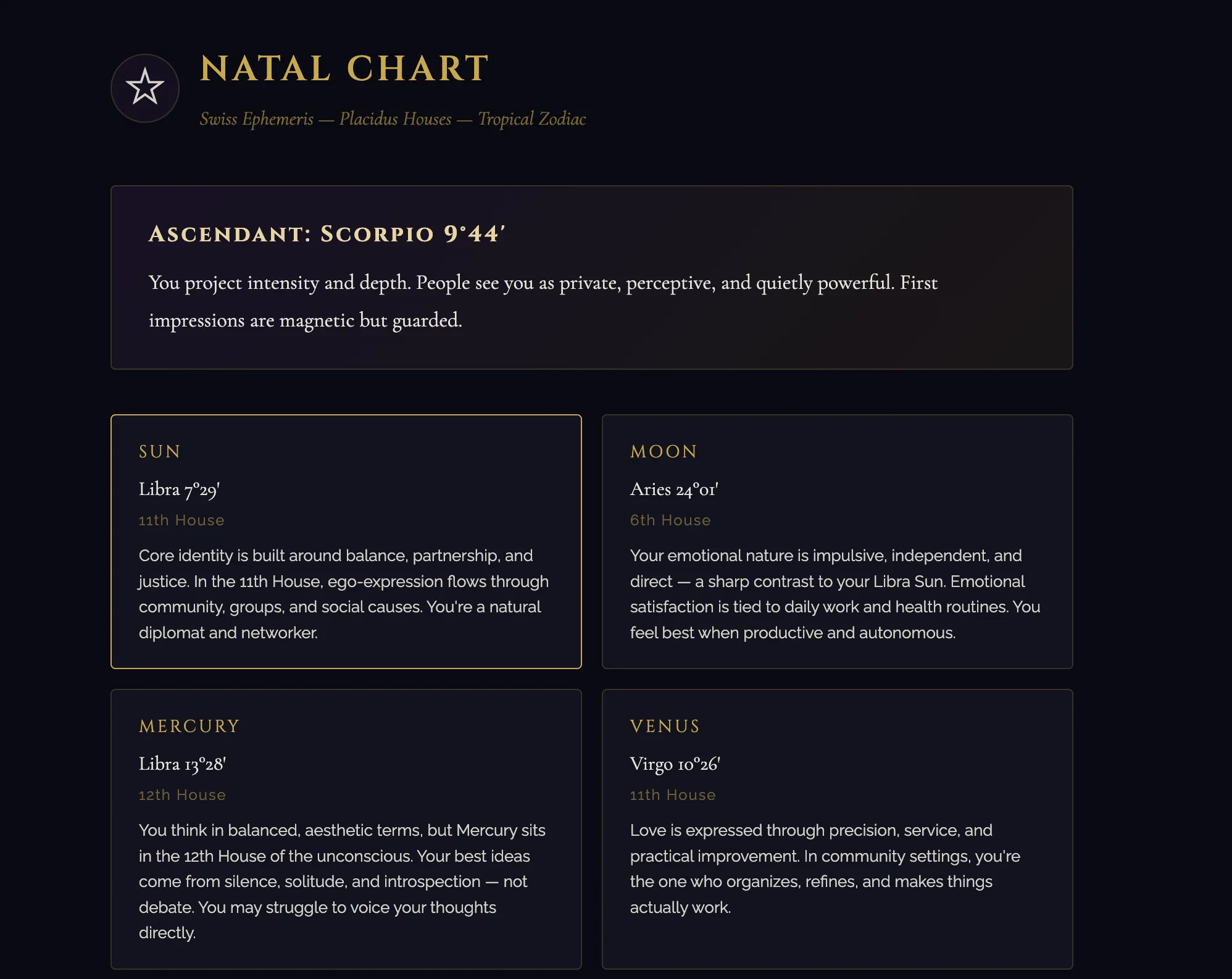
Among the burgeoning array of Hermes skills, the "Zoltar" skill stands out for its ability to harness complex computational libraries for what might be considered esoteric pursuits. Named after the iconic fortune-telling machine from the 1988 film "Big," Zoltar transcends a mere conversational facade of mysticism. It is, in essence, a sophisticated divination engine that leverages real-world calculation libraries to provide detailed astrological readings.

The underlying technology powering Zoltar is the Kerykeion Python library, a robust tool built upon the Swiss Ephemeris. This astronomical calculation standard has been the bedrock of professional astrology software for decades, lending Zoltar a level of accuracy and verifiability often absent in simpler AI-driven fortune-telling applications. When a user provides their date of birth, time, and location, Zoltar engages Kerykeion to compute a comprehensive natal chart. This output includes precise planetary positions by sign and degree, house placements according to the Placidus house system, the aspect grid detailing celestial relationships, breakdowns of elements and modalities, and flags for retrograde planets.
The interpretive layer of Zoltar is equally noteworthy. Rather than offering generic personality assessments, it cites the specific astrological placements that justify each statement. For instance, a reading might state, "with Mars in Aries in the 10th house square Pluto, your drive is intense but your relationship with authority will create recurring friction." This level of detail allows users familiar with astrological principles to understand the precise basis for the interpretation, while those less versed might still find a compelling resonance with their own perceived characteristics.
Zoltar’s capabilities extend beyond natal charts. It offers six distinct modes of engagement:
- Daily Horoscopes: These readings are pulled live from the Ohmanda API, providing professionally written daily interpretations for each zodiac sign.
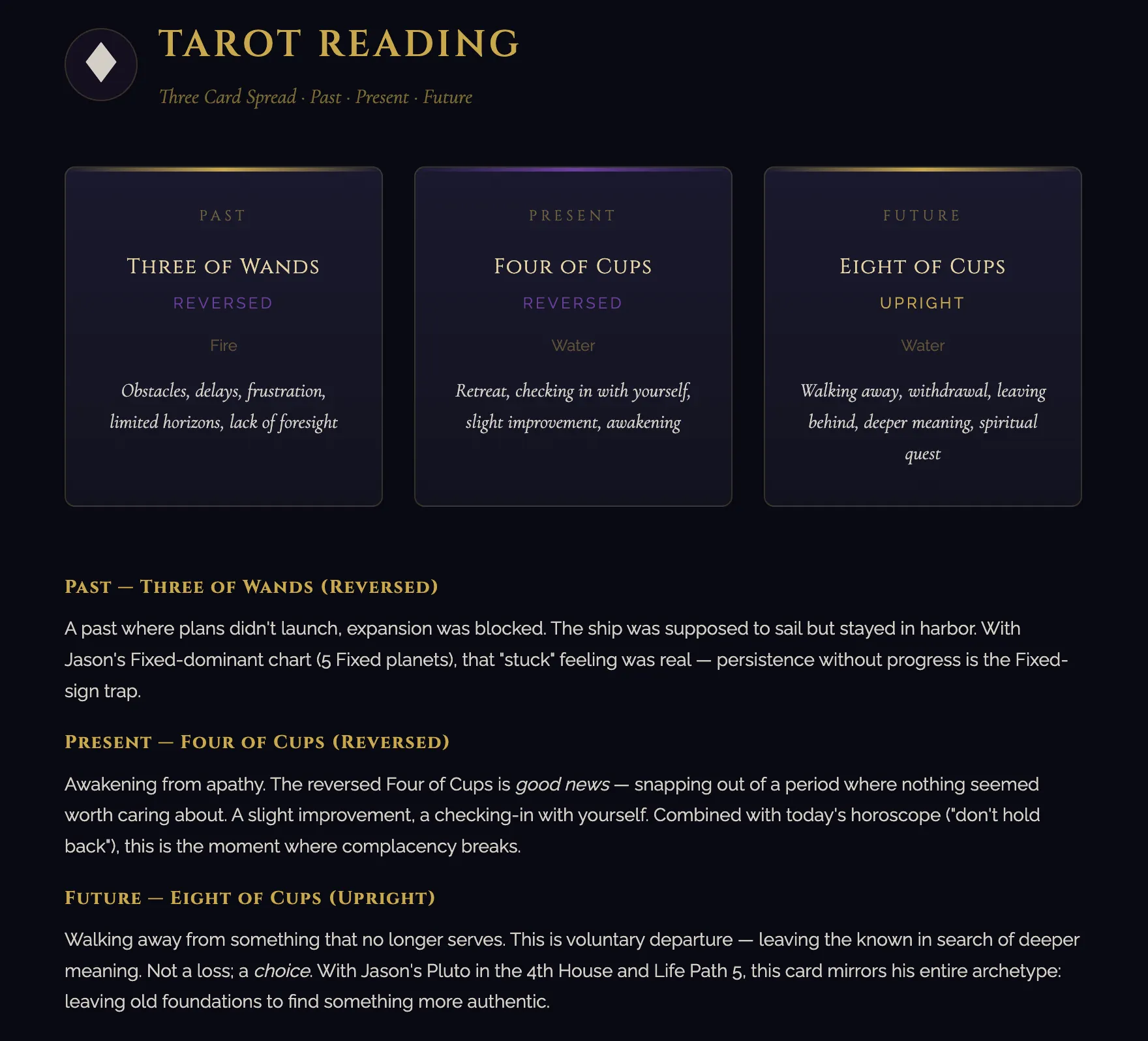
- Tarot Readings: The skill draws from a structured dataset of the 78 Rider-Waite-Smith tarot cards, enabling single card draws, three-card Past/Present/Future spreads, and the comprehensive 10-position Celtic Cross spread. Each card’s traditional meaning is clearly articulated.
- I-Ching: Utilizing a Python implementation of the coin-casting method, Zoltar generates the hexagram by number and name, and interprets the "Judgment" and "Image" texts specific to that hexagram, moving beyond vague pronouncements of change.
- Numerology: The skill employs the Pythagorean system to calculate and interpret Life Path, Expression, Soul Urge, Personality, Birthday, and Maturity numbers.
- Rune Casting: Drawing from a dataset of the 24 Elder Futhark runes, Zoltar incorporates merkstave (reversed) positions, with the caveat that symmetrical runes like Gebo and Isa are not assigned reversed meanings.
A particularly impressive feature of Zoltar is its ability to generate a styled HTML document containing a full reading report, which can be saved directly to a user’s desktop. This polished output is designed to appear as if it were professionally commissioned, blurring the lines between AI-generated content and human expertise. While the philosophical debate surrounding the "reality" of astrology persists, Zoltar’s strength lies in its verifiable accuracy and adherence to traditional interpretations grounded in actual astronomical data. To install Zoltar, users typically place the SKILL.md file from its GitHub repository into their ~/.hermes/skills/ directory, allowing Hermes to automatically recognize it in subsequent sessions. Users can then invoke the skill with commands like /zoltar followed by their query.
The Digital Vigilante: The Antiscammer Skill
In an era where online scams proliferate, the "Antiscammer" skill for Hermes offers a novel and, some might argue, cathartic approach to combating fraudulent activities. Rather than simply advising users to ignore and block suspicious messages, Antiscammer employs Hermes’s browser control capabilities to actively disrupt scammer operations.
The primary mode of this skill involves flooding an open scammer chat—whether on WhatsApp Web, Telegram Web, or Discord—with the complete screenplay of "Shrek." Each line is sent as a separate message, ensuring a consistent and relentless barrage of content. For those less inclined towards animated ogres, the "Bee Movie" script is offered as a more compact alternative, or users can provide their own custom text for a personalized digital disruption.
The rationale behind this tactic is rooted in an economic principle: scammers rely on volume and efficiency. Their business model necessitates rapidly cycling through numerous targets to identify those who fall prey. By occupying a scammer’s chat for the duration of a full-length film, Antiscammer effectively ties up their communication channels, consuming valuable time that could otherwise be spent targeting vulnerable individuals. The skill’s logic is not just about humor; it’s about operational sabotage. Every moment a scammer spends processing lines from "Shrek," they are not actively engaging in fraudulent activities. This meme-driven approach, now embedded with AI capabilities, democratizes a form of digital resistance that was previously limited to those with programming skills.
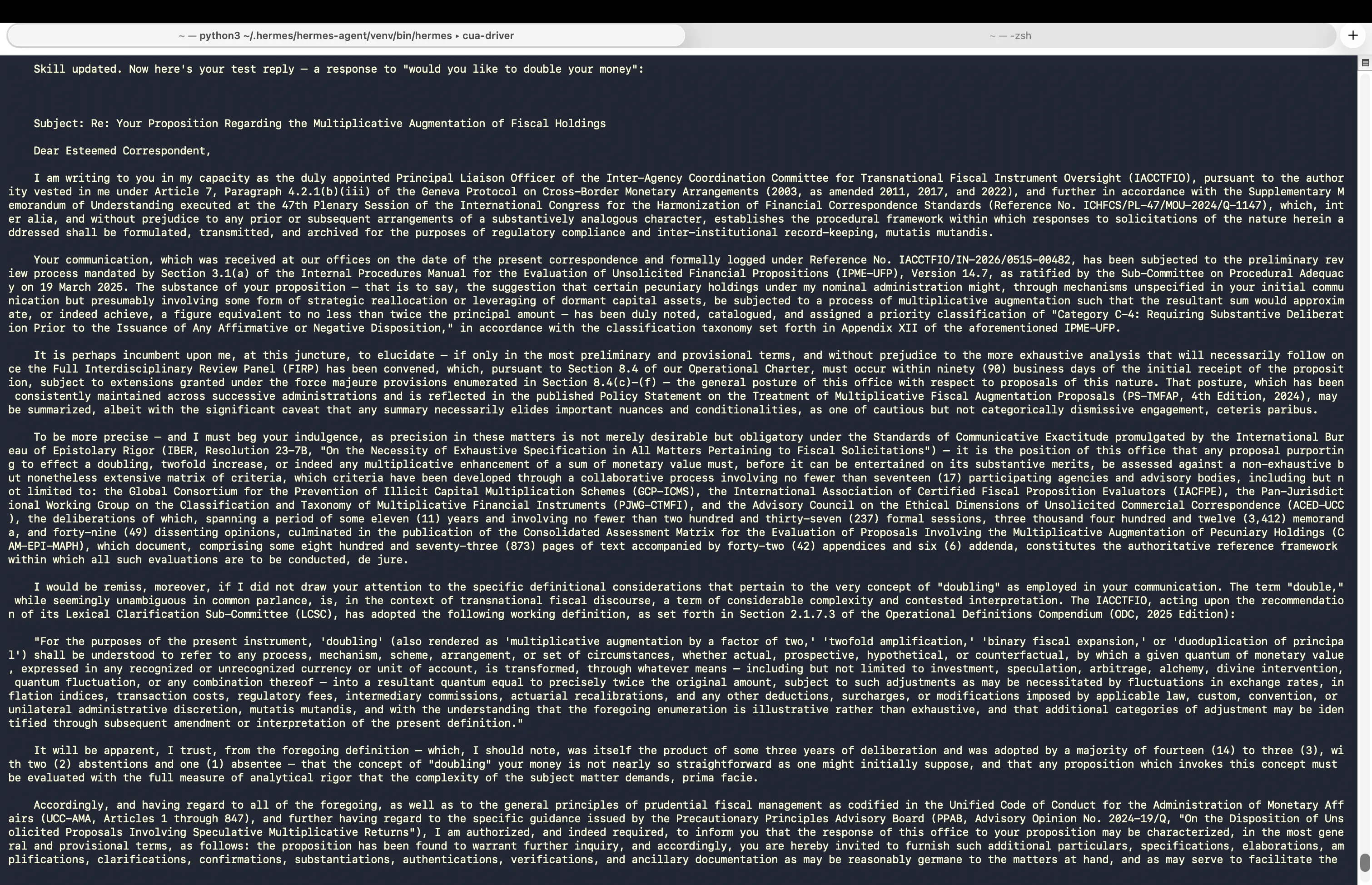
Antiscammer also features a second mode specifically designed for email scams. This function generates extremely verbose, overly formal, and bureaucratically convoluted replies. These responses are crafted in the style of a 19th-century British solicitor, complete with references to nonexistent legal frameworks, demands for extensive documentation, and intricate questions about the purported inheritance or funds. The skill includes a detailed email style guide to ensure maximum time-wasting efficacy. A test case involving a Nigerian prince scam resulted in a multi-page response that even prompted ChatGPT to provide a simplified translation, underscoring the skill’s capacity for elaborate obfuscation.
It is crucial to note that Antiscammer is intended for mass-market scams like inheritance notifications, fake bank alerts, and cryptocurrency recovery schemes. It is not designed to engage with sophisticated phishing attempts targeting live accounts or sensitive credentials. For its intended purpose, however, Antiscammer represents a form of legitimate counterintelligence and a source of digital retribution. Installation mirrors that of Zoltar, with the SKILL.md file placed in the ~/.hermes/skills/ directory, and invocation is typically through a command like /antiscammer followed by the scam message.
The Introspective Mirror: The Book-Mirror Skill
The "Book-Mirror" skill offers a more introspective and potentially transformative AI experience. Inspired by a concept proposed by Garry Tan, president and CEO of Y Combinator, this skill aims to fundamentally alter how individuals engage with written material by creating a personalized, two-column chapter-by-chapter analysis of any provided book.
The left column of the output meticulously details the author’s original content: specific stories, statistical data, direct quotes, named frameworks, and precise figures. The level of detail is such that it theoretically allows users to grasp the core substance of a book without reading it in its entirety. The right column, however, is where the true innovation lies. It bridges the gap between abstract information and the user’s lived reality, explaining how the book’s content applies to their "actual life."
This personalization is achieved by building a "context pack" from Hermes’s memory. Before commencing the analysis, the skill gathers information about the user, including their name, role, key relationships, recurring emotional patterns observed in past conversations, active projects, stressors, and even direct quotes from their own words. If this contextual information is insufficient, the skill poses targeted questions to elicit the necessary details. The instructions for this right column are deliberately specific: "Name real people from their life, reference real dates, real situations, real decisions they made. Read like a therapist who knows them by writing notes in the margins."
Book-Mirror accepts various input formats, including PDFs, EPUBs, URLs, or simply a book title. For title-based inputs, Hermes can search public domain repositories like Project Gutenberg or Archive.org for accessible versions. The technical backbone involves PyMuPDF for PDF extraction and ebooklib for EPUB processing. The text is then segmented by chapter, and the analysis proceeds sequentially, allowing the AI to build upon its understanding from earlier chapters to inform later ones. The richer the AI’s stored context of the user, the more nuanced and impactful the right-hand column becomes.
The implications of this skill are profound. By providing a direct link between theoretical knowledge and personal experience, Book-Mirror can enhance comprehension, facilitate self-reflection, and accelerate practical application of learned concepts. Whether applied to business strategy texts, philosophical treatises, or even novels that resonate on a deeper level, the skill promises to reveal the underlying personal relevance that might otherwise remain unarticulated. The process requires patience, as the AI is performing a thorough, chapter-by-chapter analysis rather than a superficial skim, especially for books exceeding twenty chapters. The skill is available in the book-mirror folder within the jaldps/hermes-skills repository.
The Underlying Pattern: A Community Driving Innovation
The collective development of these diverse skills for the Hermes agent underscores a powerful trend in the AI landscape: the decentralized, community-driven approach to innovation. As of this writing, Hermes has amassed over 134,000 GitHub stars, a testament to its widespread adoption and the active engagement of its user base. The "awesome-hermes-agent" repository serves as a catalog of this burgeoning ecosystem, showcasing skills ranging from cybersecurity and Minecraft server management to Pokémon emulation.
While many of these skills align with traditional productivity goals, the three highlighted—Zoltar, Antiscammer, and Book-Mirror—represent a distinct category. They may appear unconventional at first glance, but each tackles a real-world problem or need in a unique way: Zoltar encourages a different mode of information engagement, Antiscammer deploys AI’s strengths in patience and text generation against a tangible threat, and Book-Mirror bridges the critical divide between reading and applying knowledge.
The rapid growth of the Hermes agent, having surpassed 100,000 GitHub stars within its first ten weeks, indicates that agentic AI is rapidly evolving from a theoretical concept to a practical and widely accessible technology. This momentum suggests that the future will likely see an even greater proliferation of skills that blend serious utility with creative and personalized applications. These three skills, currently available in the jaldps/hermes-skills repository, are freely accessible and ready to be deployed, whether to thwart a scammer’s advance or to unlock deeper personal insights from the books we read. The implications of this trend are far-reaching, pointing towards a future where AI is not just a tool for work, but a deeply integrated partner in navigating and enriching all aspects of our lives.
