

The promise of AI agents revolutionizing workflows across organizations is rapidly encountering a fundamental barrier: a lack of deep, contextual understanding. While connecting AI tools like Claude Code to platforms such as GitHub and Jira has empowered individual developers, scaling these capabilities to entire teams reveals a critical deficit. The core challenge lies not in the availability of tools, but in the absence of the organizational knowledge that makes those tools truly useful. This gap manifests as security roadblocks, overwhelming complexity due to tool proliferation, and an inability of AI agents to answer even basic, context-dependent questions. The emerging solution to this widespread problem is the "Context Lake," a concept designed to bridge the chasm between raw data access and genuine AI understanding.
The initial enthusiasm for AI agents, often driven by powerful coding assistants and workflow automation tools, quickly encounters the harsh realities of enterprise environments. When an individual developer successfully leverages an AI agent for a specific task, the natural next step is organizational rollout. However, this transition is frequently met with a series of significant obstacles. These include stringent security protocols that delay or outright block the integration of new AI services, the sheer volume of tools an AI agent might need to access which can overwhelm its processing capabilities and lead to increased costs and latency, and a persistent inability of these agents to comprehend fundamental organizational information, such as service ownership or deployment status.
The Gauntlet of Security Approvals
One of the most immediate and formidable hurdles organizations face is security. In most large enterprises, integrating any new tool or service, especially those that access sensitive data, requires extensive review and legal approval for each data source. This process can be arduous, with some companies establishing dedicated AI committees to vet these integrations. The timeline for such approvals can stretch for months, and in some cases, organizations are entirely blocked from adopting these technologies.
A platform lead within a major financial institution shared a stark example: "It took us over 9 months to get GitHub Copilot approved for internal organization usage. MCP servers are entirely blocked." This sentiment underscores the deep-seated caution and procedural inertia that often characterize enterprise technology adoption, particularly concerning AI technologies that interact with proprietary code and data. The fear of data breaches, intellectual property leakage, and compliance violations necessitates a rigorous, albeit often slow, vetting process.

The Paradox of Tool Proliferation
Once the initial security hurdles are cleared, organizations often fall into another trap: enabling as many Machine Code Platforms (MCPs) and associated tools as possible in an attempt to maximize the AI agent’s capabilities. This approach, while seemingly logical, can backfire spectacularly. When an AI agent attempts to load the definitions for dozens of MCP servers and hundreds of individual tools into its context window, the computational overhead becomes immense.
Anthropic’s engineering team has extensively documented this issue, estimating that AI agents can consume up to 150,000 tokens simply to load these tool definitions. This not only inflates operational costs due to increased token usage but also significantly degrades performance, leading to higher latency and, consequently, lower-quality responses. Developers using integrated development environments (IDEs) like Cursor have likely encountered visual cues, such as error messages and alerts, signaling that the proliferation of tools is negatively impacting the AI’s effectiveness. This situation creates a feedback loop where increased connectivity leads to decreased utility, a counterintuitive outcome that impedes AI adoption.
The Knowledge Deficit: Accuracy Fails
Even when an organization successfully navigates the security gauntlet and manages tool proliferation, a more insidious problem emerges: the AI agent’s fundamental lack of understanding regarding core organizational knowledge. For instance, asking an AI agent "What are my open PRs?" or "What’s the deployment status of this service?" often results in a speculative or entirely incorrect answer. The agent may possess the ability to query GitHub or a deployment system, but it lacks the inherent knowledge of what constitutes an "open PR" in the context of the organization’s specific workflows, or what "deployment status" signifies for a particular service.
This is analogous to hiring a new human employee and expecting them to possess immediate, comprehensive knowledge of every aspect of the business. Just as a new hire requires onboarding, training, and access to company documentation and institutional memory, AI agents need a structured way to acquire this contextual understanding. The current reliance on ad-hoc methods, such as individual developers manually configuring agents with specific prompts or integrations, proves unsustainable and unscalable.
The Limitations of AGENTS.MD
In an effort to provide AI agents with essential context, many organizations have experimented with approaches like AGENTS.MD files. These are essentially markdown documents designed to explain codebase structure, conventions, and operational knowledge to AI agents. While this method can be effective for a single repository or a small project, it quickly becomes unmanageable as the number of repositories grows into the hundreds or thousands. Maintaining synchronization across such a large dataset, ensuring consistent application of rules across diverse teams, and managing context at this scale presents an insurmountable challenge. The fundamental issue is that these markdown files, while informative for humans, are not structured for efficient, programmatic querying by AI agents.

Enter the Context Lake: Bridging the Understanding Gap
The concept of "context engineering" emerges as the critical discipline for addressing these challenges. It involves the systematic management, curation, and delivery of relevant contextual information to AI systems at scale. This is where the "Context Lake" finds its purpose. A Context Lake is envisioned as a dedicated layer of organizational knowledge that AI agents can query, moving beyond mere tool access to provide genuine understanding.
Unlike traditional service catalogs, which are primarily designed for human consumption and browsing, a Context Lake is engineered for programmatic access by AI agents. It acts as a unified repository of organizational knowledge, enabling agents to answer complex, context-dependent questions that raw API access cannot satisfy. For example, while an agent might have access to GitHub and can list all repositories, it wouldn’t inherently know which services the "Payments team" owns. This relational information – the ownership of a service – is not typically exposed through standard APIs. A Context Lake explicitly defines and stores these relationships, providing agents with the necessary understanding.
The analogy often used is that a Context Lake encapsulates the knowledge a new engineer acquires during their first few months on the job, but it is structured in a machine-readable format. This allows both humans and AI agents to access and utilize this information efficiently.
Key Use Cases Enabled by a Context Lake
The implications of a Context Lake are far-reaching, transforming how AI agents can assist with critical operational and development tasks.
-
Service Ownership and On-Call Responsibilities: A fundamental question like "Who owns this service?" or "Who is on-call if something breaks at 2 a.m.?" can be answered instantly. With a Context Lake, an agent can definitively state that the "payment service" is managed by the "Payments team," identify the current on-call engineer (e.g., Sarah), and know the escalation path, such as the relevant Slack channel (#payments-incidents). Without this, the agent would be unable to provide such crucial operational intelligence.

-
Impact Analysis and Dependency Mapping: Before making any code changes, understanding the potential "blast radius" is paramount. An agent equipped with a Context Lake can explicitly map downstream dependencies, answering questions like "What breaks if I change this?" or "What services consume this API?" This proactive risk assessment prevents unintended outages and ensures more stable deployments.
-
Organizational Terminology and Standardization: Every organization develops its own unique lexicon and definitions for processes. A Context Lake translates raw data into the company’s specific language. A GitHub repository, for instance, is not merely a collection of code but is explicitly linked to a service, a team, and the environments it operates in. Similarly, the distinction between a "deployment" and a "release" is clarified within the context of the organization’s SDLC.
-
Prioritization and Criticality Assessment: AI agents often struggle to understand the business context that dictates prioritization. The concept of "production-ready" varies significantly between organizations. A Context Lake can capture critical business context such as revenue impact (e.g., a checkout service handling $2 million daily), customer tiers, Service Level Agreement (SLA) requirements, and compliance scope. This allows agents, and by extension, human users, to prioritize tasks based on genuine business value and risk.
The Emerging Possibilities
The implementation of a Context Lake moves AI agent interactions from probabilistic guesswork to deterministic, reliable outputs. Instead of receiving different answers based on subtle variations in phrasing or the specific tools connected, users can expect consistent and accurate responses. For example, asking "What are my team’s open PRs?" will yield the same, dependable answer every time, as the underlying relationships and definitions are explicitly defined, not merely inferred.
This enables entirely new workflows. A developer using GitHub Copilot within their IDE can query the Context Lake to understand the blast radius of a proposed code change, identifying downstream dependencies before committing. The same agent can be used to verify which libraries are approved for their team’s use or to suggest relevant tasks to pick up next, based on project priorities and individual skill sets. The ability to query for information like "Which services are using deprecated libraries?" or "Identify all services that are not meeting security standards" becomes a reality, driving proactive improvements in code quality and security posture. Furthermore, AI agents can assist in onboarding by providing new team members with immediate access to essential contextual information about projects, teams, and best practices.

How a Context Lake Works
The development of solutions like Port’s Context Lake focuses on creating a unified layer of organizational knowledge accessible to both humans and AI agents. This is achieved through several core components:
-
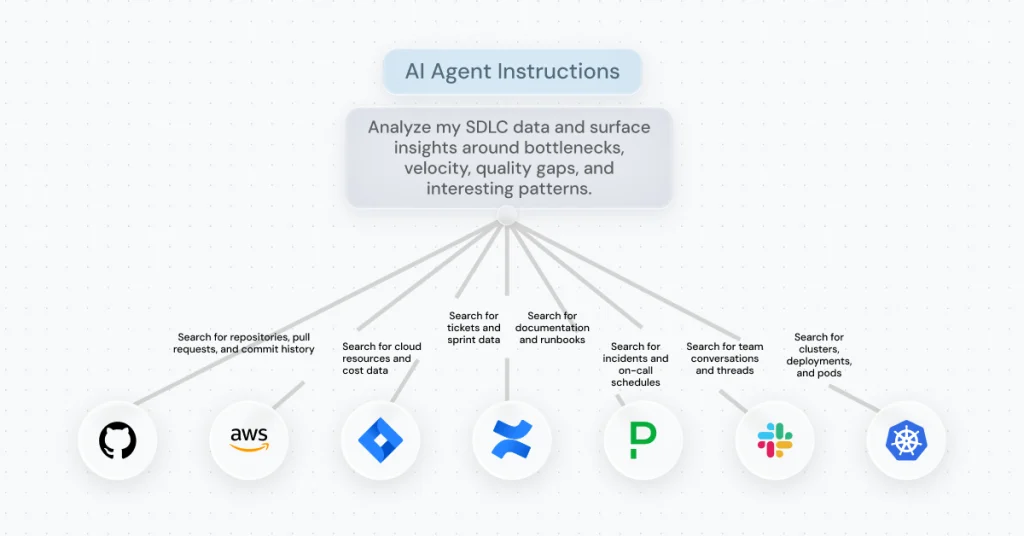
Integrations: Data flows into the Context Lake from a wide array of sources, including GitHub, Jira, AWS, PagerDuty, and other critical business systems. These integrations act as the ingestion points for raw operational data.
-
Mapping and Blueprints: The raw data is then mapped to the organization’s specific terminology and structure. For instance, a GitHub repository is defined as a "service," a Jira project as a "team’s backlog," and an AWS resource as part of an "environment." This process involves defining "blueprints" for core entities like services, teams, environments, and deployments, and establishing the relationships between them. This ensures that when a service is queried, its ownership, dependencies, and compliance status are consistently reported.
-
Scorecards and Standards: To enforce organizational standards, Context Lakes often incorporate "scorecards." These define what constitutes "production-ready" for services, track adherence to security requirements, and monitor progress against key performance targets. This allows AI agents to assess the readiness and compliance of various components within the organization’s tech stack.
-
Access Control and Guardrails: Similar to how human users have defined permissions, AI agents operate under strict access controls. They only have visibility into the data that the requesting human user is authorized to see, preventing unauthorized data access and ensuring compliance with internal policies.

-
Human and AI Interfaces: Humans interact with the Context Lake through dashboards and user interfaces, while AI agents access it via specialized MCP servers or APIs. Crucially, both humans and AI agents draw from the same, single source of truth, ensuring consistency and reducing the potential for information silos.
The Future of Context Engineering
The journey toward fully realized AI agent capabilities is ongoing. Companies are actively working with customers to identify evolving needs and further refine the functionality of Context Lakes. One significant area of development is "self-discovery capabilities," where AI itself can analyze existing data, identify relationships, and suggest appropriate modeling within the Context Lake. The ultimate goal is to create a Context Lake that can largely build and maintain itself, adapting to feedback and usage patterns.
Furthermore, the distinction between persistent, structured knowledge and temporal, dynamic data is being addressed. While a Context Lake excels at modeling stable organizational structures and relationships, data like logs, Slack messages, and lengthy documents are constantly changing and may not require permanent modeling. Solutions are being explored, such as read-only actions and specialized MCP connectors, to integrate this type of temporal data effectively, expanding the scope of what AI agents can understand and act upon. The evolution of AI agents is intrinsically tied to the sophistication and comprehensiveness of the contextual knowledge they can access, and the Context Lake represents a pivotal step in unlocking their true potential.
