

In the contemporary landscape of semiconductor design, the emergence of high-performance System-on-Chip (SoC) architectures has necessitated a fundamental shift in how data moves across silicon. No longer can simple crossbar-based fabrics handle the massive throughput and connectivity required by modern AI hyperscalers and data center processors. Instead, the industry has pivoted toward the Network-on-Chip (NoC), a sophisticated internal communication backbone that manages the flow of cache lines, snoop responses, and interrupts between hundreds of processing elements (PEs). However, this architectural leap has introduced a formidable verification challenge that traditional simulation methods are increasingly ill-equipped to handle, leading to a new era of formal verification strategies.
As AI workloads become more complex, the reliance on multi-threaded architectures using hundreds of PEs has become the standard. In these environments, crossbar-based fabrics fail to scale, prompting the adoption of NoC fabrics. This transition has also redefined how coherency is managed between compute elements. The industry-standard ACE (AXI Coherency Extensions) is increasingly viewed as inadequate for the demands of hyperscale computing, leading to the widespread adoption of the Arm AMBA 5 CHI (Coherent Hub Interface) protocol. The NoC now sits at the epicenter of every data movement within a coherent SoC, making its absolute reliability a prerequisite for system stability.
The Coherency Crisis: Why NoC Verification is Evolving
The distinction between non-coherent and coherent NoCs represents a significant jump in verification complexity. A non-coherent NoC is essentially a data transport layer responsible for moving bytes from point A to point B. Its primary obligations include ensuring in-order or out-of-order delivery, preventing deadlocks, and maintaining well-formed protocol packets. While challenging—particularly when accounting for low-power optimizations and Clock Domain Crossing (CDC) issues—the scope of verification remains bounded.
In contrast, a coherent NoC must maintain the integrity of the coherence protocol across every cache, snoop filter, directory entry, and Point-of-Coherence (PoC) in the fabric. When utilizing protocols like AMBA 5 CHI, the verification surface area expands exponentially. A single error, such as a mis-routed "Comp" (Completion) flit or a stale snoop response, can corrupt a cache line’s state at a requester without the rest of the system noticing. Such errors are often "structurally silent," meaning the hardware’s Reliability, Availability, and Serviceability (RAS) architecture might perceive a transaction as clean because every individual flit appears well-formed, even though the systemic state is compromised.
The staggering combination of states and transactions in a coherent NoC—including seven cache-line states (MOESI model), dozens of read/write variations, and complex snoop protocols—creates a state space that is impossible to navigate using simulation alone. Engineers are now faced with the reality that no simulation budget, regardless of its size, can reach the deep corner cases where the most catastrophic bugs reside.

The Limitations of Traditional Simulation
For decades, constrained-random simulation has been the workhorse of hardware verification. However, in the context of modern NoCs, simulation is hitting a wall. The primary issue is not that simulation misses bugs by accident, but that it is statistically incapable of hitting the specific combination of preconditions required to trigger a failure.
A typical NoC bug might require three or four simultaneous conditions: a specific buffer being full, a concurrent snoop request from a distant node, a credit exhaustion event, and a specific routing table update. The probability of a simulation environment hitting all these variables simultaneously is vanishingly small. Consequently, these bugs often remain hidden until the silicon reaches the "bring-up" phase or, worse, until it is deployed in a data center under real-world workloads. In these environments, the sheer volume of traffic makes the "impossible" combination of events a statistical certainty, leading to system crashes, deadlocks, or silent data corruption (SDC) that can take months to diagnose and cost millions in silicon respins.
A Taxonomy of NoC Bug Families
Research conducted by formal verification experts at Axiomise has identified several recurring bug families that frequently escape traditional verification flows. These categories serve as a roadmap for what modern verification plans must address to ensure silicon success:
- Data Integrity and Corruption: Errors in data payload delivery or silent corruption during transport.
- Deadlocks: Circular dependencies in resource allocation (e.g., buffers or virtual channels) that freeze data flow.
- Livelocks: Situations where transactions continue to move but never reach their destination.
- Protocol Violations: Non-conformance to CHI or AXI standards at the interface or internal nodes.
- Credit Management: Double-counting or losing flow-control credits, leading to eventual fabric stalls.
- Ordering Violations: Failure to maintain required transaction ordering, particularly in Reorder Buffers (ROB).
- Routing Errors: Flits being delivered to incorrect NodeIDs due to aliasing or table update hazards.
- Coherency Mismatches: Inconsistent cache states across different agents (e.g., a line marked "Unique" in two places).
- Snoop Failures: Dropped or incorrectly handled snoop responses.
- Virtual Channel Interference: Improper isolation between different traffic classes.
- Reset and Power States: Bugs occurring during the transition between low-power and active states.
- Security and Isolation: Unauthorized access to memory regions or leakage between secure and non-secure worlds.
Case Study: Silent Data Corruption and Deadlocks
To illustrate the severity of these issues, Axiomise highlighted two specific examples of bugs caught during the verification of complex NoCs.
The ID-Ordering Hazard: In one instance involving an AXI-based NoC, a bug was discovered in the Reorder Buffer (ROB). The ROB was designed to write responses to memory locations indexed by transaction IDs. However, a subtle flaw allowed two consecutive responses with the same ID to be written to the same address. The result was that the earlier response was silently overwritten by the later one. Because the flits themselves were valid, the system continued to operate without a crash, but the data being processed was incorrect—a classic case of Silent Data Corruption.
The NodeID Aliasing Deadlock: In a 2D mesh NoC carrying CHI traffic, a deadlock was traced back to a non-atomic update of a routing table. During a sequence of nine response flits transiting through a router, a routing table update occurred mid-stream. Because the update was not synchronized with the in-flight traffic, a "Consistency Hazard" occurred. Flits were routed based on a mixture of old and new table logic, leading to a circular dependency that halted the RSP (Response) virtual channel. This bug is particularly notable because it involved no bit-flips or parity errors; every component functioned exactly as programmed, yet the system failed due to a high-level architectural oversight.

Automated Formal Verification: The nocProve Breakthrough
Recognizing that manual formal verification is often too labor-intensive for fast-moving design teams, Axiomise developed nocProve, a domain-specific application powered by their CoreProve technology. The goal of this tool is to provide a "push-button" flow that brings the power of exhaustive formal proofs to NoC designers without requiring them to be formal verification experts.
The nocProve flow is designed to be minimally invasive. Engineers provide the NoC Register Transfer Level (RTL) code and the configuration files. The tool then automatically generates the necessary properties and invariants based on the protocol (AXI, CHI, etc.) and the topology (Mesh, Ring, or Crossbar).
This approach offers three distinct deliverables:
- Mathematical Proofs: A guarantee that a specific bug family (like deadlocks) is absent across all reachable states.
- Counter-examples: If a bug exists, the tool provides a full waveform trace showing exactly how to trigger it.
- Coverage Data: Insights into which parts of the design have been exhaustively verified.
Scalability and Performance Metrics
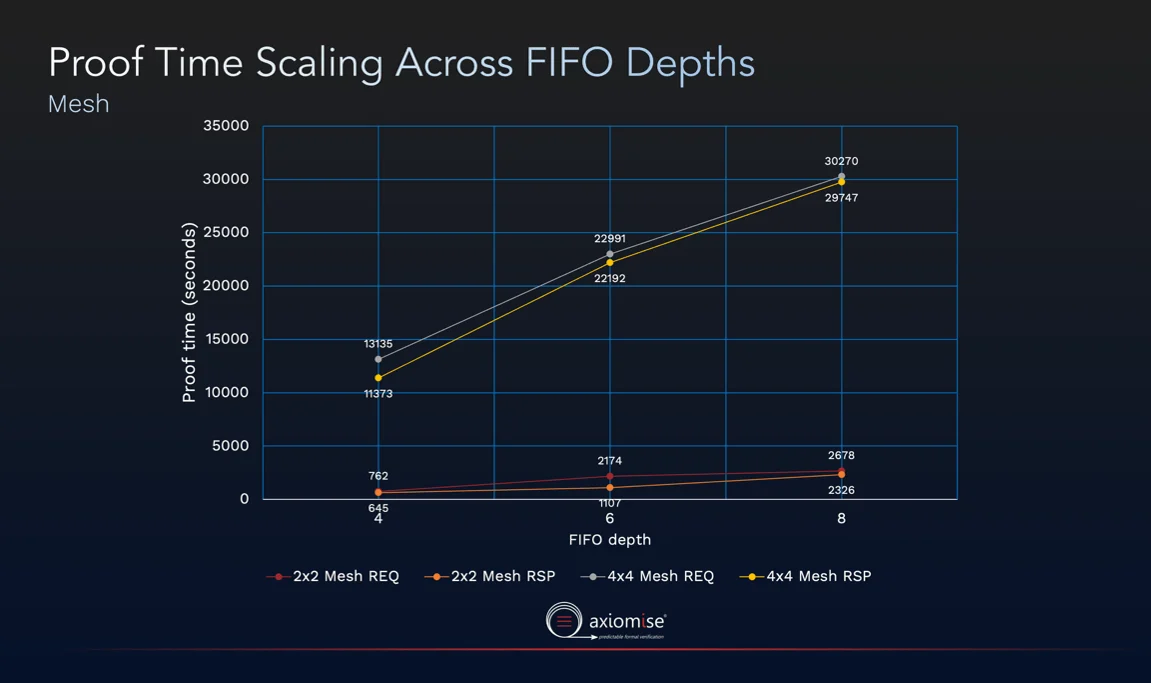
A common criticism of formal verification is that it struggles to scale to large designs. However, recent benchmarks on the "FlooNoC" (an open-source NoC generator) demonstrate that modern abstraction techniques are overcoming these hurdles.
In tests involving different mesh configurations, nocProve successfully analyzed designs with significant gate counts. For a 2×2 mesh with a FIFO depth of 8, the tool handled over 1.36 million gates. More impressively, in a 4×4 mesh configuration with a FIFO depth of 8, the gate count exceeded 5.77 million.
The analysis showed that while traditional formal tools often remain "inconclusive" (failing to find a proof or a bug within a reasonable timeframe), the abstraction-driven techniques in nocProve allowed for convergence in practical "wall-clock" time. For a 4×4 mesh, proofs were completed in significantly less time than would be required to run a comprehensive but non-exhaustive simulation suite.

| Mesh Size | FIFO Depth | Gate Count |
|---|---|---|
| 2×2 | 4 | 1,013,566 |
| 2×2 | 6 | 1,178,606 |
| 2×2 | 8 | 1,361,166 |
| 4×4 | 4 | 4,327,516 |
| 4×4 | 6 | 5,015,836 |
| 4×4 | 8 | 5,774,236 |
Table 1: Scalability data for FlooNoC configurations verified using automated formal methods.
Implications for the Semiconductor Industry
The shift toward automated, exhaustive NoC verification has profound implications for several key sectors:
AI and High-Performance Computing (HPC): For companies building massive AI accelerators, a single deadlock in the NoC can render an entire server rack useless. Exhaustive verification ensures that these expensive chips can handle the unpredictable traffic patterns of neural network training.
Automotive Systems: As vehicles move toward "Zonal Architectures" with central compute clusters, the NoC becomes a safety-critical component. The ability to prove the absence of certain bug families is essential for meeting ISO 26262 functional safety requirements.
Data Centers: In the hyperscale world, "Silent Data Corruption" is a nightmare scenario that can lead to corrupted databases or compromised encryption. Automated formal verification provides a level of data integrity assurance that simulation simply cannot match.
Conclusion
The verification of Network-on-Chip architectures has reached a tipping point. The complexity introduced by coherency protocols like Arm CHI, combined with the massive scale of modern SoCs, has rendered traditional simulation-only strategies obsolete for high-stakes silicon. As demonstrated by the research from Ashish Darbari and Bing Xue, the future of hardware integrity lies in "shifting left"—using automated formal verification to identify and eliminate deep corner-case bugs months before the first piece of silicon is ever poured. By moving from a posture of "searching for bugs" to "proving bug absence," design teams can finally keep pace with the relentless demands of the AI era.
