

A Network Policy Server (NPS) is a critical infrastructure component that empowers network administrators to establish and enforce stringent policies governing network access. Its primary function is to ensure that only authorized users and devices can connect to and utilize network resources. This versatile tool is central to achieving centralized authentication, authorization, and accounting (AAA) for all entities that interface with an organization’s network. Essentially, NPS serves as Microsoft’s robust implementation of a Remote Authentication Dial-In User Service (RADIUS) server and proxy within the Windows Server operating system, playing an indispensable role in both network management and security. To fully grasp the significance of NPS, it is essential to first understand the foundational RADIUS protocol, followed by an exploration of NPS’s specific purpose, its multifaceted benefits, its strategic role in contemporary networking, and the best practices for its effective management.
The Paramount Importance of Network Security and Policy Management in the Digital Age
In an era defined by an ever-increasing reliance on technology for core business operations, data exchange, and interpersonal communication, networks and their underlying servers have become prime targets for malicious actors. The proliferation of sophisticated cyber threats necessitates the implementation of exceptionally robust network security measures and meticulous policy management. The escalating frequency and complexity of cyberattacks, ranging from ransomware and data breaches to denial-of-service attacks, underscore the critical need for proactive and comprehensive security strategies. Effective policy management, facilitated by tools like NPS, is not merely a technical requirement but a fundamental business imperative, directly impacting data integrity, operational continuity, and reputational standing.
The key reasons highlighting the importance of network security and policy management include:
- Protection of Sensitive Data: Organizations handle vast amounts of sensitive data, including customer information, financial records, intellectual property, and proprietary business strategies. Unauthorized access to this data can lead to severe financial losses, legal liabilities, and irreparable damage to customer trust.
- Ensuring Business Continuity: Network disruptions caused by security breaches can halt operations, leading to significant downtime and lost productivity. Robust security measures and well-defined access policies help maintain network availability and ensure uninterrupted business operations.
- Compliance with Regulatory Requirements: Numerous industries are subject to stringent data protection regulations, such as GDPR, HIPAA, and PCI DSS. Effective network security and policy management are essential for meeting these compliance mandates and avoiding substantial fines and legal repercussions.
- Mitigating Financial Losses: The direct costs associated with cyberattacks, including incident response, data recovery, and legal fees, can be astronomical. Furthermore, indirect costs, such as lost revenue due to downtime and reputational damage, can be even more significant.
- Maintaining Customer Trust and Brand Reputation: A breach of network security can severely erode customer confidence and damage an organization’s brand image. Demonstrating a commitment to strong security practices is crucial for building and maintaining trust.
Understanding the RADIUS Protocol: The Foundation of Network Access Control
The RADIUS (Remote Authentication Dial-In User Service) protocol stands as a cornerstone of network access control, providing a standardized framework for comprehensive and centralized Authentication, Authorization, and Accounting (AAA) for users who connect to and utilize network services. Developed in 1991, RADIUS quickly became the de facto standard for network access servers, playing a pivotal role in managing and controlling access to networks, particularly in the early days of dial-up connectivity and subsequently evolving to support modern wireless and VPN infrastructures.
Authentication: Verifying User Identity
The first crucial component of the AAA framework is Authentication. This is the fundamental process by which a network verifies the identity of a user or device attempting to gain access. When a user initiates a connection request to a network service, they are typically prompted to provide credentials. These credentials commonly take the form of a username and password, but can also include certificates or other authentication factors. The RADIUS server meticulously examines these submitted credentials, cross-referencing them against its established user database and security policies. The successful verification of these credentials confirms the user’s legitimate identity, thereby preventing unauthorized access by imposters. This rigorous verification step is the initial and most critical barrier in securing network entry.
Authorization: Defining Access Privileges
Following successful authentication, the next critical phase is Authorization. This process meticulously determines the scope of access and the specific actions an authenticated user is permitted to perform within the network. Authorization policies are granular and can be tailored to individual users, user groups, or even specific devices. For instance, a senior IT administrator might be granted extensive privileges to manage network infrastructure, while a standard employee’s access might be limited to specific applications and data repositories relevant to their role. RADIUS servers manage these permissions dynamically, ensuring that each authenticated entity can only access the resources and functionalities that align with their designated authorization level, thereby enforcing the principle of least privilege.
Accounting: Tracking Resource Utilization
The final, yet equally vital, component of the AAA framework is Accounting. This function involves the systematic tracking and logging of user activities and their consumption of network resources. This detailed record-keeping includes monitoring the duration of user sessions, the specific network services accessed, the volume of data transferred, and the endpoints involved. The accounting data generated is invaluable for a multitude of purposes. It forms the basis for network usage analysis, capacity planning, and troubleshooting. Furthermore, it is indispensable for billing purposes in environments where resource consumption is charged, and it provides critical audit trails necessary for compliance with internal policies and external regulations. Understanding usage patterns through accounting data allows organizations to optimize resource allocation and identify potential security anomalies or policy violations.
The Operational Mechanics of RADIUS Servers
RADIUS operates on a well-defined client-server model. The RADIUS client, typically a network access server such as a VPN concentrator, a wireless access point, or a network switch, acts as the intermediary. When a user or device attempts to connect, the client intercepts the request and forwards the user’s credentials and connection parameters to the designated RADIUS server. The RADIUS server, upon receiving this request, processes it by consulting its user database and applying predefined access policies. Based on this evaluation, the server then transmits a response back to the client, either granting or denying access. If access is granted, the response may also include specific attributes that dictate the user’s session parameters, such as IP address assignment or bandwidth limitations.
Key features and functionalities of RADIUS servers include:
- Centralized AAA Management: Consolidating authentication, authorization, and accounting processes into a single server simplifies administration and enhances security.
- Protocol Support: RADIUS typically uses UDP ports 1812/1645 for authentication and authorization, and UDP ports 1813/1646 for accounting.
- Extensibility: The RADIUS protocol supports vendor-specific attributes (VSAs), allowing for customization and integration with a wide range of network devices and services.
- Security: RADIUS communication between the client and server is typically secured using shared secrets, and more advanced implementations can leverage EAP (Extensible Authentication Protocol) for enhanced security, including support for certificates and multi-factor authentication.
The Strategic Purpose of Network Policy Server (NPS)
Within an organization’s IT infrastructure, the Network Policy Server (NPS) plays a pivotal role, primarily serving as Microsoft’s comprehensive implementation of a RADIUS server and proxy. The overarching objective of NPS is to centralize and streamline the Authentication, Authorization, and Accounting (AAA) processes for all users and devices attempting to access the network. This consolidation significantly enhances both network security posture and the overall efficiency of network management.
Centralized Authentication and Authorization: The First Line of Defense
Centralized authentication ensures that every user and device seeking entry to the network undergoes a rigorous verification process, thereby establishing a robust first line of defense against unauthorized access. Authorization, in turn, defines the precise boundaries of what authenticated entities are permitted to access and do within the network. NPS expertly manages these critical functions to maintain a secure and efficient network environment.
NPS manages these crucial functions through:
- Connection Request Policies: These policies determine whether a connection request should be processed by the local NPS server or forwarded to a RADIUS proxy. They can also specify conditions based on the NAS (Network Access Server) identifier, the calling station ID, or the user’s domain.
- Network Policies: These are the core of NPS’s authorization capabilities. They define the conditions under which users and groups are granted or denied access to network resources. Conditions can include user group membership, time of day, the type of network connection (e.g., Wi-Fi, VPN), and the health status of the connecting device. Actions associated with these policies can include granting access, denying access, or applying specific constraints like bandwidth limits or session timeouts.
- RADIUS Client Configuration: NPS requires configuration of RADIUS clients (network access servers) to identify them and establish shared secrets for secure communication.
Accounting and Compliance: Ensuring Visibility and Accountability
The accounting capabilities of NPS are vital for tracking and logging all user activities and resource consumption within the network. This detailed auditing is paramount for monitoring purposes and for demonstrating compliance with internal policies and external regulatory standards. In today’s data-sensitive world, where organizations face increasing scrutiny regarding data handling and privacy, NPS plays a critical role in ensuring compliance.
NPS aids in ensuring compliance through:

- Detailed Logging: NPS can generate comprehensive logs of connection attempts, successful and failed authentications, authorization decisions, and accounting data. These logs can be stored locally or sent to a central syslog server for long-term retention and analysis.
- Reporting Capabilities: While NPS itself has limited built-in reporting, its logs can be integrated with third-party reporting and SIEM (Security Information and Event Management) solutions to generate detailed reports on network usage, security events, and compliance status.
- Support for Standards: NPS supports various accounting methods, including RADIUS standard accounting and Extended Accounting, which provide richer data points for analysis.
Policy-Based Network Management: Granular Control and Flexibility
Policy-based network management, as facilitated by NPS, empowers administrators to create and enforce highly specific network access policies, precisely tailoring network security and usage to meet the unique demands of an organization. This granular control over who can access what, and under what conditions, is fundamental to modern network security.
NPS facilitates the creation of these policies, impacting network security, user access, and overall network management through:
- Conditional Access: Policies can be configured to grant or deny access based on a wide array of conditions, offering flexibility and the ability to adapt to changing security requirements.
- Dynamic Policy Enforcement: Policies can be updated and enforced dynamically without requiring manual intervention on individual network devices.
- Integration with Other Systems: NPS can integrate with other Windows Server roles and services, such as Active Directory, to leverage user group memberships and other attributes for policy decisions. It can also integrate with Network Access Protection (NAP) to enforce device health policies.
The Multifaceted Benefits of Implementing NPS
The adoption and implementation of NPS within an organization’s network infrastructure yield a substantial array of benefits, significantly bolstering both security and operational efficiency. These advantages position NPS as an indispensable asset for organizations striving to optimize their network management practices.
Key benefits of using NPS include:
- Enhanced Network Security: By centralizing authentication and authorization, NPS significantly reduces the attack surface and prevents unauthorized access to sensitive network resources.
- Improved Administrative Efficiency: Consolidating AAA management simplifies the administration of network access policies, reducing the manual effort required to configure and manage individual network access devices.
- Scalability: NPS can be scaled to support large and complex network environments, handling a high volume of authentication and authorization requests.
- Flexibility and Customization: The policy-based approach allows for highly granular control over network access, enabling administrators to create policies tailored to specific user roles, device types, and security requirements.
- RADIUS Proxy Capabilities: NPS can act as a RADIUS proxy, forwarding requests to other RADIUS servers, which is crucial for distributed networks or for load balancing.
- Support for Various Network Access Technologies: NPS seamlessly integrates with a wide range of network access technologies, including VPNs, wireless access points, and dial-up connections.
- Compliance and Auditing: The robust accounting features of NPS provide essential data for auditing, compliance reporting, and troubleshooting.
- Centralized Management of Network Access: NPS provides a single pane of glass for managing network access policies, simplifying the overall network management experience.
The Three Distinct Roles of NPS in Network Management
NPS is a versatile tool that fulfills three fundamental roles within a network infrastructure, each contributing to its comprehensive network management capabilities.
1. NPS as a RADIUS Server: The Core Authentication Engine
In its primary role as a RADIUS server, NPS is responsible for processing authentication and authorization requests originating from network access servers. When a user or device attempts to connect to the network, the network access server forwards the credentials to NPS. NPS then rigorously verifies these credentials against its configured user database and access policies. Based on this verification, NPS determines the user’s access level and transmits a response back to the network access server, either granting or denying access. This function is critical for securing connections from various network access points, including VPN servers, wireless access points, and dial-up servers, thereby centralizing and streamlining the authentication process and efficiently managing user access across the entire network.
2. NPS as a RADIUS Proxy: Orchestrating Distributed Access
When configured as a RADIUS proxy, NPS acts as an intelligent intermediary, forwarding authentication and configuration requests to other RADIUS servers within the network. This capability is particularly valuable in complex, geographically dispersed, or multi-domain network environments. The proxy functionality enables NPS to centralize the management of RADIUS policies while distributing the actual authentication processing to multiple backend RADIUS servers. This approach can enhance performance through load balancing, distributing incoming requests across several servers to prevent any single server from becoming a bottleneck. Furthermore, it provides resilience through failover mechanisms; if one backend RADIUS server becomes unavailable, the proxy can reroute requests to an operational server, ensuring continuous network access. This role is instrumental in facilitating seamless cross-network authentication and management in large-scale deployments.
3. NPS as a Network Policy Server: Enforcing Access Rules
As a Network Policy Server, NPS’s primary directive is to manage and enforce network access policies. It defines the specific conditions under which users and devices are granted or denied access to network resources. This role allows administrators to establish highly granular control over network access by creating policies based on a diverse set of criteria. These conditions can include the time of day, the user’s group membership within Active Directory, the type of network connection being used, or even the health status of the connecting device. NPS’s ability to integrate with technologies like Network Access Protection (NAP) further enhances its capability to enforce device health policies, ensuring that only compliant and secure devices are permitted to connect to or communicate on the network, thereby bolstering overall network security.
Best Practices for Deploying and Managing NPS
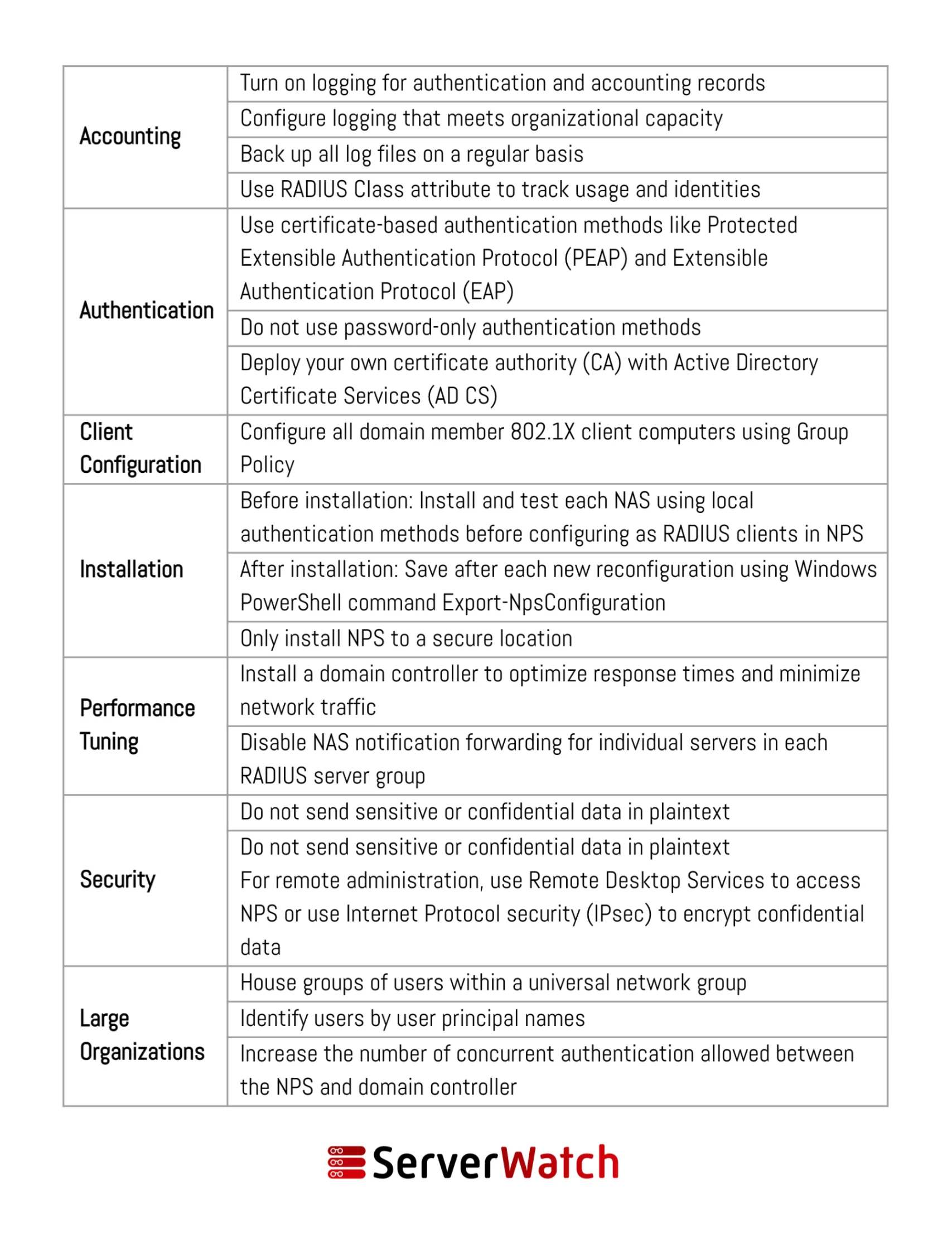
To maximize the effectiveness, security, and reliability of a Network Policy Server (NPS) deployment, adhering to established network and server management best practices is paramount. These practices ensure that NPS operates efficiently, securely, and in alignment with an organization’s broader network management objectives. Microsoft offers specific recommendations, but several additional considerations are crucial for a robust NPS implementation.
Key NPS best practices include:
- Segregation of Duties: Implement a clear separation of roles and responsibilities for managing NPS and network access policies to prevent unauthorized changes.
- Strong Shared Secrets: Utilize strong, complex, and regularly rotated shared secrets for communication between NPS and RADIUS clients to enhance security.
- Regularly Update and Patch NPS: Keep the Windows Server operating system and the NPS role updated with the latest security patches and updates to protect against known vulnerabilities.
- Secure Communication Channels: Wherever possible, use EAP methods that provide stronger authentication and encryption, such as PEAP or EAP-TLS, especially for wireless networks.
- Comprehensive Logging and Monitoring: Configure NPS to generate detailed logs and integrate these logs with a centralized logging system or SIEM for proactive monitoring, threat detection, and forensic analysis.
- Principle of Least Privilege: Apply the principle of least privilege to NPS service accounts and administrative access, ensuring that only necessary permissions are granted.
- Document Policies Thoroughly: Maintain clear and up-to-date documentation of all NPS policies, including their purpose, conditions, and actions, to facilitate understanding and troubleshooting.
- Regular Policy Review and Auditing: Periodically review NPS policies to ensure they remain relevant, effective, and aligned with current security requirements and business needs. Conduct regular audits of NPS logs to identify any suspicious activities or policy violations.
- Implement Failover and Load Balancing: For high availability and performance, deploy NPS in a clustered configuration or utilize RADIUS proxy capabilities for load balancing and failover.
- Test Changes in a Staging Environment: Before deploying any significant changes to NPS policies or configurations in a production environment, test them thoroughly in a staging or lab environment to identify potential issues.
- Utilize Network Access Protection (NAP): Integrate NPS with NAP to enforce device health policies, ensuring that only compliant and secure devices can access the network.
- Backup NPS Configuration: Regularly back up the NPS configuration to facilitate rapid recovery in the event of a system failure or disaster.
Bottom Line: The Indispensable Role of NPS in Modern Network Management
The Network Policy Server (NPS) has firmly established itself as an indispensable tool within the realm of network and server management, offering a potent, flexible, and highly secure solution for maintaining the integrity and efficiency of network operations. Integrating NPS into an organization’s network infrastructure is not merely about implementing a technical feature; it is a strategic decision that significantly enhances security by rigorously enforcing access policies, while simultaneously simplifying administrative tasks and leading to a more streamlined and effective management of network resources.
By diligently adhering to the recommended best practices in the deployment and ongoing management of NPS, organizations can substantially mitigate the inherent risks associated with network security threats. This proactive approach ensures a more seamless, secure, and reliable operational flow, safeguarding valuable data and maintaining business continuity in an increasingly complex digital landscape. The strategic deployment of NPS is, therefore, a critical step towards achieving robust network security and operational excellence.
To further enhance NPS functionality and performance, consider exploring one of the best free RADIUS server testing and monitoring tools, meticulously selected and reviewed by our experts.
Sam Ingalls contributed to this article.
