

Moore’s Law, the long-standing observation that the number of transistors on a microchip doubles approximately every two years, is entering its most turbulent phase as the semiconductor industry moves toward the 2-nanometer (2nm) node and sub-angstrom dimensions. While the industry continues to pursue higher transistor density, the traditional scaling formula—shrinking the size of components to gain speed and efficiency—is meeting unprecedented physical and economic resistance. At these extreme scales, "more" transistors often result in "less" efficiency if the surrounding infrastructure of the chip cannot keep pace. The transition marks a pivotal shift from simple geometric scaling to a complex era of "More-than-Moore" architectures, where advanced packaging, new materials, and workload-specific customization define the leading edge of computing.
The Physical Constraints of Sub-2nm Logic
Historically, the semiconductor industry relied on a predictable cadence of shrinking transistors, wires, and memory cells to improve performance. However, as dimensions drop below 2nm, the physics of the chip changes. One of the most pressing challenges is Resistance-Capacitance (RC) delay. As interconnect wires become thinner to accommodate higher density, their electrical resistance increases sharply, slowing down signal transmission and generating excess heat.
Furthermore, Static Random-Access Memory (SRAM) scaling has significantly lagged behind digital logic scaling. SRAM is essential for on-chip caching, but because memory cells cannot be shrunk at the same rate as logic gates without losing stability, the amount of memory that can fit on a standard reticle-sized die is becoming a bottleneck. This divergence forces designers to dedicate a larger percentage of the chip’s real estate to memory, effectively cannibalizing the space intended for processing power.
Yield management has also become a critical concern. In a modern fabrication facility (fab), process variation is an inherent reality. However, at 2nm, the sensitivity to these variations is magnified. Even minor warpage in ultra-thin metal layers or microscopic defects in raw materials can lead to faulty connections. With thousands of insertion points and dozens of sophisticated tools involved in the manufacturing process, the probability of a "perfect" chip decreases. As a result, while a die may contain billions more transistors, the percentage of functional chips per wafer often drops, driving up the cost per unit and complicating the return on investment for chipmakers.
A Chronology of Transistor Evolution: From FinFET to CFET
The path to 2nm has been defined by radical changes in transistor architecture. For over a decade, the FinFET (Fin Field-Effect Transistor) was the industry standard, providing superior control over current compared to earlier planar designs. However, as the industry approached the 3nm and 2nm thresholds, FinFETs reached their physical limits regarding leakage and drive current.
In response, the industry is transitioning to Gate-All-Around (GAA) FETs, also known as nanosheets or RibbonFETs. In this architecture, the gate surrounds the channel on all four sides, offering significantly better electrostatic control and allowing for further voltage scaling. Leading foundries, including TSMC, Samsung, and Intel, are currently deploying or refining GAA technologies for their 2nm-class nodes.

Looking further ahead to the 10-angstrom (1nm) node and beyond, the industry is preparing for the Complementary FET (CFET). This represents a structural revolution: instead of placing n-type and p-type transistors (nFETs and pFETs) side-by-side on a wafer, CFETs stack them vertically. While this dramatically increases structural complexity and introduces new interconnect challenges—such as the need for backside power distribution—it offers a path to continue increasing density when lateral space is exhausted. This transition is expected to be one of the most difficult engineering feats in semiconductor history, requiring entirely new material sets and manufacturing equipment.
Rethinking Margin and Real-Time Monitoring
As manufacturing becomes more precarious, the "guard-bands" or safety margins used by designers are under scrutiny. Traditionally, engineers added significant margins to their designs to account for potential process variations, thermal fluctuations, and aging. At 2nm, these static margins consume too much valuable space and power.
Experts from the Electronic Design Automation (EDA) and monitoring sectors argue that a shift toward real-time telemetry is necessary. Rather than relying on a "worst-case scenario" design, modern chips are beginning to incorporate built-in sensors that monitor timing margins, thermal gradients, and workload stress in real-time. This allows the system to adjust performance dynamically, reclaiming performance that was previously "hidden" behind conservative safety margins. This "workload-aware" design is particularly vital for Artificial Intelligence (AI) applications, where training and inference patterns create highly non-uniform stress across the silicon.
The Economic Necessity of Chiplets and Panel-Scale Processing
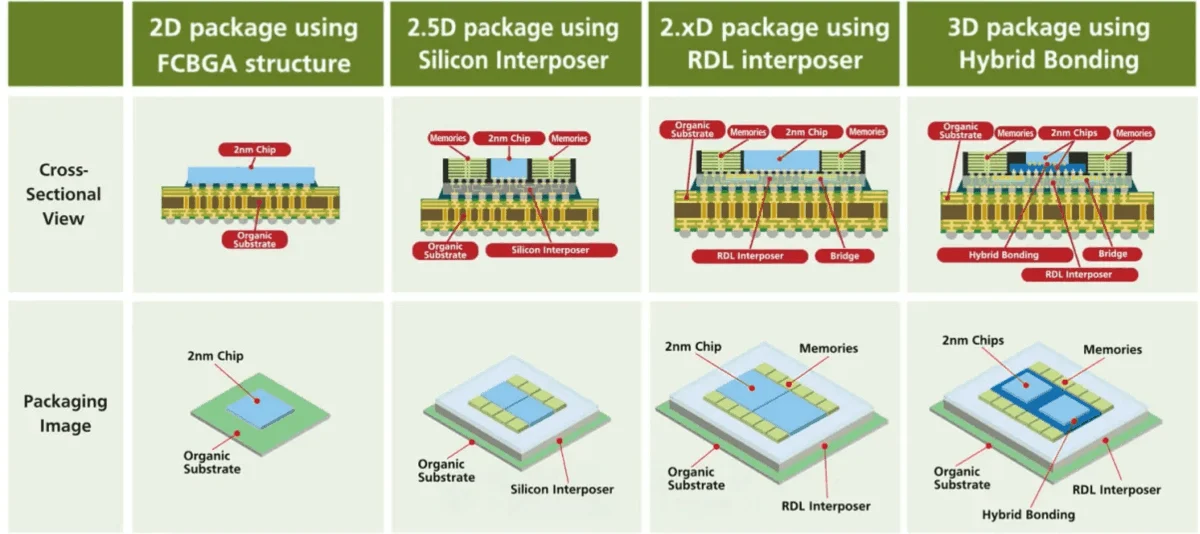
The massive capital requirements of the 2nm node are reshaping the economics of the industry. The cost of developing a 2nm chip can exceed $1 billion when accounting for design, IP licensing, and manufacturing. To mitigate these costs, the industry is moving away from monolithic designs—where everything is on one large chip—toward "chiplets."
By breaking a system into smaller, functional dies (chiplets) and connecting them in an advanced package, manufacturers can use the most expensive 2nm logic only where it is needed, while using more mature, cost-effective nodes for components like I/O or power management. This modular approach also improves yield, as smaller dies are less likely to contain defects than a single, massive reticle-sized chip.
This shift has also revived interest in large-format manufacturing. Since 2008, the industry debated moving from 300mm to 450mm circular wafers to increase throughput, an effort that was largely abandoned by 2017 due to technical hurdles and lack of industry-wide consensus. Today, the focus has shifted toward rectangular panel-scale processing. Rectangular panels provide more usable area and less waste compared to circular wafers, particularly for the large interposers required in AI data center chips. Intel and other major players are exploring panels as large as 510mm x 515mm to meet the insatiable demand for AI hardware.
Material Innovation and the Role of Photonics
To overcome the electrical bottlenecks of sub-2nm nodes, the industry is turning to exotic materials. The transition from Tungsten to Molybdenum for wordlines in NAND and DRAM is already underway, while Cobalt is increasingly being replaced by Ruthenium for low-level interconnects. These materials offer lower resistivity at smaller dimensions, helping to combat the RC delay that plagues copper wiring.

Furthermore, the integration of photonics—using light instead of electricity to move data—is moving from a research concept to a manufacturing reality. Large AI clusters require massive amounts of data to be moved between chips with minimal latency and heat. Optical waveguides embedded in glass substrates are being developed to facilitate this movement. Glass substrates offer several advantages over traditional organic materials, including superior structural stability, reduced warpage, and a coefficient of thermal expansion that closely matches silicon, making them ideal for the next generation of multi-die assemblies.
Industry Reactions and Foundries’ Strategic Shifts
The global foundry landscape is currently a four-way race between TSMC, Intel Foundry, Samsung Foundry, and the Japanese newcomer, Rapidus. Each is taking a slightly different approach to the 2nm challenge:
- TSMC is leveraging its "NanoFlex" architecture, which allows designers to mix and match different types of standard cells (high-performance vs. high-density) within the same design, providing a balance between power and speed.
- Intel Foundry is betting heavily on its 18A (1.8nm) and 14A (1.4nm) nodes, emphasizing "definitional customers" who help shape the node’s requirements. Intel is also a pioneer in High-NA EUV (Extreme Ultraviolet) lithography, which uses a higher numerical aperture to print finer features in a single pass, potentially reducing costs and complexity.
- Samsung is focusing on the synergy between its logic and memory divisions, planning to offer custom High Bandwidth Memory (HBM) that is integrated directly with 2nm logic to eliminate data bottlenecks.
- Rapidus is aiming for a "die-on-wafer" and "die-on-panel" approach, attempting to collapse the traditional wall between front-end wafer fabrication and back-end packaging into a single, streamlined process.
Broader Impact and Implications for the Global Economy
The successful transition to 2nm and beyond is not merely a technical milestone; it is a geopolitical and economic imperative. AI data centers, which currently drive the majority of leading-edge demand, require exponential increases in performance-per-watt to remain sustainable. If the industry fails to overcome the 2nm hurdles, the progress of generative AI and high-performance computing could stall due to energy constraints and prohibitive costs.
Moreover, the shift toward customization means that the era of "general-purpose" silicon is fading. Hyperscalers like Amazon, Google, and Microsoft are increasingly designing their own bespoke chips tailored to their specific AI workloads. This trend empowers the foundries but puts pressure on traditional chip designers to offer more flexible, IP-rich platforms.
In conclusion, the journey to 2nm and the subsequent angstrom nodes represents a fundamental transformation of semiconductor manufacturing. The industry is moving from a focus on the transistor to a holistic view of the system, where materials, light, and 3D structures are just as important as the size of the logic gate. While the challenges of physics and economics are more daunting than ever, the convergence of AI demand and manufacturing innovation suggests that Moore’s Law will continue to evolve, even if the "law" itself looks very different in the decade to come.
