
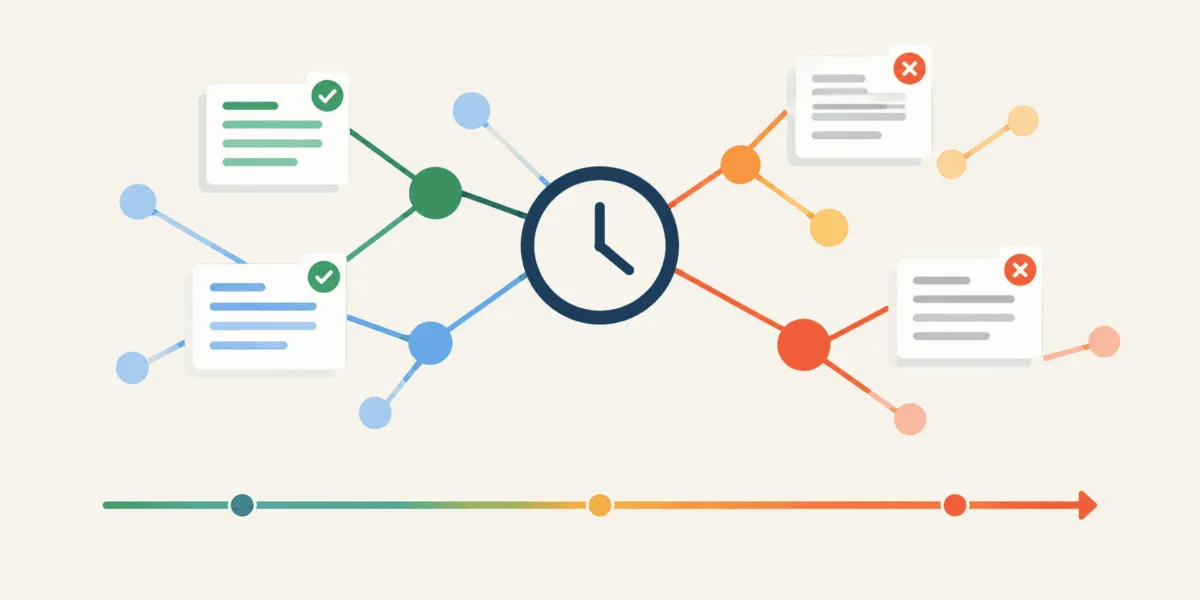

In the rapidly evolving landscape of Retrieval-Augmented Generation (RAG) architectures, the persistence of stale information remains a significant barrier to the deployment of high-fidelity automated reasoning systems. While traditional Knowledge Graphs (KGs) have long been utilized to structure data into discrete Subject-Predicate-Object (SPO) triples, this format inherently lacks a temporal dimension. In real-world enterprise environments, where leadership, policies, and market conditions shift with high velocity, the inability to distinguish between current truths and legacy data often leads Large Language Models (LLMs) to generate hallucinations. By implementing a lightweight temporal reasoning layer—transitioning from static triples to dynamic, time-stamped quadruples—developers can significantly enhance the precision of RAG outputs through a process of weighted recency scoring.
The Problem of Static Knowledge in Dynamic Contexts
The foundational weakness of standard graph-based retrieval lies in its context-agnostic nature. In a conventional Knowledge Graph, the statement (TechCorp, HAS_CEO, Alice) is recorded as a binary truth. If the graph is updated to include (TechCorp, HAS_CEO, Bob) without an associated metadata layer, the retrieval engine treats both facts as equally valid. When a user queries the system for the current CEO of TechCorp, the retriever may surface conflicting or outdated information.
For enterprise applications, such as legal document analysis or financial forecasting, this ambiguity is unacceptable. Studies indicate that LLMs, when provided with contradictory retrieved context, often default to the most frequent entity or the one mentioned earliest in the provided snippet, regardless of temporal accuracy. The transition to temporal quadruples—(Subject, Predicate, Object, Timestamp)—is not merely an architectural upgrade; it is a necessity for maintaining data integrity in systems where the state of the world is subject to frequent change.
Chronology and the Implementation of Temporal Quads
To mitigate the risk of stale data, the integration of a temporal reasoning engine requires a re-engineering of the graph’s data ingestion pipeline. Instead of storing a singular value for a predicate, the knowledge base must be restructured to maintain a time-series history of facts.
In a practical implementation, a TemporalGraph class acts as the primary data structure. Unlike a standard graph database that overwrites previous entries, this approach appends a timestamp to every assertion. The following Python logic illustrates the transition:
import datetime

class TemporalGraph:
    def __init__(self):
        # Data is stored as: Subject -> Predicate -> List of (Object, Date)
        self.knowledge_base =

    def add_fact(self, subject, predicate, obj, date_string):
        fact_date = datetime.datetime.strptime(date_string, "%Y-%m-%d").date()
        if subject not in self.knowledge_base:
            self.knowledge_base[subject] =
        if predicate not in self.knowledge_base[subject]:
            self.knowledge_base[subject][predicate] = []
        self.knowledge_base[subject][predicate].append((obj, fact_date))
This structure allows the system to retain a complete historical record, providing the necessary context for the reasoning engine to determine which information remains relevant at any given "query time."
Applying Exponential Decay for Truth Calibration
Once the historical timeline is established, the system must assign a confidence score to each retrieved fact. Simple linear sorting is often insufficient, as the rate of information decay varies across different domains. For example, a company’s incorporation date is a static, high-confidence fact, while a temporary management appointment is subject to rapid obsolescence.
To address this, developers utilize an exponential decay function. By setting a "half-life" for facts, the system can mathematically downgrade the relevance of older data points. The formula weight = (0.5) ^ (age_in_days / half_life) serves as a robust mechanism for weighting. If a half-life of 365 days is applied, a fact exactly one year old will carry a weight of 0.5, while a fact recorded today will carry a weight of 1.0.
This approach forces the retrieval layer to prioritize the most current truth. For instance, in a scenario involving a rapid succession of corporate appointments—where Alice, Bob, and Charlie occupy the CEO position within the same week—the temporal engine sorts these candidates by their confidence weight at the moment of the query, effectively "time-traveling" to the correct state of reality.
Comparative Analysis: Querying the Temporal Graph
The effectiveness of this system is best demonstrated through comparative query analysis. Consider a corporate timeline where leadership changes are frequent. If the system is queried for the CEO on November 18, 2023, the engine correctly identifies Bob (appointed November 17, 2023) as the most accurate candidate. If queried again on December 1, 2023, the engine recognizes the subsequent update from November 21, 2023, and re-ranks the results accordingly.
The implications for this are vast. In automated compliance monitoring, for instance, a system that can distinguish between a policy that was active in 2022 versus one that was amended in 2024 prevents the retrieval of deprecated compliance standards. This reduction in the "noise-to-signal" ratio during the retrieval phase allows the LLM to function more efficiently, as the prompt window is populated with only the most relevant, time-sensitive facts.
Broader Implications for Enterprise AI
Industry analysts suggest that the integration of temporal logic into RAG systems is a critical step toward achieving "deterministic" AI. Currently, many organizations are hesitant to deploy RAG in high-stakes environments due to the "black box" nature of information retrieval. By explicitly defining the temporal boundaries of facts, companies can provide audit trails that explain why a specific piece of information was selected.
Furthermore, this method provides a scalable solution for managing data drift. In traditional vector-based RAG, updating the knowledge base often requires costly re-embedding of the entire corpus. With a temporal graph, the system can be updated by adding a single record, with the decay function automatically ensuring that the new information supersedes the old without requiring a total system re-index.
Challenges and Future Considerations
Despite the efficacy of this approach, several challenges remain. The primary constraint is the availability of accurate timestamps for ingested data. In many legacy enterprise datasets, dates are often missing, inaccurate, or stored in heterogeneous formats, complicating the parsing process. Furthermore, determining the optimal "half-life" parameter requires domain-specific knowledge; a universal half-life is rarely applicable across diverse sectors like healthcare, finance, and logistics.
Research into adaptive, dynamic half-life tuning—where the system learns the decay rate of specific types of facts based on historical performance—is currently a primary area of focus. As these systems mature, the synergy between Knowledge Graphs and Large Language Models will likely become the standard architecture for enterprise-grade generative AI, providing a reliable bridge between historical data and real-time decision-making.
Conclusion
The evolution of RAG architectures from static, retrieval-based search engines to dynamic, temporal-aware reasoning systems represents a fundamental shift in how organizations leverage their data. By upgrading SPO triples to temporal quadruples and applying exponential decay to fact weights, developers can eliminate the pervasive issue of stale information. This technical advancement not only minimizes the potential for AI hallucinations but also ensures that the context provided to LLMs remains rooted in the most current, verifiable truth. As the industry moves toward more complex agentic workflows, the ability to navigate the dimension of time will undoubtedly be a defining characteristic of reliable and robust AI systems.
