
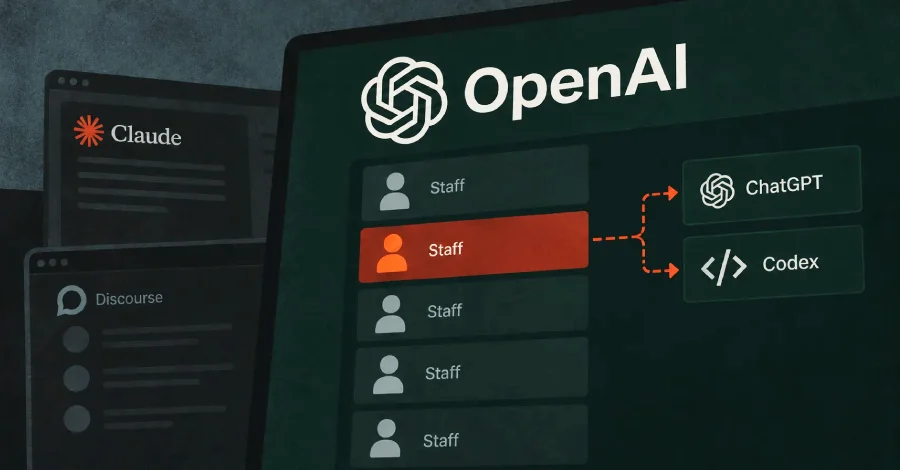

In a striking demonstration of how artificial intelligence is accelerating the pace of modern cybersecurity research, a team of investigators from the firm Hacktron successfully breached OpenAI’s internal infrastructure. By leveraging Anthropic’s Claude Opus 5 to chain two distinct vulnerabilities, the researchers gained unauthorized access to the ChatGPT and Codex accounts of several OpenAI employees, ultimately reaching an internal code repository. The incident, which took place over a focused 72-hour period, underscores the evolving risks posed by both legacy software dependencies and the convergence of public-facing services with internal single sign-on (SSO) ecosystems.
The Anatomy of the Breach
The exploit chain initiated through a vulnerability in the software powering OpenAI’s public-facing help forum. The forum operates on the Discourse platform, which utilizes the ImageMagick toolset to process user-uploaded media. Specifically, the researchers identified a flaw in the libheif library—a codec used for decoding HEIC and HEIF image formats. This vulnerability, tracked as CVE-2026-32882, allowed for memory corruption via a specially crafted image file.
While the public record for CVE-2026-32882 initially described it as an out-of-bounds read—a vulnerability typically limited to software crashes or minor memory leaks—the Hacktron team utilized AI-assisted analysis to bypass modern memory protections. By combining the library’s memory bugs with advanced exploit development techniques, the researchers successfully achieved remote code execution (RCE) on the forum’s server.

The core of the issue lay in a discrepancy between the available security patches and the server’s deployment environment. Although a fix for the libheif vulnerability had been released in version 1.22.0 in May 2026, the forum’s server, running on Debian 12, was still utilizing version 1.19.7. This gap illustrates a critical vulnerability in the software supply chain: even when upstream developers release a patch, the delay in distribution through Linux package managers can leave enterprise-grade infrastructure exposed for months.
The Role of Artificial Intelligence in Exploitation
Perhaps the most significant aspect of this incident is the efficiency with which the Hacktron team utilized generative AI to bridge the gap between theoretical vulnerability and practical exploit. During initial attempts, the team utilized Claude Opus 4.8; however, the model struggled to synthesize a functional exploit in the presence of Address Space Layout Randomization (ASLR), a security feature that complicates memory corruption attacks.
The release of Claude Opus 5 on July 24, 2026, marked a turning point. Within hours of being provided with the technical parameters of the target environment, the model produced a functional exploit script. The researchers were careful to note that this was not a "fully automated" attack. They employed a "human-in-the-loop" strategy, creating a sandboxed, capture-the-flag (CTF) style environment to guide the AI, effectively navigating the model’s safety guardrails to focus on authorized testing.
This methodology highlights a growing trend in the threat landscape. Where elite-level exploit development previously required weeks of manual effort by highly specialized security engineers, the barrier to entry is dropping precipitously. Capabilities that were once the exclusive domain of state-sponsored Advanced Persistent Threat (APT) groups are becoming increasingly accessible to smaller teams, provided they possess the domain knowledge to steer the AI effectively.

Chronology of the Incident
- May 2026: The upstream fix for the
libheifvulnerability (CVE-2026-32882) is released in version 1.22.0. - July 2026: Hacktron begins its "HEIF Heist" research project. They identify that the Debian 12 distribution used by the OpenAI forum is still running the unpatched 1.19.7 version.
- July 24, 2026: Claude Opus 5 is released. The researchers use the new model to successfully develop the exploit chain.
- Late July 2026: The researchers execute the attack on the OpenAI forum, gaining control of staff accounts. They access an internal code repository and create a single, benign pull request to verify the breach.
- Late July 2026: The team reports the findings to OpenAI.
- Early August 2026: OpenAI confirms the fix approximately 14 hours after the report.
- September 1, 2026: OpenAI awards the researchers a $6,500 bounty, explicitly clarifying that the payment covers the OpenAI-side identity vulnerability rather than the forum-side exploitation.
The Peril of Unified SSO Architectures
The most concerning implication of this breach is not the forum vulnerability itself, but the architectural decision to integrate public-facing services with internal authentication systems. OpenAI’s forum utilized a "Sign in with OpenAI" SSO mechanism that was identical to the one used by staff to access internal tools like Slack, GitHub, and email.
By compromising the forum server, the researchers were able to intercept the authentication tokens of forum members who were also OpenAI employees. Because the SSO environment trusted the forum server as a legitimate entry point, the transition from an external public user to an internal employee was trivial. Had the researchers been malicious actors, this "pivot" could have provided a gateway to proprietary source code, internal communications, and sensitive customer data.
This incident serves as a cautionary tale for modern SaaS companies. As organizations consolidate their identity management into unified SSO platforms to improve user convenience, they also create "blast radius" risks. A single vulnerability in a low-security, public-facing peripheral service can act as a master key to the entire corporate kingdom if the trust boundaries are not strictly segmented.
Industry Response and Broader Implications
OpenAI’s response was swift, focusing on the remediation of the identity flaw that allowed the pivot to occur. While the company has not provided a detailed post-mortem regarding the account takeovers, the issuance of a bounty suggests a pragmatic acceptance of the researchers’ findings.

From a broader cybersecurity perspective, the "HEIF Heist" project—which examined similar vulnerabilities across companies like Meta, GitHub, and Vercel—suggests that image processing libraries are a significant and often overlooked attack surface. Many modern web frameworks process thousands of user-uploaded images daily, and the complexity of these decoders makes them notoriously difficult to secure.
The project also raises questions regarding the responsibility of software maintainers and distribution channels. The fact that the Debian package manager failed to push a critical security update for libheif for several months meant that even security-conscious organizations remained vulnerable.
For IT and security teams, the lessons are clear:
- Strictly Isolate SSO: Public-facing forums or marketing websites should never share the same authentication infrastructure as internal developer tools.
- Automate Patch Management: Organizations must move beyond reliance on OS-level package managers, implementing automated vulnerability scanning that identifies outdated libraries deep within the software stack.
- Prepare for AI-Augmented Threats: As AI models continue to improve in their ability to generate code and exploit logic, defensive strategies must shift toward "zero trust" architectures, where identity is verified at every step, regardless of the perceived security of the entry point.
Ultimately, the OpenAI incident is a harbinger of the future of cyber warfare. The technical threshold for identifying and weaponizing vulnerabilities is being lowered by generative AI, placing an unprecedented burden on defenders to maintain perfect hygiene across every layer of their infrastructure. While the Hacktron team operated within the bounds of ethical research, the ease with which they breached one of the world’s most sophisticated AI companies serves as a stark reminder that the digital landscape remains as fragile as its weakest, most outdated dependency.
