

As artificial intelligence systems transition from experimental prototypes to mission-critical production environments, enterprise engineering teams frequently encounter severe architectural bottlenecks. Modern autonomous agents require robust underlying infrastructure capable of maintaining persistent operational states across complex multi-step workflows that frequently span multiple hours or even consecutive days. Furthermore, these sophisticated workloads demand seamless coordination between diverse collaborative agents, secure context sharing, and, in many specialized scenarios, direct access to hardware accelerators such as Graphics Processing Units (GPUs) for intensive computational tasks.
Historically, developing, configuring, and scaling this requisite infrastructure has placed a heavy operational burden on software developers, requiring them to manually provision virtual servers, construct complex networking rules, and manage persistent session states. To mitigate these industry-wide challenges, Amazon Web Services (AWS) has announced the official launch of runtime instances, a comprehensive, complementary compute option integrated directly into the Amazon Bedrock AgentCore Runtime service. This new offering provides developers with fully managed, persistent infrastructure specifically engineered to support demanding, long-running, and highly collaborative agent ecosystems at enterprise scale.
Background Context and Architectural Evolution
The introduction of runtime instances represents a major step forward in the evolution of managed AI infrastructure. Previously, the Amazon Bedrock AgentCore Runtime relied primarily on microVM architectures designed for invocations lasting up to eight hours, supported by managed session storage. While highly efficient for lightweight, rapid orchestration tasks, these microVMs presented limitations for enterprise workloads requiring continuous, multi-day execution, direct operating system access, or heavy GPU utilization.

To overcome these constraints, developers previously had to shoulder the complete operational responsibility of setting up raw Amazon Elastic Compute Cloud (Amazon EC2) instances. This manual approach required engineering teams to configure secure virtual private clouds (VPCs), establish intricate networking layers, construct custom session management frameworks, and stitch together disparate monitoring tools. The new runtime instances completely eliminate this heavy lifting, abstracting away the underlying infrastructure provisioning while seamlessly preserving the established security controls, observability features, and application programming interfaces (APIs) inherent to the AgentCore ecosystem.
Core Capabilities and Technical Specifications
At its foundation, runtime instances deliver AWS-managed EC2 infrastructure that allows engineering teams to deploy multiple autonomous agents within a single, unified runtime environment. Each deployed agent maintains its own isolated dependencies and artifact types while retaining the ability to collaborate directly with peer agents operating on the same physical host.
A defining feature of this release is the support for extended session persistence, allowing shared multi-agent sessions to remain active for up to 14 consecutive days. Additionally, the platform fully supports GPU acceleration for computationally demanding tasks such as machine learning model training, deep code compilation, and complex graphical user interface (GUI) automation. To optimize resource utilization and control enterprise cloud expenditure, the service incorporates intelligent session stop and restart functionalities, allowing organizations to hibernate idle workflows and resume operations seamlessly.
For persistent knowledge storage that must survive beyond the lifecycle of a temporary session, runtime instances integrate natively with Amazon Elastic Block Store (Amazon EBS) and AgentCore Memory. This integration grants agents long-term recall capabilities across distinct sessions and isolated runtime environments, significantly enhancing their contextual awareness and reasoning capabilities over extended periods.
Multi-Agent Collaboration and Framework Flexibility
Modern enterprise AI applications increasingly rely on multi-agent architectures where specialized agents divide and conquer complex problem domains. Runtime instances facilitate this paradigm by allowing distinct agents to invoke one another directly as tools within a shared session, iterating autonomously until a designated objective is successfully accomplished.
Crucially, the architecture remains entirely agnostic regarding the underlying development frameworks and machine learning models utilized by engineering teams. Developers retain complete freedom to build solutions using popular frameworks such as CrewAI, LangGraph, LlamaIndex, and Strands, while coupling them with any preferred foundation model. Packaging an agent for deployment requires minimal friction, typically involving a simple @app.entrypoint decorator combined with a lightweight container image or compressed zip file. Furthermore, complex multi-day workflows can be safely hibernated—such as pausing execution on a Monday evening—and resumed mid-week with all operational contexts, files, and memory states completely intact.
Complementary Integration of Compute Options
Rather than replacing existing deployment models, runtime instances are designed to operate harmoniously alongside runtime microVMs. Enterprises can deploy these two complementary compute options independently or combine them within a unified architectural design using standard AgentCore runtime APIs.
In a typical hybrid configuration, a lightweight orchestrator agent running on a rapid-scaling runtime microVM can manage high-level API calls, execute task routing, and handle result aggregation. Meanwhile, specialized worker agents deployed on runtime instances can execute heavy, compute-intensive processes—such as automated security vulnerability scanning, deep code analysis, or large-scale data compilation—that require continuous state management and direct operating system visibility.
Practical Implementation and Demonstration
To illustrate the practical utility of runtime instances, developers can construct multi-agent workflows that leverage shared file systems for seamless inter-agent communication. In a representative demonstration scenario, an engineering team deploys two distinct agents: a code writer agent programmed to generate Python applications from natural language prompts, and a code reviewer agent tasked with analyzing generated code for bugs, adherence to style guidelines, and potential security vulnerabilities.
By deploying both agents to share the same underlying EC2 capacity provider and referencing a unified session identifier, the two entities share a common working directory on the host file system. When the writer agent generates a Python script, it writes the artifact directly to the shared session storage path. Subsequently, when the reviewer agent is invoked within the same session, it reads the identical file path without requiring any external data transfers, intermediate network calls, or complex API integrations.
Deploying this infrastructure through the AWS Management Console follows a structured, multi-step methodology:
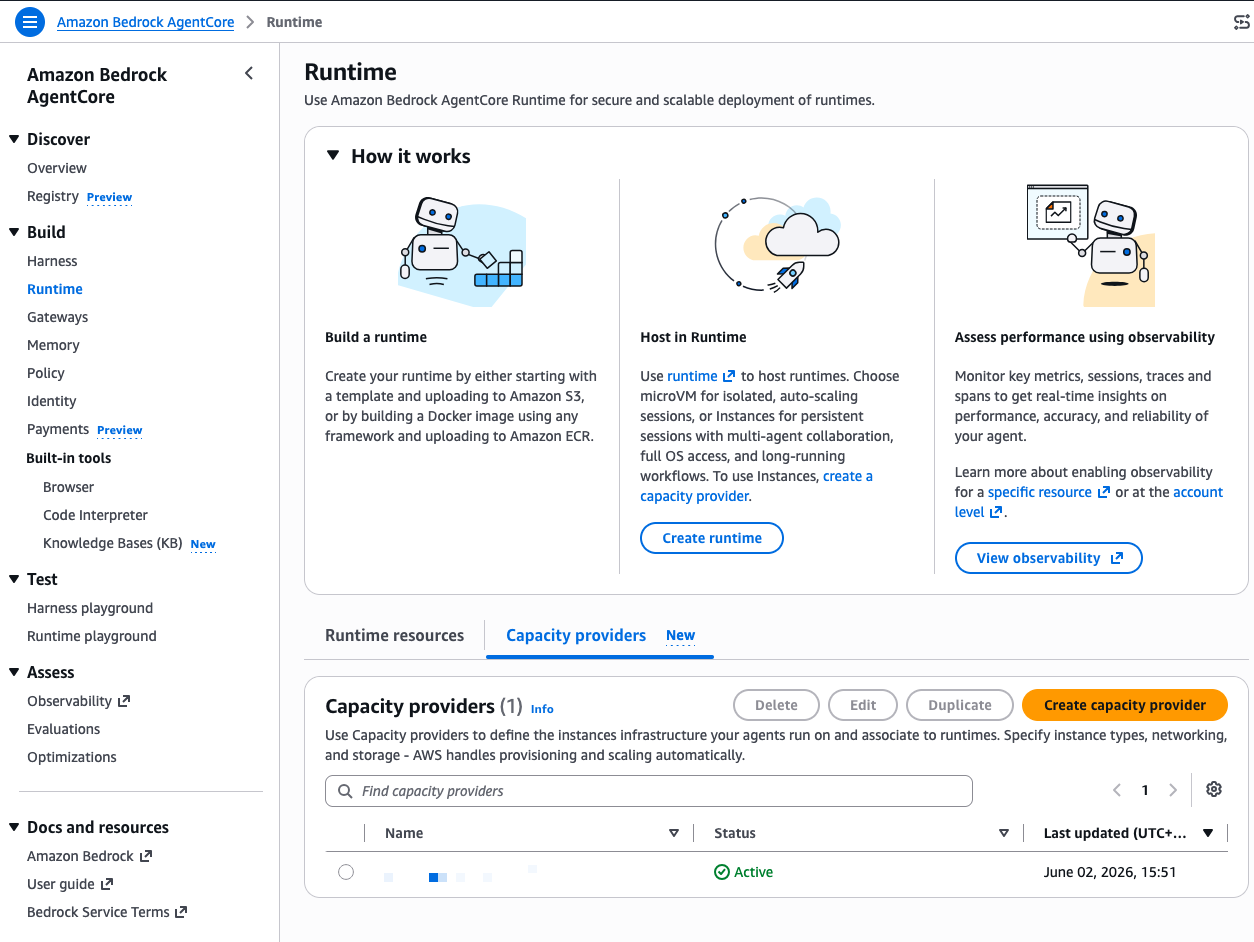
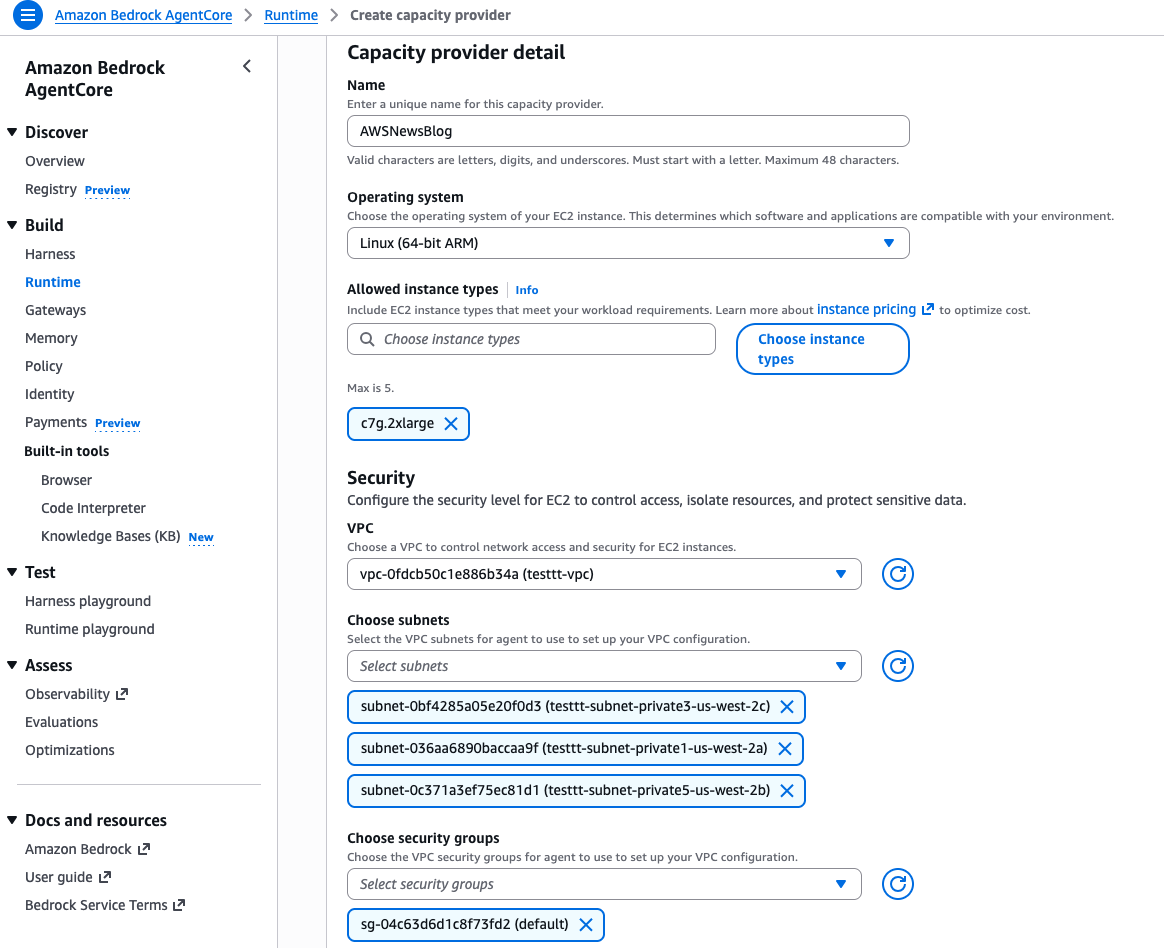
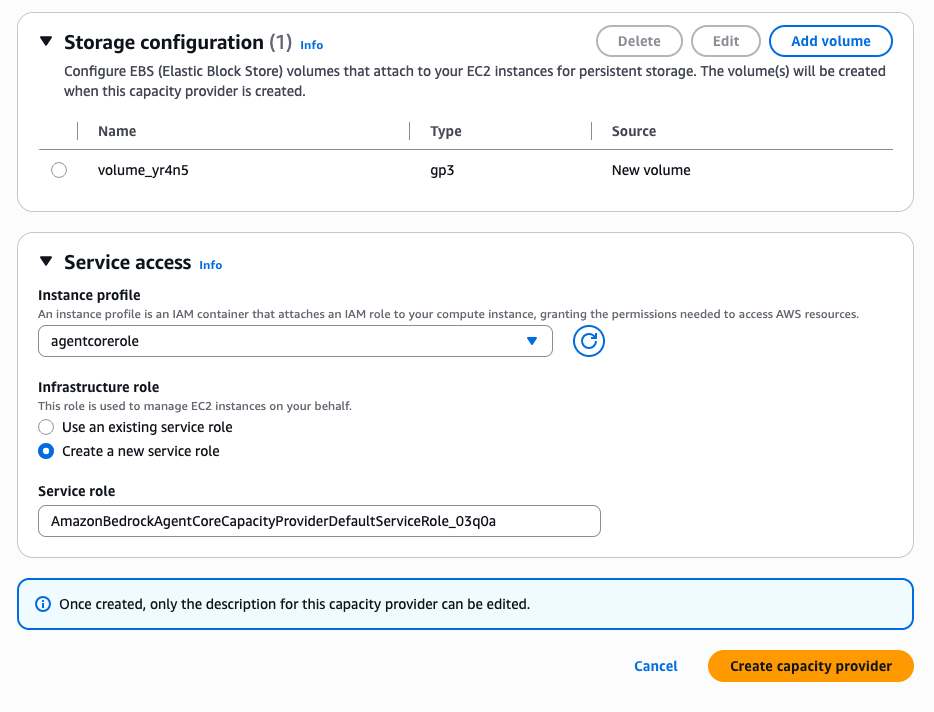
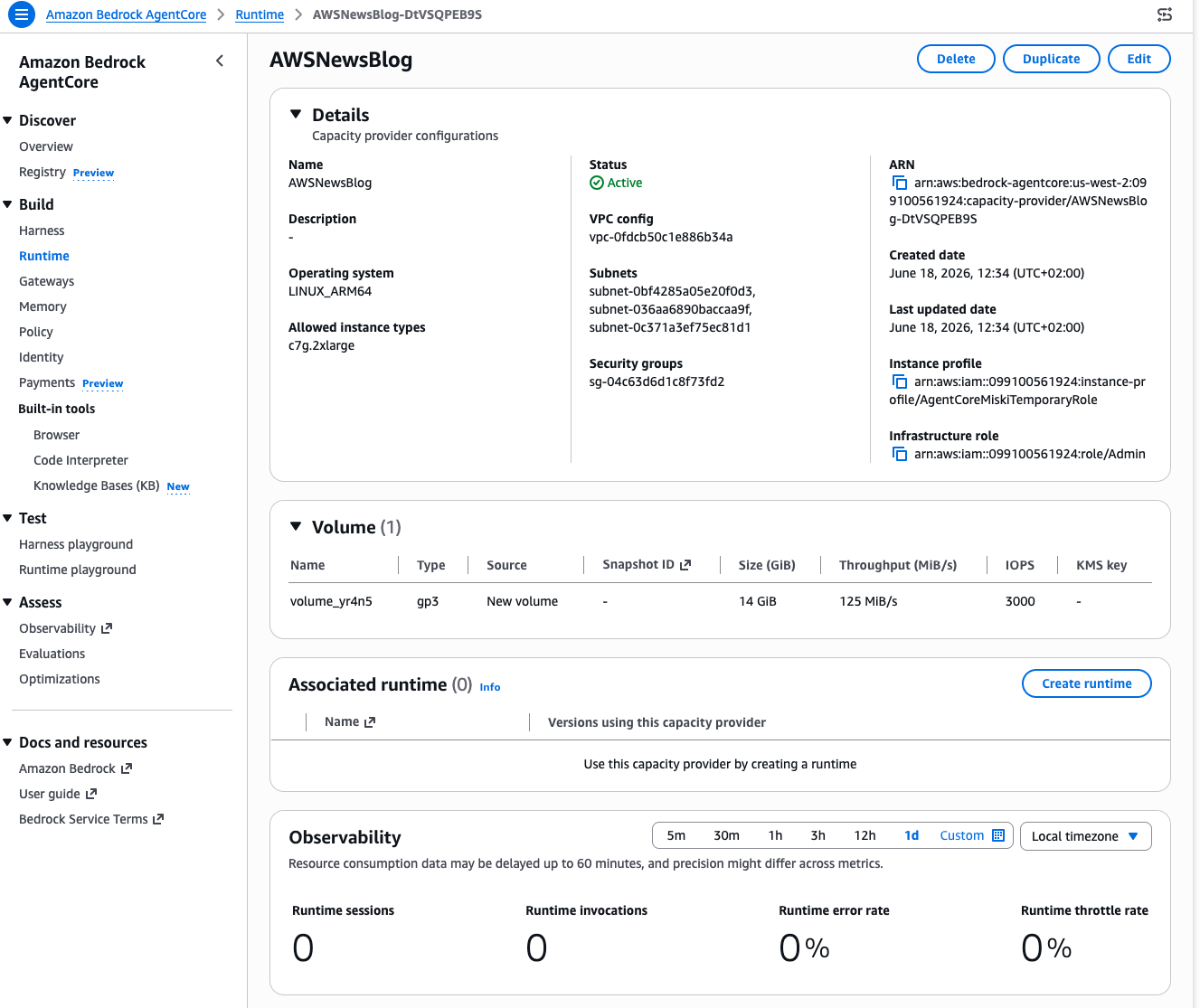
- Capacity Provider Provisioning: Administrators define the underlying EC2 infrastructure by selecting operating system parameters—such as Linux on 64-bit ARM architecture—and configuring appropriate instance types, such as
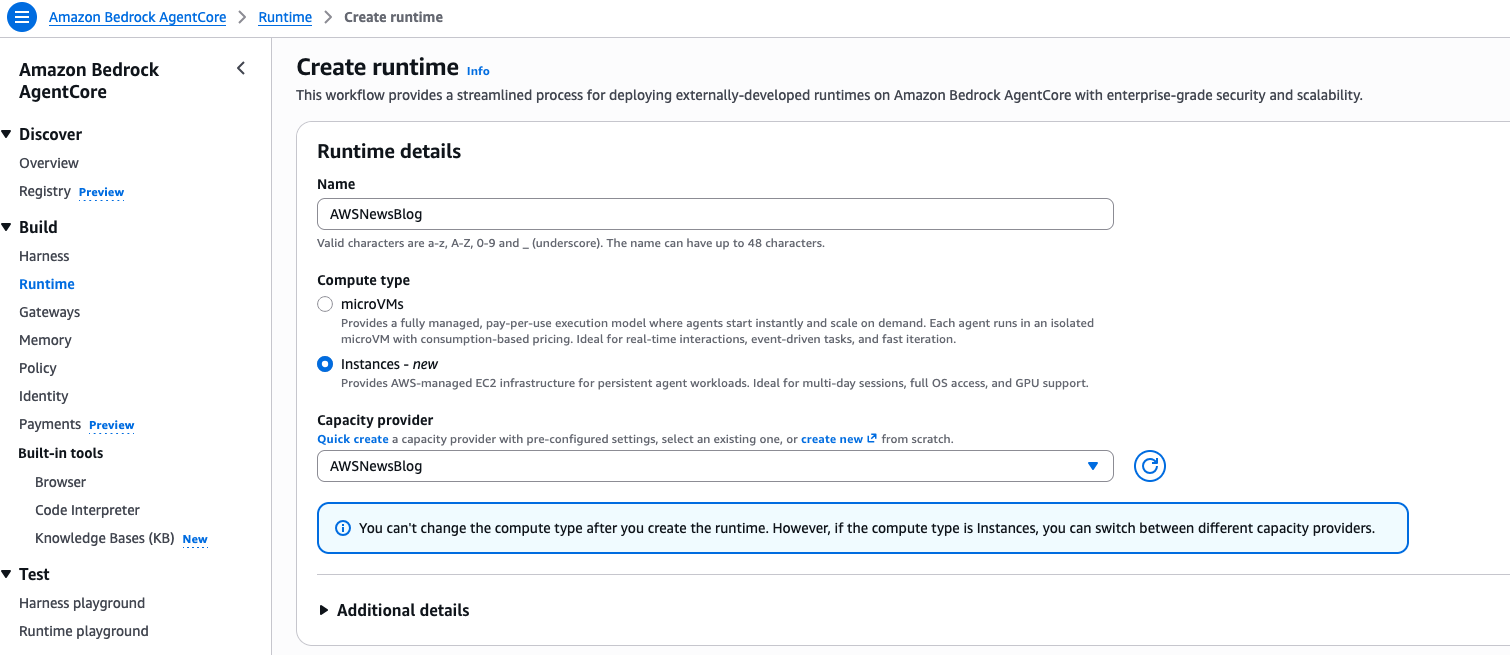
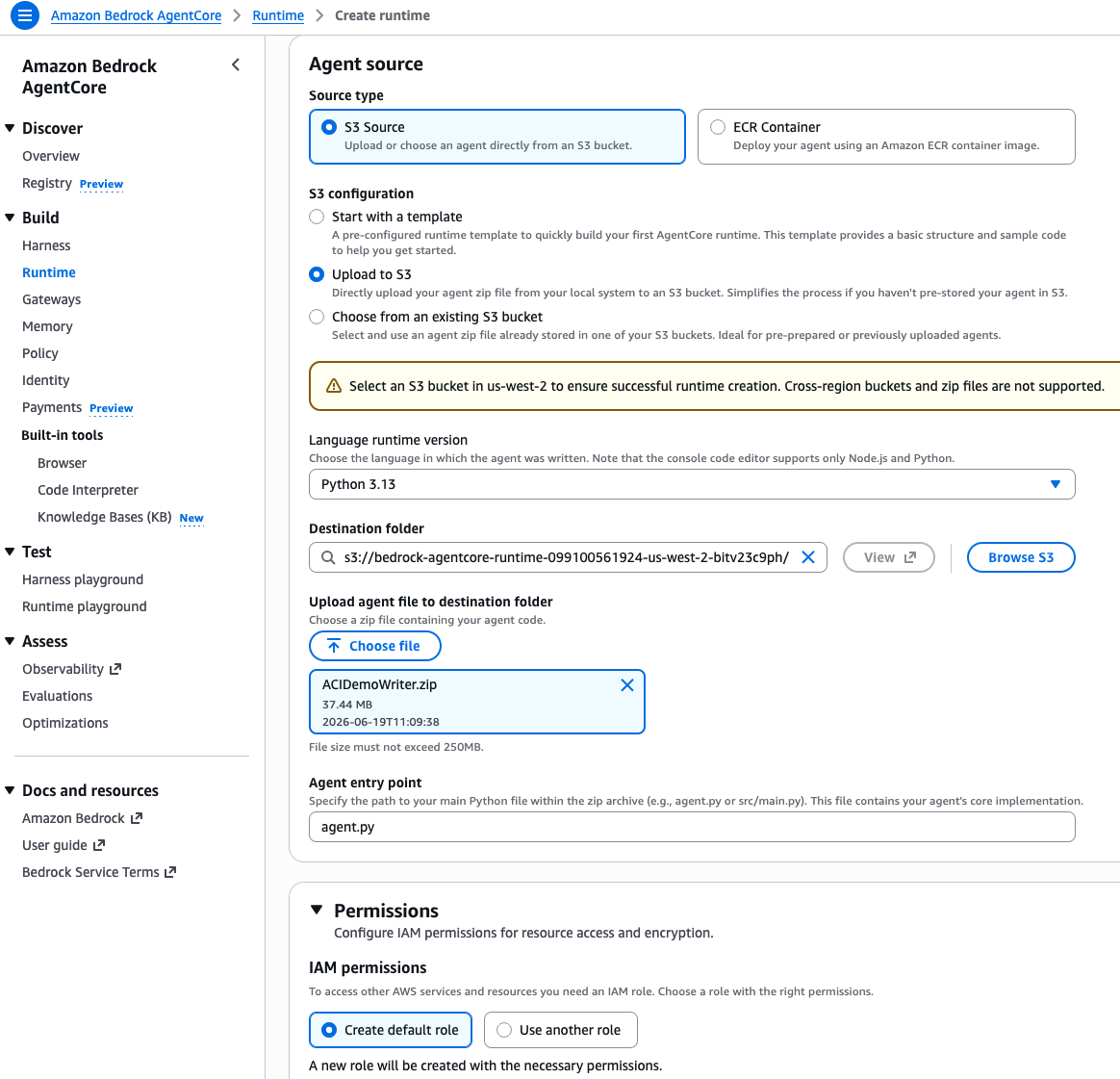
c7g.2xlargeinstances, which provide ample virtual CPUs and memory to run collaborative agents side by side. Network parameters, including VPC subnets, security groups, and automated service roles, are established during this phase to ensure secure operational boundaries. - Runtime and Agent Deployment: Once the capacity provider reaches an active status, developers create individual runtimes, assign the chosen compute capacity, and upload agent artifacts via Amazon S3. By specifying the language runtime version and the designated entry point file containing the
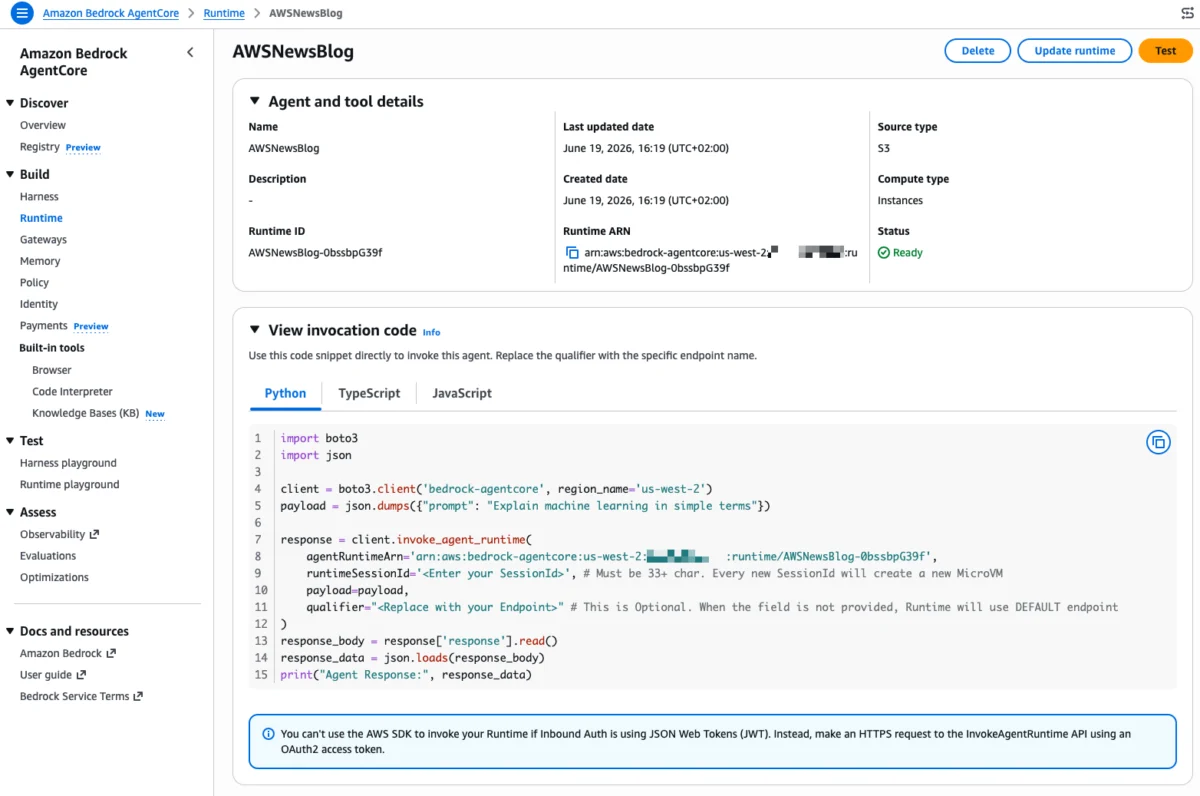
@app.entrypointdecorator, the platform automatically provisions the necessary IAM execution roles and deploys the agent code. - Session Orchestration and Testing: Using built-in runtime playground environments or programmatic invocation codes, engineers initiate tasks by passing structured JSON payloads. By maintaining a consistent session identifier across different agent invocations, administrators can observe autonomous collaboration, file generation, and peer review processes operating in real time within a unified environment.
Industry Implications and Strategic Outlook
The launch of Amazon Bedrock AgentCore Runtime instances addresses a critical enterprise demand for scalable, persistent, and secure foundational infrastructure tailored to autonomous artificial intelligence systems. By alleviating the immense operational overhead traditionally associated with managing multi-day, multi-agent server environments, AWS enables organizations to accelerate their transition from theoretical artificial intelligence proofs-of-concept to robust, production-grade enterprise deployments.
As businesses increasingly adopt complex multi-agent architectures to automate software engineering, financial modeling, cybersecurity monitoring, and research workflows, managed compute layers that balance deep operational control, hardware acceleration, and persistent session management will become indispensable. The integration of runtime instances into the Amazon Bedrock ecosystem marks a significant milestone in providing the mature infrastructural foundation required for the next generation of autonomous enterprise applications.
