
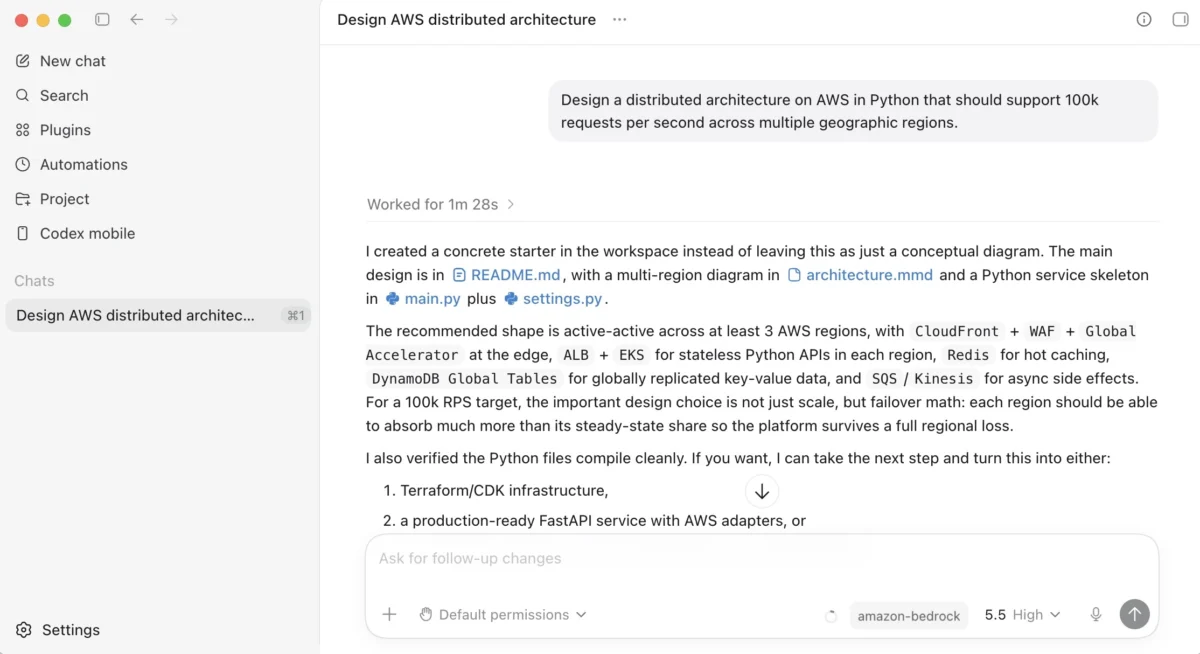

In a significant development poised to reshape the landscape of enterprise artificial intelligence and software development, Amazon Web Services (AWS) has announced the immediate availability of OpenAI’s cutting-edge GPT-5.5 and GPT-5.4 models, alongside the powerful Codex coding agent, on its Amazon Bedrock platform. This strategic integration, initially previewed during the "What’s Next with AWS 2026" event, grants developers and businesses unparalleled access to frontier large language models (LLMs) and an advanced AI-powered assistant specifically engineered for complex software engineering tasks. The move underscores AWS’s commitment to offering a diverse array of leading foundation models to its customers, fostering innovation and accelerating the adoption of generative AI across industries.
A New Era for Enterprise AI on Amazon Bedrock
The inclusion of OpenAI’s GPT-5.5 and GPT-5.4 models on Amazon Bedrock marks a pivotal moment for businesses seeking to leverage the most advanced generative AI capabilities without the overhead of managing complex infrastructure. Amazon Bedrock, a fully managed service, simplifies the process of building and scaling generative AI applications, providing a secure and reliable environment for accessing foundation models from various providers. By integrating OpenAI’s latest offerings, AWS significantly enhances Bedrock’s appeal, allowing customers to choose from a broader spectrum of best-in-class models tailored to their specific needs.
According to statements from OpenAI, the GPT-5.5 and GPT-5.4 models are engineered for exceptional performance across critical domains, including sophisticated coding, advanced reasoning, agentic workflows (multi-step autonomous task execution), and demanding professional work. The GPT-5.5 model is positioned as the ideal choice for the most challenging customer workloads, implying superior performance in complex problem-solving, nuanced understanding, and high-stakes decision-making. Conversely, GPT-5.4 is highlighted for its optimal price-performance ratio, making it an attractive option for broader deployment and scenarios where efficiency and cost-effectiveness are paramount. Both models are accessible through the Responses API, leveraging Amazon Bedrock’s next-generation inference engine, which is purpose-built to deliver high performance, reliability, and robust security.
Codex: Revolutionizing Software Development with AI
Perhaps one of the most impactful additions is OpenAI’s Codex, an AI coding agent that has already become indispensable for millions of developers worldwide. With over 4 million developers reportedly utilizing Codex weekly, its integration with Amazon Bedrock is set to further democratize and enhance AI-powered software development. Codex empowers developers to automate and accelerate various stages of the coding lifecycle, including writing new code, refactoring existing code for efficiency, debugging errors, developing comprehensive tests, and validating code across expansive codebases.
The pairing of Codex with the inferential power of GPT-5.5 represents a significant leap forward. This synergy introduces a new tier of intelligence optimized for "complex, long-horizon developer workflows." This implies that Codex, backed by GPT-5.5, can now handle more intricate, multi-step development projects, understand broader architectural contexts, and generate more coherent and functional code over extended development cycles. Developers can engage with Codex through multiple familiar interfaces: the dedicated Codex App, the Codex Command Line Interface (CLI), and seamlessly integrated extensions for popular Integrated Development Environments (IDEs) such as Visual Studio Code, JetBrains, and Xcode. All model inference for Codex, regardless of the interface used, is securely routed through the Responses API on Amazon Bedrock, ensuring consistency in performance and security.
Technical Accessibility and Enterprise-Grade Features
For enterprises with stringent data governance and compliance requirements, the integration offers crucial advantages. All processing conducted using these OpenAI models on Amazon Bedrock adheres strictly to data residency requirements, meaning customer data remains within the specific Bedrock Region selected by the user. This feature is particularly vital for organizations operating in highly regulated sectors such as finance, healthcare, and government, where data sovereignty is non-negotiable.

The economic model for accessing these models is also designed for enterprise flexibility and scalability. Customers pay per token consumed, eliminating the need for burdensome seat licenses or per-developer commitments. This consumption-based pricing model ensures that businesses only pay for the resources they use, allowing for cost-effective scaling from small pilot projects to large-scale deployments.
Programmatic access to GPT-5.5 and GPT-5.4 on Bedrock is facilitated via the OpenAI Responses API, which interacts with the bedrock-mantle endpoints. Developers can utilize the OpenAI SDK for Python, making integration into existing applications straightforward. A typical workflow involves installing the OpenAI SDK, setting environment variables for the Bedrock API key and model ID, and then making API calls to generate responses. Similarly, direct interaction with the model endpoint is possible using command-line tools like curl, providing flexibility for various development environments and scripting needs. The Responses API is particularly well-suited for scenarios requiring model-managed multi-turn state, hosted tools, function tools, richer tool orchestration, or the execution of background and long-running tasks. Comprehensive documentation and examples are available in the OpenAI Cookbook and dedicated getting started guides.
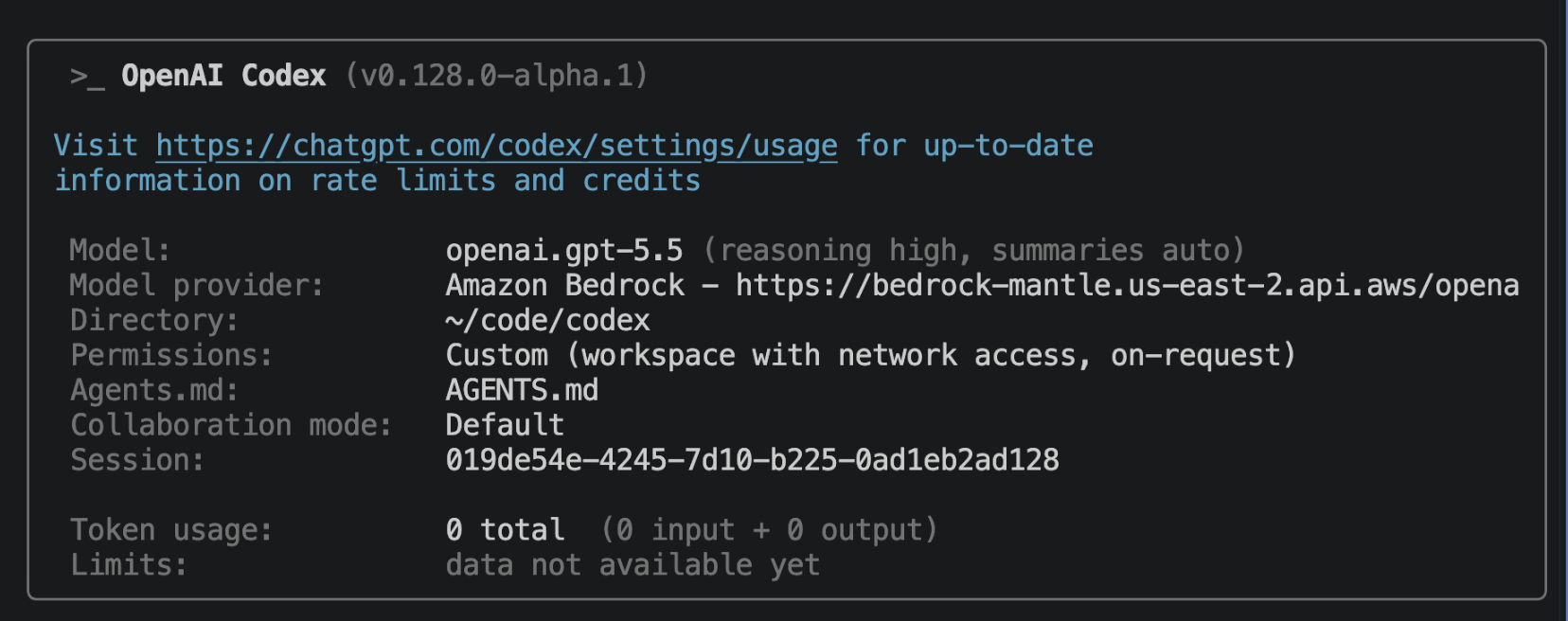
For Codex, the integration with Amazon Bedrock is equally streamlined. Developers can download the Codex CLI, App, or VS Code extension and configure it to use Bedrock for model inference. Codex supports two authentication pathways for Bedrock: an Amazon Bedrock API key or the standard AWS SDK credential chain, offering flexibility based on existing security postures. Configuration involves setting environment variables, such as AWS_BEARER_TOKEN_BEDROCK, and specifying the preferred AWS Region and model ID (e.g., openai.gpt-5.5) in the ~/.codex/config.toml file. Visual confirmation of the Bedrock integration is provided through status tabs in the Codex CLI and desktop app, ensuring seamless setup and operation.
A Chronology of Availability and Expansion
The journey of these advanced OpenAI models to Amazon Bedrock began with their preview at the "What’s Next with AWS 2026" event, signaling AWS’s forward-looking strategy in the generative AI space. The official announcement brought immediate availability, albeit with a phased regional rollout and feature enhancements.
- Initial Launch (Late May 2026): GPT-5.5 model became available in the US East (Ohio) Region, while GPT-5.4 was launched in both the US East (Ohio) and US West (Oregon) Regions. This initial rollout focused on core AWS regions to serve a broad base of early adopters.
- June 1, 2026 Update: An important clarification was issued, stating that the GPT-5.5 and GPT-5.4 models initially supported the
ResponsesAPI only on Amazon Bedrock, with console support slated for a future update. This highlighted the API-first approach for developers. - June 3, 2026 Update: Expanding its reach to government and highly regulated sectors, Amazon Bedrock announced support for GPT-5.4 from OpenAI in the AWS GovCloud (US-West) Region. This move addressed critical compliance and security requirements for public sector and defense workloads.
- June 7, 2026 Update: Further enhancing user experience and accessibility, AWS confirmed that the GPT-5.5 and GPT-5.4 models could now be accessed and utilized through the new Amazon Bedrock console experience, providing a graphical interface for managing and interacting with these models.
AWS continues to update its model-region compatibility list, advising customers to check for the latest information regarding regional availability and forthcoming expansions.
Strategic Implications and Market Impact
The integration of OpenAI’s GPT-5.5, GPT-5.4, and Codex into Amazon Bedrock carries profound implications for the broader AI and cloud computing markets.
- Strengthening Bedrock’s Position: This move significantly bolsters Amazon Bedrock’s offering, making it an even more compelling choice for enterprises seeking a comprehensive platform for generative AI. By providing access to leading models from OpenAI, alongside those from Anthropic, AI21 Labs, Meta, Stability AI, and Amazon’s own models, Bedrock solidifies its reputation as a model-agnostic, enterprise-grade hub for foundation models. This choice and flexibility are key differentiators in a rapidly evolving market.
- Accelerating Enterprise AI Adoption: The combination of powerful, frontier models and the robust, secure infrastructure of AWS Bedrock removes significant barriers for enterprises looking to deploy generative AI solutions. Companies can now experiment, prototype, and scale AI applications faster, leveraging pre-trained models without the immense computational and data requirements of training their own. This will likely lead to an acceleration of AI adoption across various business functions, from customer service and content creation to data analysis and strategic planning.
- Empowering Developers and Driving Innovation: For the developer community, the integration of Codex with GPT-5.5 on Bedrock offers an unprecedented level of AI assistance. This could lead to substantial productivity gains, allowing developers to focus on higher-level architectural design and complex problem-solving rather than repetitive coding tasks. The ability to handle "long-horizon developer workflows" means AI can now assist in more complex, multi-faceted projects, potentially shortening development cycles and enabling the creation of more sophisticated software solutions. This democratizes access to advanced AI tools, fostering a new wave of innovation in software engineering.
- Competitive Landscape Shift: The collaboration between AWS and OpenAI, two giants in their respective fields, intensifies competition within the cloud AI market. Other cloud providers and AI platforms will face increased pressure to offer comparable access to frontier models and robust developer tools. This competitive environment is ultimately beneficial for customers, driving continuous innovation and improvement in AI services.
- Future of AI-Powered Agentic Workflows: The emphasis on "agentic workflows" in GPT-5.5 and GPT-5.4 hints at a future where AI models can perform multi-step tasks autonomously, make decisions, and interact with various tools and systems more intelligently. This capability, combined with Codex’s coding prowess, paves the way for increasingly sophisticated AI agents that can assist across a wide spectrum of professional tasks, from complex data analysis to automated system management.
The availability of OpenAI’s GPT-5.5, GPT-5.4, and Codex on Amazon Bedrock represents a strategic convergence of cutting-edge AI research and scalable cloud infrastructure. This development promises to unlock new possibilities for enterprise innovation, significantly enhance developer productivity, and further accelerate the integration of advanced generative AI into the core fabric of businesses worldwide. As these models become more widely adopted, their impact on how software is built and how businesses leverage AI is expected to be transformative, ushering in a new era of intelligent automation and creative problem-solving.
