
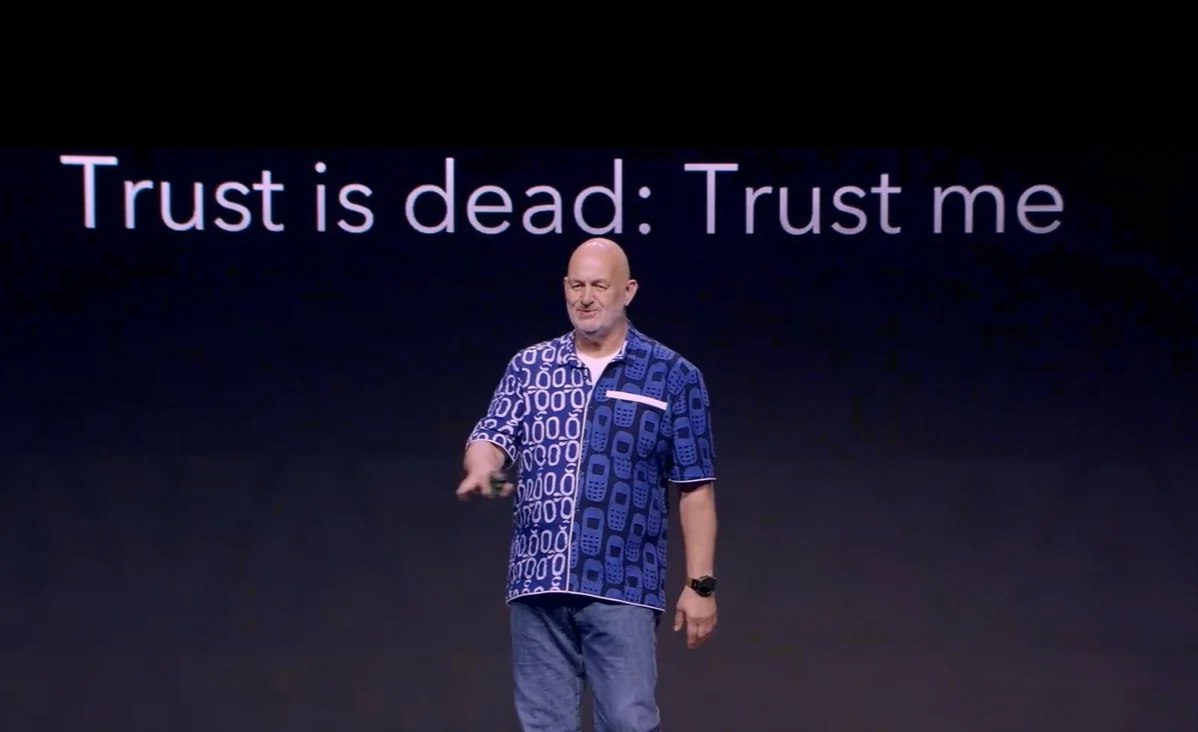

The International Telecommunication Union’s (ITU) AI for Good Global Summit in Geneva, Switzerland, served as the backdrop this week for a sobering assessment of the digital age’s most pressing crisis: the erosion of trust. Werner Vogels, the Chief Technology Officer of Amazon, delivered a keynote address that bypassed typical corporate optimism in favor of what he termed "tough love." Addressing an audience of world leaders, technologists, and policymakers, Vogels asserted that the fundamental assumptions underpinning human cooperation have been shattered by the rise of generative artificial intelligence. His core message was a radical departure from current industry trends: the public should no longer trust AI models, and developers must stop asking them to do so. Instead, the industry must pivot toward a framework of "verifiable trust," where machines are deployed to audit machines in a relentless cycle of automated scrutiny.
The Economic Collapse of Trust Signals
To understand the current crisis, Vogels navigated through a brief history of trust, which he characterized as humanity’s oldest and most vital technology. He argued that trust is the invisible infrastructure that allows for global trade, air travel, and social cohesion. Historically, this infrastructure relied on a single, expensive assumption: that it is difficult and costly to fake a signal of legitimacy.
Vogels utilized the architectural choices of the banking sector to illustrate this point. For decades, banks constructed lobbies out of marble not for utility, but as a signal of permanence and capital. "Marble does nothing for banking, but marble is expensive," Vogels noted. The expense was the message; a "fly-by-night" operation could not afford such a display, thus granting the institution immediate, if superficial, credibility. In the digital realm, similar signals—high-quality video, sophisticated prose, and complex coding—previously served as indicators of human effort and institutional backing.
However, the emergence of generative AI roughly two years ago caused the "cost of fakery" to collapse. When high-fidelity disinformation can be generated for near-zero cost at machine speed, the "marble lobby" of the digital world vanishes. According to Vogels, generative AI did not break the trust system itself; it broke the economic assumption that forgery is expensive. This shift has led to a reality where more than half of the global population struggles to distinguish genuine information from synthetic fakes.
The Failure of the Human-in-the-Loop Model
A common refrain in AI ethics is the necessity of a "human-in-the-loop"—the idea that human oversight can mitigate the risks of AI hallucinations and bias. Vogels dismissed this as a scalable solution. While humans remain the "gold standard" of trust because their labor is expensive and their judgment nuanced, they have become a logistical bottleneck.
"Human eyes cannot scale to the velocity of silicon," Vogels explained. A system that creates content at machine speed but requires human verification at a manual pace is destined for systemic collapse. As the volume of AI-generated data becomes infinite and free, the human capacity for debunking fakes is overwhelmed. This necessitates a shift in the "currency of trust" from human intuition to automatic, mathematical verification. To survive an era of cheap creation, Vogels argued, the industry must move toward a model where "the machine checks the machine."
Verifiable Trust: A Three-Stage Framework
Vogels’ alternative to blind trust is a rigorous, three-stage verification process designed to wrap around inherently untrustworthy AI models. He urged developers to abandon the quest for a "trustworthy model," stating flatly that such a thing does not exist. Instead, the focus must be on the system’s architecture:
- Input Verification: Auditing the data used to train and prompt models.
- Output Verification: Validating the accuracy and safety of the generated content.
- Action Verification: Monitoring the behavior of "agentic" systems that perform tasks autonomously.
To illustrate the dangers of unverified inputs, Vogels cited a case study from his home city of Rotterdam. Local authorities attempted to build an AI system to identify welfare fraud. In an effort to avoid discrimination, they excluded immigration status from the dataset. However, they included a variable regarding the Dutch language proficiency of applicants. This served as a "proxy" or "indirect" indicator of immigration status, resulting in a model that disproportionately targeted immigrants for investigation.
"Nobody intended to discriminate, but the data had discrimination inside," Vogels said. He warned that the same traps exist in modern automated hiring tools, which often replicate the biases of an existing workforce because they are trained on historical data.
Plausibility Versus Truth in Large Language Models
A critical portion of Vogels’ address focused on the mathematical nature of Large Language Models (LLMs). He sought to demystify the phenomenon of "hallucinations," explaining that they are not a bug, but a feature of how these systems are built. LLMs are mathematically optimized for "plausibility," not "truth." They are designed to predict the most likely next word in a sequence based on statistical patterns, not to verify the factual accuracy of the statement.
Because an LLM cannot distinguish between a factual statement and a plausible-sounding falsehood, the responsibility for truth lies entirely with the surrounding verification system. Vogels noted that for businesses operating under regulatory requirements, the stakes are high. "If the AI makes a mistake, it’s you that’s on the hook, not the AI," he reminded the audience.
He proposed a sliding scale of scrutiny based on the consequences of the task. A minor error in a meeting summary might only cost a few minutes of time, requiring only automated checks. However, marketing copy requires human review to protect brand equity, and decisions regarding legal rights or medical diagnoses must remain firmly in human hands.
The Rise of Agentic AI and the Quorum Strategy
The most significant emerging threat, according to the Amazon CTO, is the shift toward "agentic" AI—systems that do not just generate text but take actions on behalf of users. As AI is granted more autonomy to move money, access private data, or manage infrastructure, the risk shifts from "saying the wrong thing" to "doing the wrong thing."
Vogels offered a "stark advice" for those building these systems: "Don’t trust the agent." He proposed a distributed systems approach to mitigate risk, suggesting that high-stakes actions should only be taken after a "quorum" of multiple, different LLMs reaches an agreement.
By running three or five different models (an odd number to avoid ties) and comparing their outputs, developers can create a mechanical check against the idiosyncrasies or failures of a single model. If the models disagree, the process should halt until a human can intervene. This "multi-agent" verification strategy draws on thirty years of lessons from distributed computing to ensure that no single point of failure can lead to catastrophic consequences.
Broader Impact and Regulatory Implications
Vogels’ remarks come at a time of intense global debate over AI regulation. The European Union’s AI Act and various executive orders in the United States are currently attempting to codify safety standards. Vogels’ emphasis on "mechanisms over intentions" suggests that current regulatory focuses on developer "good intentions" or self-reporting may be insufficient.
The economic implications of this trust crisis are equally profound. If the public loses faith in the authenticity of digital interactions, the adoption of AI—and the productivity gains it promises—will stall. "If we have no trust, AI doesn’t matter," Vogels concluded. "No trust, no AI."
Industry analysts suggest that Amazon’s position, as articulated by Vogels, reflects a broader move toward "Enterprise-Grade AI," where the focus shifts from the novelty of generative capabilities to the reliability and auditability of the systems. This approach may set a new standard for how cloud providers and software developers market their AI services, prioritizing security protocols and verification layers over the raw power of the underlying models.
As the AI for Good Summit continues in Geneva, the "tough love" delivered by Vogels has reframed the conversation. The challenge for the next generation of technologists is no longer just to make AI smarter, but to build the mechanical safeguards necessary to make it usable in a world where traditional signals of trust have permanently dissolved.
