
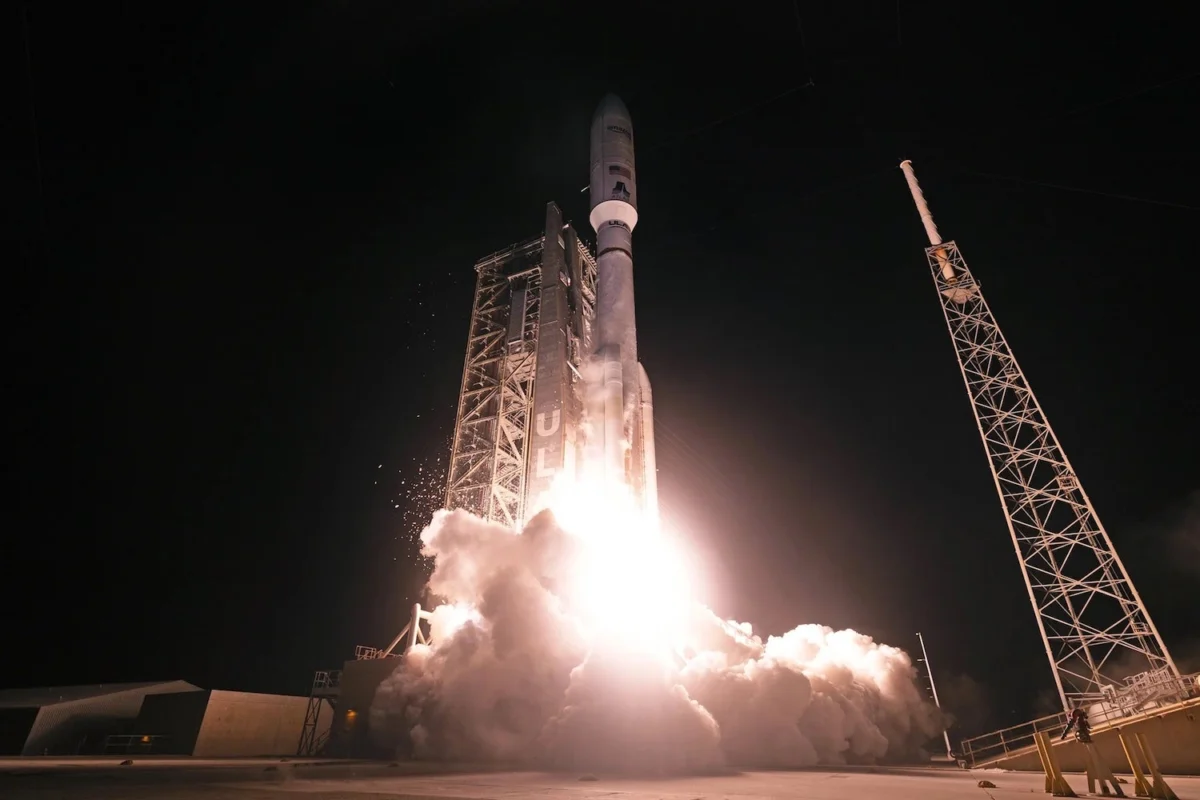

The operational deployment of the Amazon Leo satellite constellation achieved a critical milestone in the early hours of July 2, as a United Launch Alliance (ULA) Atlas V rocket successfully delivered 29 additional satellites into Low Earth Orbit (LEO). Taking off from Space Launch Complex 41 at Cape Canaveral Space Force Station in Florida at 12:30 a.m. ET, the mission, designated as the eighth dedicated launch for the program, effectively brings the total number of active satellites in the constellation to 396. This specific quantity marks the threshold required for Amazon to begin offering continuous broadband connectivity across initial latitudes, signaling the transition of the project from a purely developmental phase into a functional telecommunications network.
The achievement of this orbital density allows the company to move forward with its plans for early-access commercial service. Chris Weber, Vice President of Business Operations for Amazon Leo, confirmed the significance of the mission shortly after satellite deployment was verified. Weber noted that while the constellation has reached the necessary count for "continuous service across initial latitudes," the engineering team remains focused on the complex task of orbit raising, where the newly launched units use onboard propulsion to move from their injection altitude to their final operational stations. This successful launch concludes the specific sequence of missions required to initiate service within the current calendar year, with all subsequent launches intended to increase the network’s overall capacity and geographic reach.
Chronology of the Amazon Leo Deployment
The journey toward this 396-satellite milestone has been defined by a rapid acceleration in launch frequency over the past 18 months. Amazon’s satellite initiative, part of a broader multi-billion dollar investment in space-based infrastructure, began its operational phase following the successful testing of two prototype satellites, KuiperSat-1 and KuiperSat-2, in late 2023. These prototypes validated the core technology, including the optical inter-satellite links and the phased array antennas required for high-throughput, low-latency communication.
Following the prototype phase, the mission on July 2 represents the fourth launch of the current year alone. ULA has been the primary partner for this initial deployment phase, utilizing the venerable Atlas V workhorse. The partnership with ULA is part of the largest commercial launch procurement in history, which includes contracts with Arianespace for the Ariane 6, Blue Origin for the New Glenn, and even SpaceX for Falcon 9 missions. This diversified launch strategy was designed to mitigate the risks associated with rocket development delays and to ensure the company could meet strict regulatory deadlines.
The timeline for the Amazon Leo project is dictated largely by its license from the Federal Communications Commission (FCC). Under the terms of its authorization, Amazon is required to deploy at least half of its planned 3,236-satellite constellation—roughly 1,618 satellites—by July 2026. Failure to meet this mid-way milestone could result in the loss of a portion of its spectrum rights. Consequently, the success of the July 2 mission is a pivotal step in maintaining the project’s regulatory standing as the company approaches its 2026 deadline.
Technical Specifications and Launch Vehicle Performance
The mission utilized the Atlas V 551 configuration, the most powerful version of the Atlas V rocket. This configuration features a five-meter payload fairing, five solid rocket boosters, and a single-engine Centaur upper stage. The 551 variant is typically reserved for heavy payloads or missions requiring high-energy orbits, underscoring the significant mass and volume of the 29-satellite stack.
The Atlas V has maintained a 100% success rate throughout its support of the Amazon Leo project. For this mission, the rocket’s RD-180 main engine provided the initial thrust to clear the pad, followed by the jettisoning of the solid rocket boosters and the fairing. The Centaur upper stage performed multiple burns to precisely place the 29 satellites into their target orbital plane. Once separated, the satellites began their automated health checks and deployed their solar arrays to begin power generation.
The satellites themselves are designed for high-capacity throughput. While specific bandwidth figures for the latest generation remain proprietary, Amazon has previously indicated that the user terminals for the service will be capable of speeds up to 400 Mbps for residential models and up to 1 Gbps for enterprise and government applications. The constellation operates in the Ka-band frequency, which offers a balance between high data rates and manageable atmospheric interference.
Strategic Service Rollout and Geographic Coverage
As the constellation reaches its initial operational capacity, the strategy for service rollout is becoming clearer. During the annual SATShow Week earlier this year, Chris Weber detailed a phased approach to global connectivity. Rather than attempting to cover the entire planet simultaneously, Amazon Leo will initially focus on two distinct bands of latitude: one in the Northern Hemisphere and one in the Southern Hemisphere.
These initial bands were selected based on population density and the specific orbital mechanics of the 396 satellites currently in place. As more satellites are added to the constellation in subsequent missions, these coverage zones will gradually expand inward toward the equator and outward toward the poles. This "expanding band" strategy allows the company to begin generating revenue and testing its ground infrastructure in key markets while the full constellation is still being built out.
When a specific geography "goes live" within these bands, Amazon intends to offer the full suite of its services immediately. This includes:
- Consumer Broadband: High-speed internet for households in rural or underserved areas where terrestrial fiber or cable is unavailable.
- Enterprise Solutions: Secure, low-latency backhaul for businesses, including remote mining, agriculture, and maritime operations.
- Government and Public Sector: Dedicated connectivity for emergency response, defense applications, and educational initiatives in remote regions.
Market Implications and Competitive Landscape
The entry of Amazon Leo into the commercial market represents a significant challenge to existing satellite internet providers, most notably SpaceX’s Starlink. While Starlink currently holds a dominant lead with thousands of satellites in orbit and a global subscriber base, Amazon brings a unique set of advantages to the "NewSpace" race.
The most prominent advantage is the integration with Amazon Web Services (AWS). By linking the satellite constellation directly to AWS’s global network of data centers and edge locations, Amazon can offer enterprise customers a "one-hop" connection to the cloud. This reduces the number of terrestrial handoffs required for data, significantly lowering latency and increasing security for corporate and government traffic.
Furthermore, Amazon’s massive logistics and retail engine provides a ready-made distribution channel for user terminals. The company’s experience in mass-producing consumer electronics, such as Echo and Kindle devices, is expected to be leveraged to keep the cost of satellite dishes low—a historically significant barrier to entry for satellite internet adoption.
Analysts suggest that the 396-satellite milestone is the point where Amazon moves from a theoretical competitor to a tangible market force. The ability to provide "continuous service" means the company can now begin signing Service Level Agreements (SLAs) with corporate partners and government agencies, providing the first real-world validation of the network’s performance.
Future Outlook and Scaling Operations
While the July 2 launch is a cause for celebration within the program, the path to a full 3,236-satellite constellation remains steep. To meet the 2026 FCC deadline, Amazon and its launch partners will need to significantly increase the cadence of missions. This will likely involve the transition from the Atlas V to newer, high-capacity rockets.
United Launch Alliance is currently phasing out the Atlas V in favor of the Vulcan Centaur, which is designed to provide greater lift capacity at a lower cost. Similarly, the upcoming maiden flight of Blue Origin’s New Glenn rocket is expected to play a massive role in the Amazon Leo deployment, as its seven-meter fairing can accommodate significantly more satellites per launch than the Atlas V.
In the coming months, the focus for the Amazon Leo team will shift toward optimizing the ground segment. This includes the deployment of gateway stations—large antennas that connect the satellite network to the terrestrial internet—and the finalization of the user terminal manufacturing process. The company has already broken ground on a state-of-the-art satellite processing facility at the Kennedy Space Center, which will streamline the final assembly and integration of satellites before they are mated to their launch vehicles.
The successful delivery of these 29 satellites ensures that Amazon is on track to meet its goal of beginning beta testing with commercial customers later this year. As the constellation grows, the "initial latitudes" will eventually merge into a global web of connectivity, fulfilling the project’s mission to bridge the digital divide and provide high-speed internet to the billions of people currently without reliable access. For now, the 396 satellites in orbit stand as a testament to the project’s momentum and the beginning of a new era in the global telecommunications landscape.
