
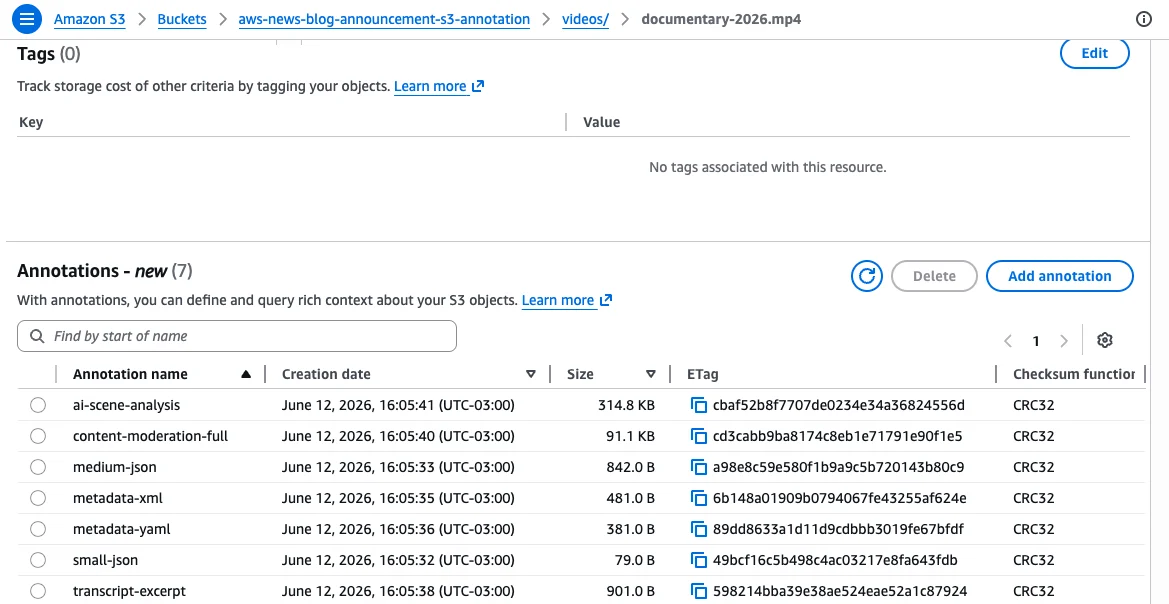

Today, Amazon Web Services (AWS) announced the general availability of Annotations for Amazon Simple Storage Service (Amazon S3), a significant new metadata capability designed to attach rich, large-scale business context directly to S3 objects. This innovative feature allows organizations to store up to 1,000 named annotations per object, each up to 1 MB in size, culminating in a remarkable total of up to 1 GB of contextual data per object. These annotations can be stored in flexible formats such as JSON, XML, YAML, or plain text, offering unprecedented versatility. Crucially, annotations can be modified or deleted at any time without necessitating the re-writing of the associated S3 objects, ensuring that data context remains current and agile in dynamic environments.
Understanding S3 Annotations: A Deep Dive into Enhanced Metadata
The introduction of S3 Annotations marks a pivotal evolution in how data is managed and understood within cloud storage. Historically, metadata in S3 has been categorized into system-defined metadata (like object size, storage class, and creation time), user-defined metadata (small, custom key-value pairs set at upload), and object tags (limited to 10 per object, primarily for operational tasks such as access control, lifecycle management, and cost allocation). While effective for their specific purposes, these existing mechanisms often proved insufficient for the burgeoning demands of modern, data-intensive applications, particularly those leveraging artificial intelligence (AI) and machine learning (ML).
Annotations directly address these limitations by offering a fundamentally different scale and flexibility. Unlike the immutable nature of user-defined metadata set at upload or the constrained number of object tags, S3 Annotations are mutable, allowing for dynamic updates. Their sheer capacity—1,000 annotations, each up to 1 MB, totaling 1 GB—provides ample space for detailed business context that goes far beyond simple key-value pairs. This capability is critical for complex data environments where objects might represent anything from high-resolution media files to scientific datasets or legal documents, each requiring extensive descriptive information. The support for structured formats like JSON, XML, and YAML means that this context can be machine-readable and highly organized, facilitating advanced programmatic access and analysis.
Addressing the Metadata Challenge: Why Annotations are a Game-Changer
In an era defined by exponential data growth and the rise of AI agents, the ability to find, understand, and act on data without human intervention has become paramount. Organizations are increasingly building autonomous workflows that depend on rich, evolving metadata to make sense of vast datasets. The traditional approach of storing such detailed context in separate databases or sidecar files often led to significant operational overhead, including complex synchronization workflows, potential data inconsistencies, and increased storage and retrieval costs.
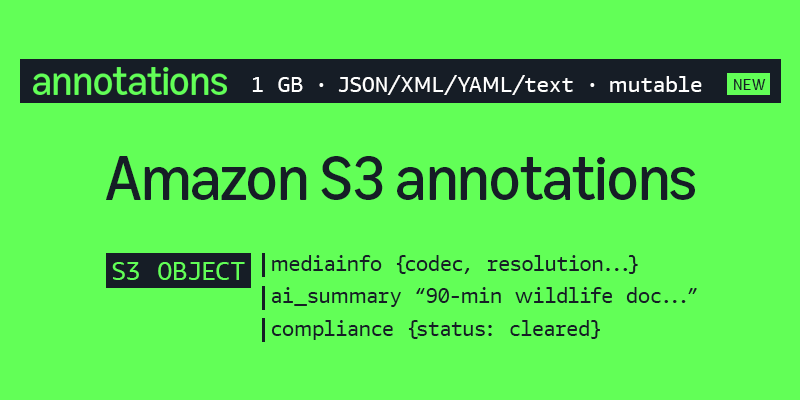
S3 Annotations directly tackle these challenges. By allowing context such as AI-generated transcripts, content ratings, technical specifications, or compliance information to reside directly alongside the S3 object, AWS simplifies data management architecture. This co-location ensures that the metadata automatically moves with the object during copy, replication, and cross-region transfers, and is automatically removed when the object is deleted, eliminating the need for complex, error-prone external synchronization logic. This integrated approach not only streamlines operations but also enhances data governance and reliability, as the context is inherently tied to the data it describes.
The strategic intent behind this launch, according to industry analysts, is to empower developers and data scientists with tools that accelerate the development of agentic AI systems. "The ability to embed rich, queryable context directly within S3 objects removes a significant bottleneck for AI/ML pipeline development," noted one cloud infrastructure analyst. "It allows models to ‘understand’ data with greater nuance, without requiring bespoke, external metadata services for every use case. This is a clear step towards more autonomous and intelligent data systems."
Seamless Integration and Queryability: Unlocking Data Insights at Scale
While attaching annotations to individual objects is powerful, the true transformative potential lies in their queryability at scale. AWS has engineered S3 Annotations to seamlessly integrate with its broader data analytics ecosystem. When S3 Metadata is enabled on a bucket, annotations automatically flow into fully managed annotation tables, built on Apache Iceberg. Apache Iceberg, an open table format for large analytic datasets, offers high performance and schema evolution capabilities, making it an ideal choice for dynamically changing metadata.
These annotation tables can be queried directly using Amazon Athena, AWS’s interactive query service, or any other Iceberg-compatible analytics engine. This capability means that organizations can run complex SQL queries across petabytes of annotated objects to discover insights, filter data, and identify specific assets without restoring the objects or incurring retrieval charges from various storage classes, including S3 Glacier.
Furthermore, S3 Annotations are designed to enhance AI-driven data discovery. Through the S3 Tables MCP server, a standardized interface for AI models to query annotations, AI agents can discover data using natural language queries. Imagine an AI agent being able to respond to a prompt like "find all PG-rated movies with Spanish subtitles from 2023." This capability dramatically reduces the time and effort required for data discovery, shifting from hours of querying disparate systems to seconds of natural language interaction. This represents a significant leap forward in making data more accessible and actionable for AI and autonomous systems.

Practical Applications Across Industries: From Media to Compliance
The flexibility and scale of S3 Annotations address complex metadata challenges across a diverse range of industries:
- Media and Entertainment: A media company can attach detailed technical specifications (codec, resolution, audio tracks, frame rate) as JSON, along with AI-generated summaries or content ratings as plain text, directly to video assets. This enables rapid content search, automated transcoding workflows, and efficient content syndication based on precise metadata. For instance, a studio could quickly identify all 4K HDR footage shot with a specific camera model or retrieve all content featuring a particular actor based on annotation data.
- Life Sciences and Healthcare: Researchers can store experimental parameters, patient consent details, genomic sequencing metadata, or image analysis results alongside raw data files. This ensures data provenance, facilitates reproducible research, and supports stringent compliance requirements like HIPAA by keeping critical context intrinsically linked to sensitive data.
- Financial Services: For regulatory compliance and audit trails, financial institutions can annotate transaction records or customer documents with compliance statuses, audit flags, retention policies, and PII classifications. This streamlines audit processes and enhances data governance by making compliance-critical metadata readily available and queryable.
- Manufacturing and IoT: Sensor data streams from IoT devices or CAD files for manufacturing processes can be annotated with device IDs, calibration data, environmental conditions, or version control information. This allows for intelligent analysis of operational data, predictive maintenance, and efficient asset management.
- AI/ML Training Data: For machine learning workflows, datasets can be enriched with labels, data quality scores, model versioning information, or data lineage details. This is crucial for managing vast datasets used in training, validating, and deploying AI models, ensuring that models are trained on correctly classified and contextually relevant data.
These examples underscore how annotations can simplify complex data architectures, enhance automation, and unlock new insights by making data more "intelligent" and self-describing.
Implementation and Management: Getting Started with Annotations
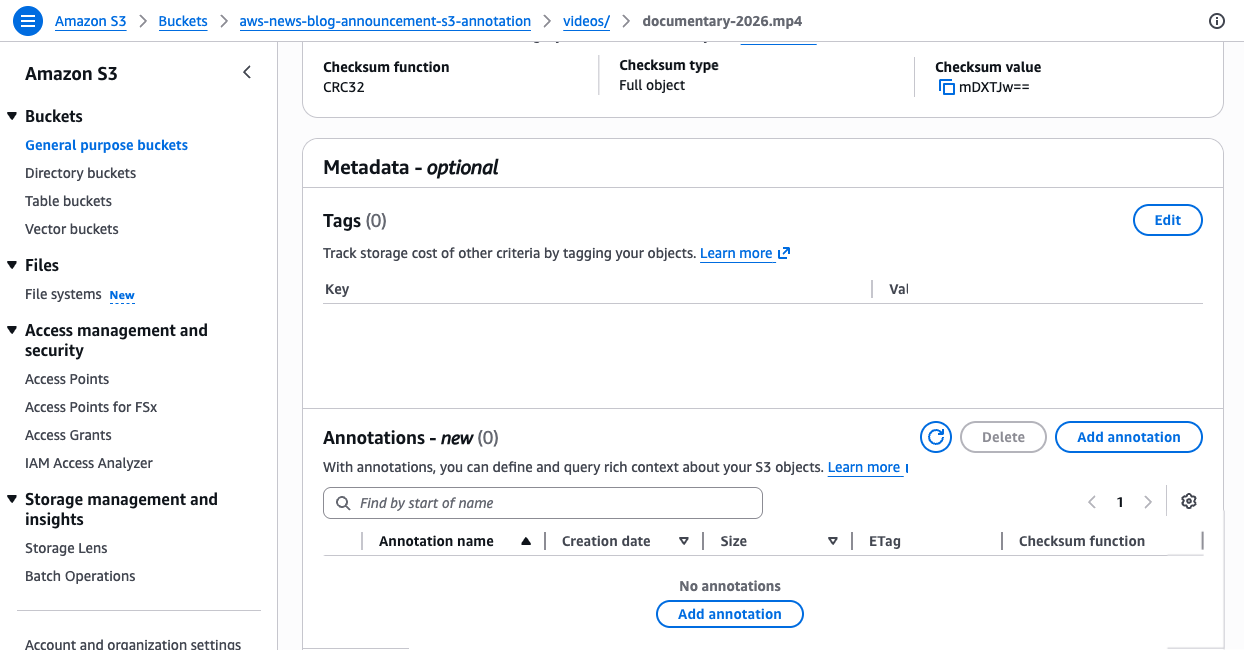
Implementing S3 Annotations is straightforward for developers already familiar with the AWS ecosystem. To begin, AWS Identity and Access Management (IAM) policies or bucket policies must grant permissions for s3:PutObjectAnnotation and s3:GetObjectAnnotation actions. Once permissions are configured, annotations can be added to any existing or new S3 object using the PutObjectAnnotation API.
For example, using the AWS Command Line Interface (AWS CLI), a media company can create a JSON file with technical metadata (mediainfo.json) and attach it as an annotation to a video asset. Simultaneously, a separate plain-text AI-generated summary (ai_summary.txt) can be attached as another annotation. Each annotation is identified by a unique name, allowing for independent reading, modification, and deletion. This design supports concurrent enrichment workflows, where different teams can add their specific metadata without conflict.
Retrieving a specific annotation is done via the GetObjectAnnotation API, while ListObjectAnnotations provides an overview of all annotations attached to an object. When an annotation is no longer needed, the DeleteObjectAnnotation API facilitates its removal. The ability to update an existing annotation by simply calling PutObjectAnnotation again with the same name highlights the feature’s dynamic nature. For large objects uploaded using multipart upload, annotations can be attached after the upload is complete, ensuring flexibility for various upload strategies.
The Broader Impact: Empowering Autonomous Workflows and Data Discovery
The launch of S3 Annotations is more than just an incremental feature; it represents a strategic advancement in cloud data management. By enabling rich, mutable, and queryable metadata directly on S3 objects, AWS is addressing a fundamental need for organizations grappling with massive, complex datasets. This capability is expected to significantly reduce the operational burden of managing external metadata systems, thereby lowering costs and simplifying architectural complexities.
For the burgeoning field of AI and autonomous systems, annotations provide the "context layer" necessary for machines to understand and interact with data more intelligently. This will accelerate the development of AI agents capable of performing sophisticated data discovery, processing, and analysis tasks without constant human oversight. The integration with Apache Iceberg and Amazon Athena further democratizes access to this rich metadata, making advanced analytics more accessible to a wider range of users.
Moreover, the immutable nature of S3 objects, combined with mutable annotations, creates a powerful paradigm for data governance and compliance. Organizations can maintain a pristine, unalterable core data asset while continuously updating its contextual metadata, ensuring both data integrity and relevance.
Availability and Pricing
Amazon S3 Annotations are available today across all AWS Regions, including AWS China Regions. Annotation tables, which enable large-scale querying, are available in all AWS Regions where S3 Metadata is available. Annotation storage is consistently billed at S3 Standard rates, irrespective of the parent object’s storage class (e.g., S3 Glacier), ensuring predictable pricing. This consistent pricing model simplifies cost management for organizations leveraging diverse S3 storage classes.
For detailed information and to begin leveraging this powerful new capability, users are encouraged to visit the Amazon S3 Metadata overview page and the comprehensive Amazon S3 documentation. Feedback and inquiries can be directed to AWS re:Post for S3 or through existing AWS Support channels. This new offering solidifies Amazon S3’s position not just as a leading object storage solution, but as an increasingly intelligent and adaptable foundation for modern data-driven enterprises.
