

The landscape of enterprise artificial intelligence deployment is undergoing a significant structural evolution as organizations transition from isolated conversational models to autonomous, multi-agent systems operating continuously over extended periods. Addressing the rigorous infrastructure demands of these advanced architectures, Amazon Web Services (AWS) has officially announced the launch of runtime instances for Amazon Bedrock AgentCore Runtime. This newly introduced complementary compute option is engineered to provide organizations with persistent, fully managed infrastructure explicitly designed to support complex, long-running, and resource-intensive agent workloads at scale.
Background Context and Evolution of AI Infrastructure
Historically, scaling autonomous AI agents from experimental proof-of-concept stages to robust production environments has exposed critical bottlenecks in underlying compute architectures. Standard execution models are typically constrained by ephemeral lifecycles, limited runtime durations, and a lack of native persistent state management across distributed tasks. Consequently, development teams have been forced to independently provision, orchestrate, and maintain complex fleets of Amazon Elastic Compute Cloud (Amazon EC2) instances, configure intricate networking topologies, and stitch together disparate monitoring frameworks.

While Amazon Bedrock AgentCore runtime microVMs have successfully provided managed environments for invocations running up to eight hours with session storage, many modern enterprise workloads demand significantly higher capacities. Complex operations involving continuous multi-day execution, hardware-accelerated machine learning tasks requiring Graphics Processing Units (GPUs), direct operating system access, and dense collaboration among multiple specialized agents on a single host have necessitated a more robust foundational layer. Runtime instances bridge this critical gap by abstracting the heavy lifting of infrastructure management while delivering the deep control required by advanced AI engineers.
Core Capabilities and Technical Architecture
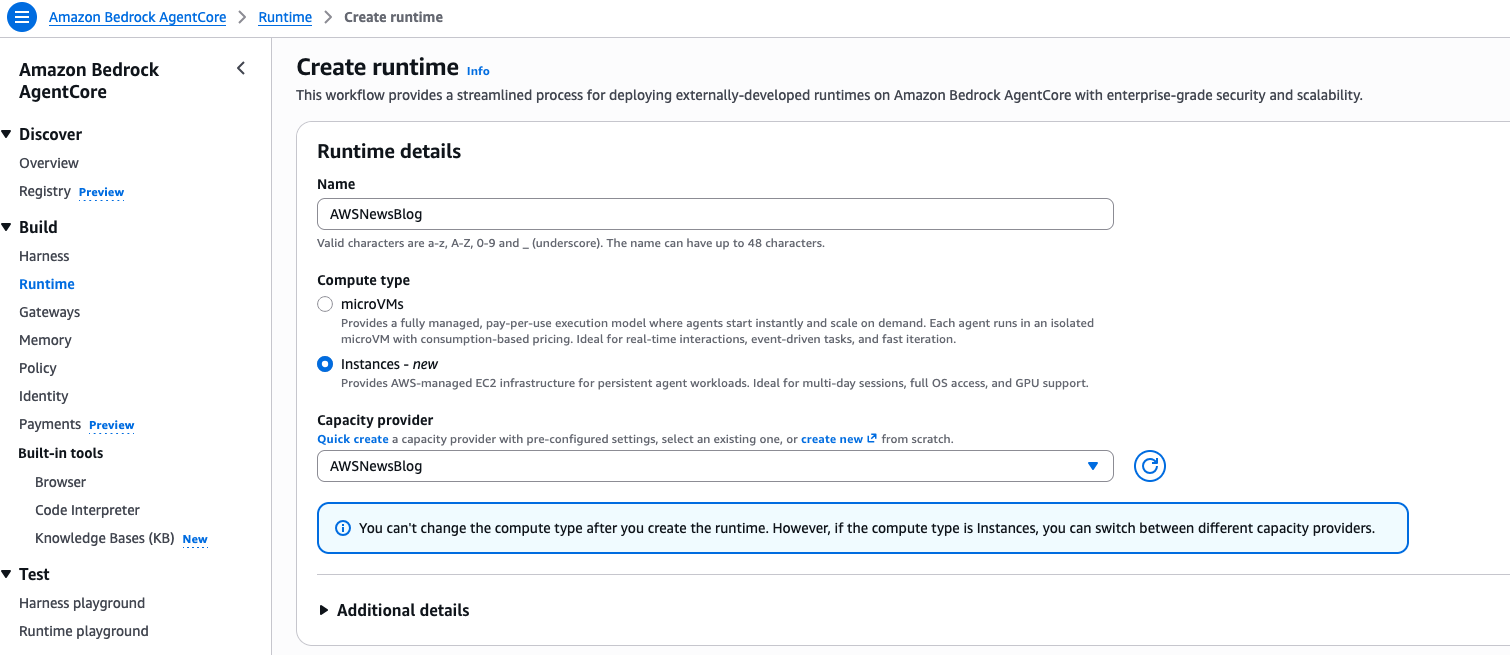
The newly unveiled runtime instances feature a suite of advanced technical capabilities tailored to enterprise-grade AI deployment. By deploying multiple agents onto AWS-managed EC2 infrastructure within a single runtime, organizations can empower distinct agents—each carrying unique software dependencies and artifact types—to collaborate seamlessly on the same host.
Key architectural highlights of the service include:
- Extended Session Persistence: Shared sessions between collaborating agents can now persist for up to 14 days, accommodating intricate, multi-stage workflows that span multiple business days.
- Hardware Acceleration: Native support for GPU-accelerated computing environments to handle computationally heavy tasks such as complex code compilation, security vulnerability scanning, and graphical user interface (GUI) automation.
- Cost Optimization Controls: Integrated session stop and restart functionalities allow administrators to hibernate workloads during idle periods, preserving state while significantly reducing compute costs.
- Containerized Deployments: Full flexibility for development teams seeking to ship independent container images or leverage minimal packaging structures via simple decorators and deployment archives.
- Long-Term Memory Integration: Seamless pairing with Amazon Elastic Block Store (Amazon EBS) and AgentCore Memory, enabling agents to retain institutional knowledge, context, and recall across multiple sessions and distinct operational environments.
Furthermore, runtime instances integrate natively with existing AgentCore APIs, identity and access management controls, and observability frameworks. Developers retain the freedom to utilize any prominent orchestration or agent framework—including CrewAI, LangGraph, LlamaIndex, and Strands—alongside any foundational model of their choice.
Complementary Compute Paradigm: MicroVMs and Instances
A defining characteristic of the updated Bedrock AgentCore architecture is the synergistic relationship between runtime microVMs and runtime instances. Rather than operating as mutually exclusive alternatives, these two compute options can be deployed independently or combined within a unified API framework.
Industry analysts and technical architects have noted the efficiency of this hybrid model. Organizations can deploy a lightweight orchestrator agent on a runtime microVM to manage inbound application programming interface (API) calls, dynamic task routing, and high-level result aggregation by leveraging the microVM’s rapid scaling capabilities. Concurrently, specialized worker agents running on dedicated runtime instances can execute heavy, resource-intensive operations requiring persistent local file systems and direct operating system visibility.
Demonstrating Multi-Agent Collaboration
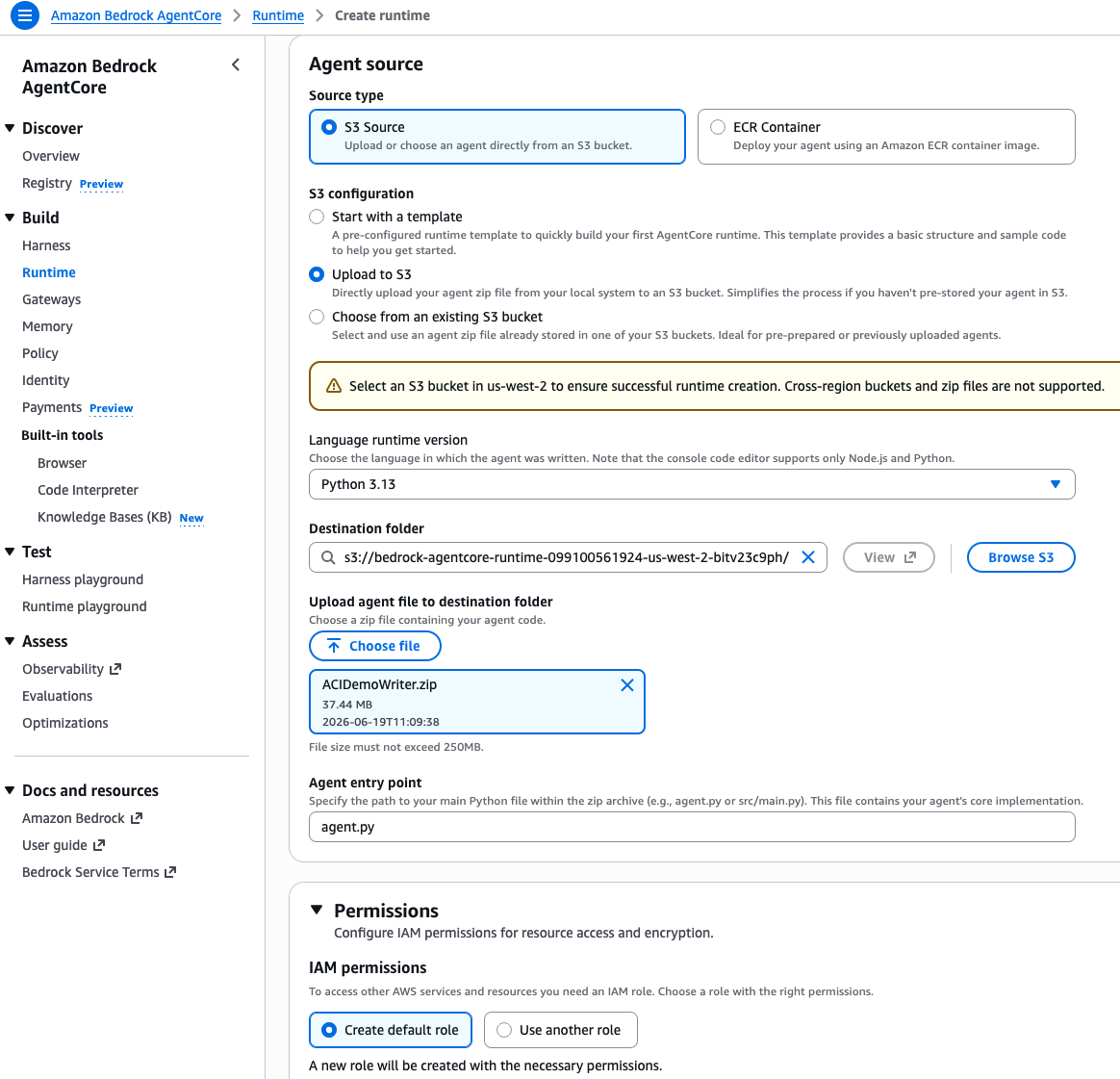
To illustrate the practical application of runtime instances, AWS technical demonstrations have highlighted multi-agent software development pipelines. In a typical configuration, a code writer agent generates Python applications from natural language prompts, while a code reviewer agent simultaneously analyzes the generated code for logical bugs, stylistic consistency, and security vulnerabilities.
By leveraging the shared file system provided within a runtime instance session, both agents operate on the same underlying storage directory without requiring explicit network data transfers or inter-agent API calls. This collaborative paradigm scales naturally to incorporate additional specialized entities, such as automated testing agents, documentation generators, and continuous security compliance scanners.
Strategic Implications for Enterprise AI Adoption
The introduction of runtime instances carries profound implications for the enterprise software ecosystem. By eliminating the administrative burden of managing distributed infrastructure for autonomous agents, AWS is effectively lowering the barrier to entry for production-grade agentic systems.
Financial analysts and technology strategists observe that persistent, stateful agent execution environments are prerequisites for realizing true automation ROI across sectors such as financial services, software engineering, supply chain logistics, and healthcare compliance. The ability to pause complex, multi-day analytical workflows on Monday evening and resume them seamlessly on Wednesday morning without state degradation introduces unprecedented operational flexibility.
Availability and Getting Started
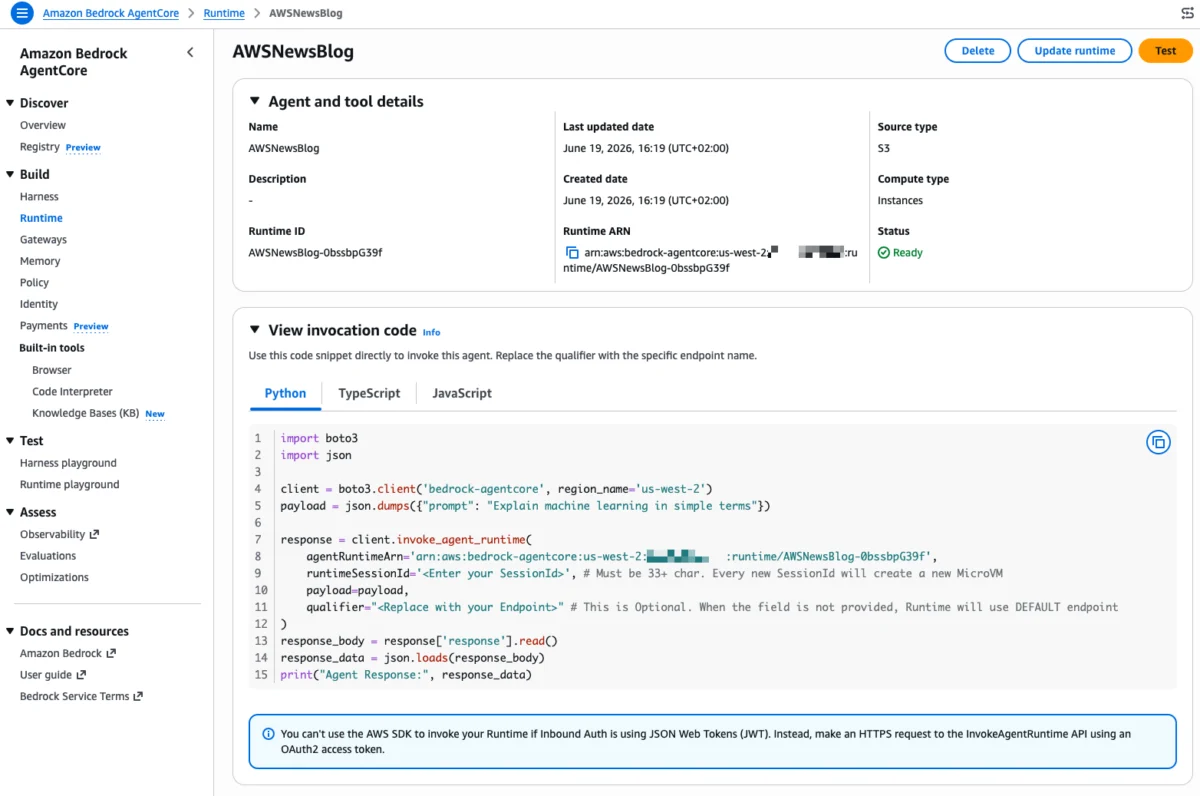
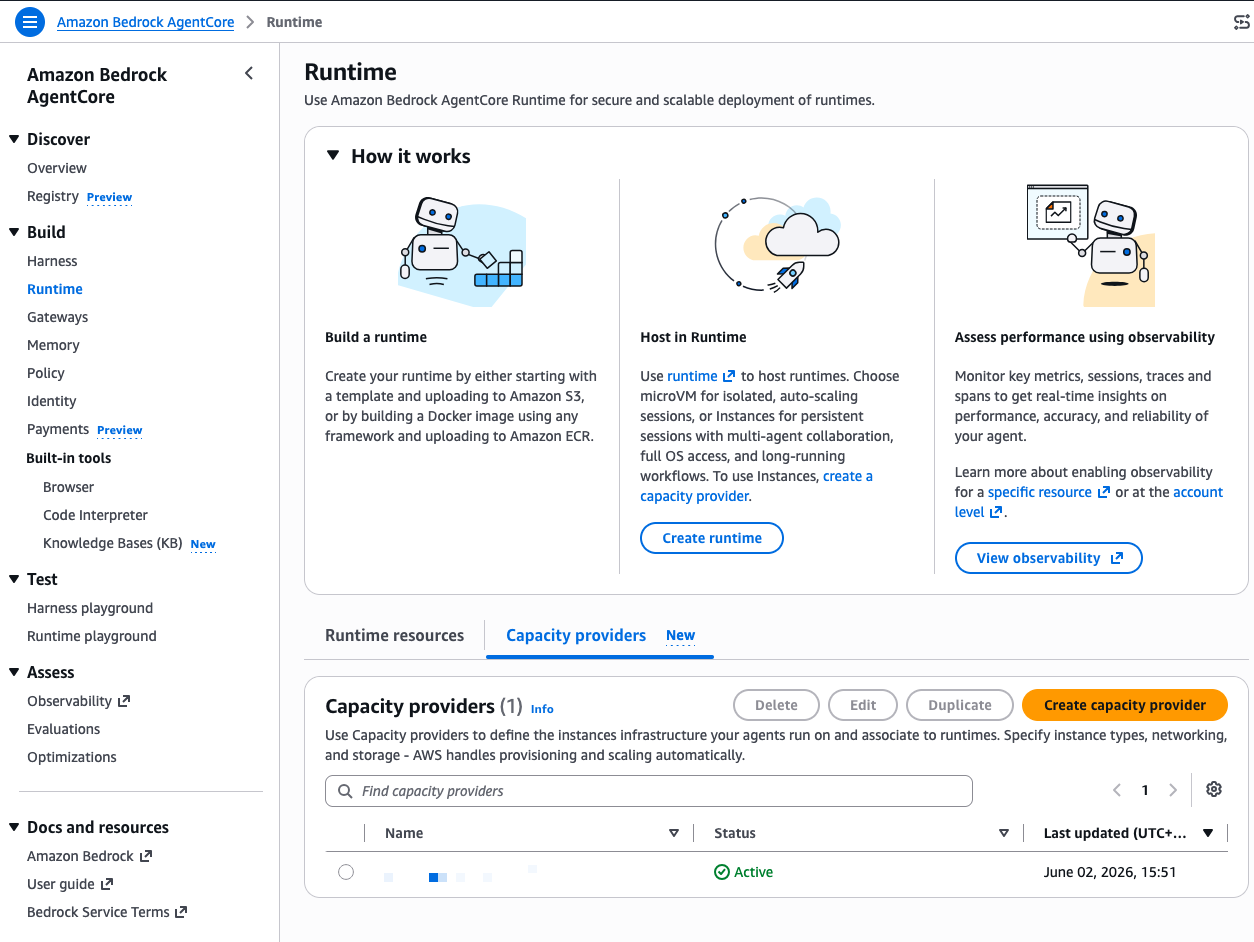
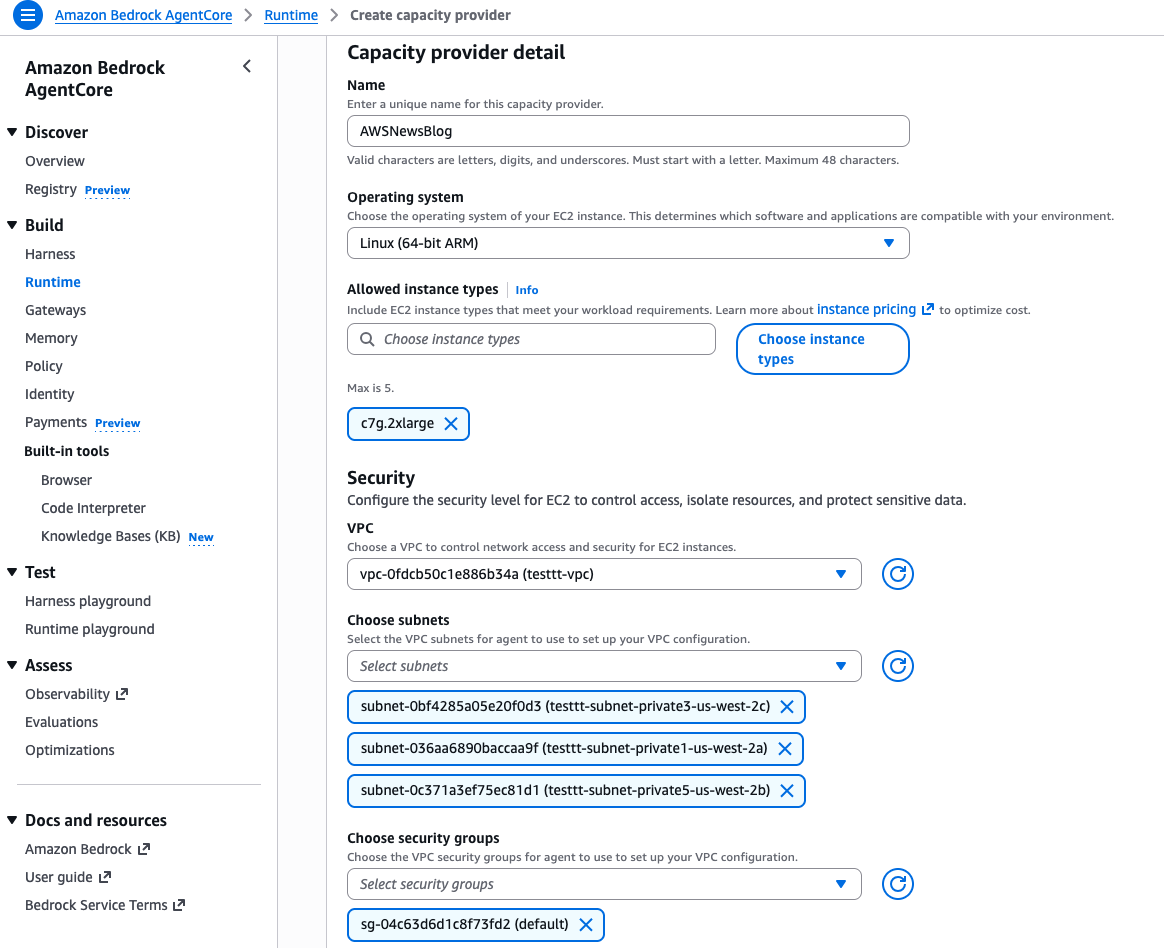
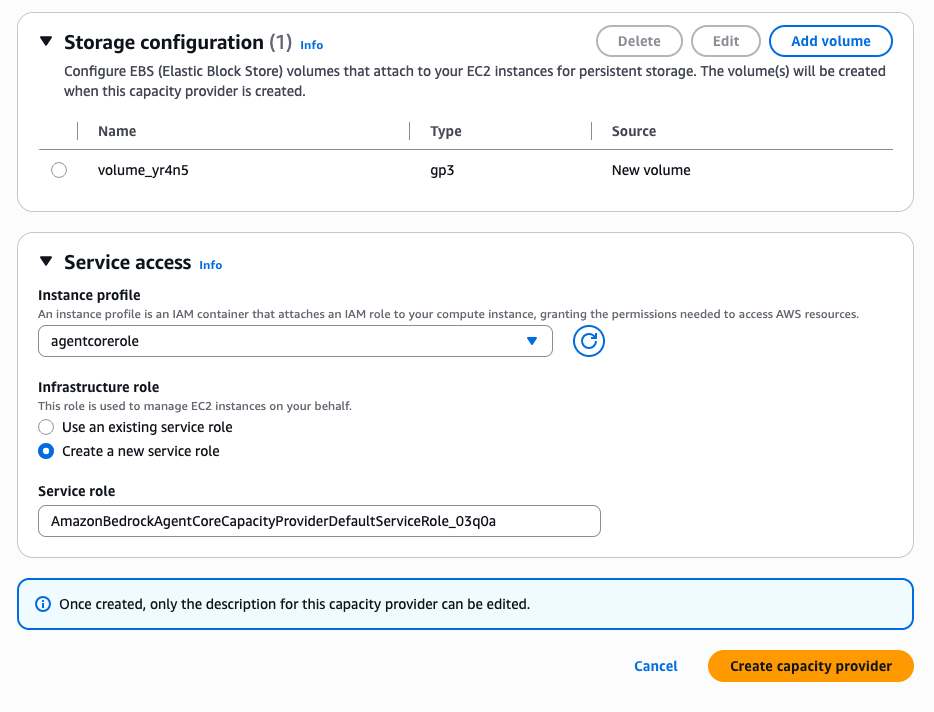
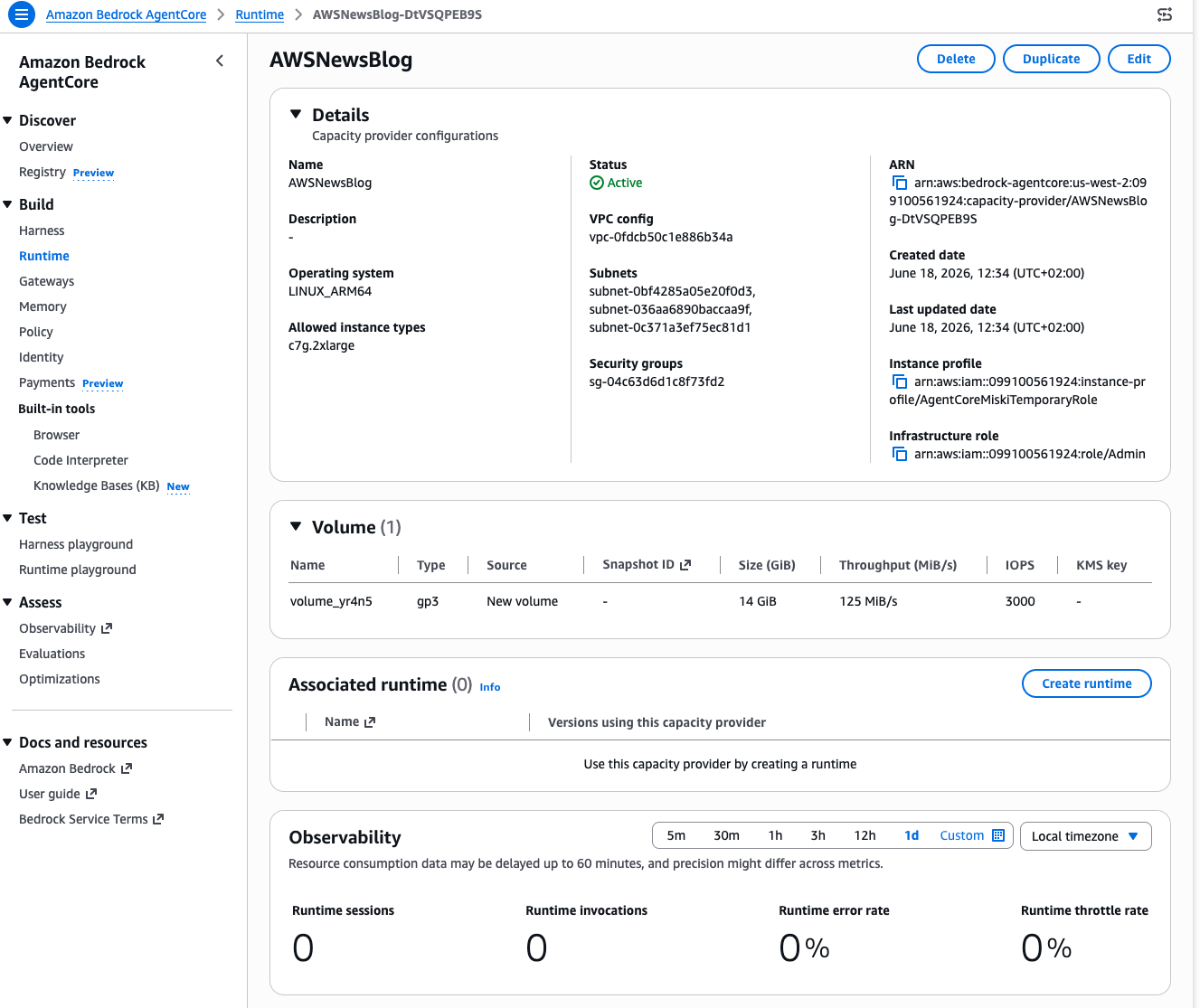
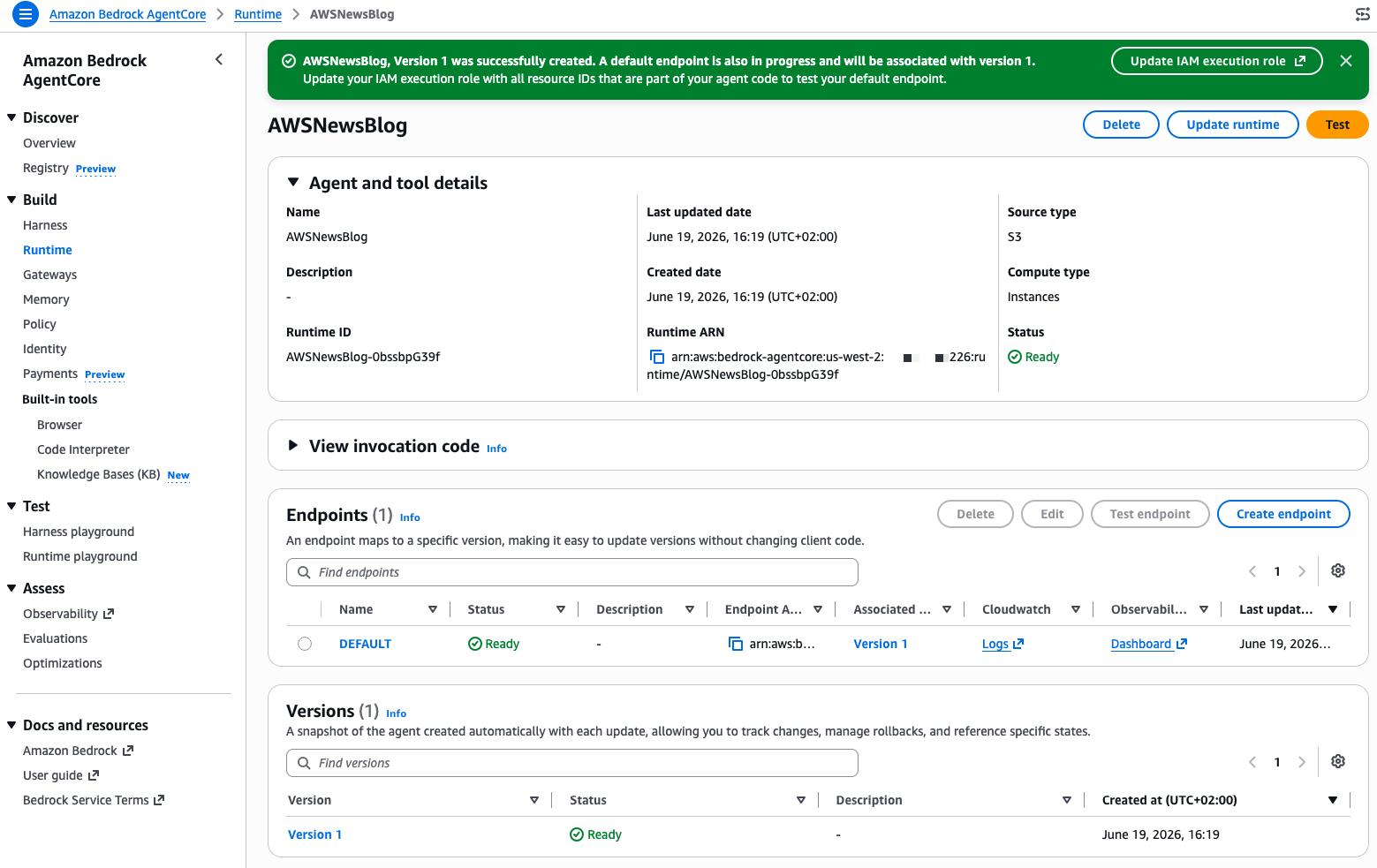
The new runtime instances capability is currently available for deployment through the AWS Management Console, the AgentCore Command Line Interface (CLI), standard AWS CLI tools, and infrastructure-as-code (IaC) templates. Developers can begin configuring their dedicated capacity providers, defining operating systems, selecting optimal instance types (such as ARM-based Graviton processors or GPU-enabled variants), and establishing secure networking parameters by consulting the official Amazon Bedrock AgentCore technical documentation. As enterprises accelerate their transition toward autonomous operations, managed compute layers like runtime instances are poised to become the foundational bedrock of modern enterprise artificial intelligence.
