
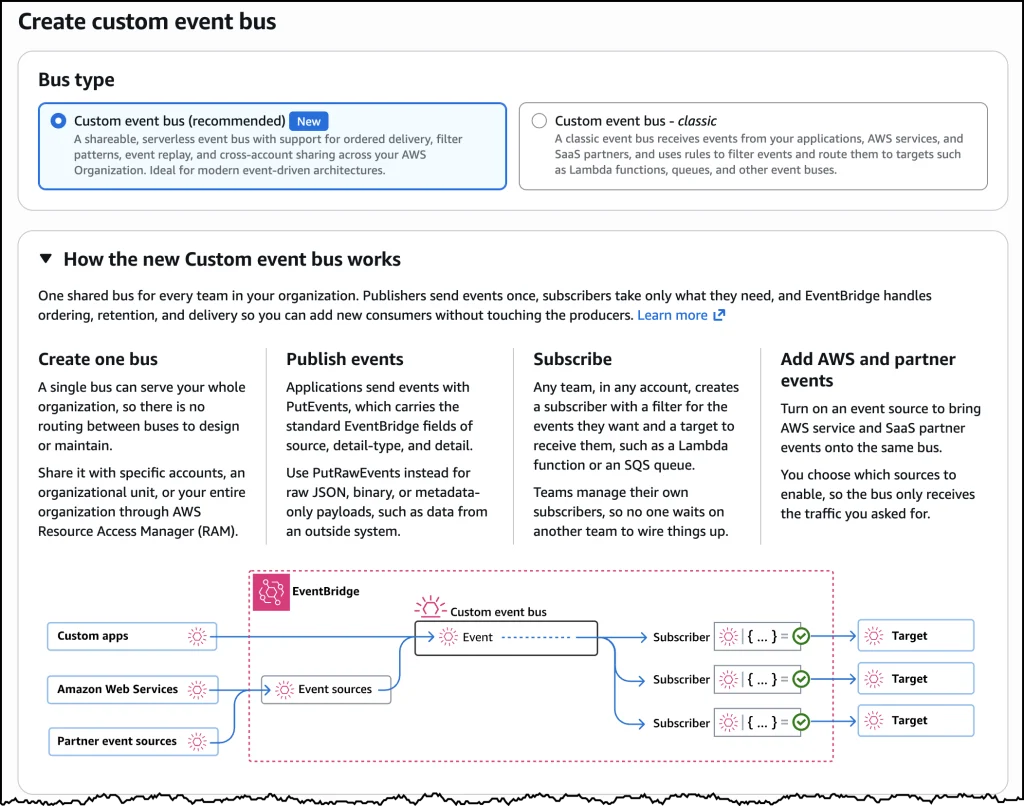

Amazon Web Services (AWS) has officially launched a major enhancement to Amazon EventBridge, introducing a brand-new custom event bus architecture designed specifically to address the operational complexities of scaling serverless, event-driven applications across large, multi-account enterprise environments. Historically, organizations constructing event-driven systems began with a single custom event bus within a solitary AWS account—a strategy that worked exceptionally well for smaller, isolated teams. However, as enterprise adoption accelerated and governance mandates required robust multi-account boundaries, this initial simplicity dissolved. Engineering teams were forced to construct intricate webs of cross-account rules and bus-to-bus configurations, inadvertently recreating the very operational overhead that serverless paradigms were engineered to eliminate.
The newly released enhanced custom event bus directly targets these friction points. By offering a centralized event backbone that spans an entire AWS organization, the update delivers native event ordering guarantees, a streamlined Subscriber resource model, advanced data transformation capabilities, and a restructured pricing framework. This release marks one of the most substantial architectural evolutions for Amazon EventBridge since its inception, signaling AWS’s continued commitment to maturing its serverless ecosystem for enterprise-grade workloads.
Background Context: The Evolution of Serverless Event Routing
Event-driven architecture (EDA) has rapidly become the foundational design pattern for modern cloud-native applications. By decoupling producers that generate state changes from consumers that react to them, organizations achieve high scalability, loose coupling, and rapid deployment cycles. Amazon EventBridge has long stood at the center of this movement within the AWS ecosystem, serving as a serverless event bus that routes data from custom applications, software-as-a-service (SaaS) applications, and AWS services.
In the early stages of cloud migration, companies typically deployed one custom event bus per AWS account. As enterprise cloud footprints expanded to hundreds or thousands of individual accounts—following AWS Well-Architected Framework guidelines for security, billing, and resource isolation—routing events between those accounts became a significant engineering hurdle. Teams had to rely on complex resource policies, cross-account permissions, and multi-hop bus configurations.
This decentralized approach introduced severe visibility gaps. Platform engineering teams often lost track of which downstream consumers were subscribing to specific event streams, making impact analysis during updates nearly impossible. Furthermore, the financial cost of multi-bus routing compounded rapidly, as every hop across accounts incurred additional charges under the legacy pricing model. Additionally, applications requiring strict sequencing—such as financial transactions or logistics tracking—were forced to either introduce supplementary queuing layers like Amazon SQS or abandon EventBridge altogether for those specific workflows, undermining the goal of a unified event architecture.

Architectural Breakthroughs of the Enhanced Custom Event Bus
The newly introduced enhanced custom event bus fundamentally alters how enterprises manage intra-organizational event flows. Available immediately through the AWS Management Console, AWS Command Line Interface (CLI), and direct APIs, the feature introduces several core architectural advancements.
Organization-Wide Sharing via AWS RAM
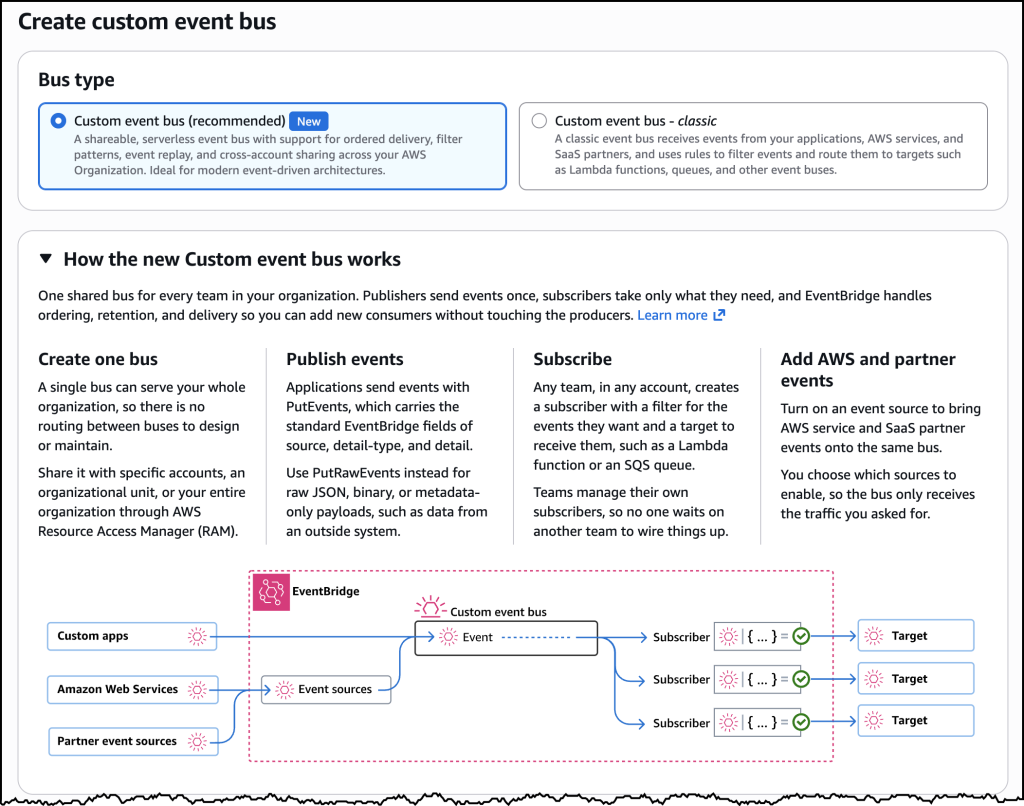
At the heart of the new offering is seamless, organization-wide sharing powered by AWS Resource Access Manager (AWS RAM). Platform teams can now provision a single, centralized event bus and share it natively across all AWS accounts within an enterprise organization. Administrators can scope access precisely, granting publishing and subscribing permissions to specific AWS accounts, organizational units, or individual IAM roles and users without manually configuring cumbersome cross-account resource policies.
This model restores centralized governance to platform teams while preserving development velocity for individual product squads. Publishers can emit events to the central bus without needing any awareness of downstream consumers, while application teams can independently establish their own subscriptions. To accommodate large-scale enterprises, AWS has established a default quota of 10,000 subscribers per enhanced event bus, with higher limits available upon request, effectively eliminating the need to fragment event architectures across multiple artificial boundaries.
Native Event Ordering and Synchronous Processing
While asynchronous communication is a core tenet of event-driven design, certain enterprise use cases demand strict message sequencing. For example, in supply chain and logistics applications, real-time fleet telemetry and driver location updates must be processed in exact chronological order; otherwise, automated routing engines risk making critical operational decisions based on stale or out-of-order data.

The enhanced custom event bus solves this challenge by supporting dual delivery patterns on a single bus. Publishers can attach an optional EventGroupId to outgoing payloads. EventBridge ensures that events sharing the same identifier are delivered in strict sequence to subscribers configured for ordered delivery, while other consumers on the same bus continue to process events concurrently and asynchronously.
To support this guaranteed sequencing without sacrificing reliability, AWS has introduced native synchronous invocation for targets such as AWS Lambda. In synchronous mode, EventBridge confirms successful target execution before acknowledging the event. This capability eliminates the historical requirement of placing an intermediary queue, such as Amazon SQS, between the event bus and the compute layer just to guarantee sequential processing.
Streamlined Subscriptions and Advanced Event Evaluation
Managing event subscriptions in legacy EventBridge configurations often required juggling multiple decoupled resources, including rules, target definitions, retry policies, and dead-letter queues. The enhanced custom event bus consolidates these operational elements into a single, cohesive entity known as the Subscriber resource. A single Subscriber definition now encapsulates event filtering criteria, target endpoints, retry behaviors, and failure destinations, drastically simplifying infrastructure-as-code (IaC) templates and day-two maintenance.
Moreover, the new architecture introduces sophisticated event evaluation tools directly into the ingestion pipeline:
- Content-Based Deduplication: For event sources that lack native idempotency tokens, publishers can enable content-based deduplication. EventBridge hashes the meaningful components of the event payload and automatically discards duplicate transmissions arriving within a five-minute window, effectively delivering exactly-once semantics for retried events.
- JSONata Transformations: Subscribers can leverage powerful JSONata expressions to reshape, filter, and map event payloads on the fly before they reach downstream targets, eliminating the need for custom transformation microservices.
- Serialization Support: Enterprises utilizing advanced data serialization formats such as Apache Avro or Protocol Buffers can now have EventBridge automatically deserialize these payloads into JSON, enabling granular filtering and routing across the entire message body without requiring custom consumer-side parsing logic.
A Scalable, Predictable Pricing Model
Addressing one of the primary historical pain points of multi-bus topologies, AWS has rolled out a completely restructured pricing model for the enhanced custom event bus. Moving away from the legacy per-event pricing structure—which frequently penalized organizations with compounding cross-account and multi-hop routing fees—the new model separates costs into ingress and egress throughput. Publishers pay strictly for the volume of events ingested into the bus, while subscribers pay for the volume of events delivered to their respective endpoints. This transparent cost-allocation model aligns infrastructure expenditures directly with organizational value and usage, making large-scale serverless adoption significantly more economical.
Industry Implications and Enterprise Outlook
Independent cloud architects and enterprise technology leaders have widely praised the release, noting that it directly resolves longstanding friction in serverless adoption. In enterprise environments where platform engineering teams strive to balance developer autonomy with strict security and auditing controls, the ability to maintain a single, governed event backbone is a major architectural win.
By collapsing what previously required complex, multi-account routing workarounds into a native, managed service feature, AWS has lowered the barrier to entry for complex, event-driven topologies. Organizations dealing with massive data streams can now enforce strict ordering, apply advanced payload transformations, and scale subscriber counts into the tens of thousands without engineering custom orchestration layers.
Availability and Deployment Roadmap
The enhanced custom event bus is generally available today across a broad footprint of global AWS Regions, including US East (N. Virginia, Ohio), US West (Oregon), Europe (Ireland, Frankfurt, Stockholm, Spain), and Asia Pacific (Hong Kong, Malaysia, Mumbai, Singapore, Sydney, Thailand, Tokyo).
AWS has emphasized that existing workloads running on legacy architecture will remain fully supported. In the management console, traditional setups are now designated as Custom event bus — classic, ensuring backward compatibility and allowing organizations to migrate to the enhanced architecture at their own measured pace. Enterprises can begin provisioning and configuring the new resource immediately via the AWS Management Console, AWS CLI, or automated deployment pipelines.
