

For nearly a decade, the architecture of open-source Kubernetes has enforced a strict unidirectional upgrade path for control planes. Once an administrator executed a version upgrade, reverting to the previous state was historically unsupported by the core platform. While the broader cloud-native community has made incremental strides—such as the introduction of KEP-4330 to explore emulated versions—the fundamental risk of a one-way door has long dictated enterprise operational strategies. Organizations managing large-scale containerized environments have traditionally relied on elaborate, time-consuming mitigation frameworks. These include mandatory bake periods, staggered rollout groups, automated sign-offs, and multi-month validation cycles designed to catch compatibility errors before they hit production.
Because the Cloud Native Computing Foundation (CNCF) schedules three minor Kubernetes releases every calendar year, this rigidity created a severe operational bottleneck. Enterprises managing hundreds or thousands of distinct clusters, particularly those bound by strict regulatory compliance frameworks, frequently chose to delay upgrades entirely. The fear of encountering an unrecoverable compatibility defect or a breaking API change outweighed the benefits of new features. Consequently, countless production workloads remained stranded on aging software versions, missing critical security patches and eventually running headfirst into the strict timelines of the Kubernetes extended support lifecycle.
Addressing this long-standing industry pain point, Amazon Web Services (AWS) announced the official launch of Kubernetes version rollbacks for Amazon Elastic Kubernetes Service (Amazon EKS). This new capability establishes a robust safety net for cloud architects and DevOps engineers, allowing them to reverse a Kubernetes version upgrade within a seven-day window if unforeseen operational defects arise. By returning the cluster to a fully validated, production-proven previous state rather than relying on an emulated transitional environment, AWS is fundamentally altering how organizations approach container lifecycle management.
The Mechanics of the EKS Rollback Feature
The newly introduced version rollback mechanism is engineered to integrate seamlessly into existing Amazon EKS operational workflows. When an administrator upgrades a cluster—for instance, moving from Kubernetes version 1.34 to 1.35—and subsequently discovers a critical incompatibility with third-party operators, custom controllers, or internal microservices, they are no longer forced to rebuild the infrastructure from scratch. Within the initial seven-day post-upgrade window, the administrator can initiate a rollback operation that reverts the control plane to the exact prior version.
Unlike alternative industry approaches that keep clusters suspended in a simulated holding state, EKS version rollbacks restore the environment to an architecture that has already proven its stability under live production traffic. The feature operates on a strict, incremental minor-version methodology, mirroring the precise stepwise progression required during standard EKS upgrades.

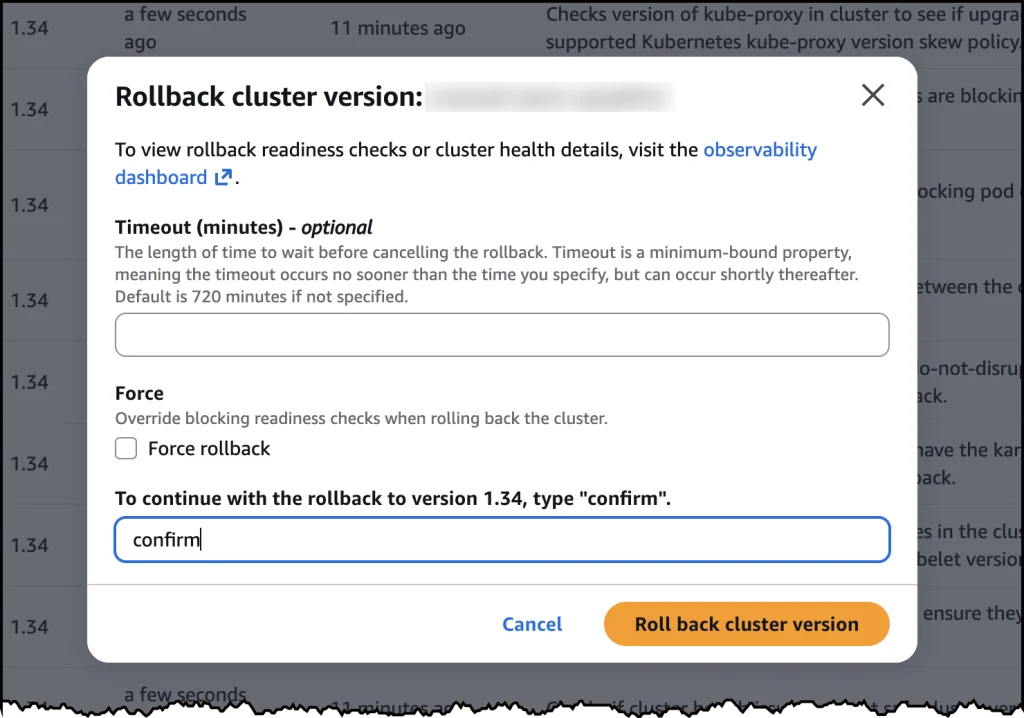
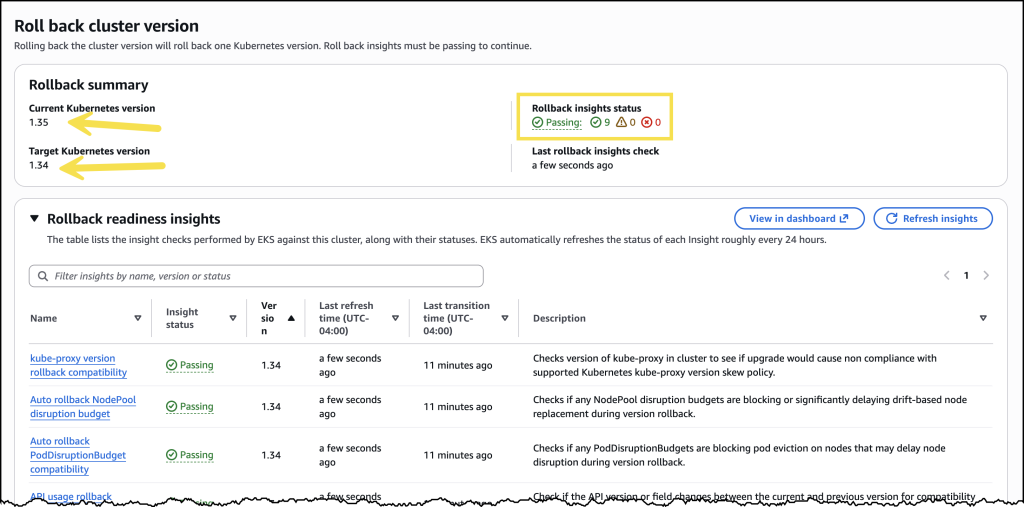
To safeguard system integrity prior to execution, the platform automatically leverages Amazon EKS Cluster Insights. This diagnostic engine evaluates the cluster’s readiness for a rollback by auditing essential dependencies, including node version compatibility and add-on software versions. If potential roadblocks are identified, the system flags them for review. However, for organizations with highly customized workflows that have already performed independent validation, administrators retain the flexibility to bypass these automated safeguards by utilizing a specific command-line override flag (--force).
While control plane rollbacks apply universally across all EKS clusters regardless of whether the underlying nodes are managed by the customer or AWS, environments utilizing fully managed infrastructure gain an even more integrated experience.
Streamlining Rollbacks in EKS Auto Mode
The launch of EKS Auto Mode earlier in the platform’s lifecycle transformed how teams deploy production-ready Kubernetes environments by fully automating compute, networking, and storage provisioning. However, rolling back an environment governed by EKS Auto Mode introduces distinct operational complexities, as both the control plane and the managed node infrastructure must be reverted in tandem.
Because node rollbacks are bound by Pod Disruption Budgets (PDBs)—safeguards designed to prevent service interruptions by limiting the number of pods that can be taken offline simultaneously—the duration of a node rollback can vary widely depending on cluster configuration and workload density. To prevent administrative bottlenecks during high-stress operational recovery scenarios, AWS has integrated a dedicated cancel API for EKS Auto Mode rollbacks.
This API provides operators with real-time agency, allowing them to halt a node rollback at any juncture if the process encounters delays or if operational priorities shift. Administrators can subsequently adjust their PDB parameters to accelerate the reconciliation process or choose an entirely different remediation pathway. By default, Amazon EKS prioritizes workload stability above all else, ensuring that system-initiated rollbacks strictly adhere to configured disruption budgets unless explicitly overridden by the engineering team.
Step-by-Step Operational Workflow
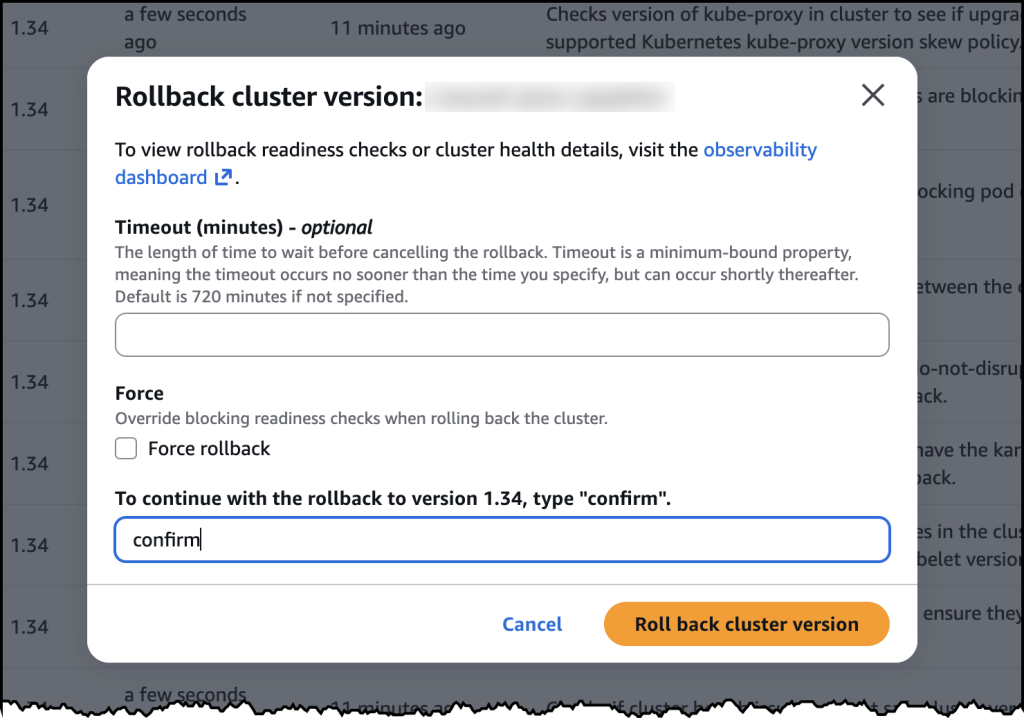
Executing a version rollback within the Amazon EKS ecosystem has been designed to mirror the intuitive nature of standard AWS console interactions. The operational workflow unfolds across several predictable phases:
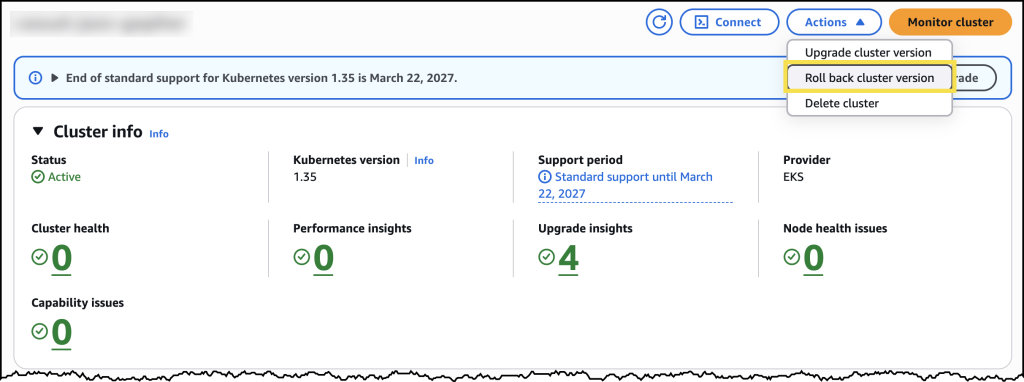
- Console Navigation and Eligibility Verification: An administrator accesses the Amazon EKS management console and selects a cluster that has undergone a recent version upgrade. The interface clearly displays the availability of the version rollback option alongside a precise countdown of the active seven-day rollback window.
- Cluster Insights Assessment: Prior to confirming the action, operators review the integrated rollback insights panel. This diagnostic view highlights node statuses, add-on compatibility metrics, and potential warnings that require attention.
- Execution and Monitoring: Upon user confirmation, the rollback sequence initiates. Throughout the process, the cluster maintains operational functionality. Control plane reversion typically concludes within approximately 20 minutes, a timeframe comparable to a standard upgrade cycle. For clusters running under EKS Auto Mode, worker nodes are systematically updated in strict accordance with defined Pod Disruption Budgets.
- Validation: Once the background orchestration completes, the cluster stabilizes on the previous minor version, restoring full operational parity with its pre-upgrade state.
Industry Context and Strategic Implications
The introduction of version rollbacks arrives at a critical juncture for enterprise cloud adoption. As containerization transitions from a cutting-edge deployment strategy to the absolute baseline of enterprise IT architecture, the scale and complexity of managed clusters have grown exponentially. Large financial institutions, healthcare providers, and government agencies operating within regulated environments frequently grapple with compliance mandates that demand exhaustive pre-production testing. Despite these rigorous protocols, zero-day anomalies and subtle application-level breakages frequently slip past staging environments into live production.
Historically, discovering a breaking change post-upgrade meant initiating emergency debugging sessions, writing custom patching scripts, or executing painful infrastructure re-deployments while under intense business pressure. By introducing what amounts to an institutional "undo button" for Kubernetes versioning, AWS significantly reduces the operational risk associated with maintaining up-to-date infrastructure.
Industry analysts note that this capability may fundamentally alter how enterprises schedule their lifecycle management calendars. Rather than hoarding upgrades to minimize organizational disruption, teams can adopt a more agile cadence, secure in the knowledge that an immediate, native fallback path exists should unforeseen software regressions occur. Furthermore, by absorbing this capability directly into the standard EKS service tier without introducing ancillary pricing premiums, AWS has lowered the barrier to entry for robust enterprise resiliency patterns.
Availability and Pricing Structure
Amazon Web Services has confirmed that Kubernetes version rollbacks are available immediately at no additional charge. The feature is accessible across all commercial AWS Regions where Amazon EKS is officially supported.
Organizations will continue to pay only standard Amazon EKS control plane fees and underlying compute charges, with zero auxiliary surcharges for invoking or configuring the rollback capability. Control plane rollbacks are universally supported across all EKS deployment models, while synchronized node rollbacks are fully integrated into clusters operating under EKS Auto Mode. The functionality extends to all Kubernetes versions currently maintained under both EKS standard support and extended support policies.
Engineering teams looking to integrate this capability into their operational runbooks can access comprehensive technical documentation directly via the official Amazon EKS user guide or initiate testing through the AWS Management Console.
