

Amazon Web Services (AWS) has announced a significant advancement in enterprise artificial intelligence (AI) deployment, revealing that Amazon WorkSpaces, its managed cloud desktop service, now enables AI agents to securely interact with desktop applications without requiring extensive modernization. This pivotal development addresses a long-standing barrier for organizations looking to integrate AI into core business workflows, particularly those reliant on legacy systems and applications that lack modern application programming interfaces (APIs). The new capability transforms WorkSpaces from merely delivering virtual desktops for human employees into a robust infrastructure for scaling enterprise productivity through intelligent automation.
The Persistent Challenge of Legacy Systems in the AI Era
For years, enterprises have grappled with the inherent incompatibility between cutting-edge AI systems and their foundational operational infrastructure. A substantial portion of global businesses, including many Fortune 500 companies, continue to operate critical processes on applications and mainframe systems developed decades ago. These systems, while robust and reliable, were not designed with modern programmatic access in mind. A compelling statistic from a 2024 Gartner report underscores this challenge, revealing that a staggering 75% of organizations worldwide utilize legacy applications that are devoid of modern APIs. Furthermore, the report highlights that 71% of Fortune 500 companies specifically run mission-critical processes on mainframe systems without adequate programmatic interfaces, creating an impenetrable wall for AI.
This architectural chasm presents a significant dilemma: enterprises are forced to choose between delaying their AI adoption strategies, thus risking falling behind in an increasingly competitive landscape, or embarking on prohibitively expensive and often risky modernization projects. Such projects can involve rewriting applications, developing custom API layers, or migrating to entirely new platforms – endeavors that are time-consuming, resource-intensive, and fraught with potential for disruption. The inability of AI agents to "see" and interact with the graphical user interfaces (GUIs) of these essential applications has been a major bottleneck, hindering the promise of pervasive automation.

Amazon WorkSpaces: A New Paradigm for AI Agent Deployment
AWS’s announcement fundamentally alters this landscape. By leveraging the existing Amazon WorkSpaces infrastructure, which millions of employees already use for secure, managed virtual desktop access, AI agents can now seamlessly operate desktop applications. This innovative approach means that enterprises are no longer burdened with the monumental task of re-architecting their entire application portfolio to become AI-ready. Instead, the AI agents function within the familiar and secure WorkSpaces environment, effectively simulating a human user’s interaction with the desktop.
The implications are profound: there’s no need to develop custom APIs for each legacy application, no complex application migrations to plan and execute, and no new, dedicated infrastructure to procure and manage. This drastically reduces the time, cost, and risk associated with deploying AI agents for tasks that traditionally required manual human intervention or prohibitively expensive system overhauls. The secure isolation provided by WorkSpaces, a hallmark of its design for human users, naturally extends to AI agents, ensuring that existing security controls and compliance policies remain fully intact.
Chris Noon, Director at Nuvens Consulting, an early adopter of the WorkSpaces for AI agents feature, emphasized the critical advantages: "WorkSpaces lets our clients give AI agents the same secure, governed desktop environment their employees already use – no custom API integrations, full audit trails, and enterprise-grade isolation out of the box. For regulated industries, that’s not a nice-to-have – it’s the baseline." His statement highlights the feature’s immediate value, particularly for sectors like finance, healthcare, and government, where stringent regulatory requirements and data privacy are paramount.
Technical Architecture: How AI Agents "See" and Interact

The technical implementation behind WorkSpaces’ new capability is designed for both security and flexibility. AI agents authenticate through AWS Identity and Access Management (IAM), ensuring granular control over their permissions and access levels. Once authenticated, agents connect via WorkSpaces, with all interactions meticulously recorded. Comprehensive audit trails are available through AWS CloudTrail and Amazon CloudWatch, providing transparency and accountability for every action performed by an AI agent. This level of oversight is crucial for debugging, compliance reporting, and maintaining trust in automated processes.
A key enabler of this functionality is WorkSpaces’ support for the industry-standard Model Context Protocol (MCP). This protocol facilitates standardized communication between AI agents and their execution environments, making WorkSpaces compatible with a wide array of popular agent frameworks. Developers leveraging tools like LangChain, CrewAI, and Strands Agents can now integrate their AI models directly with WorkSpaces, ensuring broad applicability and ease of adoption across diverse AI development ecosystems.
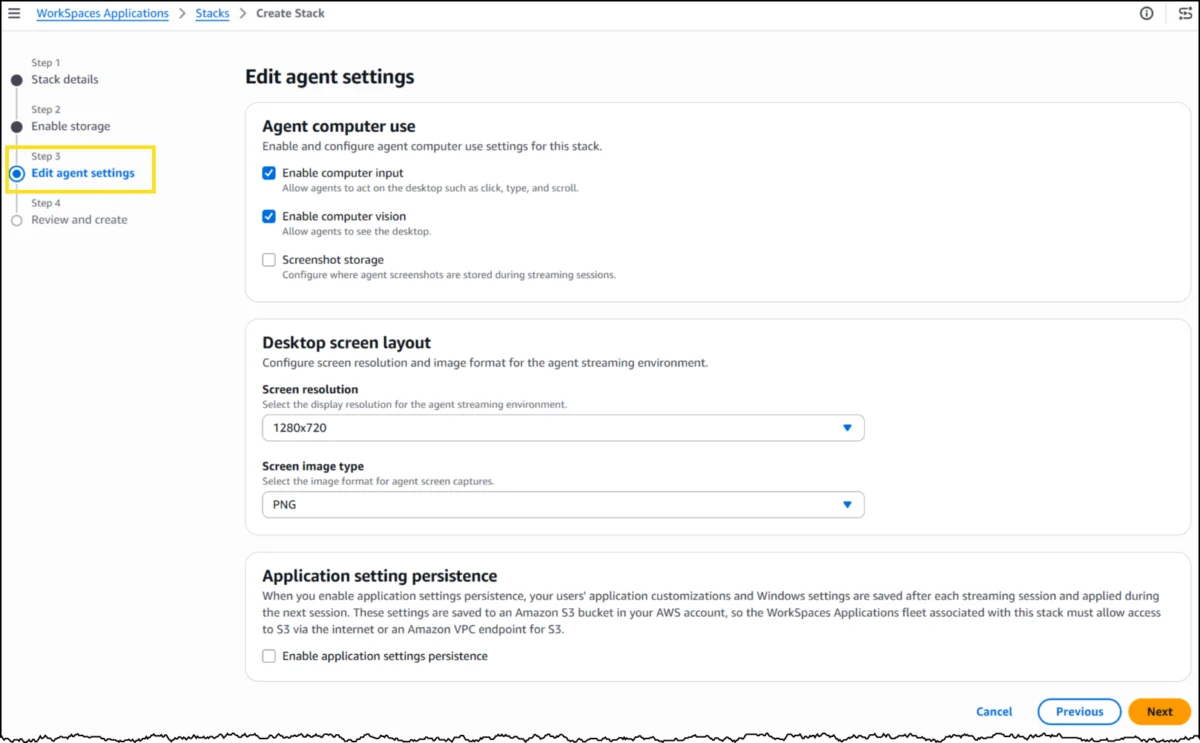
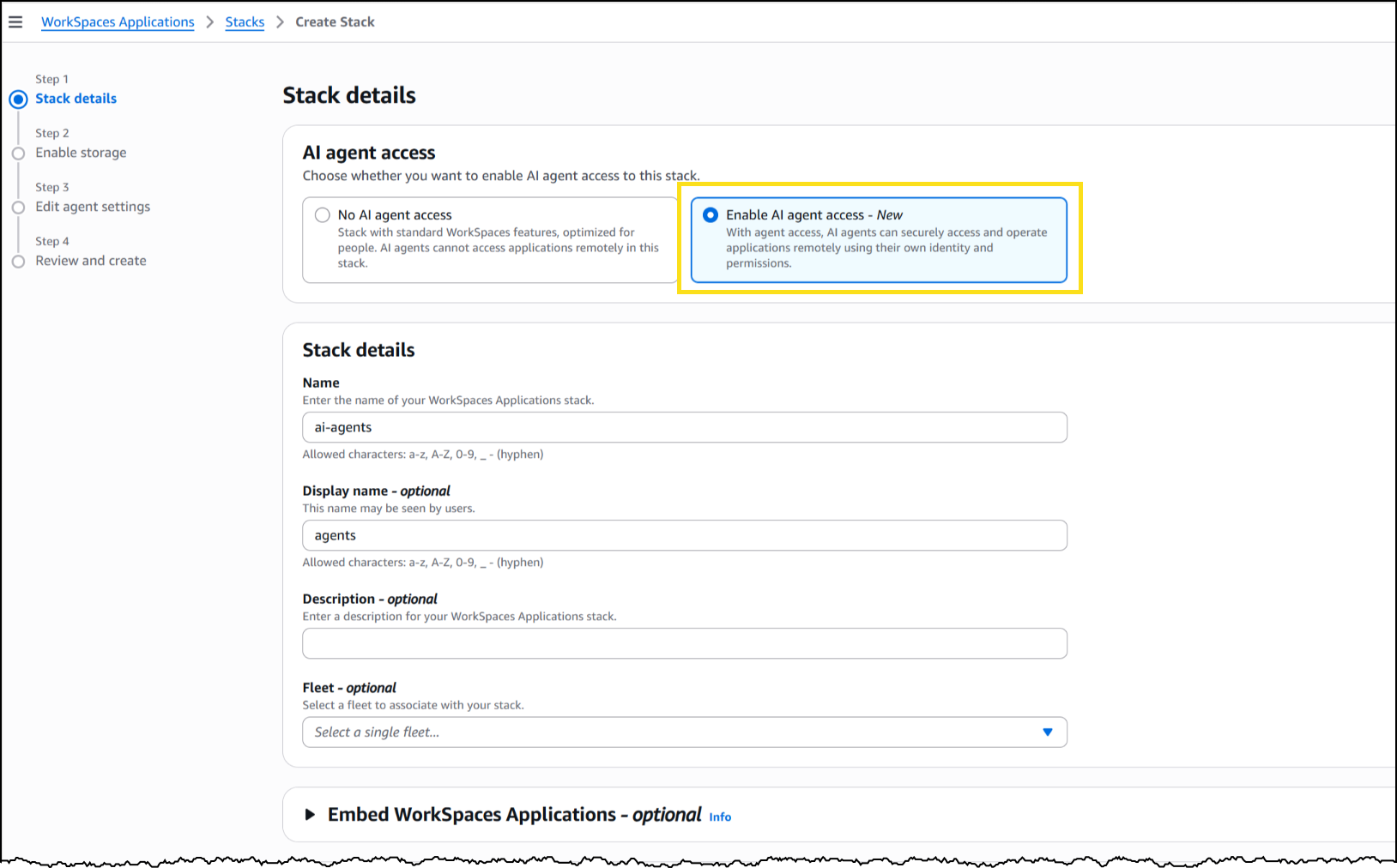
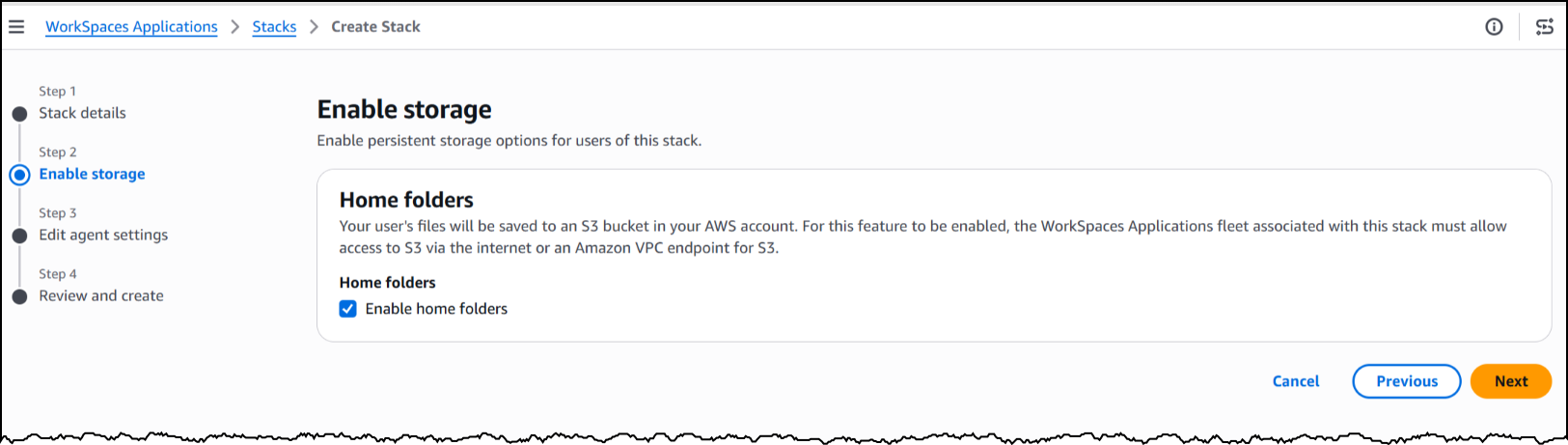
Setting up a WorkSpaces environment for AI agents involves a streamlined process within the AWS Management Console. Users begin by creating a new WorkSpaces Applications stack, which serves as the environment definition governing how agents connect and what permissions they hold. During the stack creation workflow, a new "Add AI Agents" option is available, enabling secure agent access using their own identity and permissions, distinct from human user access. This separation is vital for security and resource management.
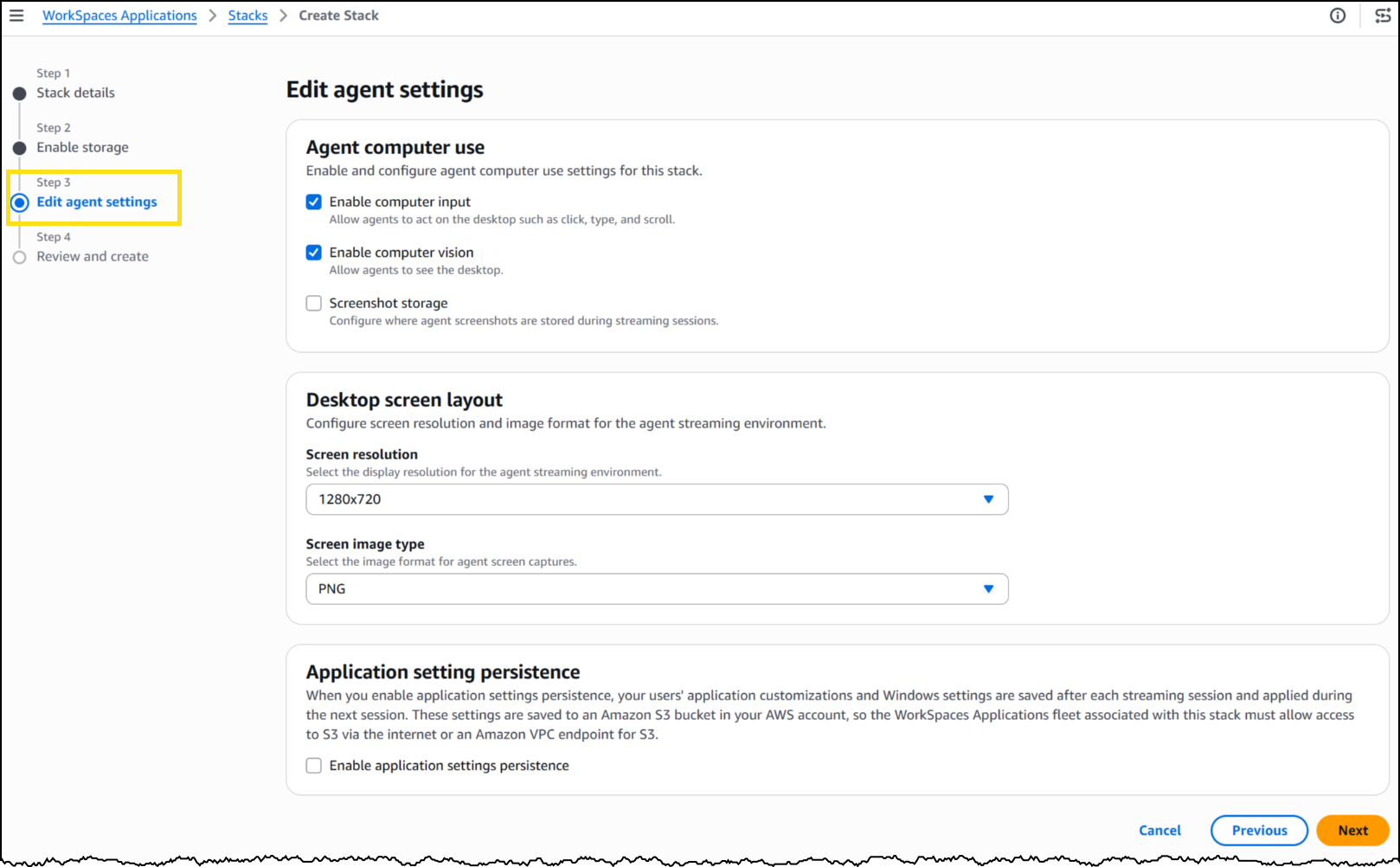
Further configuration involves enabling specific agent capabilities. "Computer input" grants the agent the ability to perform actions such as clicking, typing, and scrolling within the desktop environment, mimicking human interaction. "Computer vision" allows the agent to capture screenshots of the desktop, which is how the AI "sees" and interprets the application’s user interface. Finally, "screenshot storage" configures where these session screenshots are securely stored, providing invaluable data for audit, debugging, and continuous improvement of agent performance.
Desktop screen layout settings, such as resolution and image format (e.g., 1280×720 PNG), are also configurable. These settings directly influence the fidelity of what the agent perceives during a session; higher resolutions may be beneficial for complex applications with dense UI elements, while simpler, terminal-style interfaces might function efficiently at lower resolutions. Once the stack is configured, WorkSpaces exposes a managed MCP endpoint. Developers can then point their chosen agent framework to this endpoint, provide the necessary IAM credentials, and the AI agent can commence interacting with the desktop applications installed on the fleet’s image.
An illustrative example provided by AWS demonstrates an agent, built with the Strands Agent SDK and powered by Amazon Bedrock, executing a complex workflow within a sample pharmacy system. The agent proficiently handles a prescription refill request, which includes looking up patient records, searching for specific medications, placing the order, and confirming a successful refill – all without a single API call to the underlying application. Crucially, the pharmacy application itself remains entirely unaware that an AI agent, rather than a human, is driving it. No modifications, rebuilds, or custom integrations were necessary for the software, highlighting the profound impact of this "no modernization" approach.
A Strategic Evolution: WorkSpaces and the Rise of Enterprise AI
Amazon WorkSpaces was originally launched as a solution to provide secure, managed, and scalable cloud-based virtual desktops for human employees, allowing organizations to provision desktop experiences on demand, reduce hardware costs, and enhance data security. Over the years, it has evolved to support various operating systems, hardware configurations, and user needs.
Parallel to this, the field of artificial intelligence, particularly with the advent of generative AI and sophisticated AI agents, has experienced an explosive growth. Enterprises are increasingly eager to leverage these technologies to automate repetitive tasks, augment human capabilities, and unlock new efficiencies. However, the vast disparity between modern AI’s API-driven nature and the GUI-driven reality of legacy enterprise applications has been a persistent chasm.
This announcement from AWS represents a strategic convergence of these two trajectories. By adapting WorkSpaces to serve as an execution environment for AI agents, AWS is effectively democratizing access to AI automation for a much wider range of enterprise applications. It acknowledges the enduring presence of legacy systems and provides a pragmatic, secure, and scalable pathway for AI integration, sidestepping the often-insurmountable obstacles of full-scale digital transformation. This move solidifies AWS’s position not only as a leader in cloud infrastructure but also as a critical enabler of practical, real-world AI applications for enterprises of all sizes.
Industry Reactions and Broader Implications
The response from the industry to this development is expected to be overwhelmingly positive. Analysts foresee a significant acceleration in AI adoption within sectors heavily reliant on legacy systems, such as banking, insurance, manufacturing, and public administration. The ability to deploy AI agents without costly application modernization projects could unlock billions in potential savings and productivity gains. Enterprises previously stalled in their AI initiatives due to technological hurdles now have a viable, secure, and relatively straightforward path forward.
Beyond the immediate cost savings, the broader implications are transformative:
- Economic Efficiencies: Organizations can reallocate significant capital and human resources previously earmarked for modernization projects towards innovation, research and development, or other strategic initiatives. The accelerated automation of mundane, repetitive tasks will also lead to substantial operational cost reductions and improved return on investment (ROI) on AI investments.
- Operational Agility: AI agents operating within WorkSpaces can execute complex workflows with greater speed, accuracy, and consistency than human operators. This leads to streamlined processes, reduced error rates, and enhanced operational agility, allowing businesses to respond more rapidly to market changes and customer demands.
- Enhanced Security and Compliance: The WorkSpaces environment inherently provides robust security features, including isolation, centralized management, and integration with AWS’s comprehensive security services. By extending this secure perimeter to AI agents, organizations can ensure that AI-driven automation adheres to the highest standards of data protection and regulatory compliance, a crucial factor for regulated industries.
- Future of Work: This capability facilitates a new era of human-AI collaboration. By offloading repetitive and rule-based tasks to AI agents, human employees are freed to focus on higher-value activities requiring critical thinking, creativity, and interpersonal skills. This could lead to a redefinition of roles and foster a more engaging and productive work environment.
- Market Dynamics: This move strengthens AWS’s competitive advantage in the burgeoning enterprise AI market. By offering a practical solution to a pervasive problem, AWS further entrenches its ecosystem within enterprise IT strategies, making it easier for customers to adopt other AWS AI/ML services like Amazon Bedrock.
While the benefits are substantial, careful consideration must be given to the design and oversight of AI agents. Ensuring agents are built with ethical considerations, robust error handling, and appropriate human-in-the-loop mechanisms remains paramount to prevent misuse and maintain control over automated processes.
Availability and Getting Started
This groundbreaking feature is currently available in public preview at no additional cost beyond standard WorkSpaces usage. It is accessible in key AWS Regions globally, including US East (N. Virginia, Ohio), US West (Oregon), Canada (Central), Europe (Frankfurt, Ireland, Paris), and Asia (Tokyo, Mumbai, Sydney, Seoul, Singapore). This widespread availability ensures that a broad base of AWS customers can begin experimenting with and deploying AI agents for their legacy applications immediately.
Developers and organizations interested in leveraging this new capability can get started today by exploring the comprehensive resources available. AWS has provided a dedicated GitHub repository (aws-samples/sample-code-for-workspaces-agent-access) featuring sample code and guidelines to assist in building and deploying AI agents within WorkSpaces. Further details and documentation are also available on the official Amazon WorkSpaces product page.
Conclusion: A Leap Forward for Enterprise AI
The integration of AI agent capabilities into Amazon WorkSpaces marks a pivotal moment for enterprise AI adoption. By dismantling the long-standing barrier between modern AI systems and legacy desktop applications, AWS has provided a pragmatic, secure, and scalable solution that bypasses the need for costly and complex modernization projects. This move is poised to unlock unprecedented levels of automation, drive significant economic efficiencies, and fundamentally reshape operational paradigms across industries. As enterprises continue their journey towards digital transformation, Amazon WorkSpaces for AI agents stands as a testament to practical innovation, offering a clear pathway to harness the full potential of artificial intelligence today.
