
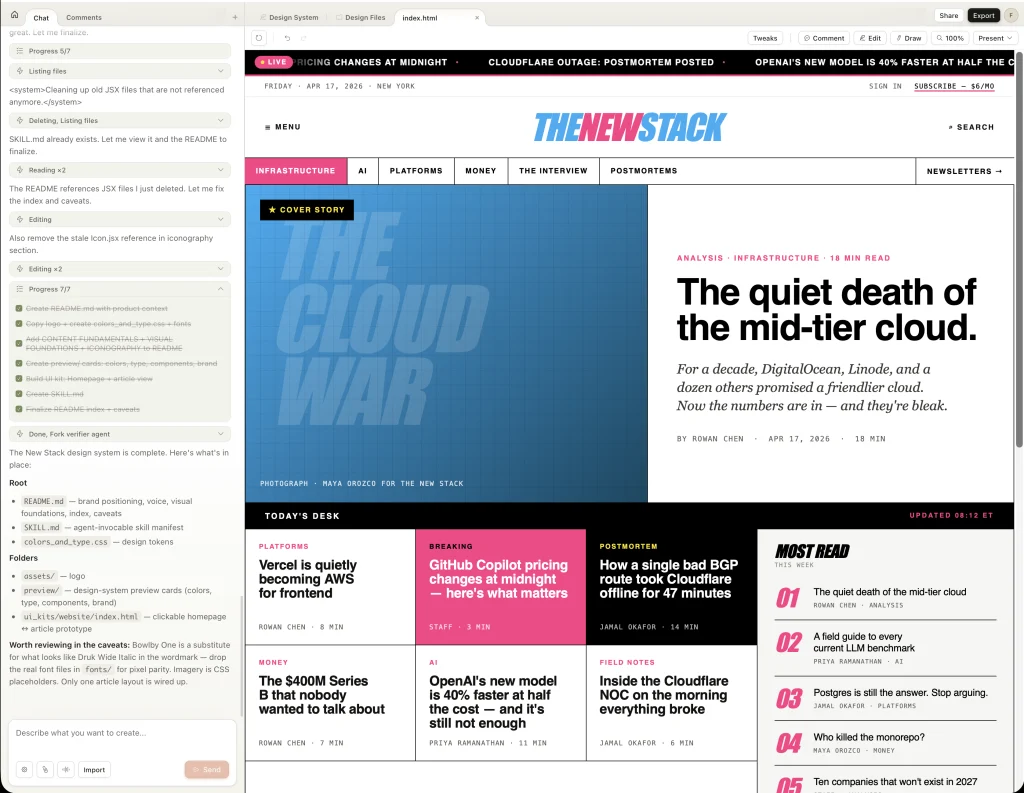

Anthropic Labs, the AI safety and research division of Claude-maker Anthropic, has officially launched Claude Design, a new service now available in research preview. This innovative tool aims to democratize the creation of sophisticated design assets, including comprehensive design systems, website prototypes, interactive websites, polished slide decks, and one-pagers. Previously, such outputs typically required the expertise of professional designers or specialized software like Canva or Figma. The release marks a significant move by Anthropic into the visual design software market, potentially reshaping how individuals and businesses approach digital and presentation design.
The unveiling of Claude Design comes amidst growing anticipation within the tech industry. Earlier this week, a report from The Information surfaced, detailing Anthropic’s development of a design-focused AI tool. Adding to the narrative, Mike Krieger, Anthropic’s Chief Product Officer, recently resigned from the board of Figma, a leading design software company. This strategic timing and personnel change have not gone unnoticed in the market. Following the announcement of Claude Design, Figma’s stock experienced a notable decline, dropping an additional 5% on Friday, building on an already challenging year where its valuation had fallen by nearly 50% over the preceding twelve months.
The introduction of Claude Design underscores Anthropic’s commitment to expanding the capabilities of its AI models beyond conversational interfaces and text generation. The tool leverages advanced generative AI to translate user prompts and existing data into visually coherent and functional design artifacts. This capability addresses a significant market need for accessible and efficient design solutions, particularly for small businesses, startups, and individuals who may not have the resources to hire dedicated design professionals.

Empowering Exploration and Production in Design
Anthropic explicitly states that Claude Design is intended to serve a dual purpose: to provide designers with an expansive canvas for creative exploration and to equip non-designers with the means to produce professional-quality visual work. However, this creative freedom is tethered to the practicalities of AI token consumption. Claude Design operates on a token-based system, with integrated weekly limits for users subscribed to paid Anthropic plans, including Pro, Max, Team, and Enterprise. The generative process, especially for complex outputs like a full design system and a website prototype, proved to be token-intensive during initial testing. For instance, after constructing a design system, a news website prototype derived from it, and a supplementary explainer video, over half of the weekly token allotment was consumed. Exceeding these limits necessitates incurring pay-as-you-go token costs.
While the token economy introduces a layer of strategic usage, the inherent appeal of Claude Design lies in its ability to facilitate novel experimentation. Users are presented with the option to generate wireframes rather than fully rendered mockups, a potentially more token-efficient approach. However, the allure of pushing the boundaries of what’s possible with AI-driven design, and the satisfaction derived from seeing creative concepts materialize rapidly, often leads users to embrace more resource-intensive options. This trade-off highlights a common dynamic in the adoption of generative AI tools: the balance between cost efficiency and the pursuit of innovative outcomes.
Navigating the Claude Design Workflow
The user journey with Claude Design begins with the generation of a foundational design system. The service allows users to input their existing codebase, design files, or any other relevant visual assets. The AI then processes this information to construct a cohesive design framework. A key feature of this process is the iterative user control it offers. While Claude Design takes the lead in proposing color palettes, typography, and design elements, the user retains the ultimate authority. Every proposal can be approved, rejected, or modified through conversational prompts, ensuring that the final output aligns with the user’s vision. This collaborative approach mitigates the "black box" perception often associated with AI tools, fostering a sense of partnership between the user and the AI.
Post-generation, users are afforded the flexibility to revisit and refine the created designs. This post-production editing capability allows for granular adjustments to elements such as background colors, fonts, and other visual attributes. Claude Design enhances this refinement process by incorporating an interactive element reminiscent of OpenAI’s approach with Codex for visual asset creation. Users can provide feedback on specific design elements within a preview interface. Claude Design extends this interactivity further by enabling direct manipulation of designs through drawing and direct editing of certain parameters. Perhaps its most compelling interactive feature is the ability for the AI to generate dynamic sliders and control options, allowing users to fine-tune designs in real-time without the need for explicit, iterative text-based requests. This dynamic adjustment mechanism significantly streamlines the iterative design process.

Anthropic posits that Claude Design holds considerable promise for a range of applications. Beyond generating realistic prototypes, product mockups, compelling pitch decks, and marketing collateral, the tool is envisioned to support "frontier design." This concept encompasses the creation of code-powered prototypes and experimental design explorations that might otherwise be prohibitively time-consuming or complex to undertake manually. The implications for rapid prototyping and innovative product development are substantial, potentially accelerating innovation cycles across various industries.
Export and Integration Capabilities
Upon completion of design work within Claude Design, users have several export options. The generated assets can be rendered as industry-standard PDFs, readily usable PowerPoint slides, or standalone HTML files for web-based applications. Furthermore, Claude Design facilitates seamless integration with Canva, allowing for further refinement and utilization within that popular design platform. For those looking to translate their designs into functional software, there is an option to hand off the design to Claude Code, which can then convert it into working product code.
While the current preview offers robust export functionalities, a direct, integrated method for sharing working prototypes with team members without an explicit export step would be a valuable addition. The Anthropic team has acknowledged this and stated their intention to enhance integration capabilities in the coming weeks, aiming to connect Claude Design with a wider array of tools commonly used by teams. This commitment to integration suggests a long-term strategy to position Claude Design as a central hub within creative workflows.
Market Context and Competitive Landscape
The launch of Claude Design occurs at a pivotal moment in the evolution of AI-powered creative tools. The competitive landscape is intensifying, with established players and emerging startups vying for dominance. The perceived threat to companies like Figma is evident in the immediate market reaction. Historically, design software has relied on human expertise for its core functionality. However, generative AI is rapidly challenging this paradigm, offering automated solutions that can augment or even replace certain aspects of traditional design processes.

The success of Claude Design will likely hinge on several factors: the quality and versatility of its output, its token economics and pricing structure, the intuitiveness of its user interface, and its ability to integrate effectively with existing design ecosystems. As a research preview, the tool is expected to undergo significant development and refinement based on user feedback and evolving AI capabilities.
The broader implications of Claude Design extend beyond its immediate utility. It represents a tangible step towards a future where AI plays an increasingly integral role in creative industries. This could lead to a democratization of design, empowering a wider range of individuals to bring their visual ideas to life. Concurrently, it raises important questions about the future of design professions and the evolving skill sets required in a rapidly automating creative landscape. The ability for designers to leverage AI as a powerful co-pilot, focusing on higher-level conceptualization and strategic decision-making, rather than rote execution, may become a defining characteristic of the profession.
Anthropic’s emphasis on AI safety and research within its Labs division suggests a deliberate approach to developing these powerful tools responsibly. The ongoing development of Claude Design will undoubtedly be watched closely by designers, businesses, and technology analysts alike, as it signals a significant advancement in the practical application of generative AI in the visual domain. The long-term impact on productivity, accessibility, and innovation in design remains to be fully seen, but the launch of Claude Design undoubtedly marks a new chapter in the intersection of artificial intelligence and creative expression.
