

Humanoid robots are rapidly transitioning from the sequestered confines of research laboratories to the high-stakes environments of commercial factories, logistics centers, and public service sectors. As the industry moves toward mass adoption, the underlying electronic and memory architecture has emerged as the most critical bottleneck for operational reliability. Analyst projections from Goldman Sachs indicate a dramatic surge in demand, with annual shipments of humanoid units expected to climb from fewer than 15,000 in 2025 to more than 6 million units by 2035. This trajectory mirrors the evolution of the autonomous vehicle industry, where success is predicated on the integration of high-density sensor arrays, power-efficient semiconductors, and sophisticated AI-driven processing units.
The Evolution of Robotic Hardware: A Chronology of Integration
The path to modern humanoid deployment began in the early 2000s, characterized by centralized, tethered prototypes that lacked the autonomy required for industrial mobility. By 2015, the shift toward localized, high-torque actuators and edge-based sensor fusion marked the transition into the "Zonal" architecture era.

Current development cycles, occurring between 2024 and 2026, have shifted focus toward "Functional Safety" and "Predictive Reliability." As these systems move from controlled lab settings to dynamic, unpredictable workspaces, engineers have encountered systemic failures related to power-loss, electromagnetic interference (EMI), and thermal degradation. Today’s state-of-the-art platforms are defined by a multi-tier electronic hierarchy, separating high-bandwidth AI processing from deterministic, real-time control loops.
The Zonal Network Framework: Decoupling Compute and Control
The operational demands of a humanoid robot require a sophisticated, multi-tier electronic architecture. In this design, a centralized compute core acts as the "brain," managing vision processing, complex AI model execution, and real-time motion planning. Simultaneously, a Time-Sensitive Networking (TSN) backbone acts as the "nervous system," distributing critical commands to microcontrollers (MCUs) embedded in limbs, joint actuators, and battery management systems (BMS).
This architecture creates a divergence in memory requirements. The central compute platform necessitates high-bandwidth memory (such as LPDDR5/5X) to handle the massive datasets required for neural network inference. In contrast, the distributed edge controllers—the "muscles" of the robot—require memory that prioritizes deterministic latency and resilience. In these peripheral modules, the ability to maintain state during a power failure is not just an optimization; it is a fundamental safety requirement.

Addressing Technical Bottlenecks in Edge Sensing
The transition from experimental to commercial-grade robotics has exposed three primary technical hurdles regarding memory performance at the edge.
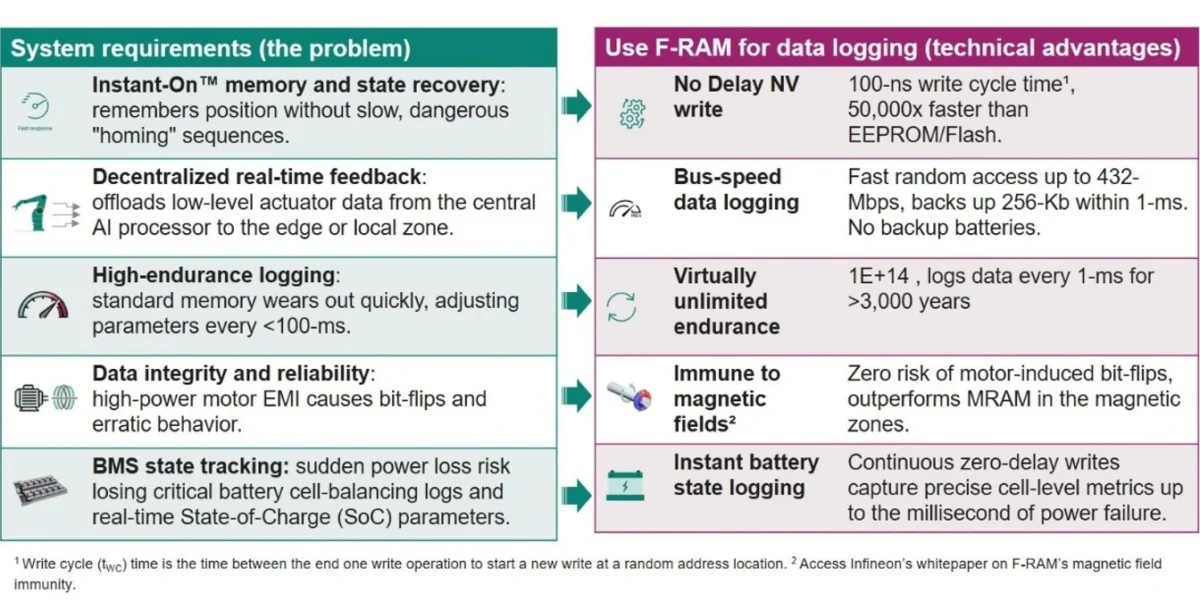
First is the issue of page-write latency. Standard Flash and EEPROM devices often require a 5 to 10 ms page-write delay, during which data is staged in volatile buffers. If a robot suffers an emergency stop or power failure during this window, the system risks "state fracturing." This loss of absolute coordinates forces the robot into a time-consuming, mechanical re-homing sequence, effectively removing the unit from production until recalibration is complete.
Second, thermal acceleration poses a significant risk to hardware longevity. Compact joint housings, where motor drivers reside, frequently experience temperatures exceeding 100°C. In legacy charge-based non-volatile memory (NVM), this thermal stress accelerates the decay of the oxide insulation layer, leading to charge leakage and data corruption. Engineers are increasingly moving toward crystal-polarization memories, which store data through atomic alignment rather than trapped charge, rendering them immune to this specific thermal degradation.

Finally, the industrial environment is inherently noisy. High-torque brushless DC (BLDC) motors generate intense electromagnetic interference. This EMI can induce bit flips in standard memory, causing unpredictable behavior in telemetry logging. The industry is currently pivoting toward memory solutions that offer native magnetic field immunity to ensure system stability in high-power motor environments.
Industry Perspectives: The Shift Toward Functional Safety
Leading semiconductor manufacturers, including Infineon and various industrial memory providers, have emphasized that safety-critical applications in robotics require a shift in regulatory compliance. The adoption of ISO 26262 and IEC 61508 standards—common in the automotive sector—is now becoming the gold standard for humanoid development.
Industry experts suggest that "SafeBoot" technology and on-chip Hardware Error Correction Code (ECC) are no longer optional features. By integrating these into the memory architecture, manufacturers can ensure that even if a single memory cell is corrupted, the system can detect, correct, and continue operation without a catastrophic failure. This is vital for regulatory traceability, as companies must maintain logs of motor torque, velocity, and position to meet safety audits in human-populated work environments.

Comparative Memory Matrix and Systemic Impacts
To understand the current deployment landscape, one must look at the specific roles assigned to different memory types. F-RAM (Ferroelectric RAM) has emerged as the premier solution for joint-level telemetry. With a write endurance of over 100 trillion cycles and near-zero latency, it enables the high-frequency logging of motor data (often exceeding 10 kHz) without the wear-out cycles that plague NAND Flash.
In contrast, the networking infrastructure relies heavily on high-speed NOR Flash. These devices act as the firmware repositories for the TSN switches, ensuring that communications between the central AI core and the limb actuators remain synchronized with minimal timing jitter. Without this deterministic performance, the robot’s movements would become jerky and imprecise, failing the standard required for delicate manufacturing or assembly tasks.
Future Implications for the Robotics Ecosystem
The implications of these architectural choices are far-reaching. As the density of humanoid deployment increases, the ability to perform predictive maintenance will hinge on the quality of the telemetry stored at the edge. If the memory architecture is unreliable, the data harvested for root-cause analysis will be corrupted or incomplete, rendering predictive algorithms ineffective.

Furthermore, the integration of cybersecurity measures into the memory layer is becoming a non-negotiable requirement. As robots become more connected, the memory must act as a secure vault for firmware. Authenticated updates and cryptographic validation are being built directly into the silicon of modern NOR Flash, protecting the robot from unauthorized software modifications that could lead to safety breaches or intellectual property theft.
Conclusion: Matching Technology to Task
The successful scaling of humanoid robotics depends on the industry’s ability to move away from a "one-size-fits-all" approach to electronics. By adopting a tiered strategy—utilizing high-capacity DRAM for AI, high-density NAND for storage, and specialized, high-endurance F-RAM for edge control—manufacturers are creating machines that are not only smarter but significantly more resilient.
As we look toward the 2035 target of 6 million units, the focus will likely move toward further miniaturization and the integration of these memory components into system-on-chip (SoC) designs. The maturation of these non-volatile memory technologies serves as the silent, yet essential, foundation upon which the future of autonomous, humanoid labor is being built. The ability to guarantee deterministic operation in the face of heat, noise, and power instability will ultimately separate the commercially viable robots from the prototypes of the past.
