
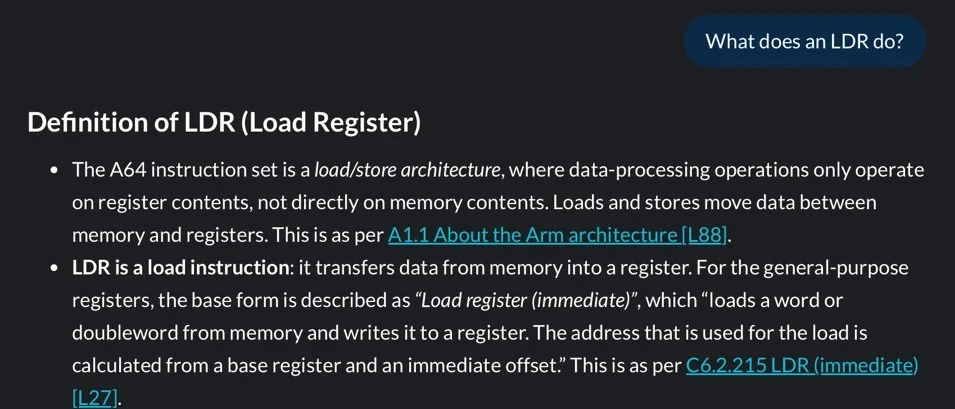

The semiconductor industry is currently navigating a period of unprecedented complexity as chip architectures evolve to meet the demands of artificial intelligence, high-performance computing, and ubiquitous edge devices. At the center of this evolution is Arm, whose architecture powers everything from the world’s most efficient sensors to the most powerful supercomputers. To address the mounting difficulty of navigating the massive volumes of technical documentation required to build and program these systems, Arm has launched an experimental project titled "The Architecture Speaks." This generative AI-powered chatbot is designed to act as a specialized guide to the Arm architecture, offering developers a streamlined interface to query the Arm Architecture Reference Manual (Arm ARM), a document that has grown to a staggering 17,000 pages in its latest iterations.
The introduction of this tool marks a significant shift in how foundational hardware specifications are consumed. Historically, hardware engineers and software developers have had to manually parse dense, technical prose to understand the intricacies of instruction sets, memory models, and system behavior. By leveraging large language models (LLMs), Arm aims to transform this static repository of information into an interactive, conversational resource that provides cited, actionable answers to highly specific technical queries.
The Growing Complexity of Modern Chip Documentation
The necessity for a tool like "The Architecture Speaks" stems from the sheer scale of modern computing specifications. The Arm ARM is the definitive source of truth for the behavior of any Arm-powered system. It details the Instruction Set Architecture (ISA), the exception model, memory management, and the rules governing how hardware interacts with software. However, as the Arm architecture has expanded—transitioning from Armv8 to the latest Armv9—the documentation has grown proportionally.
A 17,000-page document presents a significant barrier to entry for new engineers and a time-consuming hurdle for veterans. The manual is written in a specific style of technical English prose that, while precise, is not always easy to navigate quickly. For example, understanding a specific instruction like "LDR" (Load Register) requires more than just knowing its basic function; it involves understanding its interaction with the memory system, its behavior across different exception levels, and its relationship with specific architectural features like Pointer Authentication or Branch Target Identification.
Furthermore, the manual often relies on "litmus tests" to explain complex behaviors, particularly in the realm of memory concurrency. These tests demonstrate how different threads of execution interact through shared memory locations. While these tests are mathematically sound, they are presented in a format that requires significant mental overhead to interpret. "The Architecture Speaks" is designed to bridge this gap, providing a natural language interface that can synthesize these complex concepts into immediate explanations.
Technical Foundations and the Role of Generative AI
"The Architecture Speaks" is built on the principles of generative AI, specifically tailored to the domain-specific language of semiconductor engineering. Unlike general-purpose AI chatbots that draw from the broad and often unreliable datasets of the open internet, this tool is grounded in the authoritative text of the Arm ARM. When a user asks a question, the system retrieves relevant information from the manual and generates a response that includes direct HTML links to the specific sections used to formulate the answer.

This approach addresses one of the primary concerns with generative AI in technical fields: the risk of "hallucinations," where the AI generates plausible-sounding but incorrect information. By providing a direct link to the source material, Arm ensures that the tool acts as a discovery layer rather than a replacement for the manual. Users are encouraged to verify the AI’s output against the primary text, maintaining the rigor required for hardware design and low-level software development.
The project is led by Jade Alglave, a professor of computer science at University College London and a Fellow at Arm. Alglave’s background in formal methods and concurrency models is reflected in the tool’s design. The development team is currently working on integrating programmatic checks and "safety nets" to further improve accuracy. These include post-generation verification steps to ensure that any text claimed to be a direct quote from the manual is indeed verbatim. Future versions of the tool are expected to incorporate formal methods—mathematical techniques for proving the correctness of systems—to provide even higher levels of assurance.
Chronology of Development and Release
The development of "The Architecture Speaks" follows a multi-year trend of increasing digitization and automation within Arm’s documentation ecosystem.
- Phase 1: Standardization of Prose (Pre-2020): Arm focused on refining the Arm ARM into a more structured, albeit massive, prose-based document.
- Phase 2: Formalization and Tools (2020-2022): The release and support of tools like the "herd7" concurrency model tool and the ASL1.0 (Architecture Specification Language) allowed engineers to analyze architecture behavior through code and mathematical models.
- Phase 3: Experimental AI Integration (2023-Present): Recognizing the limitations of manual search and tool-specific analysis, Arm began experimenting with generative AI to provide a unified interface for all architectural queries.
- Alpha Release (May 2024): Arm officially launched "The Architecture Speaks" as an Alpha-quality tool on the Arm Developer portal. This status indicates that while the tool is functional and useful, it is not yet intended for use in production-critical workflows.
Industry Reactions and Developer Impact
The release of "The Architecture Speaks" has generated significant interest within the semiconductor and software engineering communities. Early feedback suggests that the tool’s primary value lies in its ability to significantly reduce the "time-to-discovery."
Hardware engineers working on System-on-Chip (SoC) designs often need to clarify specific edge cases in the architecture during the verification phase. Traditionally, this might involve hours of searching through the PDF or HTML versions of the Arm ARM. With the chatbot, these engineers can pose the question directly and receive a targeted summary with links to the relevant chapters.
Software developers, particularly those working on compilers, operating system kernels, and hypervisors, stand to benefit similarly. Writing code that interacts directly with hardware requires a perfect understanding of the ISA. The ability to ask "How does the memory barrier instruction DMB affect out-of-order execution in this specific context?" and receive a cited response is a significant productivity gain.
However, industry analysts note that the tool’s success will depend on its ability to handle the extreme precision required in hardware engineering. Unlike creative writing or general coding, where a "mostly correct" answer might suffice, a single misunderstanding of an architectural rule can lead to catastrophic hardware bugs or security vulnerabilities. This is why Arm’s emphasis on verification and links back to the original prose is viewed as a critical design choice.

Broader Implications for the Semiconductor Ecosystem
The launch of "The Architecture Speaks" is indicative of a broader shift toward AI-augmented engineering. As chip designs move toward smaller process nodes and more specialized accelerators, the documentation supporting these designs is becoming too vast for human cognition to manage unassisted.
This project sets a precedent for other major players in the industry, such as Intel, AMD, and the RISC-V International consortium. If Arm can successfully demonstrate that AI can safely and accurately navigate its 17,000-page specification, it is likely that similar tools will become standard across the industry. This could lead to a new era of "executable documentation," where the boundary between a technical manual and a diagnostic tool becomes increasingly blurred.
Furthermore, Arm has expressed plans to expand the scope of the chatbot. Future iterations are expected to include the "Known Issues" documentation, which tracks errata and architectural deviations in specific processor implementations. Integrating this data would allow developers to not only ask how the architecture should work but also identify how specific existing chips might deviate from that standard.
Conclusion and Future Outlook
"The Architecture Speaks" represents a bold experiment in applying modern AI to one of the most rigorous and demanding fields of engineering. While currently in its Alpha phase, the tool provides a glimpse into a future where technical complexity is managed through intelligent interfaces.
By grounding the AI in the authoritative Arm Architecture Reference Manual and implementing safety nets based on formal methods, Arm is attempting to harness the power of generative AI without sacrificing the technical integrity that hardware design demands. As the project evolves, it will likely become an indispensable part of the Arm developer experience, transforming a 17,000-page "wall of text" into a dynamic, conversational partner in the design of next-generation computing systems.
For now, Arm encourages the developer community to engage with the tool on developer.arm.com, providing feedback that will shape the transition from an experimental Alpha project to a robust, production-ready engineering utility. The success of this initiative may well determine how the entire semiconductor industry approaches the challenge of information management in an increasingly complex technological landscape.
