
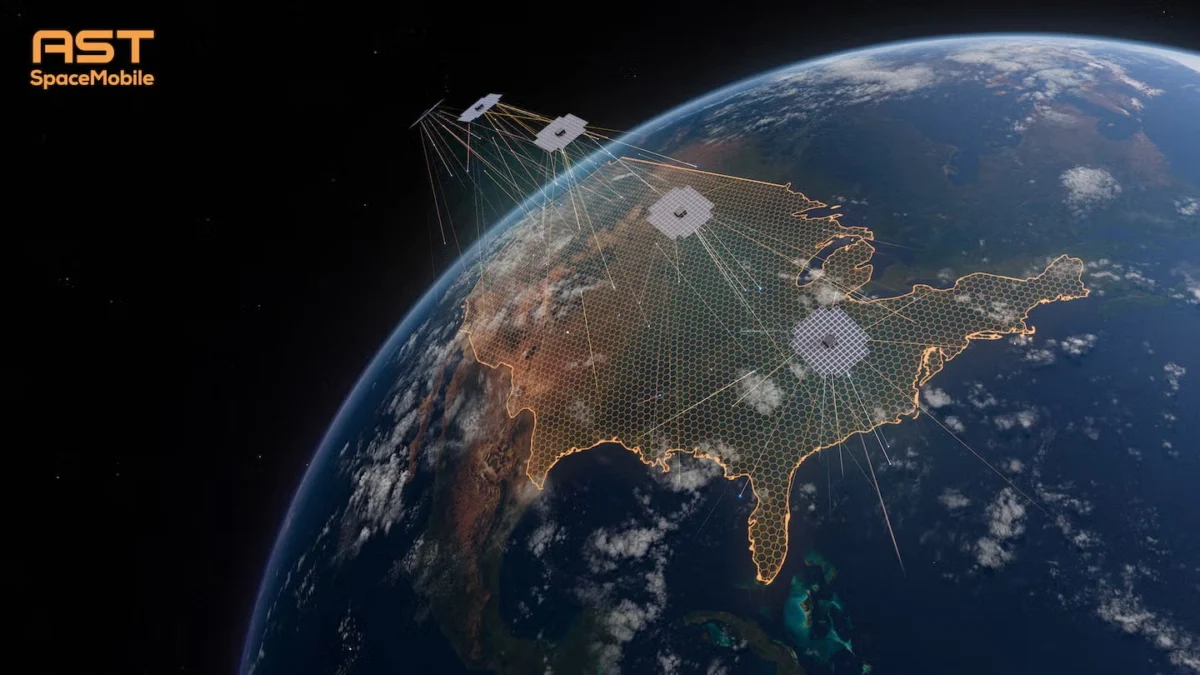

AST SpaceMobile, the company building the first space-based cellular broadband network accessible directly by standard smartphones, has reaffirmed its commitment to deploying 45 BlueBird satellites by the end of 2026. This announcement comes during a pivotal period for the company, characterized by significant financial growth, strategic launch adjustments, and the navigation of recent operational setbacks in the launch sector. During a quarterly update provided to investors on Monday, CEO Abel Avellan and the executive leadership team detailed the company’s resilience in the face of a recent launch failure involving Blue Origin, while outlining a robust schedule for upcoming missions with SpaceX and other heavy-lift launch providers.
The company’s ability to maintain its deployment timeline is central to its mission of providing continuous SpaceMobile service to key global markets. Despite the loss of a satellite during a recent Blue Origin New Glenn mission, AST SpaceMobile is pivoting to its next immediate milestone: a mid-June launch with SpaceX. This mission is slated to carry three BlueBird satellites—specifically units 8, 9, and 10—into Low Earth Orbit (LEO) aboard a Falcon 9 rocket. The successful deployment of these units is a critical step in scaling the constellation to the size necessary for commercial viability.
Financial Performance and Revenue Drivers
In its first-quarter financial report released on May 11, AST SpaceMobile reported revenue of $14.7 million. This figure represents a dramatic increase compared to the $718,000 reported during the same period in the previous year, signaling a transition from a purely research-and-development phase toward a more commercially active operational status. The primary drivers of this revenue include the delivery of commercial gateways and the achievement of specific milestones related to U.S. government service contracts.
However, the financial data also revealed a sequential decline of approximately $40 million in revenue compared to the preceding quarter. Chief Strategy Officer Scott Wisniewski addressed this fluctuation, explaining that the decline was anticipated and stemmed from the cyclical nature of infrastructure deployment. According to Wisniewski, the revenue dip was tied specifically to the timing of gateway deployments for commercial customers and the schedule for completing government contract milestones. This "lumpy" revenue profile is common in the aerospace and telecommunications sectors, where large-scale hardware deliveries and contract benchmarks do not always align linearly with calendar quarters.
As of the 10-Q filing with the Securities and Exchange Commission (SEC), AST SpaceMobile disclosed that it expects to record an asset write-off in the second quarter of 2026 related to the recent launch anomaly. The loss of the satellite on the Blue Origin vehicle is estimated to be in the range of $155 million to $160 million, a figure that aligns with the carrying value of the asset. To mitigate the financial impact, the company confirmed it maintained launch insurance coverage for a portion of the satellite and launch costs and has already initiated the claims process.
The Blue Origin Anomaly and Strategic Resilience
The recent setback involving Blue Origin’s New Glenn vehicle served as a reminder of the inherent risks of the space industry. Last month, a New Glenn rocket failed to deliver an AST SpaceMobile satellite to its intended orbit, rendering the asset unusable for its primary mission. While such an event would be catastrophic for smaller startups, AST SpaceMobile leadership emphasized that their production pipeline is designed to absorb such shocks.
"At the end of the day, remember, we have 33 satellites in advanced stages of production at the factory," Wisniewski told investors. "So it was a loss, we’re on to the next." This sentiment reflects a broader industry trend where satellite constellations are built with redundancy in mind. Wisniewski also expressed continued confidence in Blue Origin, noting that AST SpaceMobile is working closely with the launch provider and remains optimistic about New Glenn’s return to flight.
The company’s strategy for 2026 relies heavily on its "launch vehicle-agnostic" design. By engineering the BlueBird satellites to be compatible with multiple heavy-lift rockets, AST SpaceMobile has insulated itself from the grounding of any single launch vehicle. In addition to SpaceX’s Falcon 9 and Blue Origin’s New Glenn, the company is looking toward United Launch Alliance (ULA) and its Vulcan Centaur configuration. Wisniewski noted that a single Vulcan launch could potentially carry five BlueBird satellites, providing a high-capacity alternative for rapid constellation scaling.
Scaling the Constellation: The Path to Continuous Service
The ultimate goal for AST SpaceMobile is the provision of "SpaceMobile" service—broadband connectivity delivered directly to unmodified cellular devices. Achieving this requires a specific number of satellites in orbit to ensure that at least one satellite is always within view of a user on the ground. Chief Financial Officer Andrew Johnson provided clarity on the numbers required to reach these service tiers.
According to Johnson, the company needs between 45 and 60 BlueBird satellites in orbit to enable continuous service across high-priority markets, including the United States, Europe, and Japan. Reaching this threshold would mark the transition from experimental or intermittent service to a fully functional commercial utility. To expand this service to additional strategic markets worldwide, the company aims to operate a constellation of approximately 90 satellites.
The 45 satellites targeted for the end of 2026 represent the "Block 2" generation of BlueBirds. These satellites are significantly larger and more capable than the initial test units, featuring massive phased-array antennas designed to bridge the gap between space-based transmitters and small, handheld devices. The complexity of these antennas—which must unfold in space to a size comparable to a small apartment—is one of the primary engineering challenges the company has successfully demonstrated with its BlueWalker 3 test satellite.
Industry Context and Competitive Landscape
AST SpaceMobile is operating in an increasingly competitive "direct-to-cell" market. Other major players, such as SpaceX’s Starlink (in partnership with T-Mobile) and Lynk Global, are also racing to eliminate cellular dead zones. However, AST SpaceMobile distinguishes itself through its focus on high-speed broadband rather than just low-bandwidth emergency messaging or SMS.
The company has secured strategic partnerships with some of the world’s largest telecommunications operators, including AT&T, Verizon, and Vodafone. These partnerships are not merely commercial agreements but involve deep technical integration. For instance, AT&T and Verizon have both committed to using AST SpaceMobile’s network to provide supplemental coverage for their customers in remote areas where terrestrial cell towers are impractical or impossible to build.
The U.S. government has also shown significant interest in the technology. The revenue generated from government service milestones suggests that the Department of Defense or other federal agencies see the value in a secure, space-based cellular network that can be accessed by standard equipment. This dual-use potential (commercial and governmental) provides AST SpaceMobile with a diversified revenue stream that is less dependent on consumer adoption alone.
Chronology of Recent and Upcoming Milestones
To understand the trajectory of AST SpaceMobile, it is helpful to look at the timeline of its 2026 operations:
- Q1 2026: Reported $14.7 million in revenue; achieved major gateway deployment milestones.
- April 2026: Experienced a launch anomaly with Blue Origin’s New Glenn; one satellite lost due to incorrect orbital placement.
- May 2026: Confirmed insurance claims and planned asset write-off of $155M–$160M for Q2.
- Mid-June 2026 (Projected): Scheduled launch of BlueBirds 8, 9, and 10 with SpaceX on a Falcon 9 rocket.
- Late 2026 (Target): Completion of the 45-satellite constellation to begin continuous service in primary markets.
Implications and Market Outlook
The ability of AST SpaceMobile to maintain its end-of-year target despite a $160 million loss is a testament to its capital structure and manufacturing throughput. The company’s focus on the "heavy launcher footprint" ensures that it can pivot between SpaceX, Blue Origin, and ULA as launch slots become available or as vehicles are cleared for flight.
For investors and consumers, the next six months will be a defining period. The mid-June SpaceX launch will be a high-stakes event; a successful deployment of three satellites would restore momentum and demonstrate that the company can maintain its launch cadence. If AST SpaceMobile reaches its 45-satellite goal, it will effectively change the landscape of global telecommunications, turning every smartphone into a satellite phone and potentially solving the "digital divide" in rural and underserved regions.
While the financial sequential decline and the recent launch failure present short-term challenges, the underlying demand for ubiquitous connectivity remains a powerful tailwind. As CFO Andrew Johnson noted, the roadmap to 90 satellites is clear, and the company is now focused on the execution of its production and launch strategies to turn its vision of a space-based cellular network into a global reality. In an industry where "space is hard," AST SpaceMobile’s strategy of redundancy, launch agnosticism, and strategic carrier partnerships appears designed to weather the volatility of the final frontier.
