
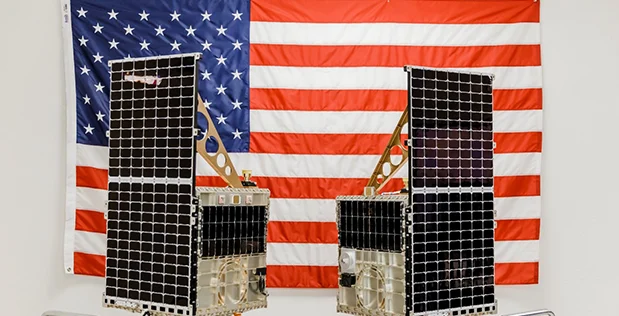

Satellite manufacturer Astro Digital has announced definitive plans to transition into a publicly traded enterprise through a merger with special purpose acquisition company (SPAC) Proem Acquisition Corp I. Valued at an enterprise level of $587 million, the transaction represents a significant milestone for the aerospace and defense manufacturing sector. The merger agreement, which was formally made public on Monday, is projected to finalize during the first quarter of 2027, subject to customary regulatory approvals, shareholder consents, and the satisfaction of closing conditions.
This financial maneuver places Astro Digital at the forefront of a renewed wave of aerospace enterprises utilizing blank check companies to access public capital markets. As the commercial space economy transitions from a phase dominated by technology demonstrations to one characterized by large-scale commercial and defense constellations, the influx of capital is expected to accelerate the company’s manufacturing capabilities and expand its operational footprint across United States civil, defense, and international sovereign markets.
Financial Architecture and Transaction Details
Under the terms of the proposed business combination, the transaction is structured to inject up to $180 million in gross financing into Astro Digital. This capital infusion comprises approximately $130 million held in Proem Acquisition Corp I’s trust account—contingent upon minimal shareholder redemptions—alongside an additional $50 million secured through a private investment in public equity (PIPE) financing round.
The valuation metrics outlined in the transaction reflect consistent historical financial growth and strong fundamental margins. Astro Digital reported revenue of $25 million in fiscal year 2024, which expanded to $34 million in fiscal year 2025. For the current fiscal year, the company anticipates generating $50 million in top-line revenue. Furthermore, executive leadership has outlined long-term financial targets, projecting that the company could exceed $500 million in annual revenue by 2032. This anticipated expansion is predicated on a blend of organic growth derived from existing enterprise clients, the acquisition of new market segments, and targeted mergers and acquisitions (M&A).
During a Monday investor briefing, Astro Digital Chief Executive Officer Chris Biddy characterized the 2032 revenue milestone as an aspirational objective rather than a formal financial forecast. Biddy emphasized that the primary driver of this projected growth is the anticipated transition of existing customers from single-satellite or small-batch demonstration phases to full-scale constellation deployments.
In addition to top-line revenue growth, Astro Digital has highlighted robust profitability and order backlog metrics. The company operated with a positive Adjusted EBITDA margin of 11 percent in 2024, which improved to 14 percent in 2025. Order intake has mirrored this upward trajectory, with the company closing out the previous year holding $64 million in contracted backlog and projecting an ending backlog of $86 million for the current fiscal year.
Operational Legacy and Industry Partnerships
Founded with a vision to streamline the design, manufacture, and operation of small satellites, Astro Digital has established a formidable track record within the global aerospace community. To date, the company has successfully manufactured and delivered nearly 40 spacecraft across a diverse array of mission profiles, catering to a prestigious roster of institutional and commercial clients that includes the National Aeronautics and Space Administration (NASA), Sony Corporation, Boeing, EchoStar, and various defense entities.
The company’s modular and adaptable satellite platforms have served as the foundational infrastructure for numerous high-profile space missions. Notably, Astro Digital platforms supported the Starcloud-1 on-orbit computing mission, which pushed the boundaries of edge computing and data processing in the harsh environment of space. Additionally, the company manufactured the Mandrake 2 spacecraft, a critical asset deployed for the Defense Advanced Research Projects Agency (DARPA) Blackjack program, which seeks to demonstrate the military utility of low-Earth orbit (LEO) constellations composed of resilient, interoperable nodes. Furthermore, Astro Digital constructed the Lyra Internet of Things (IoT) satellites for EchoStar, cementing its reputation as a reliable partner for commercial connectivity initiatives.
Strategic Roadmap and the Physical Layer of the Space Economy
Looking forward, Astro Digital’s strategic roadmap focuses heavily on scaling its manufacturing infrastructure. CEO Chris Biddy outlined plans to shift the organization toward constellation-scale production, characterized by modular manufacturing lines and co-manufacturing partnerships. As satellite operators evolve from experimental prototypes to constellations comprising hundreds or even thousands of individual spacecraft, the demand for standardized, high-reliability bus manufacturing has intensified.
Beyond traditional satellite manufacturing, Astro Digital is positioning itself to capture value in the emerging segments of orbital infrastructure. Biddy articulated the company’s long-term vision to serve as the foundational physical layer of the broader space economy. This ambition encompasses providing the underlying platforms for orbital data centers, facilitating in-space power generation, and supporting burgeoning markets for in-space servicing, assembly, and manufacturing (ISAM), as well as orbital logistics.
The path to achieving these objectives involves aggressively expanding the company’s sales capacity and pursuing strategic opportunities within the U.S. civil space sector, Department of Defense modernization initiatives, and allied international sovereign programs. Biddy noted that the company maintains an active sales pipeline featuring multiple new enterprise clients, which are expected to convert more rapidly as the organization scales its commercial infrastructure post-merger.
Contextualizing the SPAC Renaissance in the Aerospace Sector
The announcement of Astro Digital’s public debut via Proem Acquisition Corp I reflects a broader resurgence in special purpose acquisition company transactions within the commercial space and satellite industries. While the peak of the SPAC boom occurred in 2021—when prominent space enterprises such as Rocket Lab, Spire Global, BlackSky, Momentus, and AST SpaceMobile utilized blank check mergers to access public markets—subsequent market corrections led to a prolonged cooling period for such financial instruments.
However, 2026 has witnessed a measured revival of SPAC activity tailored specifically to mature space infrastructure firms possessing demonstrated revenue streams and positive EBITDA margins. Astro Digital joins a select group of aerospace and space economy companies that have pursued public listings via SPAC mergers during the year. Notable recent counterparts include NorthStar Earth & Space, which announced a $300 million SPAC transaction in April; Quantum Space, which initiated its public path in June; and Astrum Space, which struck a SPAC agreement valued at $1 billion in August to advance direct-to-device (D2D) mobile connectivity services.
Market analysts observe that unlike the speculative, pre-revenue space SPACs of the 2021 era, the current generation of companies entering the public markets via this mechanism typically present audited financial histories, positive operational margins, and tangible multi-year backlogs. This shift is designed to instill greater confidence among institutional investors navigating the capital-intensive aerospace sector.
Implications for the Satellite Manufacturing Landscape
The integration of Astro Digital into the public equity markets is poised to alter the competitive dynamics of the small-satellite manufacturing sector. Traditional aerospace primes have historically relied on bespoke, high-cost manufacturing paradigms. In contrast, NewSpace manufacturers like Astro Digital have championed streamlined, commercial-off-the-shelf (COTS) components and modular bus architectures designed to reduce lead times and lower unit costs significantly.
With the anticipated influx of $180 million in gross proceeds from the Proem Acquisition Corp I merger and associated PIPE investment, Astro Digital will possess the financial liquidity required to invest heavily in factory automation, supply chain resilience, and advanced research and development. As commercial and defense entities increasingly embrace disaggregated architectures—deploying large numbers of smaller satellites to ensure orbital redundancy and survivability—companies capable of delivering standardized platforms at scale are expected to capture disproportionate market share.
The successful closure of the transaction in the first quarter of 2027 will ultimately test the public market’s appetite for small-satellite manufacturers that balance commercial constellation demands with classified defense and civil government programs. As Astro Digital navigates the transition to becoming a publicly traded entity, its performance will likely serve as a bellwether for the broader industrial maturation of the commercial space economy.
