

The modern enterprise software development lifecycle operates at a velocity that traditional security frameworks struggle to match. As developers increasingly rely on frontier artificial intelligence models to accelerate code generation, threat actors have mirrored this technological adoption. Security research demonstrates that malicious actors can now analyze a newly published vulnerability disclosure and generate working exploit code within mere minutes. This asymmetry in speed has overwhelmed security operations centers and development teams alike, who are routinely forced to triage thousands of daily vulnerability scanner alerts—many of which turn out to be false positives, unreachable paths, or risks already mitigated by existing runtime controls.
To address this pressing industry challenge, Amazon Web Services (AWS) has officially announced the general availability of AWS Continuum for code vulnerabilities. Designed to bridge the operational gap between security alerts and software patching, AWS Continuum fundamentally rethinks vulnerability management. Rather than merely generating a high volume of raw scanner findings accompanied by generic severity scores, Continuum is engineered to find, validate, and contextualize code vulnerabilities before autonomously delivering precision fixes directly into developer workflows as ready-to-review pull requests.
The Genesis and Context of Automated Remediation

For years, enterprise application security has suffered from a critical contextual blind spot. Standard static and dynamic application security testing (SAST and DAST) tools evaluate code in isolation. Consequently, a vulnerability discovered in a non-production development utility often receives the same critical severity score as a vulnerability located in a service residing merely a single network hop away from a core financial database or customer data repository.
Confirming whether a specific finding is genuinely exploitable within a complex, multi-tiered cloud environment historically required hours—if not days—of painstaking manual investigation by specialized security analysts. Once an exploitable risk was confirmed, shipping a remediation required extensive cross-functional coordination between security teams, infrastructure administrators, and application developers. Because the exact blast radius of a code change or a dependency upgrade is notoriously difficult to assess without granular business context, deployment bottlenecks routinely delayed critical security patches.
AWS Continuum was developed to dismantle these operational silos by combining deep code analysis with comprehensive runtime environmental context. By automating the labor-intensive cycle of validation, prioritization, and patch creation, AWS aims to drastically reduce the mean time to remediate (MTTR) vulnerabilities, thereby neutralizing threats before malicious actors can weaponize them.
How AWS Continuum Operates: The Context Graph and Validation Engine

At the heart of AWS Continuum lies an advanced context-building engine that aggregates telemetry from two primary pillars of an organization’s digital footprint: source code repositories and live cloud infrastructure.
To establish environmental awareness, engineers deploy an AWS Continuum collector within the specific AWS accounts and regions where their workloads execute. This collector continuously ingests resource metadata, including configurations from AWS Config and complex network topology details. By mapping these elements together, Continuum constructs a dynamic, real-time context graph.
This context graph allows the service to understand the nuanced architecture of an application estate. It identifies business-critical systems, maps service-to-service dependencies, recognizes data classifications, and pinpoints which assets handle sensitive workloads such as payment processing pipelines, authentication services, and customer databases. When a vulnerability scanner flags a potential flaw, Continuum does not rely solely on theoretical severity metrics. Instead, it evaluates the finding against the live environment to determine whether the vulnerable code path is actually reachable over the network and what downstream systems an attacker could access if compromised.
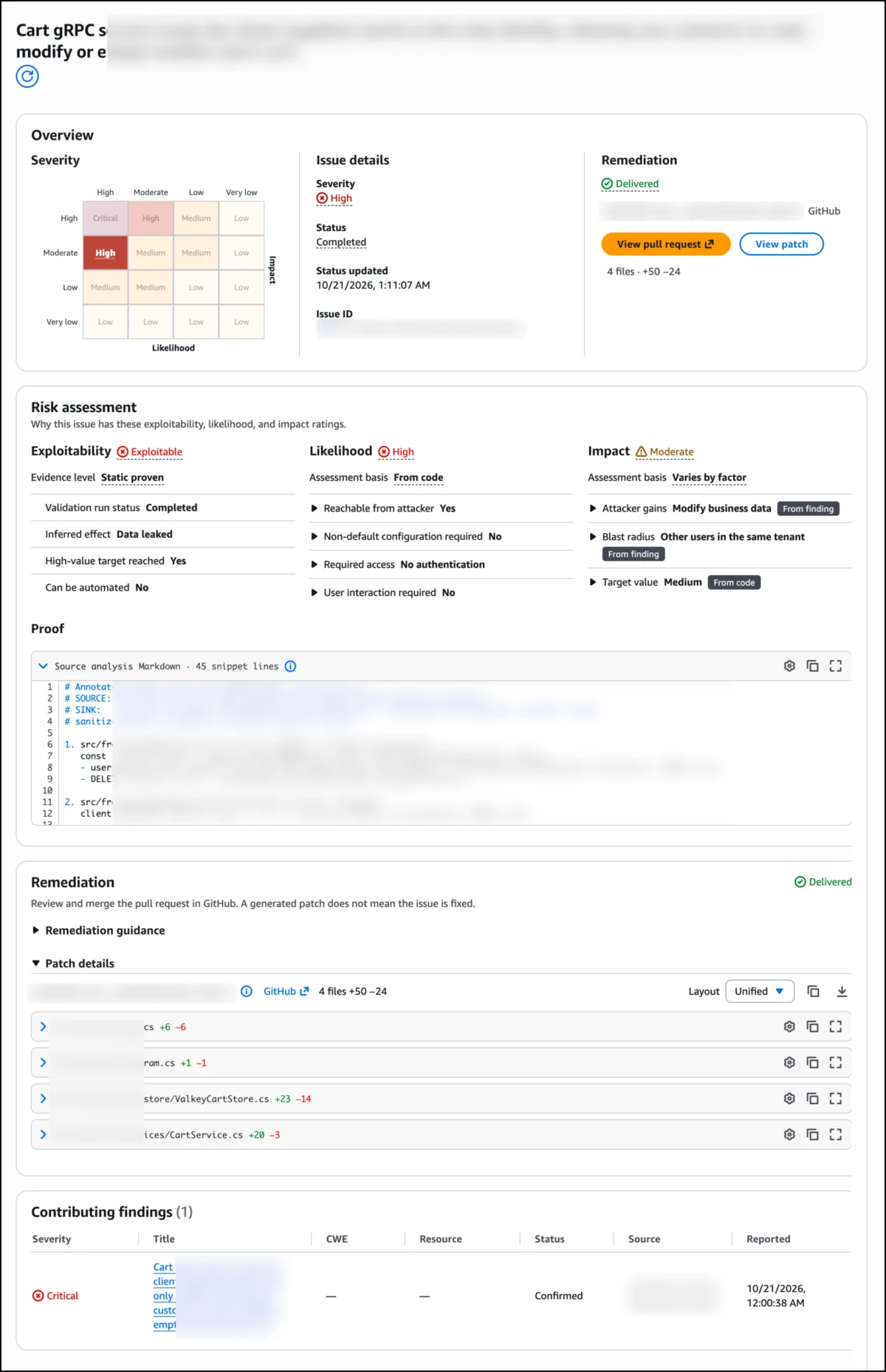
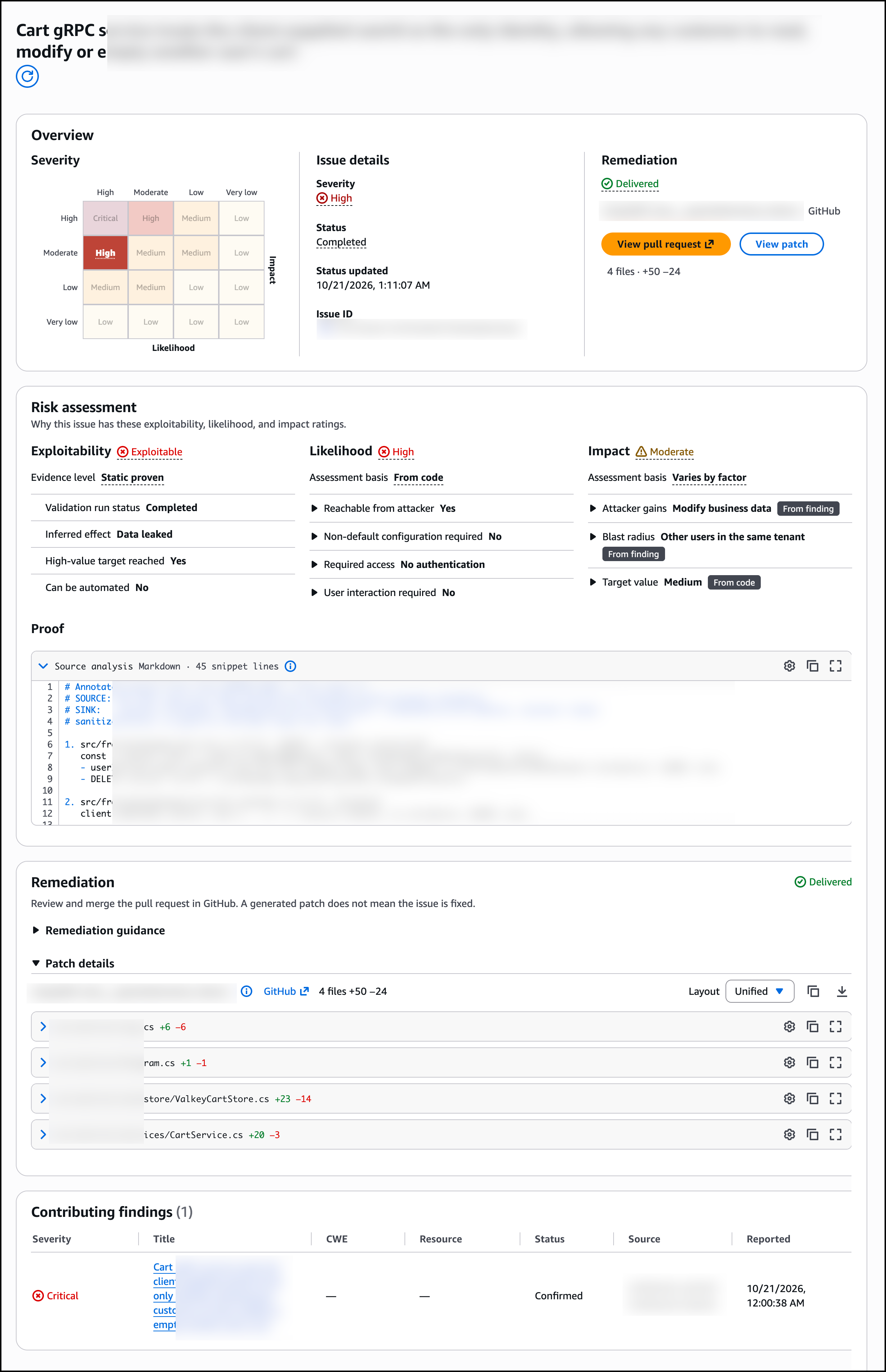
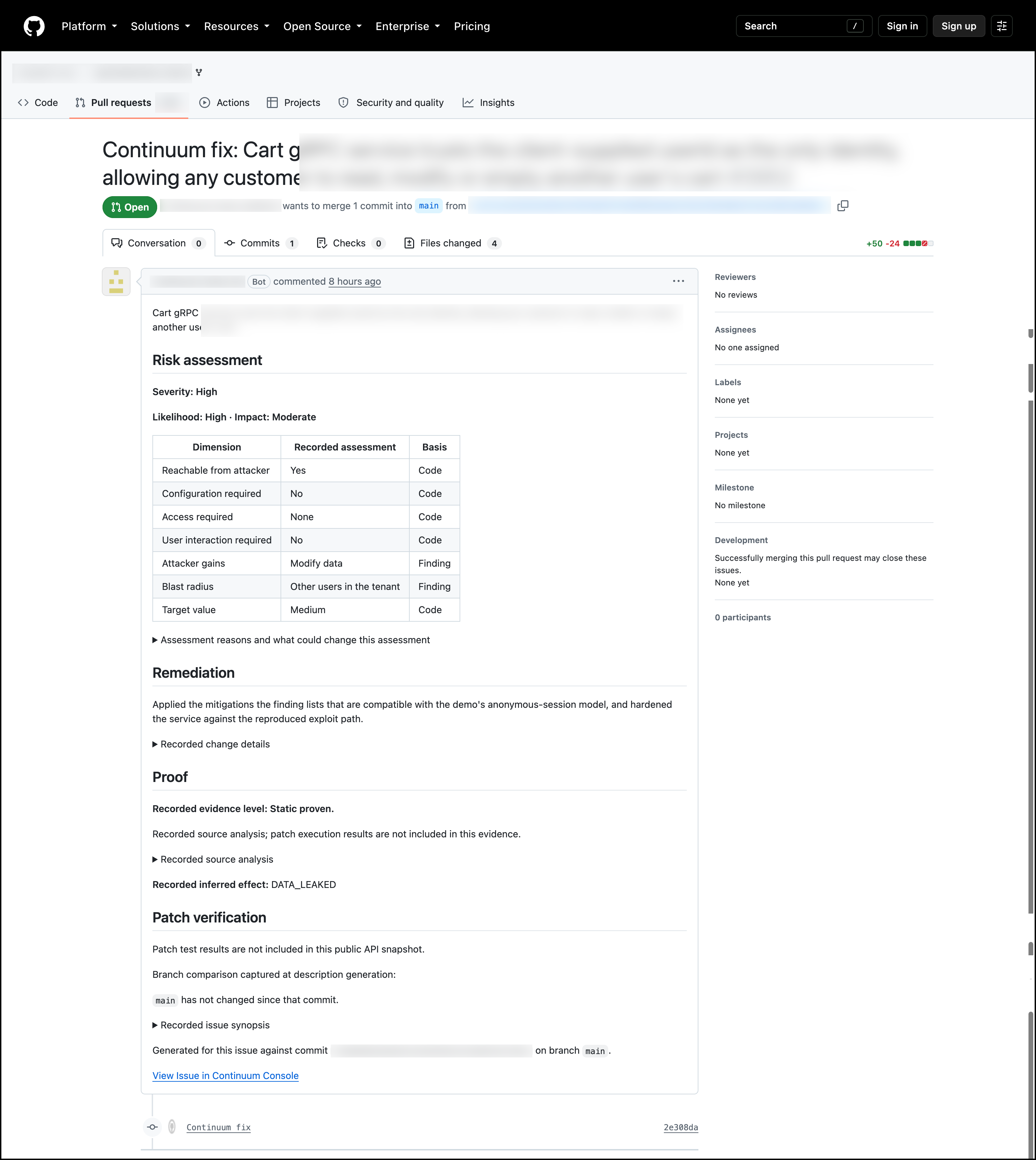
Furthermore, Continuum employs rigorous validation techniques. For findings that it can successfully reproduce, the service executes the potential exploit within an isolated, secure sandbox environment. It then generates comprehensive proof-of-concept code, complete with precise reproduction steps, source code analysis, and a detailed assessment of the potential blast radius. Rather than delivering a simple risk score, Continuum provides engineering teams with undeniable empirical evidence regarding the true threat level of a finding.
Streamlined Workflows and Developer-Centric Remediation
Once AWS Continuum validates a vulnerability and assesses its business impact, it shifts from analysis to remediation. For each confirmed issue, the service automatically generates a targeted fix—whether that entails a precise code patch, a dependency version upgrade, or a configuration adjustment.
Crucially, these fixes are delivered directly to the engineering team’s preferred environment by opening a standard pull request within connected repositories, such as GitHub, or via Amazon S3 integrations. The pull request description is automatically populated with the complete risk assessment, remediation summary, and verifiable proof gathered during the sandbox execution. This ensures that the reviewing developer can examine the empirical evidence and understand the scope of the change without ever leaving their native code review workflow.
To maintain organizational governance and trust, AWS Continuum operates under a strict human-in-the-loop paradigm during its initial rollout. Every generated patch requires explicit human review and approval. Developers retain absolute control over their codebases; they must manually review and merge the pull request for a fix to be shipped to production.
Looking forward, AWS has outlined plans to introduce configurable automation guardrails. In future iterations, organizations will be able to define specific confidence thresholds—such as required test coverage, strict scope bounds, and historical remediation success rates—allowing Continuum to apply vetted classes of security fixes automatically once those predefined criteria are met.
Getting Started and Initial Availability
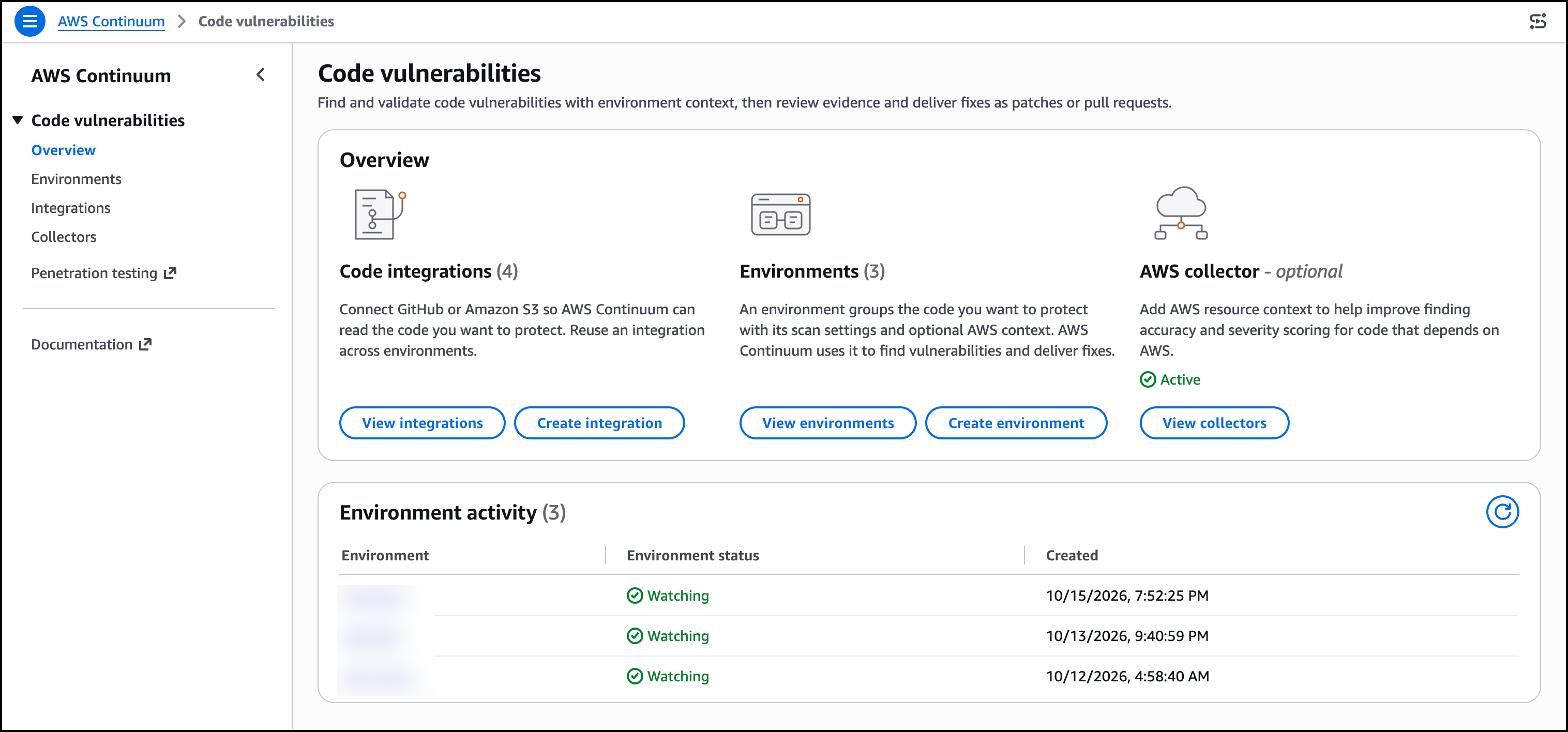
Deploying AWS Continuum for code vulnerabilities has been structured to integrate seamlessly into existing AWS management paradigms. Administrators begin by accessing the AWS Continuum console and establishing code integrations via GitHub or Amazon S3 buckets. After configuring the scanning schedule and deploying the necessary AWS collectors to supply infrastructure telemetry, security teams gain immediate access to the centralized Overview dashboard.
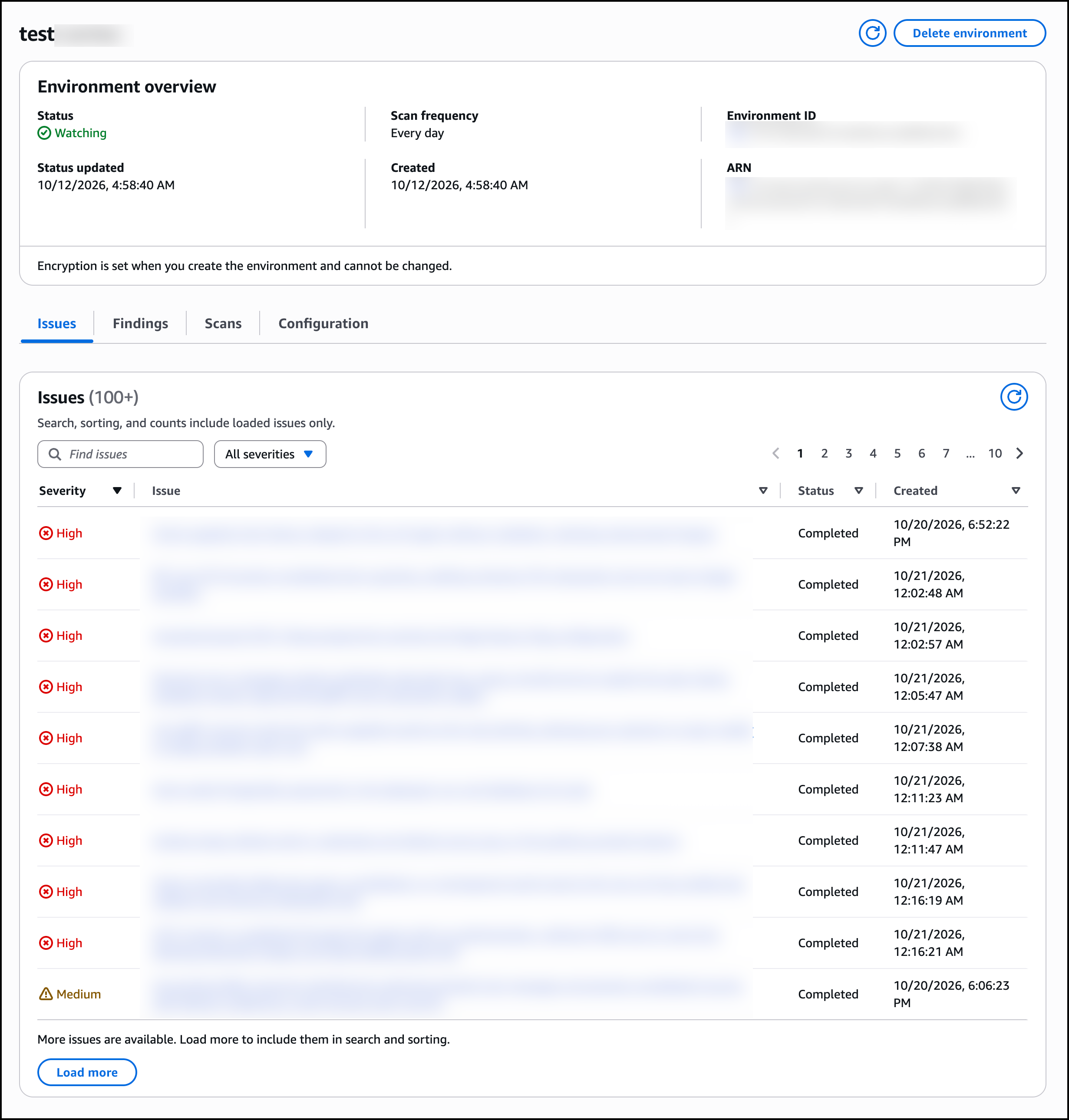
From this unified interface, practitioners can monitor code integrations, active environments, and collector health statuses. The dedicated Issues tab replaces noisy, unranked scanner outputs with a prioritized, validated ledger of actionable security items. Each item displays clear metrics regarding exploitability verdicts, likelihood of attack, and potential business impact, accompanied by direct links to the generated repository pull requests.
At the time of its general availability launch, AWS Continuum for code vulnerabilities is immediately available to customers operating within the US East (N. Virginia) and US West (Oregon) AWS Regions. Comprehensive pricing structures, user guides, and technical documentation are accessible directly through the official AWS Continuum product portal and documentation libraries.
Industry Implications and Future Outlook
The introduction of AWS Continuum marks a significant philosophical shift in how cloud security posture management (CSPM) and application security testing converge. By bridging the traditional chasm between static application code analysis and dynamic cloud runtime context, AWS is addressing one of the most persistent operational friction points in modern software engineering.
Historically, the relationship between developers and security teams has been strained by an overwhelming deluge of low-fidelity vulnerability alerts that slow feature delivery without proportionately reducing risk. Security teams face alarm fatigue, while developers view security tooling as an impediment to velocity. By automating the arduous process of exploit validation, impact ranking, and patch generation—while preserving human oversight through familiar pull request workflows—AWS Continuum offers a sustainable path forward.
Industry analysts suggest that as automated exploit generation tools continue to evolve via advancements in artificial intelligence, manual vulnerability triage will become entirely unsustainable for large enterprise estates. Services that leverage automated reasoning, runtime context mapping, and closed-loop remediation are expected to become the baseline standard for enterprise cloud defense. With the launch of Continuum, AWS has positioned itself at the forefront of this paradigm shift, offering organizations a powerful tool to shrink their vulnerability backlogs, secure critical cloud assets, and maintain developer velocity without compromising safety.
