
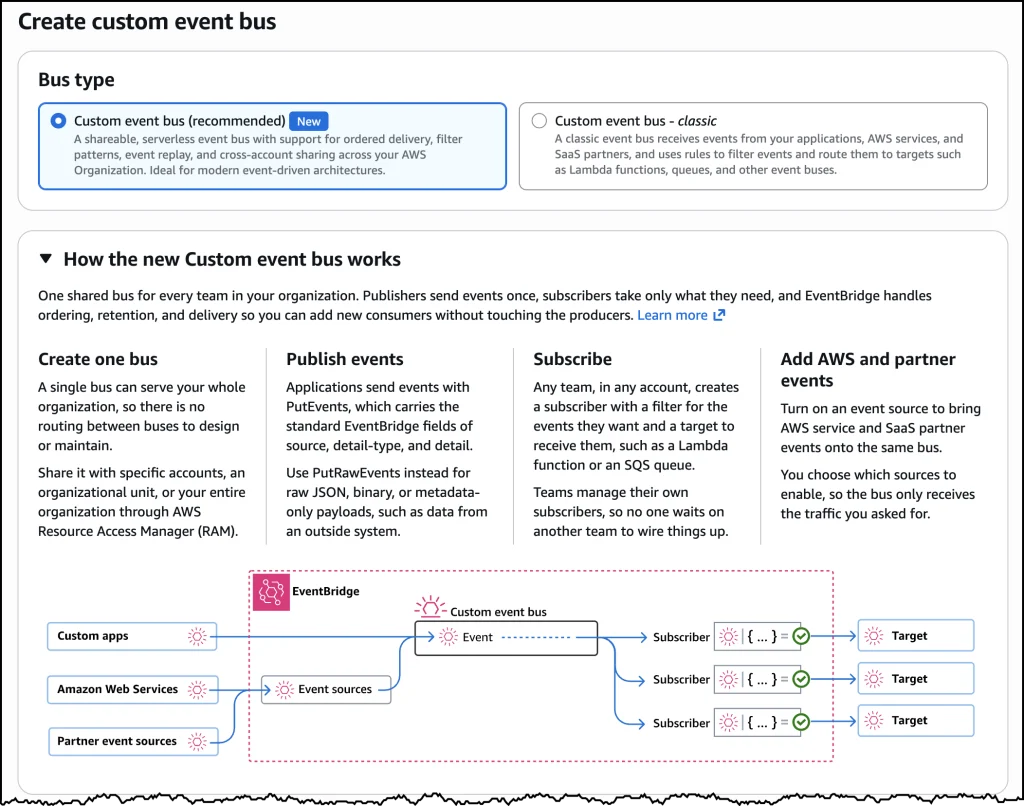

Amazon Web Services has officially announced the rollout of a significantly revamped feature for Amazon EventBridge, introducing the enhanced custom event bus designed specifically to streamline and scale event-driven architectures across complex, multi-account organizational landscapes. Historically, organizations building decoupled, serverless applications on AWS begin their infrastructure journeys with a single custom event bus confined to a single AWS account. While this minimalist configuration proves exceptionally effective under the purview of a single development team, enterprise-grade adoption rapidly necessitates a multi-account structure for security, compliance, and operational isolation.
Until now, bridging the architectural gaps between disparate accounts required cumbersome workarounds. Development teams routinely established multiple event buses interconnected through complex web configurations, including cross-account rules and direct bus-to-bus communications. Far from achieving the seamless, low-maintenance paradigm promised by serverless computing, these patchwork solutions often reintroduced substantial operational overhead. Platform engineering teams frequently found themselves grappling with degraded visibility regarding event subscriptions, compounding routing fees across multiple buses, and a severe lack of native native sequencing tools. Applications that demanded strict event ordering were routinely forced to engineer fragile, custom sequencing layers or migrate to entirely alternative technologies, dampening the core efficiency of their serverless pipelines.
The newly launched enhanced custom event bus addresses these long-standing infrastructural pain points directly. By establishing a single, centralized event backbone shared across all AWS accounts within an enterprise organization, AWS aims to eliminate the friction historically associated with multi-account event routing. The reimagined architecture introduces native ordering guarantees, a streamlined and consolidated Subscriber resource model, and a restructured pricing framework tailored to deliver optimized cost allocation and scaling economics for both event publishers and consumers.
The Architectural Evolution of Event-Driven Systems
To contextualize the significance of this release, industry analysts point to the explosive growth of event-driven architectures (EDAs) within enterprise IT ecosystems over the past decade. As businesses migrated from monolithic applications to microservices, the need for real-time, asynchronous communication mechanisms became paramount. Amazon EventBridge established itself as a cornerstone serverless event bus service, allowing applications to ingest data from custom sources, Software-as-a-Service (SaaS) applications, and integrated AWS services, routing them securely to diverse endpoints.
However, as enterprise cloud estates scaled to hundreds or thousands of distinct AWS accounts, the limitations of traditional event bus architectures became increasingly pronounced. Security frameworks dictated that individual business units operate within isolated environments, yet business logic frequently required instantaneous data sharing across departmental boundaries. The resulting web of cross-account permissions policies, resource-based access controls, and multi-hop routing chains created a heavy administrative burden for central cloud platform teams.
With the deployment of the enhanced custom event bus, AWS has fundamentally shifted how resource sharing and governance are handled at scale. Rather than forcing teams to provision redundant infrastructure, platform engineers can now provision a single, enterprise-wide event bus and delegate fine-grained publishing and subscribing rights directly to individual accounts via integration with AWS Resource Access Manager (AWS RAM). This capability allows teams to collaborate natively across organizational boundaries without waiting for provisioning tickets to clear or manually configuring intricate cross-account permission trust chains.

Core Technical Innovations and Features
The enhanced custom event bus introduces several critical engineering advancements aimed at simplifying operations while expanding functional capabilities. Principal among these innovations are native event ordering, unified subscriber resource management, and intelligent content-based deduplication.
Event Ordering and Synchronous Processing
Event-driven design principles traditionally prioritize asynchronous message processing, wherein downstream consumers operate independently and the temporal sequence of events is largely irrelevant. Nevertheless, real-world operational scenarios—such as supply chain logistics, financial transaction processing, and user session tracking—frequently demand absolute chronological integrity. In a logistics management application, for instance, fleet vehicle telemetry updates must be processed in exact sequential order; out-of-sequence payloads can easily lead automated routing algorithms to compute suboptimal or erroneous paths based on stale situational data.
To resolve this without sacrificing asynchronous throughput for other workloads, the enhanced custom event bus allows publishers to attach an EventGroupId parameter to outgoing payloads. EventBridge intelligently groups and delivers messages sharing the same identifier in strict chronological sequence exclusively to subscribers configured for ordered delivery, while simultaneously permitting other decoupled consumers to ingest the identical event stream asynchronously.
To ensure absolute reliability in ordered delivery scenarios, the enhanced event bus introduces support for synchronous invocation targeting services like AWS Lambda. This capability enables EventBridge to confirm successful downstream processing before acknowledging receipt of the event, effectively eliminating the conventional design pattern of positioning an Amazon Simple Queue Service (Amazon SQS) buffer between the event bus and the compute layer to guarantee execution integrity.
The Consolidated Subscriber Resource Model
Managing subscriptions in legacy EventBridge configurations historically required the creation and synchronization of multiple independent resources, including granular event rules, target definitions, retry configurations, and dead-letter queues scattered across various configurations. The enhanced custom event bus completely reimagines this workflow by introducing a unified entity known simply as the Subscriber resource.

The new Subscriber resource consolidates event filtering criteria, target endpoints, automated retry policies, and dead-letter destinations into a single, manageable configuration unit. Furthermore, these subscribers incorporate variable start time parameters, significantly simplifying the onboarding process for new application consumers and enabling rapid event replaying to recover from systemic application failures or hydrate newly provisioned downstream data stores.
Advanced Event Evaluation, Deduplication, and Transformation
Data hygiene and payload transformation represent additional operational hurdles that the new architecture addresses natively. Publishers can now enable content-based deduplication directly within the event bus configuration. When network timeouts, upstream retries, or partial system failures result in duplicate event transmissions, EventBridge algorithmically hashes the core attributes of the payload, automatically identifying and discarding identical messages received within a five-minute window. This capability delivers true exactly-once delivery semantics for upstream sources incapable of natively generating or tracking idempotency tokens, replacing the standard at-least-once delivery model.
For downstream consumers, the inclusion of native JSONata expression support allows subscribers to reshape event payloads dynamically before they reach their designated targets. Applications can extract specific fields, rename parameters, or compute derived values on the fly, eliminating the need for intermediate transformation middleware when downstream APIs expect specific data schemas. Furthermore, for enterprises utilizing standardized serialization protocols such as Apache Avro or Protocol Buffers, EventBridge can now automatically deserialize payloads into standard JSON formats. This permits subscribers to execute fine-grained filtering and routing operations directly on the complete event payload without requiring custom deserialization logic within their consumer applications.
Restructuring Cloud Economics: The New Pricing Model
Beyond technical enhancements, the financial mechanics of operating large-scale event buses have been entirely restructured. Traditional EventBridge pricing models relied primarily on a per-event ingestion and routing fee structure, which frequently compounded rapidly in multi-account environments where events traversed multiple interconnected buses.
The enhanced custom event bus adopts a modernized ingress and egress throughput pricing model designed to align financial expenditure with actual architectural utilization. Under this paradigm, event publishers incur charges exclusively based on the volume of events ingested into the central bus, while subscribers pay for the volume of events successfully delivered to their respective endpoints. Industry observers note that this predictable, usage-based model eliminates the financial penalties previously associated with multi-account event distribution, encouraging organizations to embrace centralized event-driven architectures without incurring unexpected infrastructure cost overruns.
Implementation, Availability, and Backward Compatibility
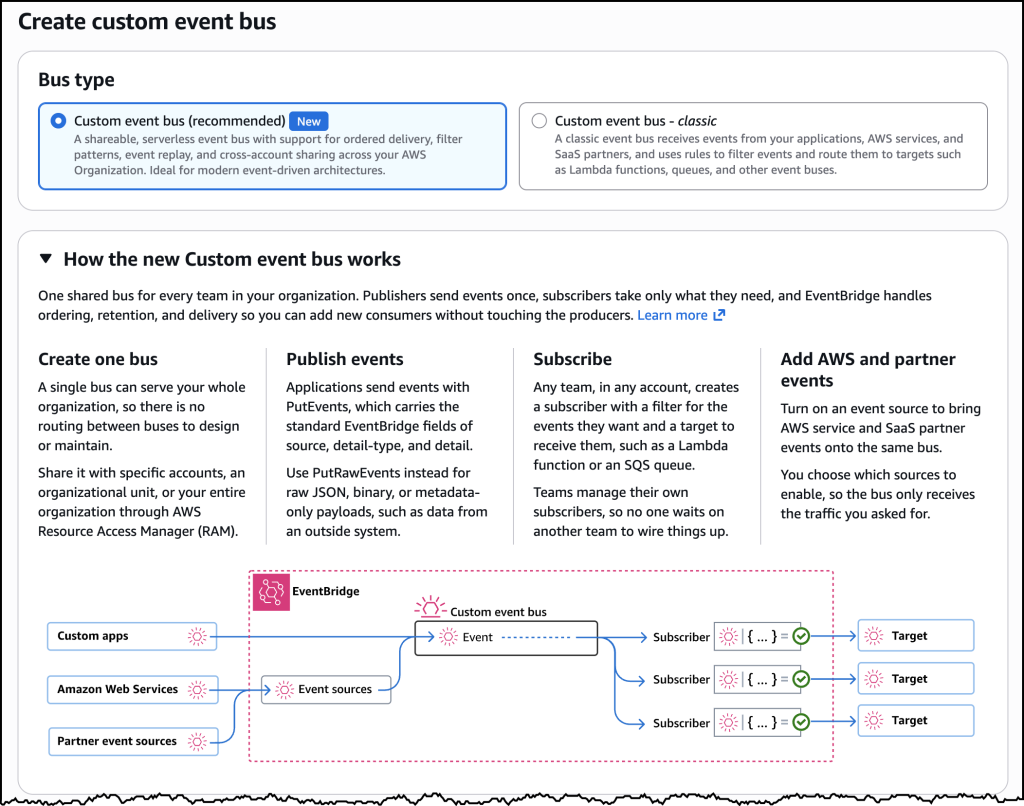
To ensure a frictionless migration path for enterprise customers, AWS has structured the release to be fully non-disruptive. Existing custom event buses will continue to function precisely as they currently do, automatically designated within management consoles and APIs as "Custom event bus – classic." These legacy buses will continue to ingest, route, and process events according to established rules without requiring immediate code modifications or architectural rewrites.
Organizations can adopt the new architecture incrementally at their own pace. When accessing the AWS Management Console, developers are now presented with a clear dichotomy between the recommended enhanced custom event bus and the classic alternative. Configuration of the new bus can be executed via the management console, the AWS Command Line Interface (CLI), or standard EventBridge APIs, with built-in resource sharing managed seamlessly through AWS RAM.
At launch, the enhanced custom event bus is globally available across a robust footprint of AWS Regions, encompassing US East (N. Virginia, Ohio), US West (Oregon), Europe (Ireland, Frankfurt, Stockholm, Spain), and Asia Pacific (Hong Kong, Malaysia, Mumbai, Singapore, Sydney, Thailand, Tokyo). The default organizational quota allows up to 10,000 active subscribers per centralized bus, with higher limits available upon enterprise request to accommodate massive, hyper-scale deployments.
Broader Industry Implications and Future Outlook
Cloud computing analysts view the launch of the enhanced custom event bus as a mature maturation step for serverless technology. As enterprises increasingly transition mission-critical, enterprise-resource-planning (ERP), and core financial workloads to cloud-native serverless environments, the demand for robust governance, strict data sequencing, and predictable cost structures has grown acute.
By bridging the historical divide between strict security isolation and seamless organizational collaboration, AWS has addressed one of the primary friction points cited by enterprise cloud architects. The ability to maintain strict auditing and visibility while granting decentralized teams autonomous publishing and subscribing capabilities is expected to accelerate the adoption of event-driven paradigms across regulated industries, financial services, and global logistics enterprises. As organizations continue to optimize their cloud footprints, infrastructure innovations of this caliber underscore the ongoing evolution of serverless platforms from lightweight tooling into foundational enterprise enterprise operating systems.
