
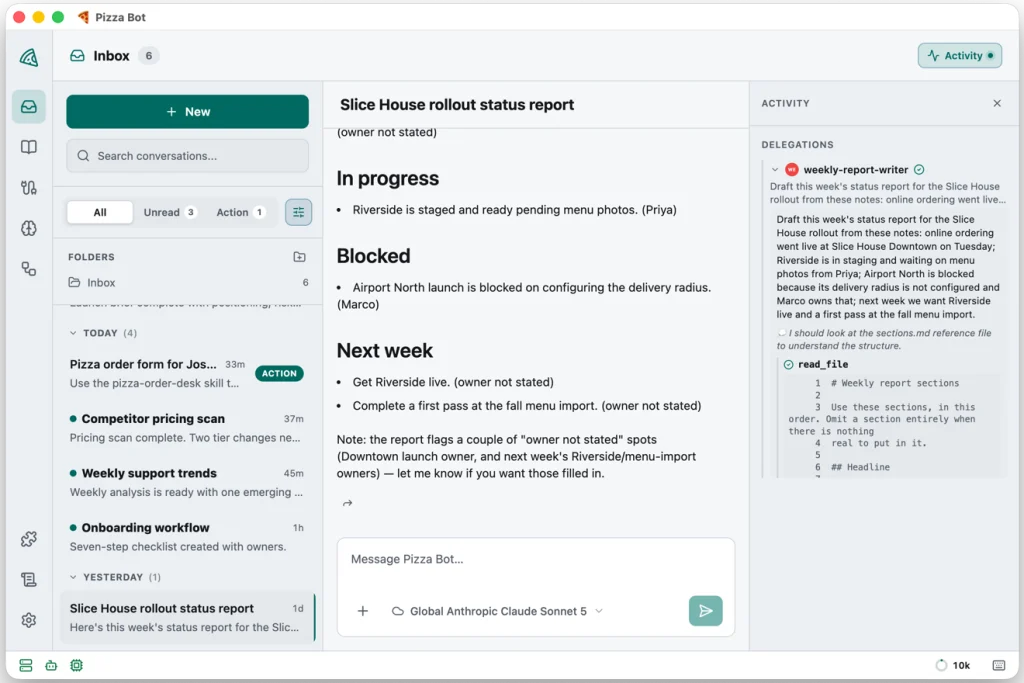

The landscape of artificial intelligence automation is undergoing a fundamental architectural shift, moving away from synchronous chat windows toward asynchronous, background-running systems. Addressing a critical limitation in how developers manage autonomous software, AWS Startups principal technologist Joseph Dolivo, alongside colleague Igor Fil, has released an open-source application titled Pizza Bot. The project introduces an email-inspired inbox interface explicitly designed to help developers monitor, triage, and manage AI agents that continue executing complex tasks long after a human user has logged off for the day.
For years, generative AI interactions have been tethered to the conversational chat paradigm—a format well-suited for interactive brainstorming or quick query-and-response tasks, but inefficient for long-running, asynchronous workflows. When an autonomous agent is tasked with running multiple automated pipelines, scraping data across browser instances, or executing multi-step CRM updates overnight, standard chat logs quickly devolve into massive, unmanageable walls of text. Pizza Bot resolves this friction by mapping the lifecycle of an AI agent to the familiar, structured mechanics of an email client. Completed jobs arrive as unread threads, tasks requiring direct intervention are flagged for human triage, and an integrated activity panel displays the ongoing progress and tool usage of specialist sub-agents.
The Origin and Evolution of Pizza Bot
The genesis of Pizza Bot dates back to April 2025, when Joseph Dolivo initiated a side-of-desk passion project originally known as "JoeBot." Designed out of a practical need to automate repetitive customer relationship management (CRM) logging tasks within Amazon, the script quickly demonstrated utility that surpassed its initial scope. Recognizing its potential across different business units, Dolivo teamed up with Igor Fil to transform the internal script into a Model Context Protocol (MCP) server capable of executing parameterized, deterministic workflows across internal engineering systems.
As the tool matured, its appeal spread organically across various teams inside Amazon. What began as a solitary developer’s script eventually scaled to encompass more than 30 internal contributors and over 2,000 active users within the tech giant. However, this internal scaling exposed a significant usability hurdle: relying on an MCP server meant that non-technical stakeholders were forced to interact with the system through command-line terminals or integrated development environments (IDEs).
"An MCP server requires an MCP client, and expecting non-technical users to work out of an IDE or terminal was never going to cut it," Dolivo explained in public commentary regarding the launch. "We had to meet people where they actually work and own the experience end to end."

This realization prompted the development of a dedicated front end, culminating in the public release of Pizza Bot as a community-driven open-source application. Despite its Amazon lineage, Pizza Bot is maintained entirely as a standalone open-source project hosted within an independent GitHub organization. It operates without corporate service-level agreements (SLAs) or dedicated AWS support, functioning entirely as a self-hosted platform.
Under the Hood: Ambient Agents and LangGraph Architecture
From an architectural standpoint, Pizza Bot’s runtime environment is constructed using advanced open-source orchestration frameworks. The application leverages LangChain’s DeepAgents—a specialized harness engineered for long-running, autonomous task execution—which in turn relies on LangGraph, a stateful framework designed for managing complex multi-agent graphs.
The cornerstone of Pizza Bot’s technical design is robust persistence. As background agents execute their instructions, LangGraph checkpoints the agent’s exact state at regular intervals. This capability ensures that a running process can safely pause to request human approval, survive a sudden client-side disconnection, or resume operations after a system reboot without forcing the agent to restart its workload from scratch. Pizza Bot stores these critical checkpoints, along with communication threads and application data, locally via SQLite and standard file formats.
This technical framework aligns closely with a broader industry concept introduced by LangChain CEO Harrison Chase in January 2025: "ambient agents." Chase defined ambient agents as autonomous software entities capable of reacting dynamically to system events, running concurrently in the background, and consulting human operators only when a decision point requires human judgment. LangChain’s early reference implementations for this paradigm included an executive AI assistant and a foundational "Agent Inbox"—a support-desk-inspired interface designed to streamline interactions between humans and asynchronous background agents.
While Amazon Web Services maintains its own open-source agent development kit, known as Strands Agents, architectural choices for Pizza Bot leaned heavily toward the LangGraph ecosystem. Industry analysts note that AWS typically positions Strands as a lightweight alternative for basic agentic tasks that do not necessitate explicit graph control flows, whereas Pizza Bot’s complex requirements for state checkpointing, interruption handling, and resumable threads made LangGraph the ideal runtime foundation.
Flexible Deployment and Extensibility

Pizza Bot is packaged primarily as a desktop application supporting macOS, Windows, and Linux operating systems, with complementary browser and terminal clients available for power users. Upon launch, the application initializes a local Pizza Bot server directly on the host machine. Developers retain complete autonomy over the underlying foundational intelligence, configuring the application to interface with major model providers including Anthropic, Amazon Bedrock, Google Gemini, OpenAI, OpenRouter, or locally hosted open-source models via Ollama.
Furthermore, the platform’s utility is significantly expanded through support for MCP servers and custom Agent Skills. For instance, the application ships with a bundled browser-automation skill that utilizes Playwright MCP to safely navigate, scrape, and interact with complex web pages without manual human intervention. For enterprise or advanced development use cases, the Pizza Bot server can also be deployed to an always-on remote host or containerized environment. This capability allows scheduled agents to continue processing workloads even when the developer’s laptop is powered down, ensuring that updated threads remain accessible across multiple devices.
Broader Industry Implications and the Shift Toward Asynchronous AI
The public release of Pizza Bot highlights a maturing consensus within the software engineering community: the future of AI automation lies beyond synchronous chat windows. As enterprises deploy agents capable of executing multi-hour or multi-day tasks—such as code refactoring, market research, and automated testing—the demand for asynchronous oversight tools has intensified.
By operating under the explicit design assumption that the human user is not actively watching the screen every second, Pizza Bot addresses a core friction point in human-agent collaboration. The software shifts the cognitive load away from real-time monitoring and toward passive exception handling. Rather than forcing developers to babysit progress bars or parse thousands of lines of raw terminal logs, the inbox paradigm filters the noise, presenting actionable insights only when critical decisions or human sign-offs are required.
As open-source developer adoption accelerates, tools like Pizza Bot may well establish a new baseline design pattern for developer tooling. By combining the persistence of stateful execution graphs with the familiar, battle-tested UX of an email inbox, the project offers a compelling blueprint for how teams will supervise autonomous software systems in the years to come.
