

The Amazon Web Services (AWS) Builder Center marked its official one-year anniversary last week, reflecting on twelve months of rapid evolution that has transformed the platform from a nascent community hub into a comprehensive, feature-rich technical ecosystem. Launched initially on July 9, 2025, the platform has steadily expanded its utility for developers, cloud architects, and engineers globally. What began as a centralized space featuring Wishlist voting, individual community profiles, and a developer toolbox has grown into an interconnected environment complete with dedicated sandbox environments, structured workshops, collaborative community Spaces, and an extensive Builders’ Library.
To commemorate this milestone, senior leadership and community organizers published detailed retrospectives outlining the platform’s trajectory, key performance metrics, and a comprehensive timeline of feature rollouts. The anniversary coincides with the introduction of one of the platform’s most anticipated features to date: free, pre-provisioned Sandbox Environments designed to streamline hands-on learning without the traditional friction of managing personal cloud billing or manual resource teardown.
A Year of Rapid Iteration and Feature Rollouts
The evolution of the AWS Builder Center over its inaugural year has been marked by a consistent cadence of feature deployments aimed at improving user experience, collaboration, and educational accessibility. According to the anniversary feature timeline published by Rick Suttles, the platform shipped numerous critical capabilities designed to cater to a rapidly expanding global developer base.
Among the foundational architectural improvements is the integration of AWS Capabilities by Region, providing builders with real-time transparency across more than 1,500 services distributed throughout 37 distinct geographic regions. To foster deeper peer-to-peer engagement, AWS introduced Spaces, empowering community members to create and manage interest-driven groups. Educational resources were similarly prioritized through the deployment of interactive workshops equipped with intuitive category and complexity filters.
Gamification and user engagement initiatives also played a central role in retaining community interest. The introduction of a robust badge and streak system in March 2026 incentivized consistent participation, resulting in tens of thousands of digital credentials earned by active builders. Additional user-centric enhancements deployed over the past year include multi-article series publishing, real-time view counts, saved item bookmarks, dedicated student status verification, customizable availability notifications, and simplified authentication options via GitHub and Amazon sign-in integrations.
Milestone Metrics and Community Engagement
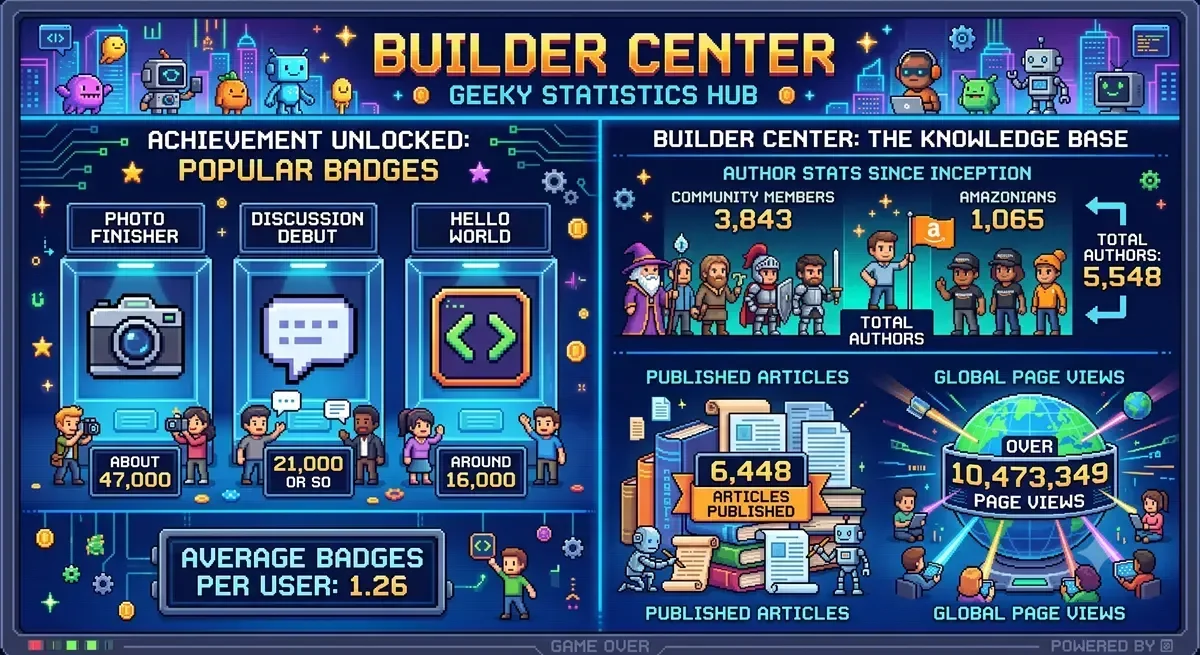
In a comprehensive retrospective published alongside the anniversary updates, Chief Evangelist Jeff Barr detailed the staggering scale of community adoption over the platform’s first year. Since its inception, the AWS Builder Center has cultivated a prolific publishing ecosystem, with 5,548 unique authors contributing a combined total of 6,448 technical articles. These contributions have resonated globally, generating more than 10.4 million aggregate page views.
The community’s enthusiasm for gamified learning is further evidenced by the badge system; since its rollout in March 2026, participating builders have earned 99,226 distinct badges. Furthermore, the platform’s feedback mechanisms have demonstrated a direct pipeline from user demand to product development. Community members have submitted 565 feature wishes via the platform’s voting mechanism. Of those submissions, 10 have already been successfully shipped to production, with an additional 20 items currently slated on the near-term product roadmap.
Top-Performing Community Content
The intellectual capital shared within the AWS Builder Center has established the platform as a premier destination for advanced cloud architecture and engineering insights. Over the past year, several community-authored articles rose to prominence, capturing tens of thousands of views and sparking industry-wide discussions on emerging technologies.
Leading the engagement metrics is an article authored by Dineshraj Dhanapathy titled Building an AWS Study Buddy with MCP + Strands Agents SDK, which surpassed 50,000 views. The deep-dive technical guide explores the integration of advanced model context protocols and agent development kits to create intelligent, cloud-native educational assistants.
Securing the second position in readership is Chris Miller’s comprehensive tutorial, Migrating an End-of-Life Linux Server to AWS in 8 Hours with Kiro, which garnered over 45,000 views. The practical migration guide addressed critical enterprise pain points surrounding legacy operating system deprecation and accelerated cloud migration strategies.
Rounding out the top tier of community publications is Yash Aggarwal’s AIdeas: NeuroVoice – Multimodal AI for Early Screening of Neurological Diseases, which attracted more than 38,000 views. The article highlighted the intersection of multimodal artificial intelligence and healthcare infrastructure, showcasing how developers are leveraging AWS to build impactful, life-sciences applications.
Introduction of Sandbox Environments

The headline announcement accompanying the one-year anniversary is the official launch of Sandbox Environments on the AWS Builder Center, introduced by Rick Suttles. Designed specifically to eliminate friction in practical learning, the new sandbox feature provides builders with a free, pre-provisioned AWS account tailored for completing workshop exercises and technical tutorials.
Under the new system, each sandbox environment remains active for a duration of eight hours. Upon the expiration of this window, the account and all associated provisioned resources are automatically and permanently de-provisioned, ensuring zero residual costs or security risks for the user. To maintain equitable access across the global community, builders are permitted to maintain one active sandbox at a time, with a request limit of one sandbox per week.
Crucially, this capability removes several historical barriers to cloud experimentation. Users are no longer required to input personal credit card information, link a personal AWS account, or perform manual resource cleanup upon completing a tutorial. By abstracting the administrative overhead of cloud management, AWS aims to democratize access to hands-on technical training for students, hobbyists, and enterprise professionals alike.
Broader Impact and Strategic Implications
The maturation of the AWS Builder Center reflects a broader strategic shift within the cloud computing industry toward community-led development and frictionless developer onboarding. By combining user-generated documentation, structured learning pathways, and risk-free testing environments into a single web-based portal, Amazon Web Services has successfully created a sticky digital ecosystem that bridges the gap between novice learners and veteran cloud architects.
The integration of direct feedback loops—such as the Wishlist voting system—signals an ongoing commitment to listening closely to the developer demographic, ensuring that platform investments directly mirror real-world engineering needs. As the Builder Center enters its second year, the combination of expansive regional service tracking, collaborative Spaces, and the newly launched Sandbox Environments positions the platform to remain a vital pillar of the global cloud development community.
