

Amazon Web Services (AWS) has unveiled AWS Transform – continuous modernization (preview), a significant new capability designed to autonomously analyze and remediate technical debt across enterprise codebases at an unprecedented scale. This innovation extends the existing AWS Transform suite, providing organizations with full visibility into their code, prioritized findings, and automated pull requests to implement necessary fixes, thereby addressing a persistent and costly challenge in software development.
Understanding Technical Debt: A Persistent Challenge in Enterprise IT
Technical debt, often described as the shortcuts or compromises made during software development that save time in the short term but accrue costs and complexity over the long run, has long plagued engineering organizations globally. It manifests in various forms: outdated dependencies, deprecated frameworks, security vulnerabilities, poor code quality, and non-compliance with internal coding standards. Industry reports consistently highlight the substantial burden technical debt places on IT budgets, with estimates suggesting that organizations spend anywhere from 20% to 40% of their engineering capacity – and consequently, their IT budgets – grappling with its ramifications. The AWS announcement itself notes that engineering organizations typically consume up to 30% of IT budgets, much of which is diverted to managing this accumulating debt.
Traditionally, addressing technical debt has been a fragmented and labor-intensive process. Enterprises often stitch together disparate point tools: one for detecting dependency issues, another for flagging vulnerabilities, and yet another for assessing general code quality. This patchwork approach leads to manual, application-by-application cycles that drain engineering capacity, consume valuable developer hours, and frequently result in delayed remediation. Development leaders often rely on self-reported team statuses, which can lag reality, hide regressions, and provide an incomplete picture of the overall technical debt landscape.
The advent of AI-assisted development tools and coding agents, while accelerating the pace of code generation, has inadvertently exacerbated the problem. As code is produced faster, technical debt accumulates at an accelerated rate, making it even more challenging for human developers to keep pace with identification and remediation. This creates a pressing need for a comprehensive, continuous, and autonomous solution that can detect, prioritize, and remediate technical debt at the scale demanded by modern enterprise environments. AWS Transform – continuous modernization aims to be that solution, offering a unified platform to manage this ever-growing challenge.
The Evolution of AWS Transform: Building on Modernization Efforts
AWS Transform was initially introduced to help enterprises navigate complex cloud migration and modernization journeys. Its foundational capabilities have focused on streamlining the often arduous tasks of moving out of traditional data centers, modernizing legacy mainframe and Windows applications, and handling the undifferentiated heavy lifting of routine software maintenance. This includes critical but time-consuming activities such as upgrading Java versions, swapping out deprecated frameworks, and ensuring AWS Lambda runtimes are updated before they reach their end-of-life. These tasks, while essential for maintaining system health, security, and performance, consume significant developer time that could otherwise be spent on innovation.
The introduction of AWS Transform – continuous modernization represents a strategic expansion of this vision. While the original Transform focused on project-based modernization and large-scale migrations, the new capability targets the ongoing, day-to-day management of technical debt that pervades all active codebases. It acknowledges that modernization is not a one-time event but a continuous process. By offering autonomous analysis and remediation, AWS is empowering organizations to maintain a healthy, current, and secure codebase proactively, rather than reactively addressing issues after they have become critical or costly. This aligns with AWS’s broader strategy of abstracting away complex infrastructure and operational tasks, allowing customers to focus on their core business logic and innovation.
Key Features: Continuous Analysis and Autonomous Remediation
The core of AWS Transform – continuous modernization lies in its dual pillars: continuous analysis and autonomous remediation at scale.
Continuous Analysis: Unparalleled Visibility and Real-time Insights
To tackle the perennial visibility challenge, the new capability automatically scans an organization’s code repositories against configurable baselines. Unlike traditional manual audits that can take weeks, AWS Transform – continuous modernization generates actionable findings in a matter of hours. This rapid feedback loop is critical for staying ahead of accumulating technical debt.
Out of the box, the service includes robust policies designed to detect common sources of technical debt, such as end-of-life dependencies and deprecated frameworks. This immediate utility allows organizations to start identifying critical issues without extensive initial configuration. Crucially, the system also supports extensibility, enabling customers to define and implement their own remediation patterns specific to their organizational needs. This includes codifying approved libraries, enforcing internal coding standards, or integrating existing technical debt policies enforced by platform teams. For instance, if a team has deprecated an internal library or standardized on a particular logging pattern, these preferences can be codified as policies and continuously enforced across all repositories.
This continuous analysis paradigm provides "ground truth" directly from the codebase. Instead of relying on subjective reports or periodic manual efforts, platform teams receive real-time, objective data. When a repository deviates from its configured baseline, stakeholders are immediately notified, understanding precisely which components are lagging and by how much. This eliminates the need for time-consuming status check-ins and manual compliance tracking, providing platform teams with an always-current, holistic view of their technical debt landscape. This constant monitoring ensures that issues are identified early, before they can escalate into larger, more expensive problems.
Autonomous Remediation at Scale: Proactive Problem Solving
Once technical debt findings have been identified and prioritized, AWS Transform – continuous modernization shifts to proactive problem-solving through autonomous remediation. The service can be configured to automatically generate pull requests (PRs) for affected repositories, streamlining the fix process.
AWS provides a suite of out-of-the-box remediation transformations for common scenarios. These include routine yet vital updates such as Java version upgrades, SDK migrations, and library updates. Beyond these standard transformations, organizations can also create custom transformations tailored to their unique, organization-specific patterns or proprietary frameworks. This flexibility ensures that the remediation process can adapt to diverse technological stacks and internal best practices.

When a remediation campaign is launched, the continuous modernization capability automatically creates individual pull requests for each affected repository. The owning team is notified with a clear message, such as: "This repository is behind on your organization’s baseline for this dependency. Here’s a PR that resolves it." This direct communication minimizes friction and provides immediate context. Teams then have the flexibility to review and merge the generated PR, or if they prefer, remediate the issue using their own internal approach. Regardless of the chosen method, the continuous analysis component detects when the fix is in place, providing automated verification without requiring manual confirmation, thereby closing the loop on the remediation process and ensuring compliance. This blend of automation and human oversight ensures both efficiency and control.
Seamless Integration and Security Enhancements
A critical aspect of AWS Transform – continuous modernization is its integration with other AWS security services, specifically the AWS Security Agent. This integration is designed to detect and remediate security vulnerabilities directly at the source-code level. By funneling security findings into the same prioritized list and pull-request workflow as other forms of technical debt, AWS provides a unified approach to maintaining both code quality and security posture.
This means that a potential vulnerability, such as the use of an insecure library version or a known pattern for injection flaws, will be identified, prioritized, and subjected to the same autonomous remediation workflow as a deprecated framework or an outdated dependency. This holistic view of code health, encompassing both functional and security aspects, significantly enhances an organization’s overall resilience. It moves security left in the development lifecycle, identifying and fixing issues early in the codebase rather than discovering them later in testing or production, where remediation costs are exponentially higher. This integrated approach ensures that security is not an afterthought but an intrinsic part of continuous modernization.
Real-World Application: A Step-by-Step Overview
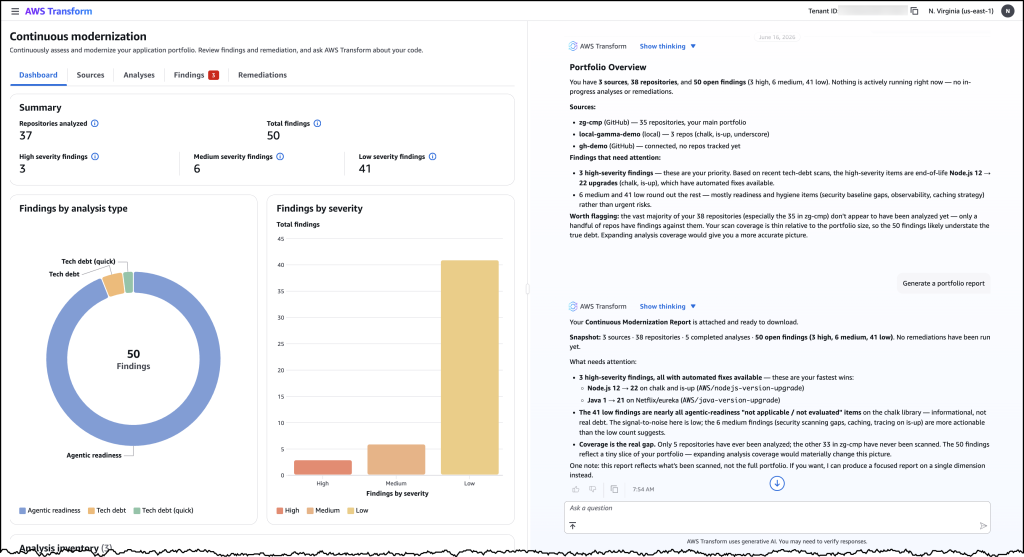
Getting started with AWS Transform – continuous modernization is designed to be intuitive and efficient. The journey typically begins by navigating to the AWS Transform web application. From the central dashboard, users gain an immediate overview of their organization’s repository portfolio and their current status against configured baselines. This provides a high-level health check, identifying areas that require immediate attention.
The first practical step involves connecting the organization’s source control system (e.g., GitHub, GitLab, Bitbucket) to AWS Transform. Once connected, users initiate an analysis, specifying the desired policies to scan against. These policies can include both the default AWS-provided rules and custom, organization-specific standards. Within hours, the analysis completes, presenting a detailed report of findings across all connected repositories. This report clearly indicates which repositories are behind the baseline, by how much, and the specific technical debt patterns detected, categorized by severity, the number of affected files, and the type of debt.
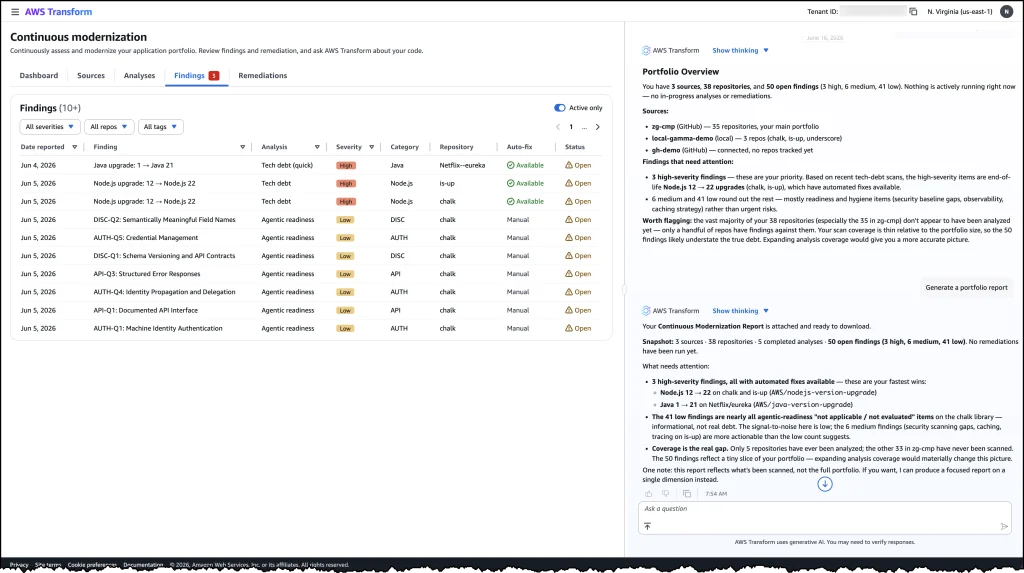
The dashboard then allows users to delve into these findings, offering granular views. For instance, a detailed findings view lists individual technical debt items, categorizing them by severity (e.g., critical, high, medium), category (e.g., security, performance, maintainability), and the specific repository they affect. Crucially, it also presents available remediation options for each item. This comprehensive insight enables platform teams and developers to make informed decisions about where to focus their efforts.
From this detailed view, users can select a group of high-priority findings and launch a targeted remediation campaign. AWS Transform – continuous modernization then automatically generates pull requests for each affected repository. The progress of these campaigns can be monitored in real-time directly from the dashboard, allowing teams to track which PRs have been created, which have been merged by development teams, and which repositories have successfully returned to compliance. This transparency ensures that the impact of the modernization efforts is immediately visible and verifiable, reinforcing the "ground truth" principle.
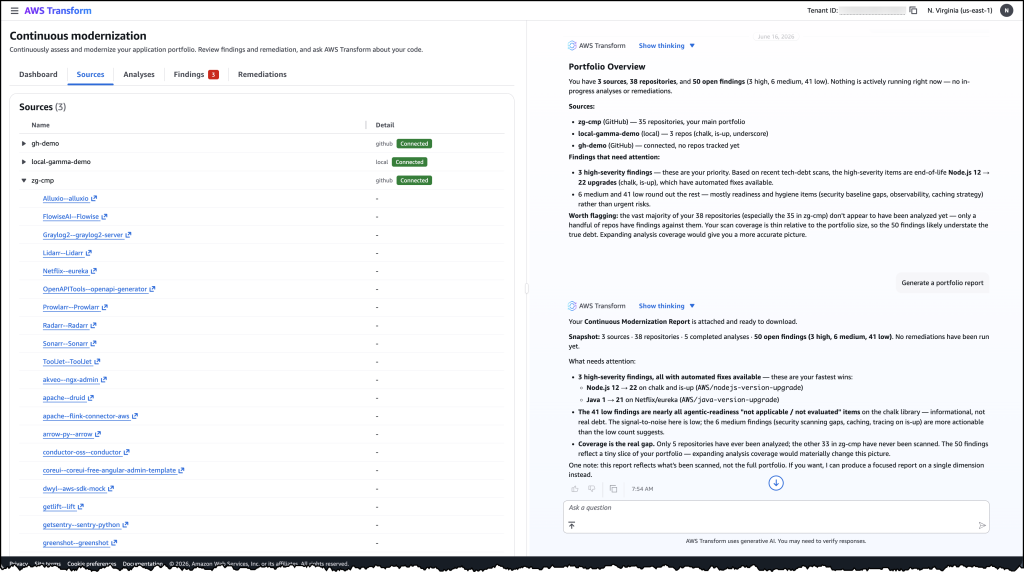
The user interface, as demonstrated by the provided images, offers a clear and actionable overview:
- Image 1: Portfolio Overview: Displays a high-level summary of technical debt findings across all connected repositories, offering a bird’s-eye view of an organization’s code health.
- Image 2: Detailed Findings View: Provides a granular list of individual technical debt items, complete with severity, category, and repository information, alongside suggested remediation options.
- Image 3: Sources View: Showcases the connected source control repositories (e.g., GitHub, local environments) that are actively being tracked and analyzed by the continuous modernization service.
Modernization Approaches: Continuous vs. Campaign Modes
AWS Transform – continuous modernization supports two distinct yet complementary approaches to code modernization, catering to different scales and types of work.
Continuous Mode: This mode is designed for the ongoing, day-to-day work of keeping codebases current as baselines evolve. It addresses the constant need to upgrade libraries, apply security patches, and enforce coding standards across an organization. Think of it as preventative maintenance – a steady stream of small, incremental improvements that prevent technical debt from accumulating into a critical mass. This mode is ideal for platform teams responsible for maintaining the overall health and compliance of hundreds or thousands of microservices and applications, ensuring they remain robust, secure, and performant over time. It shifts the paradigm from reactive firefighting to proactive, automated upkeep.
Campaign Mode: For larger, more complex modernization projects, such as migrating from one major framework to another (e.g., Spring to Spring Boot, Angular.js to Angular) or upgrading a significant runtime version across hundreds of applications, the existing AWS Transform custom capabilities continue to provide the flexible primitives. This "campaign mode" is suited for targeted, project-based modernization efforts that often involve architectural changes, significant code refactoring, and a defined project timeline. While continuous modernization handles the recurring, high-volume tasks, campaign mode empowers teams to tackle strategic, transformative initiatives with dedicated resources and structured workflows.
In essence, AWS Transform – continuous modernization is purpose-built for the recurring, high-volume work that platform teams manage every day, ensuring that the underlying infrastructure and common components of an application portfolio remain evergreen. The broader AWS Transform suite, with its campaign mode, continues to serve as the powerful engine for larger, more disruptive modernization projects.
Industry Implications and Expert Perspectives
The introduction of AWS Transform – continuous modernization is poised to have significant implications across the enterprise IT landscape. For development teams, it promises a substantial reduction in the time spent on mundane, repetitive maintenance tasks, freeing them to focus on feature development, innovation, and strategic projects. This shift could lead to increased developer satisfaction and higher productivity, directly impacting the speed at which businesses can bring new products and services to market.
From a financial perspective, the autonomous detection and remediation of technical debt can translate into substantial cost savings. By preventing technical debt from escalating, organizations can avoid costly emergency fixes, extended debugging sessions, and the massive refactoring efforts often required to address deeply entrenched legacy issues. The ability to automatically identify and address security vulnerabilities at the source-code level also enhances an organization’s security posture, potentially reducing the risk of breaches and the associated financial and reputational damage.
Industry analysts are likely to view this offering as a crucial step in AWS’s continued efforts to provide end-to-end solutions for enterprise cloud adoption and modernization. An AWS spokesperson, speaking on the importance of this release, might emphasize, "Our customers consistently tell us that technical debt is a major impediment to innovation. AWS Transform – continuous modernization is designed to tackle this challenge head-on, offering an intelligent, autonomous solution that liberates engineering teams and allows businesses to accelerate their digital transformation journey with confidence."
Experts might also highlight how this service empowers platform teams, shifting their role from manual oversight and compliance chasing to strategic enablement and policy enforcement. By providing a centralized, automated mechanism for managing code health, platform teams can ensure consistency and compliance across a vast array of services without becoming a bottleneck. This is particularly relevant in large, distributed organizations with numerous microservices and independent development teams. The service effectively addresses the "last mile" problem of technical debt, where detection is often possible, but consistent, scalable remediation remains elusive.
Availability and Future Outlook
AWS Transform – continuous modernization (preview) is available today, marking a significant milestone in autonomous code management. Customers can get started through the AWS Transform web application, providing an accessible entry point to its capabilities. Additionally, the service can be accessed via AWS Transform Kiro Power, or through MCP and skills for integration with existing coding agents, offering flexibility for various development workflows and toolchains. Detailed information and guidance are available in the comprehensive AWS Transform documentation.
This preview release signals AWS’s continued commitment to addressing the complex and evolving needs of enterprise modernization. As organizations increasingly rely on cloud-native architectures and leverage AI in their development processes, tools that intelligently manage the underlying complexity and ensure code health will become indispensable. The future outlook for AWS Transform – continuous modernization likely involves expanding its policy library, enhancing its remediation capabilities, and integrating with an even broader ecosystem of development and security tools, solidifying its position as a cornerstone of modern software development practices.
