
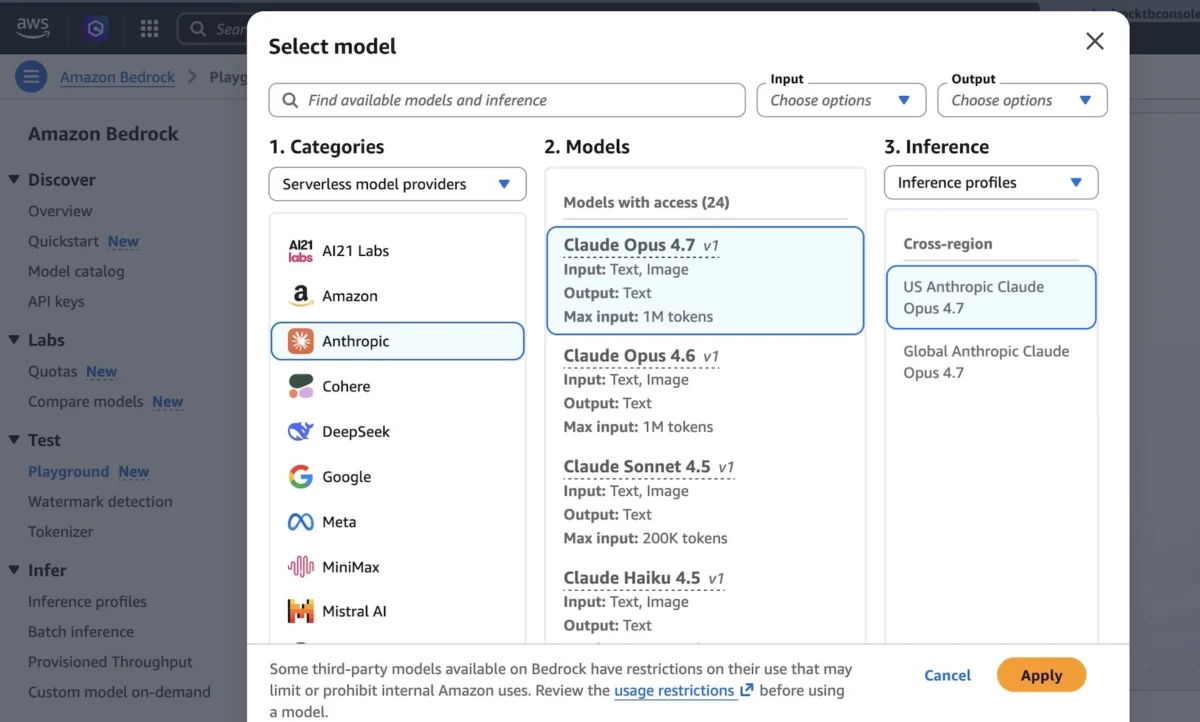

Amazon Web Services (AWS) has announced the general availability of Anthropic’s Claude Opus 4.7 model within its Amazon Bedrock service, marking a significant advancement in the accessibility of highly intelligent generative AI for enterprise applications. This integration brings Anthropic’s most capable model to a broad spectrum of businesses, promising enhanced performance across critical domains such as sophisticated coding tasks, long-running autonomous agents, and demanding professional knowledge work. The strategic deployment of Claude Opus 4.7 on Amazon Bedrock is set to empower developers and organizations to build, deploy, and scale generative AI solutions with unprecedented intelligence, security, and operational efficiency.
Claude Opus 4.7: A Leap in AI Reasoning and Performance
Claude Opus 4.7 represents the pinnacle of Anthropic’s foundational model development, designed to tackle the most complex and ambiguous challenges encountered in enterprise environments. According to Anthropic, the model delivers substantial improvements over its predecessors, including the previous Opus 4.6, particularly in its ability to navigate intricate problem spaces. Its enhanced reasoning capabilities allow for more thorough problem-solving, precise instruction following, and a superior understanding of context, even when faced with ambiguous prompts. This makes Opus 4.7 an invaluable tool for tasks requiring deep cognitive abilities, such as generating complex code, synthesizing vast amounts of information for knowledge work, interpreting visual data, and managing multi-step, long-running automated processes.
The model’s improvements are not merely incremental; they are designed to fundamentally transform the efficacy of AI-driven workflows. For instance, in agentic coding, Opus 4.7 can better understand high-level architectural requirements, generate more robust and optimized code, and even debug intricate systems with greater accuracy. In knowledge work, its ability to process and synthesize information from diverse sources, identify subtle patterns, and provide nuanced insights stands to revolutionize research, legal analysis, and strategic planning. The model’s refined visual understanding capabilities further extend its utility, allowing for more accurate interpretation of images and diagrams, which is critical in fields ranging from medical diagnostics to engineering design. Developers are advised that while Opus 4.7 offers a significant upgrade, some prompting changes and harness adjustments may be necessary to fully leverage its advanced capabilities, underscoring the iterative nature of optimizing interactions with cutting-edge AI.
Amazon Bedrock’s Next-Generation Inference Engine: Powering Enterprise AI with Security and Scale

The integration of Claude Opus 4.7 is underpinned by Amazon Bedrock’s newly developed, next-generation inference engine. This advanced infrastructure is specifically engineered to provide enterprise-grade reliability, scalability, and security for production workloads. A core innovation of this engine is its brand-new scheduling and scaling logic, which dynamically allocates capacity to requests. This dynamic allocation significantly improves availability, particularly for steady-state workloads that require consistent performance, while simultaneously ensuring that the system can rapidly scale to accommodate sudden spikes in demand from rapidly growing services. This flexibility is crucial for enterprises operating at scale, where unpredictable usage patterns are common.
Beyond performance, the new inference engine sets a new benchmark for data privacy and security. It features "zero operator access," a critical architectural design that ensures customer prompts and responses are never visible to either Anthropic or AWS operators. This stringent privacy measure is paramount for organizations handling sensitive data, intellectual property, or regulated information, providing an unparalleled level of confidentiality and compliance assurance. In an era where data privacy is a top concern, Bedrock’s commitment to isolating customer data from human intervention reinforces its position as a secure platform for deploying mission-critical AI applications. This feature is particularly appealing to industries like finance, healthcare, and government, where data sovereignty and confidentiality are non-negotiable.
Strategic Partnership: AWS and Anthropic Shaping the Future of Enterprise AI
The deployment of Claude Opus 4.7 on Amazon Bedrock is a testament to the deepening strategic partnership between AWS and Anthropic, a collaboration that has consistently aimed to democratize access to leading-edge generative AI models for enterprises worldwide. This partnership began with AWS’s early investment in Anthropic and has seen successive iterations of Claude models, including Claude 2 and the Claude 3 family (Haiku, Sonnet, and Opus), becoming available on Bedrock. This ongoing collaboration highlights a shared vision to accelerate the adoption of safe and responsible AI.
For AWS, integrating Anthropic’s models reinforces Bedrock’s position as a comprehensive, fully managed service that offers a diverse array of high-performing foundation models (FMs) from various leading AI providers. This "model choice" philosophy allows customers to select the best model for their specific use case, rather than being locked into a single provider. For Anthropic, leveraging AWS’s global infrastructure through Bedrock provides unparalleled reach to enterprise customers, enabling their innovative models to be deployed at scale with the robust security, reliability, and cost-effectiveness that AWS is known for. This synergy is crucial in the highly competitive generative AI landscape, where both model quality and deployment infrastructure are key differentiators. The partnership reflects a broader trend in the industry where cloud providers are forging alliances with AI labs to offer a complete, end-to-end solution for AI development and deployment.
Amazon Bedrock: A Catalyst for Enterprise AI Adoption

Amazon Bedrock simplifies the complex process of accessing and utilizing foundation models, acting as a crucial catalyst for enterprise AI adoption. It abstracts away the operational complexities of managing underlying infrastructure, allowing developers to focus purely on building innovative applications. With Bedrock, organizations can experiment with different FMs, fine-tune them with their proprietary data, and integrate them into their applications using a unified API. This managed service approach significantly lowers the barrier to entry for businesses looking to harness the power of generative AI, democratizing access that was once limited to companies with extensive AI research teams and infrastructure.
Bedrock’s comprehensive suite of capabilities extends beyond mere model access. It provides tools for customization, including fine-tuning and retrieval-augmented generation (RAG), enabling models to be specialized for specific business contexts and to access real-time, proprietary information. Furthermore, Bedrock integrates seamlessly with other AWS services, allowing for robust data pipelines, secure storage, and advanced analytics, creating a holistic environment for AI development. This platform is not just about running models; it’s about providing an entire ecosystem that supports the lifecycle of AI applications, from prototyping to production at enterprise scale.
Practical Applications and Developer Accessibility
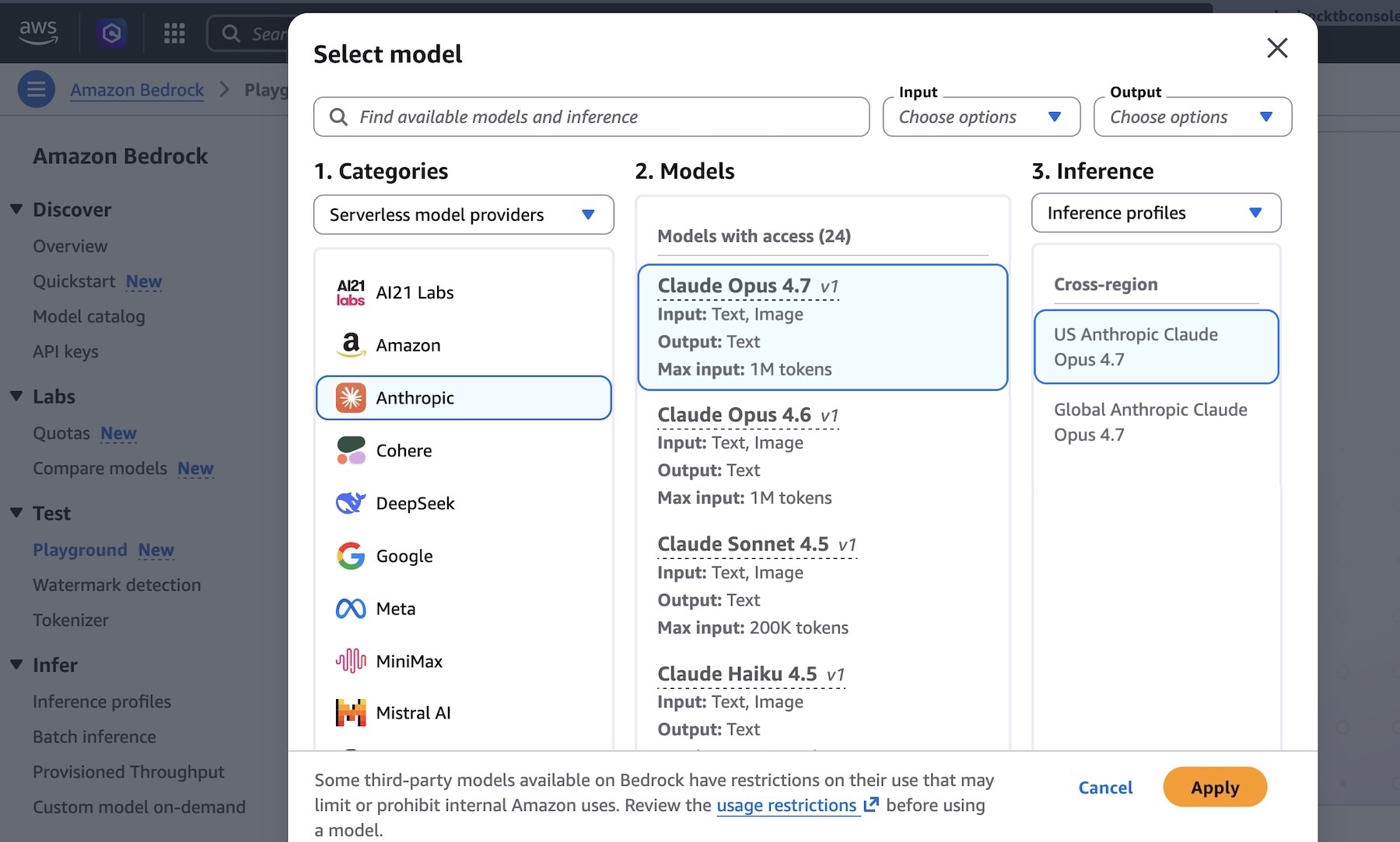
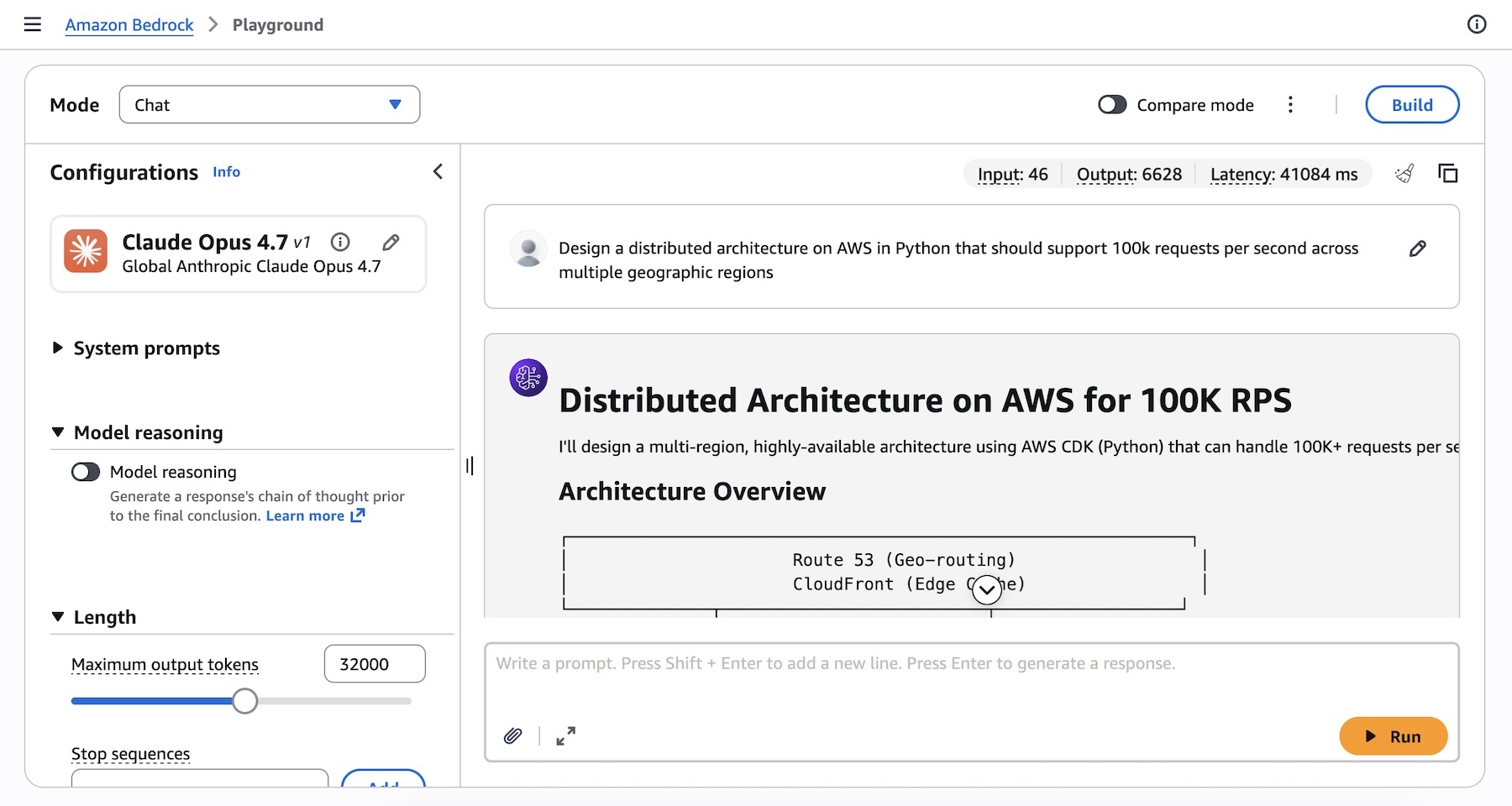
The immediate availability of Claude Opus 4.7 in Amazon Bedrock means that developers can begin experimenting and building with the model today. Users can access the model through the Amazon Bedrock console, navigating to the "Playground" under the "Test" menu and selecting "Claude Opus 4.7." This interactive environment allows for rapid prototyping and testing of complex prompts, such as designing distributed architectures on AWS for high-throughput applications, as demonstrated in the announcement.
For programmatic access, developers have multiple avenues. The Anthropic Messages API can be invoked directly through the bedrock-runtime endpoint, either via the Anthropic SDK (specifically the anthropic[bedrock] package for a streamlined experience) or by interacting with bedrock-mantle endpoints. Alternatively, the standard AWS SDK and AWS Command Line Interface (AWS CLI) provide access through the Invoke and Converse API on bedrock-runtime. The AWS console’s "Quickstart" feature further simplifies the onboarding process, allowing users to generate short-term API keys for testing purposes and providing sample code snippets for various API methods, including OpenAI-compatible responses.
An illustrative example demonstrates how developers can use the anthropic[bedrock] SDK package to design a distributed architecture capable of handling 100,000 requests per second across multiple geographic regions:
from anthropic import AnthropicBedrockMantle

# Initialize the Bedrock Mantle client (uses SigV4 auth automatically)
mantle_client = AnthropicBedrockMantle(aws_region="us-east-1")

# Create a message using the Messages API
message = mantle_client.messages.create(
    model="us.anthropic.claude-opus-4-7",
    max_tokens=32000,
    messages=[
        "role": "user", "content": "Design a distributed architecture on AWS in Python that should support 100k requests per second across multiple geographic regions"
    ]
)
print(message.content[0].text)
Similarly, the AWS CLI offers a direct method for invoking the model:
aws bedrock-runtime invoke-model
 --model-id us.anthropic.claude-opus-4-7
 --region us-east-1
 --body '"anthropic_version":"bedrock-2023-05-31", "messages": ["role": "user", "content": "Design a distributed architecture on AWS in Python that should support 100k requests per second across multiple geographic regions."], "max_tokens": 32000'
 --cli-binary-format raw-in-base64-out
invoke-model-output.txt
Furthermore, Claude Opus 4.7 supports "Adaptive thinking," a feature that allows the model to dynamically allocate computational resources (thinking token budgets) based on the perceived complexity of each request. This intelligent resource management optimizes performance and efficiency, ensuring that the model dedicates appropriate processing power to truly challenging tasks while handling simpler requests expeditiously. Developers can explore the Anthropic Claude Messages API documentation and provided code examples for various use cases and programming languages to fully leverage these advanced features.
Broader Market Implications and Industry Impact
The introduction of Claude Opus 4.7 on Amazon Bedrock carries significant implications for the broader generative AI market and various industries. It intensifies the competition among cloud providers to offer the most advanced and secure foundation models, further solidifying AWS’s position as a leading platform for enterprise AI. This move underscores the ongoing arms race in AI, where access to state-of-the-art models is a key differentiator for attracting and retaining enterprise customers.
For industries, the enhanced capabilities of Opus 4.7 translate into tangible benefits:
- Software Development: Accelerates the development lifecycle by automating code generation, refactoring, and complex system design, potentially reducing time-to-market for new applications.
- Customer Service & Support: Enables the creation of more sophisticated, long-running AI agents that can handle multi-turn conversations, resolve complex customer issues, and provide personalized support, moving beyond simple chatbots.
- Research & Development: Facilitates advanced data analysis, hypothesis generation, and literature review, speeding up discovery processes in scientific and medical fields.
- Legal & Compliance: Improves the efficiency and accuracy of document review, contract analysis, and regulatory compliance checks, mitigating risks and reducing manual effort.
- Financial Services: Enhances fraud detection, risk assessment, and personalized financial advice through more intelligent data processing and pattern recognition.
- Creative Industries: Supports content generation, scriptwriting, and creative ideation with more nuanced and contextually aware outputs.
The emphasis on "zero operator access" will particularly resonate with enterprises in highly regulated sectors, enabling them to confidently adopt generative AI without compromising sensitive data, thereby accelerating the deployment of AI in areas previously constrained by privacy concerns. This focus on security and privacy is not just a feature but a foundational requirement for widespread enterprise AI adoption.
Availability and Future Outlook
Anthropic’s Claude Opus 4.7 model is immediately available in several key AWS Regions, including US East (N. Virginia), Asia Pacific (Tokyo), Europe (Ireland), and Europe (Stockholm). AWS has indicated that additional regions will be supported in future updates, underscoring its commitment to global accessibility. Detailed information regarding regional availability can be found on the Amazon Bedrock models and regions page.
Pricing for Claude Opus 4.7, like other models on Amazon Bedrock, will follow a usage-based model, with specifics available on the Amazon Bedrock pricing page. This pay-as-you-go structure ensures that businesses can scale their AI consumption efficiently and cost-effectively, only paying for the resources they utilize.
The release of Claude Opus 4.7 on Amazon Bedrock represents a significant milestone in making advanced generative AI both powerful and practical for enterprise use. It provides organizations with a robust, secure, and scalable platform to innovate and transform their operations with the latest in AI intelligence. AWS encourages developers and businesses to explore Claude Opus 4.7 in the Amazon Bedrock console and provide feedback through AWS re:Post for Amazon Bedrock or their usual AWS Support contacts.
Updated on April 17, 2026 – Code samples and CLI commands have been updated to align with the new version.
