

Amazon Web Services (AWS) has announced the launch of CloudFormation Express mode, a transformative new deployment option designed to significantly accelerate infrastructure deployments for developers and AI tools engaged in iterative development. This innovation marks a pivotal step in enhancing developer productivity and enabling more agile cloud infrastructure management, reducing deployment times by up to four times for crucial iterative workflows and select production scenarios.
The Evolution of Cloud Infrastructure Management and the Need for Speed
For years, AWS CloudFormation has stood as a cornerstone of Infrastructure as Code (IaC) within the AWS ecosystem. It empowers developers and operations teams to define their cloud resources using declarative templates, ensuring consistency, repeatability, and version control for entire application stacks. This programmatic approach to infrastructure provisioning has been instrumental in the adoption of DevOps practices, allowing organizations to manage their cloud environments with the same rigor as their application code.
The standard mode of CloudFormation deployments, while robust and reliable, incorporates comprehensive stabilization checks after resources are configured. These checks are vital for ensuring that newly provisioned resources are fully operational and ready to serve traffic before the deployment is officially marked complete. This meticulous process guarantees the integrity and readiness of production environments, minimizing potential disruptions. However, in the fast-paced world of software development and the burgeoning field of AI-assisted infrastructure creation, these extended stabilization periods can become a bottleneck.
Modern development methodologies, particularly those emphasizing continuous integration and continuous delivery (CI/CD), thrive on rapid feedback loops. Developers often iterate on infrastructure configurations multiple times a day, testing small changes and refining their environments. Similarly, advanced AI tools designed to generate, optimize, or modify cloud infrastructure require near-instantaneous feedback to efficiently learn and adapt. The traditional CloudFormation deployment model, with its emphasis on full operational stabilization before completion, while essential for many production scenarios, often introduced delays that hampered these rapid iteration cycles. This led to a growing demand for a deployment option that could prioritize speed for specific use cases without compromising the underlying provisioning quality.
CloudFormation Express Mode: A Paradigm Shift for Iterative Workflows
CloudFormation Express mode addresses this critical need by fundamentally altering when a deployment is considered complete. Instead of waiting for extensive stabilization checks to confirm resources are fully operational and ready to handle traffic, Express mode completes the deployment process as soon as CloudFormation confirms that the resource configuration has been successfully applied. The process of resources becoming fully operational continues in the background, decoupled from the immediate completion status of the deployment.
This strategic shift dramatically reduces deployment times. For instance, creating an Amazon Simple Queue Service (SQS) queue with a dead letter queue (DLQ) in Standard mode typically takes around 64 seconds. With Express mode, this operation can conclude in as little as 10 seconds, representing a more than six-fold improvement. Even more striking are the gains observed in resource deletion scenarios. Deleting an AWS Lambda function with a network interface attachment, a process that can take 20 to 30 minutes in Standard mode due to complex network cleanup, now completes in approximately 10 seconds with Express mode. Such drastic reductions in wait times are not merely incremental improvements; they represent a qualitative leap in developer efficiency.
Underlying Mechanisms and Built-in Resilience
Despite its focus on speed, CloudFormation Express mode does not compromise the fundamental provisioning process or introduce undue fragility. The core mechanism of how resources are provisioned remains unchanged; only the criteria for deployment completion are adjusted. Crucially, Express mode incorporates built-in resilience: CloudFormation automatically retries dependent resources that encounter transient failures during provisioning within the same stack. This intelligent retry mechanism ensures that timing issues between resources as they stabilize in the background are gracefully handled, requiring no customer intervention and preserving the integrity of the stack. This feature is particularly important because, by completing early, there’s a higher chance that some resources might still be in the process of reaching full operational status when subsequent dependent resources attempt to interact with them. The automatic retries mitigate this risk effectively.
Express mode is specifically tailored for two primary use cases:
- Iterative Development Workflows: Developers frequently modify infrastructure as they build and test applications. For these rapid cycles, immediate confirmation of configuration application is often sufficient, allowing them to proceed with testing or subsequent changes without waiting for full operational readiness.
- Production Scenarios with Eventual Stabilization Tolerance: In certain production environments, teams may be comfortable with resources achieving full stabilization eventually, rather than immediately post-deployment. This could apply to non-critical infrastructure components or systems designed with inherent resilience to handle transient startup phases.
Seamless Adoption Across the AWS Ecosystem
Activating CloudFormation Express mode is designed to be straightforward, requiring no changes to existing CloudFormation templates. Users can enable Express mode through various interfaces:
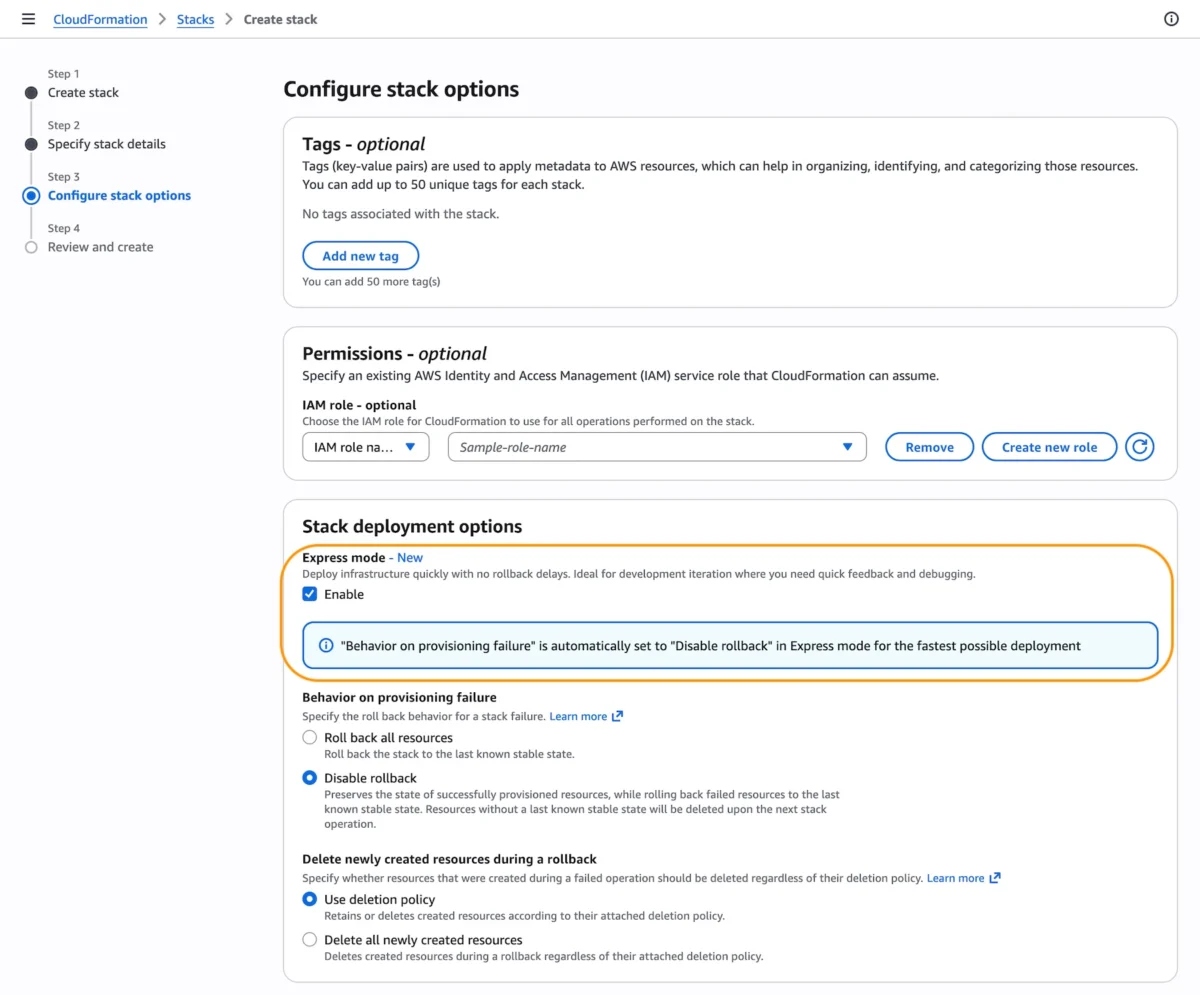
- AWS Management Console: When creating a new CloudFormation stack, users can simply select "Enable" under the "Express mode" option within the "Stack deployment options."
- AWS Command Line Interface (AWS CLI): For CLI users, Express mode is activated by setting the
--deployment-configparameter toEXPRESSduringcreate-stack,update-stack, ordelete-stackcommands.aws cloudformation create-stack --stack-name my-app --template-body file://template.yaml --deployment-config '"mode": "EXPRESS", "disableRollback": true'By default, Express mode disables rollback for the fastest possible iteration experience. For production environments where rollback capabilities are desired, users can set
disableRollbacktofalsewithin thedeployment-configparameter. - AWS SDKs and IaC Tools: Developers utilizing AWS SDKs can integrate Express mode into their programmatic deployments. Furthermore, popular Infrastructure as Code tools like AWS Cloud Development Kit (CDK) also support Express mode. With CDK, users can deploy their stacks using the
cdk deploy --expresscommand, which automatically leverages CloudFormation Express mode for provisioning. - AI Tools: The advent of AI-assisted infrastructure development benefits immensely from Express mode. Tools like Kiro, designed for AI-driven infrastructure, can leverage the sub-minute feedback loops to accelerate their learning and deployment cycles.
Practical Application: Incremental Infrastructure Development
Express mode significantly enhances the experience of building infrastructure incrementally. Consider a scenario where a developer builds a microservice component by component:
- Iteration 1: Deploy IAM role:
aws cloudformation create-stack
--stack-name my-microservice
--template-body file://iteration1-iam.yaml
--deployment-config '"mode": "EXPRESS"'
--capabilities CAPABILITY_IAM
--role-arn arn:aws:iam::123456789012:role/CloudFormationDeployRole
This initial deployment quickly establishes the necessary permissions.
- Iteration 2: Add Lambda function:
aws cloudformation update-stack
--stack-name my-microservice
--template-body file://iteration2-lambda.yaml
--deployment-config '"mode": "EXPRESS"'
--capabilities CAPABILITY_IAM
--role-arn arn:aws:iam::123456789012:role/CloudFormationDeployRole
The Lambda function is added rapidly, allowing the developer to immediately proceed with local testing or integration.
- Iteration 3: Add SQS queue and event source mapping:
aws cloudformation update-stack
--stack-name my-microservice
--template-body file://iteration3-sqs.yaml
--deployment-config '"mode": "EXPRESS"'
--capabilities CAPABILITY_IAM
--role-arn arn:aws:iam::123456789012:role/CloudFormationDeployRole
The SQS queue and its integration with Lambda are deployed quickly, enabling end-to-end testing without prolonged waiting periods between steps. Throughout this process, developers are encouraged to adhere to the principle of least privilege for IAM roles, ensuring security even with accelerated deployments.
CloudFormation Express mode maintains full compatibility with all existing CloudFormation features, including change sets, drift detection, and nested stacks. When Express mode is enabled on a parent stack, all its nested stacks automatically inherit this deployment behavior, streamlining complex multi-stack deployments. However, it is crucial to remember that for scenarios where resources must be fully operational and ready to serve traffic or undergo comprehensive testing before proceeding, the default Standard mode, with its thorough stabilization checks, remains the recommended approach.
Broader Implications and Industry Impact

The introduction of CloudFormation Express mode carries significant implications for cloud development and operations:
- Boost to Developer Productivity: By dramatically shortening deployment cycles, Express mode minimizes context switching for developers. Instead of waiting minutes or even tens of minutes for infrastructure changes to propagate, they can receive near-instant feedback, fostering a more fluid and continuous development experience. This directly translates to faster feature delivery and increased innovation velocity.
- Catalyst for AI-Driven DevOps: The sub-minute feedback loops enabled by Express mode are a game-changer for AI tools that generate, optimize, or troubleshoot infrastructure. AI models can iterate on configurations much faster, accelerating their training and enabling more sophisticated autonomous infrastructure management. This positions AWS at the forefront of integrating AI capabilities into core cloud infrastructure services.
- Enhanced Competitiveness: In the competitive landscape of cloud providers and IaC tools, deployment speed is a critical differentiator. Express mode strengthens CloudFormation’s offering, making it even more attractive for organizations seeking high-velocity development environments. It allows AWS to cater more effectively to the evolving demands of modern, agile development teams.
- Shift Towards Eventual Consistency in IaC: Express mode introduces an "eventual consistency" paradigm for infrastructure deployments in specific contexts, akin to how distributed data systems operate. For many iterative workflows, the immediate application of configuration is the primary concern, with full operational readiness following shortly thereafter. This flexibility allows developers to choose the appropriate consistency model for their specific needs.
Statements from Stakeholders (Inferred)
While no direct quotes were provided, the implications of such a release would naturally elicit specific reactions from various parties:
An AWS spokesperson familiar with CloudFormation’s roadmap might state, "CloudFormation Express mode is a direct response to our customers’ evolving needs for speed and agility, especially in iterative development and the burgeoning field of AI-assisted infrastructure. This enhancement empowers developers to innovate faster and brings a new level of efficiency to cloud resource provisioning, solidifying CloudFormation’s role as a foundational service for modern cloud architectures."
A lead DevOps engineer at a fast-growing tech company could remark, "For too long, CloudFormation deployment times, while reliable, were a bottleneck in our CI/CD pipelines. Express mode is a revelation. Being able to push infrastructure changes and get confirmation in seconds rather than minutes transforms our development sprints, allowing our teams to test and refine much more rapidly. It’s a true game-changer for developer experience."
An AI/ML engineer focused on autonomous cloud operations might add, "Our AI models constantly iterate on infrastructure configurations to optimize performance and cost. The sub-minute feedback loops provided by Express mode are absolutely critical. It means our AI agents can learn and adapt far more efficiently, accelerating our progress towards fully autonomous infrastructure management."
Availability and Future Outlook
AWS CloudFormation Express mode is now generally available across all AWS commercial Regions. Crucially, this significant enhancement comes at no additional cost, making it accessible to all CloudFormation users immediately. For detailed regional availability and insights into future capabilities, users are directed to the AWS Capabilities by Region page. Comprehensive documentation, API references, and troubleshooting guides are available through the CloudFormation documentation, and via tools like the AWS MCP Server and its plugins, particularly useful when integrated with preferred AI tools for advanced assistance.
AWS encourages users to begin leveraging Express mode today to accelerate their deployments and to provide feedback through AWS re:Post for AWS CloudFormation or their established AWS Support channels. This continuous feedback loop is vital for AWS to further refine and expand the capabilities of CloudFormation, ensuring it remains at the forefront of cloud infrastructure management. The introduction of Express mode underscores AWS’s commitment to continuously improving the developer experience and enabling the next generation of cloud-native applications and AI-driven operations.
